
What if your search for a domestic factory is actually masking a much deeper strategic flaw in your marketing plan? Most leaders hunt for USA made corporate apparel as a quick fix for shipping delays or the new 2026 CPSC eFiling requirements, but they often settle for a vendor who treats their identity like a commodity. You don’t just need a sewing line. You need a way to ensure your brand’s physical presence carries the same weight as your most expensive digital campaigns.
It’s exhausting when your premium vision arrives looking like disposable swag because of poor oversight or inconsistent garment quality. We know that managing logistics and global distribution feels like a nightmare that pulls you away from high-level strategy. This article explains why domestic manufacturing is a strategic media investment rather than a simple procurement task. You’ll learn how to move beyond the vendor trap and find a partner who manages the entire system from design to delivery, finally turning your apparel into a measurable asset for your company culture.
Key Takeaways
- Learn why prioritizing low unit costs over a strategic partnership creates a management burden that drains your internal marketing resources.
- Understand the Merch is Media™ philosophy, positioning USA made corporate apparel as a high-impact media channel that builds culture and loyalty.
- Shift from managing inventory in closets to a white-glove fulfillment system that ensures your premium apparel reaches your team without logistical friction.
- Identify the specific criteria for vetting a strategic partner who can scale your brand from small recognition gifts to high-volume corporate programs.
- Discover how a managed uniform program creates a unified brand experience that drives employee retention and measurable cultural impact.
The Cheap Vendor Trap: Why Searching for a Manufacturer Often Leads to Brand Dilution
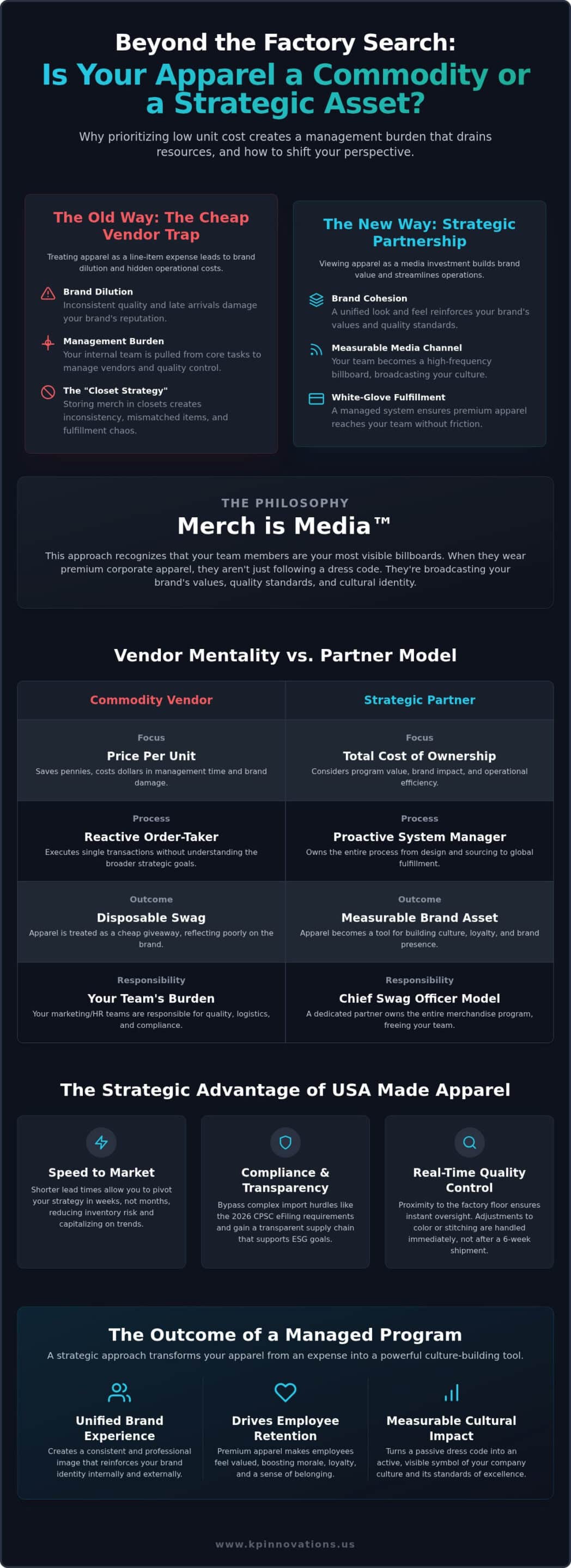
Many marketing leaders treat apparel like a line item on a spreadsheet. They search for a manufacturer based on price per unit, thinking they’ve saved the company money. This is the “Cheap Vendor Trap.” When you prioritize the lowest bid, you aren’t just buying clothes; you’re often buying a management headache that drains your team’s time. A vendor who only takes orders doesn’t care about your brand’s long-term health. They don’t understand that every piece of USA made corporate apparel is a physical representation of your values. If the garment shrinks, fades, or arrives late, it’s your brand that suffers the dilution, not the vendor’s bottom line.
Commodity thinking turns your premium brand into just another t-shirt. When apparel is treated as a disposable giveaway rather than a strategic asset, your employees and customers feel that lack of value. A vendor-only relationship places the entire burden of quality control and brand alignment on your internal marketing team, pulling them away from their core objectives. You’re left bridging the gap between factory-level production and the actual brand experience you promised your stakeholders.
Price vs. Value: The Hidden Costs of Off-the-Shelf Solutions
Choosing offshore manufacturers to save a few dollars often backfires when you factor in the July 2026 CPSC mandatory eFiling requirements and the volatility of international tariffs. These logistical hurdles turn a “cheap” order into an expensive project management crisis. High-quality garments with a verified Made in the USA label represent more than just domestic pride; they signify a commitment to ethical standards and durability. For a branded apparel program, the Total Cost of Ownership is the sum of the initial production price plus the long-term costs of logistics, compliance risks, and the negative impact of poor quality on your brand reputation.
The Logistics of Chaos: Why the Closet is Not a Fulfillment Strategy
The “closet strategy” is where brand consistency goes to die. Storing merchandise in office supply rooms or fragmented warehouses leads to a nightmare of mismatched colors and missing sizes. You might find that your sales team in one region is wearing a different shade of navy than your operations team in another. This happens because fragmented sourcing lacks a centralized vision. Transitioning from a supply closet mindset to a strategic fulfillment system allows your team to focus on growth instead of folding shirts. Professional fulfillment ensures that every employee, regardless of location, receives premium USA made corporate apparel that looks and fits exactly as intended.
Manufacturing in the USA as a Strategic Asset: The Merch is Media™ Advantage
Stop viewing your apparel program as a procurement task. To build a modern brand, you must treat every garment as a high-frequency media channel. At KP Innovations, we operate under the Merch is Media™ philosophy. This approach recognizes that your team members are your most visible billboards. When they wear a premium piece of USA made corporate apparel, they aren’t just following a dress code. They’re broadcasting your brand’s values, quality standards, and cultural identity to every person they encounter.
Domestic manufacturing isn’t just about a label; it’s a strategic tool for rapid response. The 2026 business climate moves fast. Relying on overseas shipments means navigating the July 8, 2026, CPSC mandatory eFiling requirements and potential ACE system delays. Choosing a domestic partner allows you to bypass these import hurdles entirely. It turns your supply chain into a competitive advantage that supports your broader ESG goals through transparent, local production.
Speed to Market: Outpacing Trends with Domestic Production
Shorter lead times are the ultimate hedge against market volatility. In 2026, the ability to pivot your merchandise strategy in weeks rather than months is invaluable. Domestic production runs are typically smaller and more frequent. This reduces your inventory risk and prevents capital from being locked up in dusty warehouse boxes. Proximity to the factory floor also ensures real-time quality oversight. If a stitch is off or a color needs adjustment, it’s handled instantly, not after 10,000 units have already crossed the ocean. If you want to refine your approach, consider working with a strategic sourcing partner who understands these domestic dynamics.
Ethical Transparency: Building Culture Through Responsible Sourcing
CEOs are increasingly held accountable for the ethical footprint of their organizations. Using U.S. apparel manufacturing data as a benchmark, we see a sector that prioritizes fair wages and safe conditions, with average hourly earnings reaching $23.84 in June 2026. When your employees know their uniforms were made under these standards, it fosters a sense of pride that “cheap swag” can never replicate. This transparency is a cornerstone of the Merch is Media™ philosophy. It ensures the story behind the garment is just as professional as the logo on the chest. Ethical sourcing isn’t just a compliance check; it’s a foundational element of your brand’s reputation and employee retention strategy.
Navigating the Private Label Landscape: From Concept to Global Fulfillment
Many organizations stop their merchandise strategy at co-branding. They select a pre-made shirt from a catalog and add a logo. While this works for one-off events, it rarely supports a long-term brand identity. To truly elevate your presence, you must move beyond generic blanks and embrace a private label approach. Creating USA made corporate apparel from the ground up allows you to control every variable, from the specific weight of the fabric to the custom hem tags that signify premium quality. This process requires a strategic agency that understands creative development, not just a local print shop that reacts to orders.
A strategic partner acts as your outsourced merchandise department. They own the white-glove process that begins with a concept and ends with a garment your team actually wants to wear on the weekend. This isn’t about “swag.” It’s about creating a retail-grade product that reflects the sophistication of your business. When you control the manufacturing system, you eliminate the risk of inconsistent fits and colors that plague off-the-shelf solutions.
Custom Apparel vs. Private Label: Designing for Identity
High-quality blanks serve a purpose for rapid-turn projects, but private label clothing is the gold standard for brand building. This path involves detailed fabric selection and the creation of custom tech packs to ensure every stitch meets your exact specifications. By leveraging U.S. apparel manufacturing industry data, we can see that domestic production centers offer the high-level technical skill required for this level of precision. Private label builds long-term brand equity by transforming a garment from a generic commodity into a proprietary asset that employees and customers can’t find anywhere else.
Integrated Logistics: Solving the Global Distribution Puzzle
Manufacturing a premium garment is only half the battle. The other half is ensuring that garment reaches your team, whether they sit in a Philadelphia office or a remote hub in London. This is where program management becomes essential. A strategic partner manages the logistical nightmare of international customs, duties, and individual shipping. By utilizing custom-built company stores, you can automate this distribution. Your team members can select their preferred sizes and styles through a curated portal, while your operations team receives a single, consolidated report. This system turns a complex global puzzle into a seamless, managed experience.
The Chief Swag Officer Model: Vetting Your Apparel Partner for 2026
Vetting a manufacturing partner in 2026 requires looking beyond a simple directory of factory names. You need a strategic filter. Most directories only list production capabilities, but they ignore the management layer required to protect your brand identity. A true partner doesn’t just fulfill orders. They act as an extension of your marketing department. When sourcing USA made corporate apparel, the vetting process must be rigorous enough to separate commodity vendors from strategic agencies.
The Chief Swag Officer model ensures that your merchandise program is managed with the same rigor as any other marketing investment. This involves a five step audit of any potential partner:
- Audit strategic capabilities: Do they understand your business goals, or are they just taking an order?
- Evaluate sourcing scale: Can they manage a pilot of 100 units and scale to 100,000 for a national rollout?
- Test the creative department: Are they building custom silhouettes or just placing a logo on a catalog item?
- Inspect fulfillment infrastructure: How does the product reach the end-user without creating an internal logistical nightmare?
- Review their philosophy: Do they treat your merchandise as a cost center or as a high-value media channel?
Beyond the Factory Floor: Evaluating Strategy and Creative Development
You need an agency that challenges your assumptions about what your team should wear. If a partner simply says “yes” to every request without considering your long-term brand equity, they aren’t providing value. The advantage of strategy-first sourcing is that it aligns your production with your actual business needs. Ask potential partners about their creative development process. They should be able to explain how they translate your brand’s visual language into a physical garment. If you’re ready to move beyond the vendor trap, you should audit your current sourcing strategy to find these gaps.
The Rigor of Quality Control: Protecting Your Brand Reputation
Defining quality in 2026 goes beyond checking for loose threads. It’s about prioritizing fit, finish, and long-term durability that rivals retail luxury brands. A dedicated Chief Swag Officer is essential for this level of production oversight. They ensure that your USA made corporate apparel remains consistent whether it’s part of a tech startup’s uniform or a healthcare system’s recognition gift. This level of managed consistency is what allows brands to scale their culture across diverse industry programs without losing their identity.
Scaling Your Brand Culture: The Outcome of a Managed Manufacturing Program
Scaling your company culture isn’t about buying more stuff. It’s about ensuring the physical assets you put into the world actually work for your brand. A managed program takes the guesswork out of the brand experience by aligning production with your high-level goals. When you move beyond the “swag” mindset, you start to see your USA made corporate apparel as a cultural engine that drives employee loyalty and customer trust. This is the final step in moving from a procurement task to a measured marketing investment.
A unified uniform program ensures that every customer touchpoint feels intentional and professional. It eliminates the visual static created by mismatched colors or poor fits from unmanaged vendors. Similarly, high-value business relationships are strengthened through strategic client gifting. By providing a premium, domestically manufactured product, you signal that you value the relationship as much as you value quality. This approach turns a simple gesture into a powerful tool for long-term retention.
Recognition and Employee Programs: Merchandise as a Retention Tool
High-quality apparel is a physical signal of value. When employees receive a garment that feels like a retail luxury item, it influences their sense of belonging and pride. Integrating these manufactured goods into your employee appreciation programs creates a lasting impact that generic items cannot match.
Consider the shift from generic tokens to strategic apparel. One of our partners recently transitioned from distributing low-cost plastic gifts to providing custom-designed, domestically sewn hoodies for their team. The result was a measurable increase in brand visibility. Employees didn’t just wear the hoodies at the office; they wore them in their personal lives, effectively becoming organic brand ambassadors. This transition proves that when you invest in quality, your team becomes your most effective media channel.
Measuring Impact: Treating Apparel Like a Marketing Investment
If you can’t measure the impact of your apparel, it isn’t a strategic asset. A managed program allows you to track the lifecycle and reach of your Merch is Media™ assets with the same rigor as a digital ad spend. Strategic partners focus on the total Brand Experience rather than just the Unit Price. They understand that a garment that lasts five years has a much higher ROI than a cheap one that ends up in a landfill after two washes.
When you are choosing the right apparel factory, you are selecting your next marketing channel. You aren’t just buying USA made corporate apparel; you are building a system that manages strategy, creative, and fulfillment. This holistic approach ensures that your brand’s physical presence is always premium, consistent, and impactful. It’s time to stop searching for a vendor and start building a partnership that scales your culture.
Own Your Brand Identity Through Strategic Manufacturing
Success in 2026 requires moving beyond the transactional hunt for a factory. You’ve seen how the Merch is Media philosophy transforms simple clothing into a high-frequency marketing channel. By prioritizing a managed system over a cheap vendor, you protect your brand from dilution and ensure your USA made corporate apparel reflects your true value. This approach replaces the logistical chaos of office closets with a streamlined, global fulfillment strategy that scales with your ambition.
KP Innovations provides the white-glove oversight your brand deserves. We’ve managed over 1.2 million strategic brand products through our dedicated Chief Swag Officer model. Our expertise in complex global logistics ensures your message reaches its destination without friction. It’s time to treat your merchandise as a vital marketing investment rather than a procurement task. We handle the entire system, from initial creative development to the final mile of distribution.
Elevate your brand with a strategic manufacturing partner; contact KP Innovations.
Your brand’s physical presence is its most visible billboard. We look forward to helping you build a program that reflects the sophistication and ambition of your business.
Frequently Asked Questions
What are the primary benefits of choosing a clothing manufacturer in the USA?
Speed to market and ethical transparency are the most significant advantages. Domestic production allows your brand to bypass the July 2026 CPSC mandatory eFiling requirements and ACE system delays that often stall international shipments. Additionally, manufacturing in the USA ensures compliance with domestic labor standards, which fosters employee pride and strengthens your corporate reputation.
How do I start a private label apparel line for my business?
You should begin by defining a clear merchandise strategy that aligns with your brand identity. Unlike buying generic catalog blanks, starting a private label line involves creating custom tech packs and selecting specific fabrics from the ground up. It’s essential to partner with a strategic agency that manages the creative development and production oversight to ensure the final product meets retail standards.
What is the typical lead time for domestic clothing manufacturing in 2026?
Domestic lead times for custom knits in 2026 typically range from four to eight weeks, depending on the complexity of the garment. This is a fraction of the time required for offshore production, which often involves months of transit and customs processing. Shorter lead times allow your brand to respond quickly to market trends and maintain leaner inventory levels.
Can a strategic agency manage both manufacturing and global fulfillment?
Yes, a strategic partner is designed to own the entire lifecycle of your USA made corporate apparel. This integrated approach eliminates the logistical nightmare of managing multiple vendors. By combining production management with professional fulfillment and company stores, an agency ensures that your premium apparel reaches remote teams and international offices without internal friction.
What is the difference between a traditional vendor and a Chief Swag Officer?
A traditional vendor is a transactional supplier that reacts to order requests, while a Chief Swag Officer is a strategic partner who manages your entire merchandise program. The CSO model focuses on the employee experience and long-term brand equity rather than just unit price. They act as an outsourced department, handling everything from creative strategy to global logistics so your marketing team can focus on growth.
How does Merch is Media™ change the way I should budget for apparel?
The Merch is Media™ philosophy shifts your apparel spend from a procurement expense to a high-impact marketing investment. Instead of chasing the lowest price per unit, you budget based on the reach, durability, and cultural influence of the garment. This ensures your investment produces high-quality assets that act as visible billboards for your brand rather than disposable items that end up in landfills.
Is U.S. apparel manufacturing sustainable for large-scale corporate programs?
Domestic manufacturing is highly sustainable because it significantly reduces the carbon footprint associated with transoceanic shipping. U.S. factories also adhere to rigorous environmental standards and labor laws, such as California’s Responsible Textile Recovery Act. Choosing USA made corporate apparel for large-scale programs ensures that your supply chain supports your corporate ESG goals through transparent and local production.
What should I look for in a tech pack before starting production?
A professional tech pack must include detailed technical drawings, graded measurement charts, fabric specifications, and trim details. It acts as the definitive blueprint for your garment, leaving no room for factory interpretation. You should ensure your tech pack is comprehensive enough to maintain consistency across different production runs and garment types to protect your brand’s visual identity.