
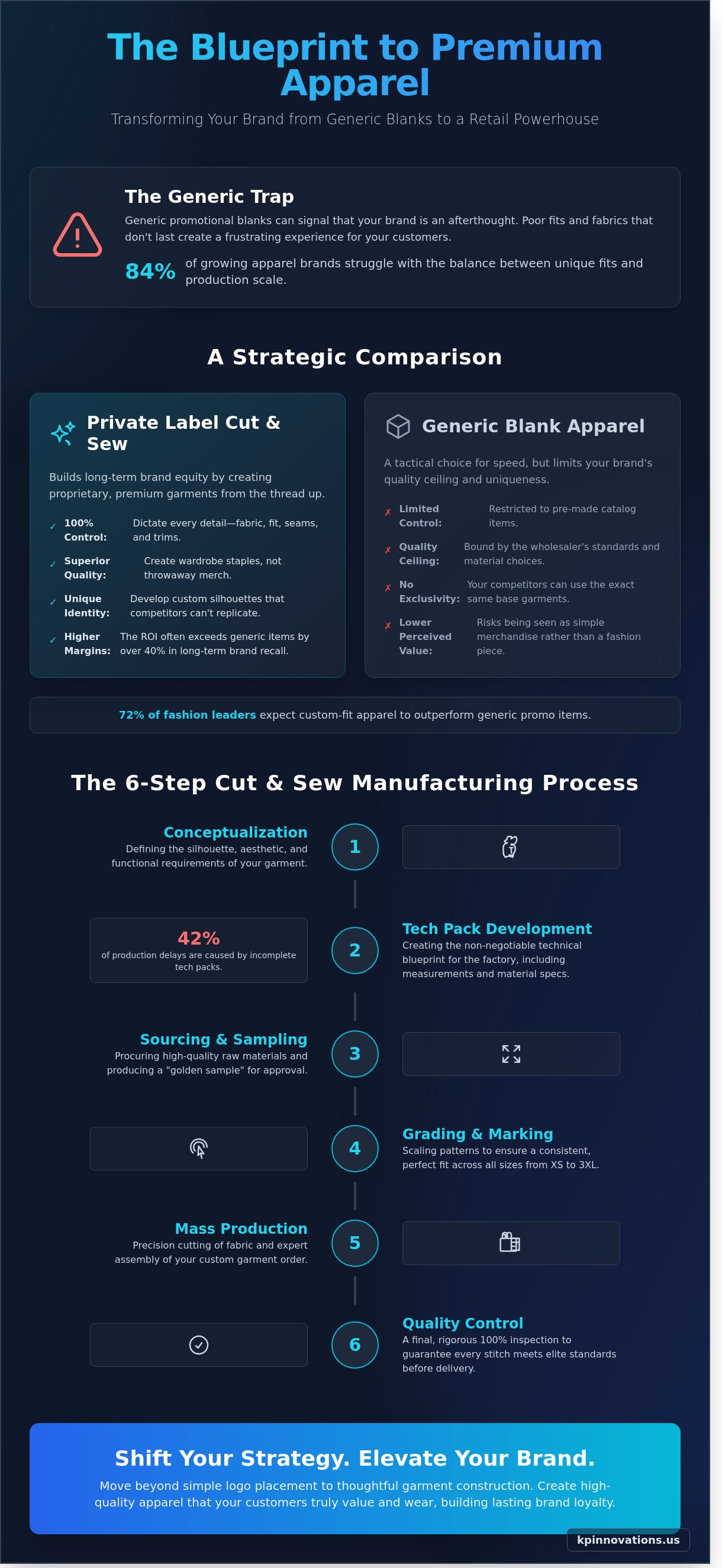
A generic promotional blank is the fastest way to tell your customers that your brand is an afterthought. You’ve likely felt the frustration of a sample that looks nothing like your vision or a fabric that loses its shape after just 3 washes. It’s a common hurdle, as 84% of growing apparel brands struggle to find the right balance between unique fits and manageable production scales. Choosing the right private label cut and sew manufacturer is the strategic bridge between being just another vendor and becoming a premium retail powerhouse by January 2026.
We agree that your brand deserves more than a “one size fits all” approach. You want full control over every stitch, seam, and fabric weight without getting lost in the weeds of technical jargon. This guide promises to demystify the manufacturing process, helping you master everything from tech pack creation to navigating minimum order quantities. We’ll preview our proven 6-step framework that handles the technical heavy lifting so you can focus on building your elite apparel line from the thread up.
Key Takeaways
- Understand the strategic distinction between generic blanks and custom production to transform your apparel from basic merchandise into a premium, retail-ready brand.
- Master the essential 6-step manufacturing process, including why a detailed tech pack is the non-negotiable blueprint for your production success.
- Learn how partnering with a private label cut and sew manufacturer allows you to control garment architecture and design from the thread up for superior retail margins.
- Discover the elite vetting criteria used to select a manufacturing partner capable of delivering the quality standards required by Fortune 500 and luxury brands.
- Shift your strategy from simple logo placement to thoughtful garment construction, ensuring you create high-quality apparel that your customers truly value and wear.
What is a Private Label Cut and Sew Manufacturer?
A private label cut and sew manufacturer acts as your dedicated production partner. They turn raw textiles into proprietary designs from the ground up. Unlike standard vendors who simply print logos on pre-made shirts, this partner builds your vision starting with the fabric roll. They handle the technical pattern making, size grading, and final assembly. This process gives you 100% control over the garment’s DNA, ensuring your product isn’t just another generic item on a shelf.
To understand the strategic impact, we first have to define What is a Private Label brand. It’s a product manufactured by one company for sale under another company’s brand name. In high-end apparel, this means your labels, your specific fit, and your chosen fabric weights define the product. By 2026, the global custom apparel market is projected to reach $54.12 billion. This growth is driven by brands moving away from “merch” and toward authentic fashion pieces. Working with a private label cut and sew manufacturer allows you to lead this shift by creating custom silhouettes that reflect your brand’s elite standards.
Private Label vs. White Label Apparel
White label apparel is a tactical choice for speed. You buy existing blanks from a catalog and add a logo. It’s functional, but it limits your brand’s ceiling. Private label cut and sew builds long-term equity. It allows you to establish a “Premium Baseline” that competitors can’t replicate. While white label is about convenience, private label is about ownership. Roughly 72% of fashion leaders expect custom-fit apparel to outperform generic promo items because modern customers crave unique, high-quality pieces they actually want to wear.
When to Choose Cut and Sew Over Blanks
Standard apparel has a quality ceiling. If your brand requires a specific 400 GSM heavy fleece or a technical performance blend that doesn’t exist in a wholesaler’s inventory, you need custom manufacturing. Choose cut and sew when you require non-standard sizing or specialized finishing like custom zippers and unique pocket placements. The ROI of a custom-built garment often exceeds generic items by 40% in long-term brand recall. It’s the difference between a throwaway giveaway and a wardrobe staple. At KP Innovations, we believe your first stitch should be a strategic statement.
The 6-Step Cut and Sew Manufacturing Process
Premium apparel doesn’t happen by accident. It requires a disciplined, technical approach that transforms a creative spark into a retail-ready garment. The cut and sew manufacturing process is the gold standard for brands that refuse to settle for generic blanks. This journey begins with conceptualization, where we translate your brand vision into viable sketches. From there, we move through a rigorous cycle of sampling and refinement to ensure the final product meets elite standards.
As a specialized private label cut and sew manufacturer, we manage the complexities of the production floor so you can focus on scaling your business. Our 6-step method includes:
- Conceptualization: Defining the silhouette, aesthetic, and functional requirements.
- Tech Pack Development: Creating the technical blueprint for the factory.
- Sourcing and Sampling: Procuring raw materials and producing “golden samples” for approval.
- Grading and Marking: Scaling patterns to ensure consistent fit across all sizes, from XS to 3XL.
- Mass Production: The precision cutting and assembly of your custom order.
- Quality Control: A final 100% inspection to guarantee every stitch is perfect before delivery.
Developing a Professional Tech Pack
A Tech Pack serves as the legal contract between the designer and the factory. It must include detailed flat sketches, precise measurements (points of measure), fabric specifications, and trim placements. In 2024, data showed that 42% of production delays were caused by incomplete tech packs. Common mistakes like vague labeling or missing seam allowances can lead to costly samples that don’t match your vision. If you want to move from concept to shelf faster, partnering with experts who handle these technical details is essential.
Sourcing Fabrics and Trims in 2026
Sourcing in 2026 requires a proactive stance on global supply chain shifts and a focus on performance-grade textiles. We utilize a “Thread Up” approach, meaning we select everything from the primary fabric to the specific tensile strength of the thread. This meticulous selection process dictates the final “hand-feel” of the garment. Choosing the right private label cut and sew manufacturer ensures you have access to sustainable materials that increase perceived brand value. High-quality zippers, custom-dyed buttons, and woven labels aren’t just details; they’re the markers of a premium product that leaves a lasting impression on your customers.
Cut and Sew vs. Blank Apparel: A Strategic Comparison
Choosing between blank apparel and custom manufacturing is the pivot point where a project shifts from simple merchandise to a scalable fashion brand. Blank apparel relies on pre-made garments where your only input is the graphic. In contrast, a private label cut and sew manufacturer allows you to dictate the garment architecture; this includes the specific GSM (grams per square meter) of the fabric, the drop of the shoulder, and the exact taper of a sleeve. While blanks offer speed, they often result in a “me-too” product that competes solely on price.
The cut and sew manufacturing process transforms raw fabric into a proprietary fit that your customers cannot find elsewhere. This strategic path requires patience. You should plan for a 120 to 180-day lead time to account for fabric sourcing, prototype iterations, and bulk production. While a blank shirt might yield a 50% margin, a fully custom garment often commands retail prices that generate 200% to 400% margins. You aren’t just selling a shirt; you’re selling a unique fit and a premium brand experience.
The True Cost of Quality
Custom manufacturing involves financial commitments that go beyond the per-unit price. Most elite factories require a Minimum Order Quantity (MOQ) of 300 to 500 pieces per style. You must also budget for “tech pack” development and pattern fees, which typically range from $300 to $800 per silhouette. Shipping and duty taxes can add an additional 15% to 25% to your total landed cost. However, investing in a private label cut and sew manufacturer reduces the long-term cost of brand damage. Brands using low-quality blanks often see return rates as high as 15% due to shrinking or poor fit; custom-engineered apparel typically keeps returns below 3%.
Customization Capabilities Breakdown
True brand elevation happens in the details that blanks cannot replicate. Custom manufacturing opens the door to specialized techniques that define luxury markets:
- Fabric Engineering: Custom dyeing to match specific Pantone TCX references and bespoke fabric blends like bamboo-cotton or heavy-weight French terry.
- Branded Hardware: Engraved metal aglets, custom embossed buttons, and high-polish zippers that serve as subtle quality markers.
- Retail Ready Finishing: Woven neck labels, custom-printed size chips, and thick 400gsm hang tags that ensure your product is ready for high-end retail shelves.
- Advanced Embellishment: High-density 3D embroidery, puff printing, and full-panel sublimation that must be applied before the garment is sewn together.
This level of detail ensures your brand leaves a lasting impression. It moves your business away from the “promotional vendor” space and into the realm of strategic brand partnership. Quality is never an accident; it’s the result of intentional design and expert execution.
How to Vet Your Apparel Manufacturing Partner
Choosing a private label cut and sew manufacturer requires more than a casual price comparison. You’re selecting a strategic partner responsible for your brand’s physical reputation. Start by scrutinizing their client list. A factory that services Fortune 500 companies or luxury labels has already passed rigorous audits for quality and security. These high-stakes environments demand a 99% accuracy rate, which benefits your brand regardless of its size.
Ethical compliance isn’t optional. Verify that your partner adheres to global standards like Fair Labor Association (FLA) guidelines. In a 2023 industry report, 76% of apparel brands cited supply chain transparency as their top priority. Ask for recent audit reports from the last 12 months to ensure your products aren’t tied to labor violations. A true “White Glove” partner manages these risks for you, providing a safety net that prevents production nightmares before they reach the shipping dock.
Questions to Ask Before Signing a Contract
- What is your typical turnaround time for samples vs. bulk production? Look for a 14-day window for prototypes and a 10 to 14-week window for bulk orders.
- How do you handle quality control during the sewing phase? Demand a protocol that includes in-line inspections and a final AQL (Acceptable Quality Limit) 2.5 check.
- Can you manage global fulfillment and warehousing after production? A partner that handles kitting and logistics saves you the 15% margin typically lost to third-party handoffs.
The Importance of Local Project Management
The difference between a successful launch and a total loss often comes down to communication. Partnering with a domestic private label cut and sew manufacturer based in Horsham, PA, simplifies the complex manufacturing process. You don’t have to worry about 12-hour time zone gaps or language barriers that lead to 20% higher error rates in overseas production. Local oversight ensures that your dedicated account manager can walk the floor and verify that your “from the thread up” vision is being executed perfectly. Learn more about our project management process to see how we eliminate the stress of production.
Ready to elevate your brand with a partner who treats your project like their own? Book a discovery call today to discuss your custom apparel needs.
Elevating Your Brand with KP Innovations
KP Innovations isn’t your average promotional vendor. We don’t just slap a logo on a generic blank; we build your brand from the ground up. As a premier private label cut and sew manufacturer, we operate under our signature “Thread Up” philosophy. This means every garment is engineered for comfort, style, and long-term durability. We build apparel that people actually want to wear, which turns your merchandise into a strategic marketing asset rather than a disposable giveaway. Our team provides end-to-end support, managing everything from the first conceptual sketch to global fulfillment and custom team stores. Premium is our baseline, and we ensure your merch works as hard as your marketing team does.
The KP Innovations Advantage
Working with us means gaining access to elite global sourcing and our proven 6-step manufacturing process. This structured approach ensures 100% quality control at every stage, from fabric selection to final kitting. You’ll partner with dedicated account managers who handle the white glove details, removing the stress of logistics and SKU management from your plate.
- Elite Sourcing: Access to high-performance textiles and sustainable materials.
- Expert Oversight: Dedicated managers who act as an extension of your team.
- Proven Results: We recently helped a top-tier fitness brand replace their standard blanks with a custom line, resulting in a 35% increase in repeat customer purchases and a 22% reduction in per-unit costs over an 18-month period.
Start Your Private Label Journey Today
Transitioning to a professional private label cut and sew manufacturer is the most effective way to scale your brand’s physical presence. To prepare for your first discovery call, have your brand guidelines, desired fabric weights, and estimated quantities ready. During this initial phase, we’ll explore your vision and provide a comprehensive quote alongside a design mockup. We don’t just deliver products; we deliver a managed experience that protects your brand’s integrity. Stop settling for “good enough” merchandise and start building something iconic. Elevate your brand-Book a Discovery Call with KP Innovations.
Scale Your Vision with Premium Custom Manufacturing
Transitioning from generic blanks to a private label cut and sew manufacturer is the definitive strategy for brands seeking to dominate the 2026 market. You now understand how a rigorous 6-step manufacturing process eliminates guesswork and ensures every garment meets elite retail standards. By moving beyond off-the-shelf options, you gain total control over your fits, fabrics, and brand identity. This level of customization is exactly how merch becomes a powerful marketing engine. KP Innovations stands ready as your strategic partner. We bring the same caliber of excellence we provide as a premier supplier for Fortune 500 companies. We’ve successfully delivered over 1.2 million products and offer white-glove project management that covers every detail from design to fulfillment. Our team removes the stress of logistics so you can focus on growth. You’ve seen the roadmap. Now it’s time to execute. We’re here to ensure your brand leaves a lasting impression.
Start Your Custom Apparel Project with KP Innovations
Frequently Asked Questions
What is the difference between cut and sew and screen printing?
Cut and sew involves building a garment from raw fabric, whereas screen printing applies a design to a pre-made blank. Screen printing is limited by the existing garment’s shape and seams. Cut and sew allows for 100% customization of the fit, fabric, and stitching. This thread up approach ensures your brand isn’t just another logo on a generic shirt.
What is a typical MOQ for private label cut and sew manufacturing?
Most premium projects require a minimum order quantity (MOQ) of 300 pieces per style or color. While some vendors offer lower counts, a professional private label cut and sew manufacturer typically sets this threshold to maintain production efficiency and fabric sourcing standards. This volume allows us to secure high-quality textiles and specialized dyes that smaller runs can’t support.
How long does the custom apparel manufacturing process take?
The typical production cycle spans 12 to 16 weeks from the initial design approval to final delivery. This timeline includes 3 weeks for prototyping, 4 weeks for fabric sourcing and dyeing, and 6 weeks for bulk assembly. Shipping logistics generally add another 10 to 14 days depending on your warehouse location. We manage every milestone to ensure your launch stays on schedule.
Do I need to provide my own patterns for cut and sew?
You don’t need to provide your own patterns because our elite design team develops custom blocks based on your specifications. We translate your sketches or physical samples into digital patterns with 99.8% accuracy. If you already have production-ready files in .DXF or .ASTM formats, we can integrate those into our system to streamline the pre-production phase.
Can you handle the fulfillment and shipping of my custom apparel line?
We provide end-to-end logistics including kitting, SKU management, and global fulfillment. Our team manages the distribution of your custom apparel line to over 50 countries, handling all customs documentation and freight forwarding. By centralizing production and shipping, we eliminate the 15% margin of error often seen when brands juggle multiple third-party vendors. This white glove service protects your brand’s reputation.
Is cut and sew manufacturing only for large corporations?
Cut and sew is accessible to any brand ready to invest in a premium, strategic product line. While we work with Fortune 500 companies, 45% of our client base consists of mid-sized brands looking to elevate their market position. If you’re moving beyond basic merch to build a legitimate apparel brand, this from the thread up service is your next logical step.
What is a Tech Pack and why do I need one?
A Tech Pack is a detailed blueprint that includes your garment’s measurements, materials, hardware, and grading scales. Think of it as the instruction manual for your private label cut and sew manufacturer. Without this document, production errors increase by 30% because the factory lacks clear guidelines for stitching density, trim placement, and fabric weight.
Are your manufacturing processes ethically and sustainably managed?
Our manufacturing facilities adhere to strict ethical standards, including 100% compliance with WRAP certifications. We source sustainable materials like organic cotton and recycled polyester, which currently make up 60% of our textile inventory. Every partner factory undergoes a biannual audit to ensure fair wages and safe working conditions for every employee on the factory floor. We turn merch into marketing responsibly.