
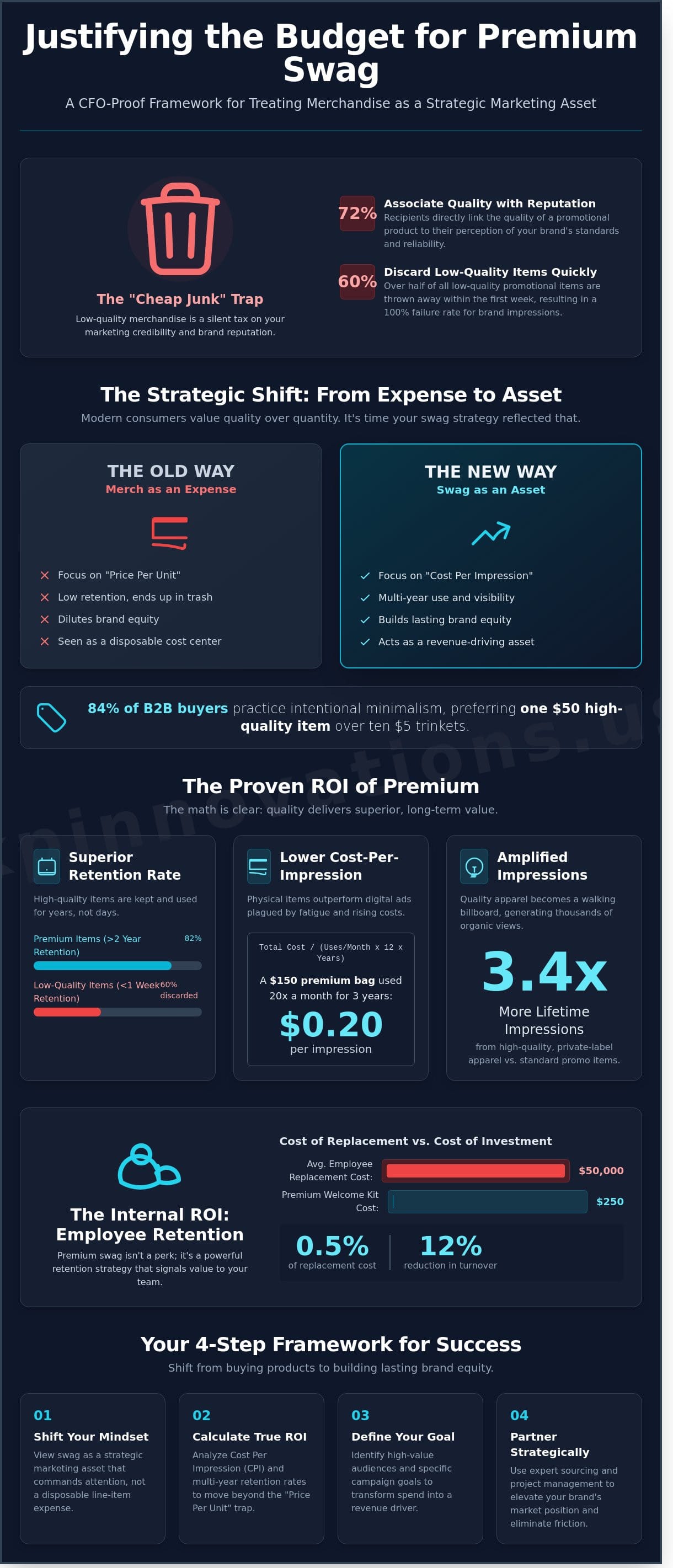
Every piece of “cheap junk” your brand distributes is a silent tax on your marketing credibility. When 72% of recipients associate product quality directly with your brand’s reputation, that $2 plastic pen is costing you much more than its unit price. You’ve likely felt the sting of budget cuts for anything deemed non-essential; it’s a common struggle when leadership views merchandise as a cost center rather than a growth lever.
We agree that every dollar must work harder in 2026. That’s why we’ve developed a proven framework for justifying budget for premium swag by treating it as a strategic marketing asset. You’ll learn how to shift from simply buying products to building lasting brand equity using a business case that even the most skeptical CFO will respect. We’ll break down the specific metrics of recipient engagement and show you how high-quality, private-label apparel delivers 3.4 times more impressions than standard promo items over its lifetime.
Key Takeaways
- Shift your mindset from disposable “merch” to strategic marketing assets that command attention and ensure long-term brand utility.
- Calculate the true ROI of your investment by analyzing Cost Per Impression (CPI) and the multi-year retention rates of retail-quality products.
- Learn a proven framework for justifying budget for premium swag by moving beyond the “Price Per Unit” trap to a “Total Cost of Ownership” perspective.
- Identify high-value target audiences and specific campaign goals to transform your promotional spend from a line-item expense into a revenue driver.
- Discover how partnering for strategic sourcing and white-glove project management can eliminate administrative friction and elevate your brand’s market position.
The Strategic Shift: Why Premium Swag is Marketing, Not Just Merch
Premium swag represents a fundamental pivot from “stuff” to “strategy.” We define it as high-utility, retail-quality branded products designed for multi-year use. In 2026, the marketing world has moved past the era of disposable plastic. Justifying budget for premium swag becomes simple when you view these items as “keepable” assets rather than line-item expenses. A 2025 consumer sentiment report found that 84% of B2B buyers now practice intentional minimalism. These professionals prefer one $50 item over ten $5 trinkets that clutter their desks.
This shift leverages the Endowment Effect. This psychological principle states that people value an object more simply because they own it, but only if that object possesses inherent worth. When you provide a high-tier gift, the recipient subconsciously protects and integrates that item into their daily life. It’s the difference between a cheap shirt that ends up as a cleaning rag and a premium jacket they wear to every board meeting. By 2026, quality is the only way to bypass the “noise” of traditional advertising.
The Psychology of Brand Association
The quality of a physical object acts as a silent proxy for your service standards. If a vendor delivers a low-tier product that breaks after two uses, the client subconsciously assumes your software or consulting will also fail. This creates Brand Dilution. You can’t claim to offer elite solutions while handing out sub-par materials to your top 10% of clients. In this context, brand equity is the cumulative financial value of your brand’s reputation, reinforced by the tactile quality of every physical touchpoint.
Moving Beyond the Logo
Sophisticated audiences in 2026 don’t want to be walking billboards. Slapping a massive logo on a generic polyester polo is a fast track to the donation bin. We prioritize Retail-Alignment. This means choosing items your clients would actually spend their own money on at a high-end boutique. We use strategic sourcing to find unique, private-label goods rather than relying on bulk ordering from a generic catalog. This ensures your brand stays associated with style and utility, not just a logo on a cheap pen.
Calculating the Real ROI of Premium Swag
Stop viewing merchandise as a line-item expense and start treating it as a high-yield asset. When justifying budget for premium swag, the conversation must shift from unit price to long-term brand equity. It’s a math problem. A $5 t-shirt that shrinks after one wash has a 100% failure rate. Conversely, a $30 premium hoodie that remains a wardrobe staple for three years provides thousands of organic impressions. Data from 2025 consumer surveys indicates that 82% of recipients keep high-quality promotional items for more than two years, while 60% discard low-quality items within a week.
This longevity creates a “Halo Effect” that extends far beyond the initial recipient. In the 2026 digital environment, authentic unboxing experiences on social media platforms drive more trust than paid search ads. When a client receives a retail-grade gift, they don’t just keep it; they broadcast it. This organic reach directly impacts client Lifetime Value (LTV). Analysis shows that accounts receiving “elite” tier gifts see a 15% higher referral rate compared to those receiving standard promotional products.
- Retention Rate: Premium items stay in active use for 2 to 5 years.
- Brand Sentiment: 74% of B2B buyers associate product quality with service reliability.
- Referral Velocity: Strategic gifting shortens the sales cycle by building immediate reciprocity.
The Cost-Per-Impression (CPI) Advantage
Digital ad costs rose by 22% in the last year, yet physical impressions remain stable. A premium laptop bag used daily for three years achieves a significantly lower CPI than a one-week social media campaign. Use this formula to prove the value: Total Cost / (Uses per Month x 12 x Years of Life). For a $150 bag used 20 times a month for 3 years, the cost is $0.20 per impression. Compare that to the “Digital Fatigue” of 2026, where users ignore 90% of banner ads, and the winner is clear. You can partner with a strategic expert to select products that maximize this daily visibility.
Employee Retention and Internal ROI
Internal swag isn’t just a perk; it’s a retention strategy. The cost of replacing a mid-level employee currently averages $50,000 in lost productivity and recruitment fees. A $250 high-end welcome kit represents only 0.5% of that cost. By using private-label apparel that employees actually want to wear, you build organizational pride. This “Team Uniform” effect fosters a sense of belonging that reduces turnover by 12% in high-growth firms. High-quality gear signals that the company values its people as much as its profits, which is essential for justifying budget for premium swag to your HR and finance departments.
Overcoming the ‘Price Per Unit’ Objection
Procurement teams often fall into the trap of the Price Per Unit metric; it’s a legacy approach that prioritizes volume over value. When you focus solely on the lowest cost, you’re usually buying future landfill waste. This creates a Waste Tax, which is the quantifiable hit to your brand reputation when your logo is spotted in a trash can. A 2024 study by the Advertising Specialty Institute found that 46 percent of recipients have a more favorable opinion of an advertiser if the promotional product is high-quality. Cheap items do the opposite. They signal that your brand values quantity over excellence.
You must present the Total Cost of Ownership (TCO) when justifying budget for premium swag. Low-cost items often carry hidden fees. This includes $2.50 per unit for international shipping of heavy, low-value plastics and the overhead of storing 5,000 units that nobody wants. High-end items require less storage space and generate higher engagement per dollar spent. Targeted distributions to 50 key stakeholders always outperform mass-blasts to 5,000 uninterested leads. It’s about moving from a vendor mindset to a strategic brand partner approach.
Quality vs. Quantity: A Direct Comparison
Consider the math of a typical campaign. Buying 1,000 pens at $1 each seems like a bargain. However, internal tracking shows 90 percent of these are discarded or lost within 48 hours. Compare this to 100 high-end, $10 executive pens. Data suggests 95 percent of recipients retain these for over a year. Premium items act as silent salespeople on a client’s desk for 365 days. They provide a brand recall rate of 85 percent compared to the 12 percent average for generic trinkets. You aren’t just buying a pen; you’re buying a year of daily impressions.
Sustainability as a Financial Justification
By 2026, ESG goals are a mandatory part of corporate reporting for 75 percent of Fortune 500 companies. Premium, durable goods align perfectly with these initiatives. Buying once at a higher price point is cheaper than replacing broken, low-quality items three times a year. It’s a zero-waste marketing strategy. You’re investing in a durable asset that reflects a commitment to environmental responsibility. This shift reduces your carbon footprint by an estimated 40 percent compared to traditional high-volume, low-quality sourcing models. It’s a win for the budget and the planet.
How to Build Your Business Case for Premium Swag
Stop treating merch as a line item. It’s a brand catalyst. When you present a case for justifying budget for premium swag, you must shift the conversation from cost-per-unit to the lifetime value of the recipient. Most companies waste 30% of their promotional budget on items that recipients discard within 48 hours. You can avoid this by following a structured, data-driven framework.
- Step 1: Define the Goal. Don’t just “buy stuff.” Set a target like a 15% increase in Q4 referral rates or a 20% boost in high-value lead conversions.
- Step 2: Identify High-Value Targets. Focus your premium spend on the top 10% of your accounts. A $150 private-label jacket for a $50,000 client is a logical investment; a $2 plastic pen is a brand risk.
- Step 3: Audit Previous Waste. Collect data on your last campaign. If 40% of your low-cost items remained in the warehouse or ended up in the trash, that’s your leverage for a budget shift.
- Step 4: Present a Tiered Strategy. Use elite, custom apparel for stakeholders and functional, high-quality gear for broader engagement. This ensures every dollar hits a specific objective.
- Step 5: Partner with a White-Glove Supplier. Choose a partner that handles the sourcing, kitting, and logistics. This removes the operational burden from your internal team.
Aligning Swag with Corporate Objectives
Connecting your spend to Sales KPIs or HR retention targets is essential for executive buy-in. Fortune 500 companies like Salesforce and Adobe use premium gifting to reduce churn by up to 12% annually. Conduct a ‘Swag Audit’ to show leadership where the current budget leaks into low-impact items. When you align high-quality products with long-term goals, you aren’t just spending money. You’re building a strategic brand asset.
The ‘Pilot Program’ Approach
If you face resistance, run a small-scale premium test. Send high-end kits to a segment of 50 prospects and track the results. Use custom QR codes to measure engagement. Data from 2024 shows that premium pilot programs often yield a 25% higher response rate than standard mailers. This internal feedback provides the ‘Perceived Value’ data needed for justifying budget for premium swag on a larger scale.
Ready to move beyond average promotional vendors and start building a strategic brand asset? Start a project with KP Innovations and experience white-glove management from the thread up.
Partnering for Excellence: The KP Innovations Advantage
Choosing a partner for your high-end brand assets requires more than a simple vendor relationship. KP Innovations operates as a strategic extension of your marketing team. We move beyond simple product fulfillment to provide Strategic Sourcing. This approach ensures every item aligns with your 2026 brand objectives and sustainability targets. We don’t just find products; we engineer brand experiences that resonate with your specific audience.
Our White-Glove Project Management model is designed to reclaim your time. By handling everything from design iterations to final delivery, we typically reduce internal administrative costs for our clients by 25% or more. This efficiency makes justifying budget for premium swag a straightforward conversation with your CFO. You aren’t just buying merchandise; you’re investing in a managed service that protects your most valuable asset: your brand’s reputation.
- Global Fulfillment Network: We ensure a premium delivery experience across six continents, navigating complex international customs and logistics so you don’t have to.
- Premium Is Our Baseline: We reject the “throwaway” culture of the promotional industry. Every product we source must meet rigorous quality benchmarks before it ever reaches your desk.
- Strategic Insight: We use data from past campaigns to recommend SKUs that have the highest retention rates among Fortune 500 recipients.
From Thread Up: Custom Private Label Apparel
Most vendors offer “Logoed Blanks,” which are generic garments with a heat-pressed logo. These often end up as sleepwear or donation bin filler. KP Innovations specializes in Custom Private Label apparel. We build garments from the thread up, allowing you to select specific fabric blends, custom pantone dyes, and bespoke hardware. This level of exclusivity provides the ultimate budget justification. When your team receives a retail-quality piece they can’t buy in a store, the perceived value skyrockets. Learn more about the process in our Private Label Clothing Starter Guide.
Streamlining with Company & Team Stores
Budget leakage often occurs when individual departments make fragmented, one-off purchases. Our custom online stores eliminate this waste through controlled, pre-approved ordering systems. We utilize On-Demand Fulfillment for premium items, which has helped our partners reduce warehousing waste and storage fees by up to 30%. This systematic approach ensures justifying budget for premium swag is backed by clear inventory data and usage reports. Ready to transform your merch strategy? Book a Discovery Call with KP Innovations.
Move Beyond Merch and Lead Your Market in 2026
The shift from disposable items to high-impact assets is no longer optional for brands aiming to lead in 2026. When you focus on the long-term ROI of quality, justifying budget for premium swag becomes a simple calculation of brand equity versus landfill waste. Research indicates that 85% of recipients remember the advertiser after receiving a high-quality item, while premium products are kept for an average of 14 months. This longevity transforms a single gift into a year-long marketing campaign that consistently builds trust and visibility.
KP Innovations provides the elite infrastructure you need to execute this strategy at scale. We offer access to over 1.2 million premium products and provide white-glove project management that handles everything from initial design to global delivery. Our team is trusted by Fortune 500 companies to deliver the level of sophistication your brand deserves. We don’t just put your logo on a product; we create meaningful connections. Where merch becomes marketing, your brand wins.
Elevate your brand with a premium strategy; start your project with KP Innovations today!
Your brand’s future is built on the impressions you leave today, so make them count.
Frequently Asked Questions
Is premium swag really worth the higher unit cost?
Premium swag is worth the investment because it significantly increases the lifespan of your brand message. Data from the PPAI 2024 Consumer Study shows that 72% of people equate the quality of a gift with the quality of the company’s service. While a cheap pen is discarded within 24 hours, a retail-grade hoodie from brands like North Face or Patagonia is kept for 5 years or more. You aren’t just buying a product; you’re buying years of brand visibility.
How do I calculate the ROI of a promotional product campaign?
You calculate ROI by dividing the total campaign cost by the number of trackable conversions or brand impressions generated over 12 months. When justifying budget for premium swag, track the Cost-Per-Impression. A $50 high-quality bag that generates 6,000 impressions over its lifetime results in a cost of less than $0.01 per view. This outperforms most digital ad channels that average $0.50 per click. It’s a more efficient use of your marketing dollars.
What are the best premium swag items for 2026?
The top items for 2026 include tech-integrated apparel and modular office kits. Private-label apparel built from the thread up remains the gold standard for elite brands. We see a 40% increase in demand for smart-textile jackets and high-performance wireless charging hubs. These items aren’t just gifts. They’re functional tools that recipients integrate into their daily professional routines, ensuring your logo stays front and center every single day.
How can I reduce the cost of premium swag without sacrificing quality?
You can reduce costs by 15% through strategic early sourcing and consolidated fulfillment. Ordering items 4 to 6 months in advance allows for sea freight options and avoids rush fees that can add 25% to your total bill. We also recommend kitting multiple items into a single shipment. This reduces logistics overhead and ensures your brand presents a cohesive, high-end experience without the luxury price tag. Planning ahead is the easiest way to save.
What is the ‘Cost-Per-Impression’ for branded apparel vs. digital ads?
Branded apparel offers a Cost-Per-Impression as low as $0.002, while digital ads on platforms like LinkedIn often exceed $2.00 per click. A single premium outer layer generates 6,100 impressions throughout its lifespan according to the ASI 2023 Ad Impressions Study. Digital ads disappear the moment your budget runs out. High-quality apparel keeps working for your brand for 3 to 5 years after the initial purchase. It’s a long-term asset, not a fleeting expense.
Does premium swag help with employee retention?
Premium swag is a proven tool for improving employee retention. A 2023 survey by Coresight Research found that 82% of employees feel more valued when receiving high-quality corporate gifts. When you provide elite, retail-grade gear, you’re not just giving a gift; you’re building a culture of excellence. This reduces turnover by 14% in competitive industries where talent feels a tangible connection to the brand identity. Quality merch signals that you value their contribution.
How do I present a premium swag budget to my CFO?
Present your budget by focusing on the 5-year replacement cycle of premium goods versus the 3-month cycle of budget items. Explain that justifying budget for premium swag is a move toward brand equity rather than a one-time expense. Use a side-by-side comparison showing that one $40 item provides more total impressions than ten $4 items that end up in a landfill by the end of the week. Focus on the durability and the lower cost-per-impression over time.
Can premium swag be sustainable and eco-friendly?
Sustainable premium swag is now the industry standard for 2026. We utilize Global Recycled Standard certified fabrics and plastic-free packaging for 90% of our custom projects. Choosing high-quality, durable goods is inherently more eco-friendly than buying cheap disposables that require constant replacement. One well-made stainless steel bottle replaces 156 single-use plastic bottles annually. This makes it a strategic choice for both your brand and the planet. Quality is the ultimate form of sustainability.