
The most expensive marketing channel in your budget might be the one currently sitting at the bottom of your employees’ dresser drawers. If your business casual corporate apparel stays hidden because it’s low-quality or poorly fitted, you aren’t just losing money on inventory. You’re missing a daily opportunity to turn your team into active brand ambassadors. Most leaders agree that managing apparel programs often becomes a logistical nightmare of spreadsheets and sizing errors that rarely results in a cohesive team look.
We believe that Merch is Media™, and your apparel should be treated with the same strategic rigor as any other high-stakes marketing investment. This guide will show you how to transform standard dress codes into a powerful asset that drives internal culture and external loyalty. We will explore how to navigate the 2026 shift in import costs following the Last Sale Valuation Act; implement a hands-off, automated fulfillment system; and select retail-grade pieces that your employees actually choose to wear on the weekend. By the end, you’ll understand how a “Chief Swag Officer” model can turn a simple polo into a strategic tool for brand elevation.
Key Takeaways
- Stop treating your dress code as a liability and start using it as a high-frequency media channel that shapes internal culture.
- Learn to select retail-quality business casual corporate apparel that meets 2026 employee expectations and ensures your brand is seen outside the office.
- Move beyond the “closet fulfillment” model by implementing a managed system that handles everything from sizing to global distribution.
- Apply the Merch is Media™ philosophy to turn every garment into a strategic asset that generates measurable brand impressions.
- Identify the critical differences between a standard merchandise vendor and a strategic agency partner that owns your entire brand experience.
Rethinking Business Casual: Why Your Dress Code is a Brand Liability
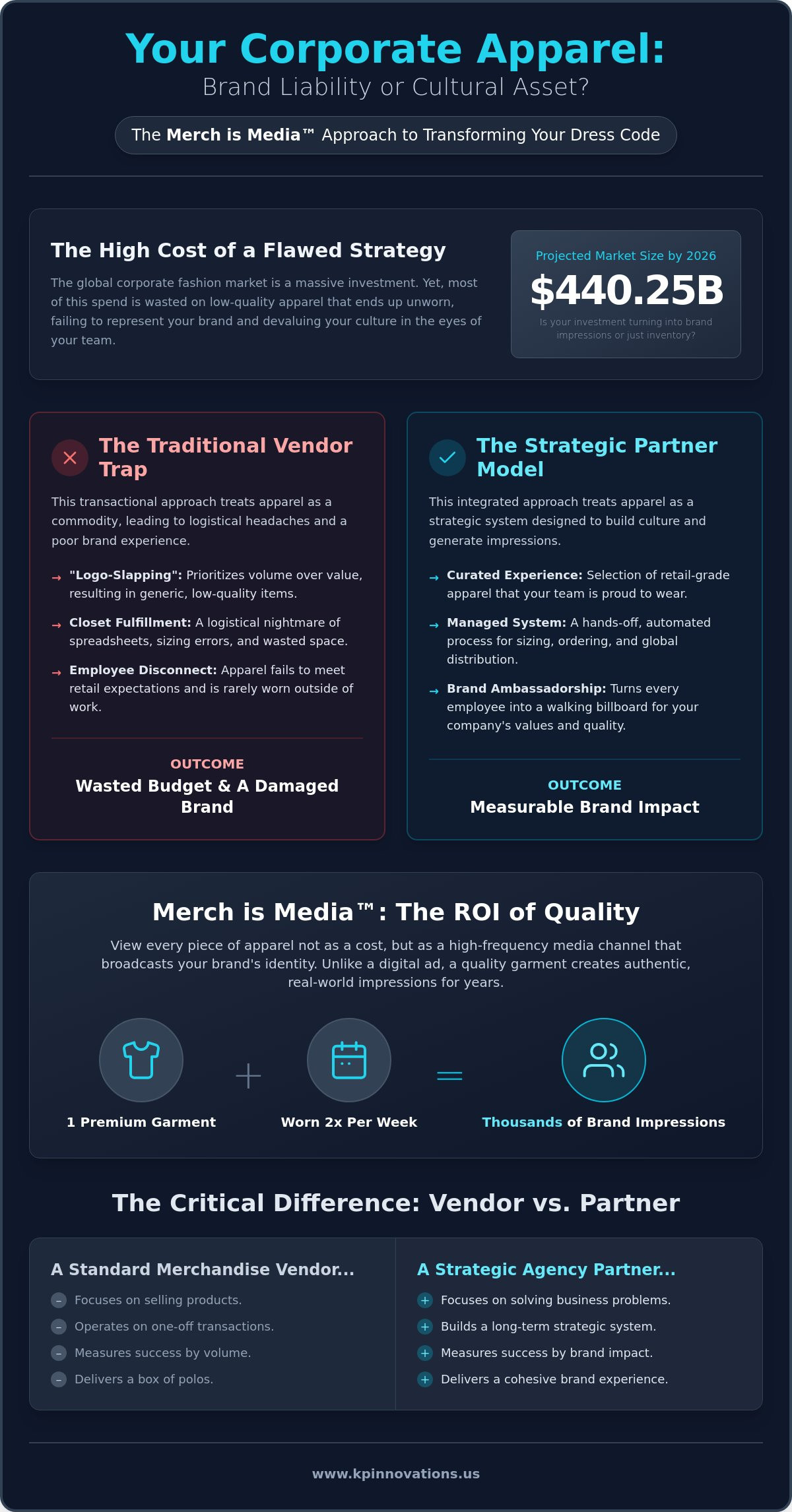
In 2026, the global corporate fashion market is projected to reach $440.25 billion. Despite this massive investment, many organizations still treat their dress code as a set of restrictive rules rather than a high-performance marketing channel. A generic policy creates a brand liability because it lacks the curated infrastructure to support it. When you tell a team to dress “business casual” without providing the right business casual corporate apparel, you leave your brand representation to chance. This ambiguity leads to a fragmented visual identity that fails to reflect your company’s actual standards or professional caliber.
The history of business casual shows a steady evolution from “Casual Fridays” to a permanent, hybrid standard that prioritizes versatility. In the 2026 corporate landscape, this means a sophisticated blend of “soft tailoring,” performance fabrics, and subtle brand identity. Low-quality merchandise is a hidden cost that devalues your brand in the eyes of your employees. If a garment feels like a cheap “uniform” instead of a piece of professional attire, it will be discarded. High-quality apparel shifts the focus from rules of dress to cultural alignment, ensuring your team looks as capable as they actually are.
The Problem with Traditional Corporate Vendors
Most companies fall into the “logo-slapping” trap. They treat apparel as a series of disconnected, one-off transactions rather than a long-term strategy. Traditional distributors prioritize volume over value, leading to a massive disconnect between employee retail expectations and corporate reality. Your team knows the difference between a high-performance stretch fabric and a stiff, budget-grade polo. When the quality of your corporate gear doesn’t match your corporate ambitions, the message to your team is that the brand experience is an afterthought. A strategic partner understands that business casual corporate apparel must rival the brands your employees buy for themselves on the weekend.
Apparel as a Tangible Extension of Culture
Strategic outfitting bridges the physical gap between remote and in-office team members. It creates a shared visual language that facilitates a sense of belonging and professional pride. At KP Innovations, we operate under the belief that Merch is Media™. Every shirt, vest, or jacket is a high-frequency channel for your brand’s story. It is not just about what people wear; it’s about how they feel while representing your organization. We define strategic apparel as a curated system of high-quality garments designed to foster cultural cohesion and professional alignment across every touchpoint of the brand experience. When apparel is done right, it becomes a tool for employee recognition and a symbol of shared success.
Merch is Media™: Turning Apparel Into a Cultural Asset
Every piece of business casual corporate apparel your team wears functions as a high-frequency media channel. We view merchandise not as a line item in a procurement budget, but as a billboard for your brand’s values. When an employee wears a branded quarter-zip to a client meeting or a local coffee shop, they’re broadcasting your brand’s identity to the world. If that garment is poorly fitted or made of inferior fabric, the “media” you’re producing signals a lack of attention to detail. Conversely, retail-grade apparel communicates excellence and professional gravitas before a single word is spoken.
This commitment to a polished image is a core value in many specialized fields; for instance, the training experts at advancedpmu.com demonstrate how meticulous attention to personal and professional presentation can define a brand’s identity.
Calculating the reach of this media channel reveals its true value. A single high-quality jacket worn twice a week can generate thousands of brand impressions over its lifespan. Unlike digital ads that users scroll past, physical apparel exists in the real world, creating authentic, face-to-face visibility. This is why the psychological impact on your team is so significant. Research published by Forbes highlights how a leader’s appearance projects trust and capability. This principle applies to your entire workforce. When employees wear gear they’re proud of, their performance and loyalty often follow suit, as the apparel becomes a tangible symbol of their membership in a high-performing culture.
Moving beyond the logo is the hallmark of a sophisticated brand experience. Modern brand communication relies on texture, drape, and fit to tell a story. A tech firm might prioritize moisture-wicking performance blends that signal agility, while a financial institution might opt for heavy-gauge knits that project stability. By focusing on these subtle cues, you communicate your brand’s “vibe” without relying on oversized graphics that employees might find off-putting.
The Chief Swag Officer Approach
Your apparel program requires a dedicated strategy, not just a repetitive ordering process. A vendor waits for your SKU list; a strategic apparel partner owns the outcome of the entire program. This approach involves curating a collection that aligns with your specific business objectives, whether that’s reducing turnover or launching a new service line. We act as an extension of your department, ensuring that every garment selected serves a measurable purpose within your broader marketing ecosystem.
Strategic Sourcing for Brand Alignment
Successful outfitting requires matching the fabric and silhouette to your industry’s specific expectations. In 2026, the benchmark for corporate gear is retail-equivalent quality. If the garment wouldn’t sit comfortably on a shelf at a premium department store, it shouldn’t represent your brand. This level of precision often requires moving beyond off-the-shelf options. You can explore the benefits of total design control in our guide on private label clothing. To ensure your brand’s physical touchpoints are as refined as your digital ones, you should consider a more intentional approach to strategic sourcing that prioritizes longevity and employee preference.
The Selection Strategy: Retail Quality vs. Private Label Customization
In 2026, the benchmark for employee satisfaction isn’t just about receiving free gear. It’s about whether that gear earns a place in their permanent rotation. As organizations adapt to the new rules of workplace attire, the choice between retail brands and private label manufacturing becomes a pivotal strategic decision. Retail brands offer immediate prestige and a familiar fit, which can be highly effective for high-level recognition programs. However, these off-the-shelf options often limit your ability to fully integrate your brand’s unique identity into the garment’s DNA.
Private label apparel provides total control over design, sizing, and material specifications. While standard “blanks” are suitable for basic promotional needs, custom-manufactured business casual corporate apparel allows you to specify everything from the exact Pantone of the thread to the weight of the fabric. This level of customization ensures that your team’s look remains consistent across global offices, regardless of local retail availability. For a brand with high ambitions, the ability to own the manufacturing process means you aren’t just buying clothes; you’re building a proprietary asset that competitors cannot replicate.
Choosing between these two paths depends on your specific business objective. If you need a quick, prestigious gift for a leadership retreat, a co-branded retail item is often the right move. If you’re building a long-term uniform program for thousands of employees, a private label line offers better scalability and long-term cost efficiency. A strategic partner helps you navigate these nuances to ensure your investment drives the intended cultural outcome.
Designing for Longevity and Wearability
Modern professionals prefer subtle branding over loud, oversized logos. The most effective business casual corporate apparel utilizes tonal embroidery or discreet hem tags that signal quality without feeling like a costume. We also prioritize technical fabrics that meet the demands of a hybrid work life. Moisture-wicking blends, four-way stretch, and non-iron finishes aren’t just features; they’re requirements for garments that people actually want to wear. You can see how we apply these principles to our client programs through our creative development services, where we align apparel design with your broader brand guidelines.
The Anatomy of a Perfect Corporate Quarter-Zip
The quarter-zip has officially replaced the blazer as the “new standard” of business casual. It offers the perfect balance of comfort and professional polish, making it a staple for everything from Zoom calls to boardroom presentations. When selecting a quarter-zip, we focus on three critical engineering points: the quality of the zipper, the durability of the cuffs, and the structure of the collar. A collar that sags or cuffs that lose their elasticity after three washes will quickly end up in the donation bin. Superior fit is the single most important factor in whether an employee adopts a garment as part of their professional identity.
5 Steps to Implementing a Managed Uniform Program
Executing a successful apparel program requires more than a talent for design; it demands a rigorous operational framework. Many organizations fail because they treat business casual corporate apparel as a series of disconnected purchases rather than a managed system. To move from a “vendor” mindset to a strategic one, you must follow a disciplined process that prioritizes long-term brand impact over short-term convenience.
- Step 1: Define the Objective. Every program starts with a specific business problem. Are you trying to standardize the appearance of a global sales team, or are you looking to increase employee retention through a high-end new hire kit?
- Step 2: Strategy and Creative Development. We align your apparel with your broader brand guidelines. This step ensures that the textures, colors, and silhouettes chosen reflect your corporate identity without relying on loud, distracting graphics.
- Step 3: Sourcing and Production Management. In 2026, ethical manufacturing and quality control are non-negotiable. We manage the complexities of the supply chain to ensure every garment meets your technical specifications and social responsibility standards.
- Step 4: Fulfillment and Logistics. This is where most programs break. We operate under the philosophy that “The Closet is Not a Fulfillment Strategy™.” Efficiency comes from automation, not manual labor.
- Step 5: Measurement and Optimization. We track adoption rates and program ROI. If your team isn’t wearing the gear, the program needs adjustment. Data allows us to refine the collection for maximum cultural impact.
Eliminating the ‘Swag Closet’ Nightmare
Manual distribution is a significant operational drain on HR and marketing departments. When your highly paid talent spends their afternoon sorting sizes and mailing individual packages, your brand’s efficiency suffers. Moving to an on-demand model removes this burden entirely. By utilizing Online Company Stores, you empower your team to select their own sizes and styles. This system ensures that inventory is managed professionally and that your “closet” is replaced by a digital, hands-off storefront that handles the heavy lifting for you.
Global Fulfillment for Distributed Teams
Managing a consistent brand experience for remote employees requires a sophisticated logistics network. In 2026, navigating international shipping and localized production is more complex than ever. Whether your team is in New York or London, they should receive the same high-quality experience. Our fulfillment and logistics services are designed to handle these complexities, ensuring that business casual corporate apparel reaches your team on time, regardless of their location. To ensure your brand’s physical presence is managed with the same precision as your digital assets, you need a strategic partner who owns the sourcing and production outcome from start to finish.
Beyond the Order: Why You Need a Strategic Apparel Partner
The difference between a standard vendor and a strategic agency partner lies in who owns the ultimate outcome. A vendor is an order-taker; they wait for you to provide a SKU and a logo file. This transactional model often results in the logistical nightmares and inconsistent brand representation that plague many organizations. A strategic partner takes a different approach by owning the entire merchandise system. Managing a database of 1.2 million products requires more than a simple search bar. It requires a deep understanding of fabric performance, global supply chains, and specific brand alignment.
Our white-glove project management exists to eliminate corporate stress. We handle the granular details of production management and supply chain logistics that typically bog down internal marketing and HR teams. By positioning your business casual corporate apparel as a strategic investment rather than a disposable expense, you build long-term brand equity. This shift in perspective ensures that every dollar spent on outfitting your team contributes to a measurable increase in cultural alignment and external brand authority.
Integrating Apparel into Recognition Programs
High-end apparel serves as a powerful tool for employee motivation when integrated into formal milestones. Rather than generic awards, providing a retail-grade piece of private label clothing creates a lasting connection between the employee’s achievement and the brand. You can see our specific approach to employee recognition programs to understand how curated merchandise drives performance. For a deeper look at how physical items function as a high-frequency media channel, read our complete guide to promotional products.
The Future of Corporate Apparel: 2026 and Beyond
As we move through 2026, sustainability is no longer an optional feature. It is a standard requirement. We are seeing a significant move toward materials like organic cotton and recycled polyester, driven by both employee preference and global environmental standards. The most successful brands are embracing “lifestyle” apparel pieces. These are garments so well-designed and comfortable that employees choose to wear them on their own time. This is the ultimate goal of the Merch is Media™ philosophy: creating a brand experience that extends far beyond the office walls.
Your brand deserves a partner that treats your apparel with the same rigor as your most important marketing campaigns. It’s time to move beyond the transaction and start building a strategic cultural asset. Partner with KP Innovations to elevate your brand experience and transform your business casual corporate apparel into a competitive advantage.
Owning Your Brand’s Physical Presence in 2026
Your organization’s identity is too valuable to be left to generic dress codes or inconsistent vendor catalogs. By embracing the Merch is Media™ philosophy, you transform every piece of business casual corporate apparel into a strategic asset that builds culture and projects professional authority. We’ve explored how retail-grade quality drives employee adoption and why a managed system is the only way to eliminate the operational drain of manual fulfillment. The shift from a transactional vendor to a strategic partner ensures your brand representation is never left to chance.
Success in the modern landscape requires a partner who moves beyond simple transactions. Our Chief Swag Officer™ model provides you with white-glove project management and access to over 1.2 million premium products. We handle every detail from deep-level customization to end-to-end global fulfillment, ensuring your brand experience remains consistent across every office and remote workspace. It’s time to stop managing closets and start managing your brand’s most visible media channel with precision and purpose.
Request a Strategic Consultation for Your Apparel Program today and discover how we can elevate your team’s professional identity. We look forward to helping you build a program that your employees are truly proud to wear.
Frequently Asked Questions
What is the best way to determine sizes for a large team apparel order?
Utilizing an online company store where employees enter their own sizing information is the only way to eliminate inventory waste. This data-driven approach removes the guesswork of manual spreadsheets and ensures every team member receives a garment that fits their specific profile. By empowering employees to choose their own sizes, you significantly reduce the rate of returns and administrative friction.
How do I ensure our corporate apparel doesn’t look like cheap ‘swag’?
Focus on retail-equivalent quality and subtle branding to avoid a “promotional” look. High-quality business casual corporate apparel should prioritize technical fabrics like moisture-wicking blends and four-way stretch. By moving the logo to a discreet location, such as the sleeve or hem, you create a sophisticated piece that employees actually choose to wear outside of office hours.
Can we set up an online store for employees to choose their own business casual gear?
Implementing an online company store is the modern standard for managing a distributed workforce. These platforms allow your team to select their own gear while giving leadership total control over the curated collection and budget. This strategic approach turns a logistical nightmare into a seamless, hands-off experience for your HR and marketing departments.
What are the most popular business casual apparel items for 2026?
The 2026 professional aesthetic favors soft tailoring and high-performance layerable basics. Technical quarter-zips, waistcoats, and moisture-wicking polos remain the foundation of the modern wardrobe. We are also seeing a significant rise in the use of sustainable, breathable fabrics like organic cotton and recycled polyester that bridge the gap between office wear and lifestyle fashion.
How long does it typically take to design and fulfill a custom apparel program?
A comprehensive program typically requires four to eight weeks for strategy, creative development, and sourcing. Fulfillment timelines depend on whether you are utilizing on-demand production or a stocked inventory model. A strategic partner manages this entire timeline on your behalf to ensure your program launches on schedule without any internal administrative burden.
Is it better to use retail brands or create our own private label apparel?
Retail brands provide immediate prestige, while private label offers total control over the garment’s DNA. If you need to specify exact thread colors or custom sizing that isn’t available off-the-shelf, private label is the superior choice. Most high-ambition brands utilize a strategic mix of both to meet different organizational objectives and recognition milestones.
What are the tax implications or benefits of providing corporate apparel to employees?
Corporate apparel is generally tax-deductible for the business if it is required for employment and not suitable for everyday wear. While standard business casual like plain khakis usually doesn’t qualify, permanently affixing a logo can help an item meet IRS standards. You should always consult with a tax professional to verify how these rules apply to your specific program.
How do we manage international shipping for a global team’s apparel program?
Managing international logistics requires a partner with a global fulfillment network and localized production hubs. This structure minimizes transit times and helps navigate the complexities of import duties and local regulations. It ensures that your business casual corporate apparel reaches your global team with a consistent brand experience, regardless of their geographic location.