
Most promotional tote bags are destined for the back of a closet or a landfill before they ever see the light of day. You’ve likely felt the frustration of spending a marketing budget on bulk orders, only to receive thin, poorly printed bags that your customers wouldn’t dream of carrying in public. It’s a costly way to create a negative impression of your brand. When you invest in promotional tote bags with logo placements, you aren’t just buying a giveaway. You’re commissioning a mobile billboard for your brand’s values.
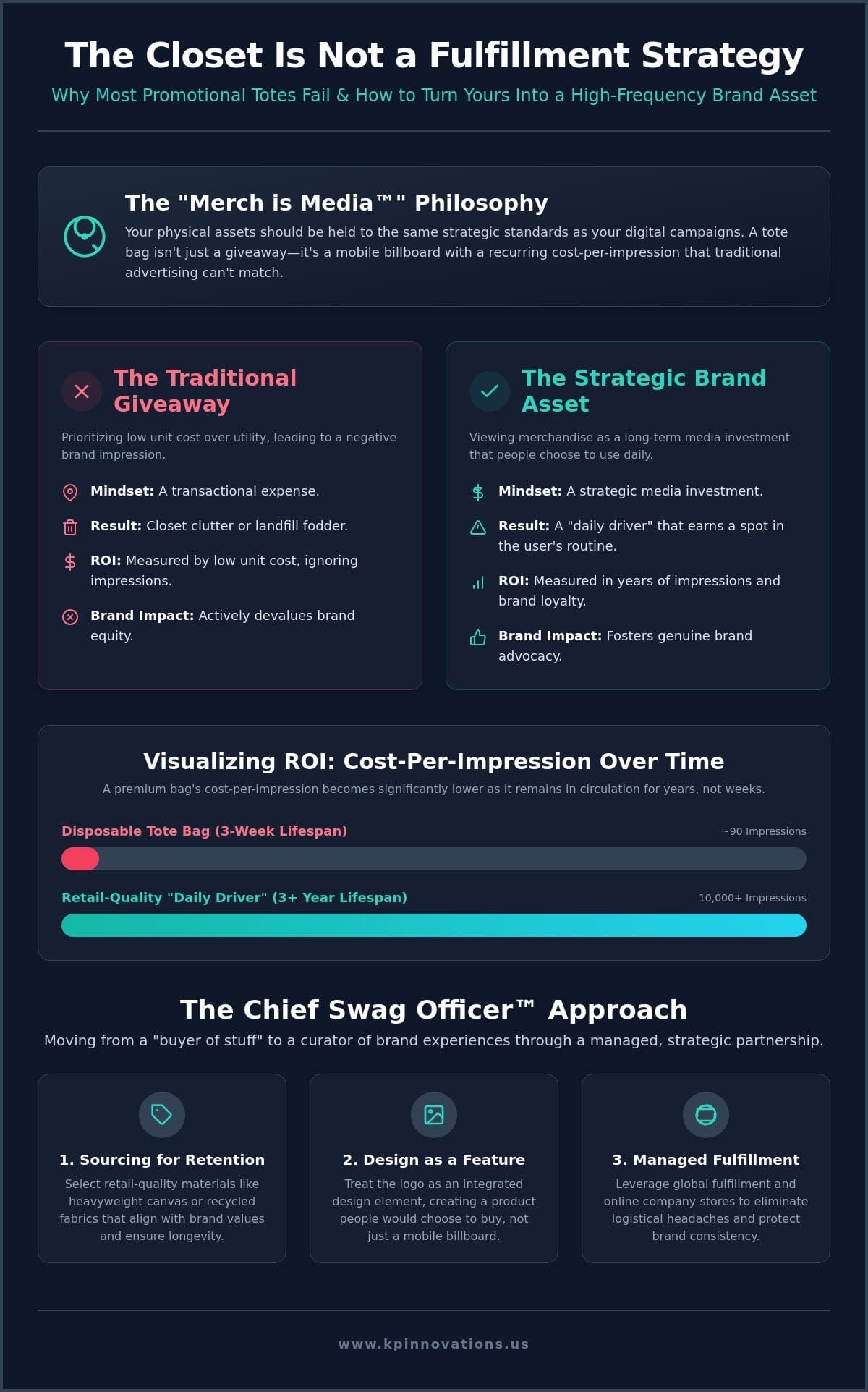
We believe that Merch is Media™. This means your physical assets should be held to the same strategic standards as your digital campaigns. In this article, you’ll discover how to transform standard totes into high-utility brand assets that drive long-term impressions and cultural relevance. We’ll explore the shift toward retail-quality merchandise and explain how to navigate the complex July 2026 regulatory landscape, including California’s SB 1053 plastic bag ban and new CPSC eFiling mandates. You will learn how a managed, hands-off fulfillment strategy eliminates logistical headaches while ensuring your brand remains a permanent part of your customer’s daily life.
Key Takeaways
- Learn why treating your merchandise as a high-frequency media asset generates more brand impressions than traditional digital channels.
- Discover how to select retail-quality materials for promotional tote bags with logo placements that ensure your brand becomes a “daily driver” rather than closet clutter.
- Move beyond the logistical headache of office storage by leveraging global fulfillment and online company stores to protect brand consistency.
- Understand the “Chief Swag Officer” model and how outsourced program management turns physical products into strategic brand investments.
The Closet Is Not a Fulfillment Strategy: Why Most Branded Totes Fail
Every year, corporations spend millions on physical items that never leave the dark corners of a storage closet. This is the “cheap” trap. When a brand prioritizes low unit cost over utility, they aren’t saving money; they’re paying to be forgotten. A thin, scratchy tote bag with a poorly centered logo doesn’t just fail to generate impressions. It actively devalues your brand equity by signaling that you prioritize quantity over quality. This approach treats Promotional merchandise as a transactional expense rather than a strategic investment.
The difference between a “daily driver” bag and a “junk drawer” rag comes down to the psychology of the recipient. People don’t want to be mobile billboards for brands that don’t respect their personal aesthetic. When you distribute promotional tote bags with logo placements that feel like retail products, you earn a spot in the user’s daily routine. If the bag is durable, stylish, and comfortable, it becomes the go-to choice for grocery runs, gym trips, and commutes. If it’s flimsy, it becomes a rag or landfill fodder. This is where most vendors fail their clients; they fulfill an order, but they don’t fulfill a strategy.
The True Cost of Disposable Swag
Calculating the ROI of your merchandise program based on unit cost is a fundamental mistake. Real ROI is measured in years of impressions. A premium bag might cost more upfront, but if it remains in circulation for three years, its cost-per-impression is significantly lower than a disposable alternative that lasts three weeks. Retail-ready aesthetics are the primary driver of this longevity. With new environmental regulations like California’s SB 1053 banning plastic bags, the demand for high-quality, reusable alternatives is surging. Brands that provide “trash” swag today face a growing reputational risk as consumers become more conscious of corporate social responsibility and waste.
Challenging the Giveaway Mental Model
To win the “daily driver” battle, you must stop treating your logo like a stamp and start treating it like a design element. High-tier brands understand that promotional tote bags with logo designs should look like something a customer would actually buy at a boutique. This shift in perspective influences more than just external marketing; it transforms company culture. When employees receive merchandise they’re proud to wear or carry, it fosters genuine brand advocacy. This is the core of our Merch is Media™ philosophy. We help you move away from being a “buyer of stuff” to being a curator of brand experiences. By outsourcing your merchandise department to a strategic partner, you ensure that every item you produce serves a measurable business purpose.
Merch is Media™: Turning Tote Bags into High-Frequency Mobile Billboards
When you view your merchandise through the lens of a media buyer, the humble tote bag undergoes a radical transformation. It’s no longer a giveaway; it’s a high-frequency media channel with a persistent physical presence. Unlike a digital ad that disappears after a single click, promotional tote bags with logo placements offer a recurring cost-per-impression that traditional advertising can’t touch. Every time a customer carries your bag to the office, the gym, or the market, they’re broadcasting your brand to a curated, real-world audience. This is the essence of the Merch is Media™ philosophy.
The effectiveness of this mobile billboard depends entirely on its “staying power.” Research indicates that 90% of people who receive a promotional product remember the brand name, but that memory only persists if the item remains in their possession. To achieve this, your bag must solve a problem or elevate the user’s style. We treat the tote silhouette as a strategic canvas, selecting materials and designs that align with your specific brand goals and audience expectations.
Silhouettes That Signal Brand Identity
Choosing the right silhouette is the first step in ensuring your media asset is actually “broadcast.” For brands aiming for a premium, retail-inspired feel, heavyweight canvas is the gold standard. It projects durability and a sophisticated aesthetic that drives long-term brand loyalty. Conversely, for Tech and SaaS brands, sustainable and recycled materials are often non-negotiable. These choices align with modern environmental standards, such as California’s SB 1053, and signal a commitment to corporate responsibility. In some cases, specialty silhouettes like insulated totes provide even higher utility by solving specific customer needs, ensuring the bag becomes a permanent fixture in their daily lives.
Strategic Logo Placement and Design
A mobile billboard only works if people are willing to carry it. This is why a “less is more” approach to design usually yields the highest ROI. When a logo is integrated as a subtle design element rather than a loud advertisement, the bag is far more likely to be used in public settings. High-end customizations, such as branded gussets or custom-colored handles, add a layer of sophistication that distinguishes your merch from standard industry “swag.” For high-stakes events, turning a tote into a limited-edition asset creates a sense of exclusivity and urgency. By focusing on these strategic details, you move beyond simple distribution and into true brand experience management. If you’re ready to elevate your brand’s physical presence, our team can help you with strategic product sourcing to find the perfect silhouette for your goals.
Sourcing for Retention: Material Science and Retail-Quality Standards
Sourcing is the engine room of a successful merchandise program. While traditional vendors simply pull from a catalog of off-the-shelf blanks, we view the process through the lens of private label apparel. This means we don’t just put a logo on a bag; we build a product from the ground up. A promotional tote bag with logo placements is only as effective as the material it’s printed on. If the fabric pills after two washes or the handle snaps under the weight of a laptop, your brand takes the hit. Our sourcing experts manage these technical details to ensure your physical assets reflect your corporate standards.
We prioritize advanced fabrications that align with 2026 consumer expectations and regulatory requirements. Organic cotton offers a premium hand-feel that synthetic alternatives can’t match. RPET (recycled polyethylene terephthalate) addresses the growing demand for circularity, while heavy-duty twill provides the structural integrity needed for a bag to stand on its own. This “stand-up” quality is a subtle retail cue that signals high value to the recipient.
The Anatomy of a Premium Tote
The difference between a disposable giveaway and a five-year asset lies in the engineering. We focus on specific manufacturing markers that dictate the lifespan of the bag:
- Fabric Weight (GSM): We specify grams per square meter because “hand-feel” is the first thing a customer notices. Higher GSM translates to a perceived luxury that earns the bag a place in the user’s daily rotation.
- Stitch Count and Reinforcement: Cross-stitched handles and reinforced stress points ensure the bag can handle real-world loads without failing.
- Internal Detailing: Branded seam tape, interior pockets, and custom linings transform a simple silhouette into a sophisticated piece of retail-quality merchandise.
Navigating the Global Supply Chain
In 2026, sourcing is no longer just about price; it’s about compliance and consistency. As of July 1, 2026, companies selling textiles in California must register with a Producer Responsibility Organization like Landbell USA under SB 707. Furthermore, the new CPSC eFiling mandate requires importers to submit product safety certificates electronically. A strategic sourcing partner mitigates these risks by vetting factories for ethical standards and ensuring every run matches your exact brand colors. We manage the complexity of global logistics so your team can focus on high-level strategy, confident that your brand’s physical footprint is both compliant and consistent.
Operationalizing Your Brand: From Company Stores to Global Fulfillment
Managing a global brand requires more than just a great design; it requires a bulletproof distribution system. The “box in the office hallway” is where brand consistency goes to die. When marketing and HR teams are forced to act as part-time warehouse workers, errors happen. Logos become inconsistent across regions, inventory disappears, and the employee experience suffers. To truly operationalize your brand, you must move toward a centralized model that treats merchandise with the same logistical rigor as your core product line. This shift ensures that every physical touchpoint is a controlled, high-quality brand experience.
By leveraging online company stores, you provide a frictionless way for distributed teams to access approved assets. Whether you’re sending a retail-quality bag to a new hire in London or a client in Tokyo, the quality remains identical. This centralized control ensures that your promotional tote bags with logo placements represent your brand perfectly every time, regardless of geography. It eliminates the risk of local offices sourcing sub-par alternatives that devalue your global identity.
The Modern Fulfillment Model
High-growth brands often struggle to balance on-demand production with the need for immediate availability. Our fulfillment services solve this by managing the entire lifecycle of your merchandise. We offer real-time inventory tracking that allows marketing and HR leaders to see exactly what’s in stock and where it’s going. This visibility reduces administrative overhead and eliminates the last-minute scramble for event materials. Instead of managing boxes, your team is free to focus on high-level strategy while we handle the heavy lifting of global logistics.
Totes in the Employee Lifecycle
Merchandise is a powerful tool for building internal culture and loyalty. Integrating a premium tote into your onboarding kits creates a lasting first impression for new hires. It’s a tangible signal of value that goes beyond a standard welcome email. These bags also serve as a functional cornerstone for uniform programs, providing a professional way for staff to carry gear while maintaining a cohesive look. For employee recognition programs, exclusive, high-GSM designs can be used as milestone awards. This turns a functional item into a badge of honor, reinforcing loyalty and pride across the organization. If you’re ready to stop managing boxes and start managing a global brand, we can help you with strategic product sourcing and distribution.
The Chief Swag Officer™ Approach: Turning Totes into Strategic Assets
Most organizations treat merchandise as a series of disconnected transactions. They react to an upcoming trade show or a holiday by ordering whatever is available at the lowest price. This reactive model is why closets are full of discarded items and wasted budget. To truly leverage the power of promotional tote bags with logo placements, you need a proactive strategy. You need a partner who functions as your outsourced merchandise department. This is the core of our Chief Swag Officer model. We move beyond “taking orders” to manage the entire system of your brand’s physical presence.
Executing a merchandise strategy requires the same rigor as any other media buy. You wouldn’t buy a billboard without knowing the traffic counts or the demographic reach. Your physical media should be held to the same standard. When you partner with a dedicated agency, program management becomes the shield that protects your brand equity. We ensure that every material choice, every stitch, and every fulfillment route aligns with your long-term business objectives. This approach transforms a simple bag into a measurable strategic asset that builds culture and drives loyalty.
Your Outsourced Merchandise Department
The role of the Chief Swag Officer is to provide white-glove project management. This starts long before a bag is manufactured. It begins with creative development and ends with a seamless global delivery. We manage the complexity of sourcing from our database of 1.2 million products while ensuring compliance with evolving regulations like the California Responsible Textile Recovery Act. By outsourcing this department, your leadership team regains focus on core operations. You get the benefit of an expert team that ensures your merchandise program contributes to your brand experience rather than just filling a storage room.
Next Steps: Elevate Your Brand Experience
Transitioning from a vendor-client relationship to a strategic partnership starts with an honest assessment. Look at your current merchandise program. How much of it ends up as “closet waste”? If your current promotional tote bags with logo designs aren’t being carried in public, they aren’t working for you. The first step is to define the specific business problem you need to solve. Are you trying to improve new hire retention? Are you looking to increase brand visibility at high-stakes industry events? Once the problem is defined, we can build a strategy to solve it. We invite you to initiate a strategy session with KP Innovations to discover how your physical assets can become your most powerful media channel.
Transform Your Physical Assets into Strategic Media
The transition from a simple vendor transaction to a managed merchandise program is the difference between wasted budget and a high-performing media channel. By prioritizing retail-quality materials and strategic silhouettes, you ensure that promotional tote bags with logo placements become permanent fixtures in your customers’ lives. You’ve seen how a strategy-first approach eliminates closet waste and protects your brand equity through meticulous program management and global distribution. It’s time to stop thinking about bags as giveaways and start seeing them as mobile billboards.
KP Innovations operates as your outsourced merchandise department. We provide white-glove global fulfillment and access to 1.2 million strategic products. As a strategy-first brand experience agency, we manage the entire system so your team can focus on high-level growth. Our model is built to handle the logistical headaches of global distribution while maintaining the high-touch service your brand deserves. It’s time to treat your physical touchpoints with the same rigor as your digital marketing campaigns.
Partner with a Chief Swag Officer to build your merchandise strategy. We’re ready to help you elevate your brand experience and turn every item into a powerful tool for lasting connection.
Frequently Asked Questions
What are the most durable materials for promotional tote bags in 2026?
Heavyweight canvas and 16-ounce recycled cotton are the gold standards for durability in 2026. These materials withstand years of daily use; ensuring your brand remains visible in the real world. We also utilize high-density RPET for brands requiring water resistance and extreme durability without compromising the environmental standards required by modern consumers.
How do I choose between screen printing and embroidery for my logo?
Screen printing is ideal for large, vibrant graphics on flat surfaces; while embroidery offers a premium, tactile finish for smaller, sophisticated logos. For promotional tote bags with logo placements that need to survive hundreds of wash cycles, we often recommend high-mesh screen printing with water-based inks or high-density embroidery that won’t pull the fabric over time.
Can you handle shipping branded totes to multiple international offices?
We manage white-glove global logistics to ensure your merchandise reaches international offices with total consistency. Our fulfillment system handles the complexities of customs, duties, and local regulations so your team in Berlin receives the exact same quality as your team in New York. This removes the administrative burden from your internal operations and marketing departments.
What is the minimum order quantity for a custom private label tote?
Custom private label projects typically require higher minimums because we’re manufacturing from the ground up rather than printing on pre-made blanks. While standard orders might start lower, strategic programs involving deep-level customization often begin at 500 to 1,000 units. This ensures production efficiency and maintains a premium cost-per-impression for your brand investment.
How do I ensure my brand colors are perfectly matched on different fabrics?
Our sourcing experts utilize the Pantone Matching System (PMS) to ensure color precision across different textile substrates. We manage the ink chemistry and thread selection specifically for each fabric type; whether it’s organic cotton or recycled polyester. This rigorous process prevents the color drift and inconsistency often seen with standard promotional vendors.
What makes a tote bag ‘retail-quality’ compared to a standard promo bag?
Retail-quality bags are defined by their structural integrity and sophisticated detailing; such as reinforced handles, custom linings, and interior pockets. Unlike standard bags that feel disposable, these assets have a high GSM (grams per square meter) and a professional hand-feel. They’re engineered to be a “daily driver” that stays in circulation for at least five years.
Do you offer eco-friendly or sustainable tote bag options?
We provide a wide range of sustainable options; including GOTS-certified organic cotton and bags made from 100% recycled post-consumer plastic. These choices ensure your promotional tote bags with logo designs comply with 2026 environmental mandates like California’s SB 707 and SB 1053. We prioritize transparency in the supply chain to protect your corporate social responsibility goals.
How long does the design and production process take for strategic merchandise?
A strategic merchandise program generally moves from creative development to final delivery in 8 to 12 weeks. This timeline allows for deep-level customization, ethical sourcing, and rigorous quality control. While this is longer than a standard transactional order, the result is a strategic asset that drives significantly more long-term brand impressions.