
Your brand is too sophisticated to be represented by a generic, off-the-shelf blank. When you invest in custom corporate uniforms, you aren’t just buying clothing. You’re deploying a physical touchpoint for your company culture. Most leaders realize too late that standard promotional catalogs offer limited ways to truly stand out. This often results in expensive apparel that sits in a storage closet because it doesn’t reflect the premium quality of the organization it represents.
We believe that Merch is Media™, which means your apparel should be treated with the same strategic rigor as any other marketing channel. This guide explores how cut and sew manufacturing provides total control over every stitch, fabric weight, and silhouette. You’ll gain a clear understanding of the manufacturing process, learn how to navigate the 2026 CPSC eFiling requirements for imports, and find a framework to help you justify the shift from generic blanks to a private label strategy. By the end of this article, you’ll know how to transform a simple garment into a powerful tool for brand elevation.
Key Takeaways
- Understand the transition from ordering to manufacturing and how creating garments from raw fabric serves as the foundation for a private label brand strategy.
- Discover how custom corporate uniforms act as strategic media that drive employee loyalty and represent your organization with retail-level quality.
- Master the technical milestones of the production cycle, including tech pack finalization and navigating 2026 global compliance and sourcing regulations.
- Learn to balance minimum order quantities with inventory health to ensure your apparel program remains an asset rather than a logistical burden.
- Identify how a strategic partnership model offloads the complexities of design, sourcing, and fulfillment from your internal marketing and operations teams.
Defining Cut and Sew in a ‘Merch is Media™’ World
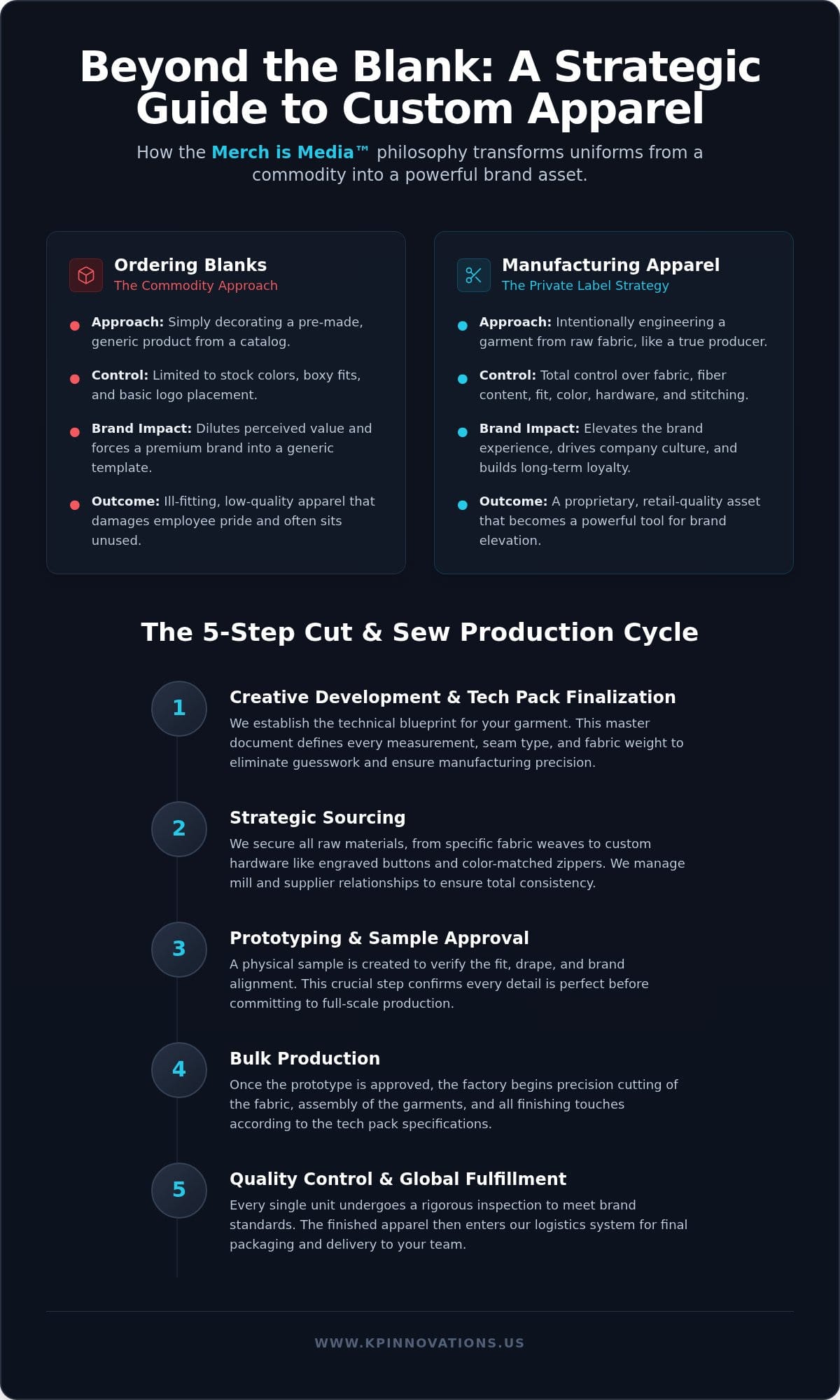
For most organizations, apparel is an afterthought. They browse a catalog, pick a shirt, and slap on a logo. This is simply ordering. It often leads to generic results that employees eventually discard. True brand leaders understand that Cut and sew manufacturing is a fundamentally different approach. It represents the transition from being a passive consumer to becoming an active producer. Instead of decorating a pre-made blank, you are engineering a garment from raw fabric. This level of intentionality is the foundation of our Merch is Media™ philosophy. The clothing isn’t just a product; it’s the medium for your brand’s unique message.
When you manufacture custom corporate uniforms from the ground up, you gain total control over the brand experience. You choose the specific fiber content, the exact GSM of the fabric, and even the custom hardware like engraved buttons or color-matched zippers. You aren’t limited by what a distributor happens to have in stock. You’re creating a proprietary asset that drives culture and builds long-term loyalty. This process ensures that every detail, from the reinforced stitching to the inner neck label, aligns with your strategic goals.
The Anatomy of a Custom Garment
Building a garment from scratch requires a structured, methodical approach. It starts with raw material selection. You define the specific weave and fiber content needed for durability and comfort. Next, pattern making creates the unique blueprint for your brand’s signature fit. This ensures that your team looks cohesive, regardless of their individual body types. Finally, the Tech Pack serves as the critical master document. It contains every measurement and specification to ensure manufacturing precision across every production run. Without a professional tech pack, your custom vision lacks the technical roadmap necessary for high-tier execution.
Why ‘Off-the-Shelf’ Fails Premium Brands
Standard blanks are designed for the masses. They rely on generic color palettes and boxy fits that rarely reflect a sophisticated brand identity. This generic approach dilutes your perceived value and can even damage employee pride. When your team wears ill-fitting, low-quality apparel, they feel like a commodity. High-performance custom corporate uniforms require a different standard. Custom patterns provide the strategic advantage of a tailored silhouette that reinforces your professional identity rather than forcing your brand to fit into a standard template designed for everyone else. By moving away from the catalog, you reclaim ownership of your visual narrative.
The 5-Step Cut and Sew Production Cycle
Transitioning from purchasing blanks to manufacturing proprietary apparel requires a disciplined, multi-phase process. While standard distributors focus on inventory availability, a strategic manufacturing partner focuses on technical execution. This cycle ensures that your custom corporate uniforms are built to your exact specifications rather than adapted from a pre-existing template. The complexity of the global apparel and textile industry demands a structured roadmap to move from a creative concept to a finished product that your team actually wants to wear.
The production cycle follows five distinct stages:
- Phase 1: Creative Development and Tech Pack Finalization. We establish the technical blueprint, defining every measurement, seam type, and fabric weight.
- Phase 2: Strategic Sourcing. This involves securing raw materials and custom hardware. We manage the relationships with fabric mills and trim suppliers to ensure consistency.
- Phase 3: Prototyping and Sample Approval. Physical samples are created to verify the fit, drape, and brand alignment before bulk production begins.
- Phase 4: Bulk Production. Once approved, the factory begins precision cutting, assembly, and finishing of the entire order.
- Phase 5: Quality Control and Global Fulfillment. Every unit undergoes a rigorous inspection before entering our logistics system for final delivery.
Managing these phases requires deep expertise in navigating these sourcing complexities to ensure your timeline and brand standards are met without compromise.
From Concept to Tech Pack
The Tech Pack is the most critical document in your apparel supply chain. It acts as the “source of truth” for the factory, eliminating guesswork and preventing costly errors. By collaborating with creative development teams, you translate your brand identity into specific physical requirements. This includes establishing grade rules, which are the mathematical formulas used to ensure consistent sizing across your entire global workforce. Without these rules, a size medium from one production run might fit differently than a medium from the next, undermining your brand’s professional image.
Sampling and Prototyping
Prototyping is where your strategy meets reality. It’s essential to understand the difference between a “fit sample” and a “pre-production sample.” A fit sample focuses on the silhouette and movement of the garment, often using substitute fabrics. The pre-production sample is the final version, using the actual materials and branding. Evaluating these samples allows you to identify potential construction issues before bulk manufacturing begins. This step is your primary tool for reducing risk and ensuring that your custom corporate uniforms deliver the intended impact on your company culture.
Blanks vs. Cut and Sew: A Strategic ROI Framework
Deciding between off-the-shelf blanks and custom manufacturing isn’t just a matter of budget. It’s a strategic choice that dictates your brand’s long-term perceived value. While many vendors treat apparel as a commodity, we view it as a strategic asset. The return on investment for custom corporate uniforms shouldn’t be measured only by the initial invoice. It must be measured by durability, employee adoption, and the brand equity you build over time. Choosing the wrong path can lead to “swag” that ends up in a landfill, while the right path creates a lasting cultural signature.
The primary trade-off involves speed versus ownership. Blanks offer immediacy, making them ideal for tactical, short-term needs. However, blanks are a shared canvas. You are essentially renting another brand’s silhouette and adding your logo. Cut and sew is a proprietary approach. It requires a longer lead time for strategy and production, but it grants you total ownership of the fit, feel, and functionality. This is the difference between being a customer of a clothing brand and owning a private label yourself.
When to Utilize Blanks
Standard blanks have a specific place in a well-managed merchandise program. They are most effective in the following scenarios:
- Short-term events. When speed is the primary driver and you need a quick solution for a trade show or a one-time activation.
- Low-volume testing. If you want to pilot a new design or concept before committing to a full-scale manufacturing run.
- Tactical needs. Situations where a standard industry-quality garment meets your current operational requirements without needing deep customization.
When Cut and Sew Is Non-Negotiable
There are moments when off-the-shelf options simply won’t suffice. Manufacturing becomes essential when you are building a private label clothing line for high-end client gifting. Premium brands require a level of sophistication that generic catalogs can’t provide. You may also require specific functional features, such as specialized pockets or moisture-wicking properties, that are unavailable in standard templates. For a workforce that demands both extreme durability and professional style, custom corporate uniforms created from scratch are the only way to ensure the garment survives the rigors of the job while maintaining a polished look.
Ultimately, you must apply the “Closet Test.” If your employees don’t want to wear the apparel on their own time, it isn’t serving your brand. Creating items that people actually value requires the intentional design that only cut and sew manufacturing can offer. This shift from “merch” to strategic media ensures your investment drives actual culture and loyalty.
Navigating Operational Challenges: Sourcing and Scale
Scaling a manufacturing program for custom corporate uniforms requires more than just a creative vision. It demands a rigorous operational framework to manage the friction inherent in global supply chains. Unlike off-the-shelf solutions, custom manufacturing forces you to confront the complexities of raw material availability, labor ethics, and international trade compliance. These aren’t just logistical hurdles. They are risks to your brand equity that must be managed with precision.
As of July 2026, the regulatory environment for apparel has become significantly more demanding. The U.S. Consumer Product Safety Commission (CPSC) now requires mandatory electronic filing of product safety information for all apparel imports. This shift makes robust manufacturing records and traceability a legal necessity rather than a best practice. Furthermore, the California Responsible Textile Recovery Act (SB 707) has established an Extended Producer Responsibility framework, requiring brands to be accountable for the entire lifecycle of their textiles. Navigating these requirements requires a partner who understands strategic global sourcing and compliance management.
Managing Minimum Order Quantities (MOQs) is another delicate balance. You must produce enough to make the custom run viable without bloating your physical inventory. We often remind our partners that the closet is not a fulfillment strategy. Stagnant inventory is stagnant capital. In a post-pandemic environment where logistics costs remain 7% higher than pre-2024 levels, every cubic foot of storage must be justified by a clear distribution plan.
The Logistics of Global Fulfillment
Moving products from the factory floor to the end-user’s doorstep requires a seamless transition between manufacturing and logistics. Your fulfillment strategy is as important as the garment itself. For a global brand, this means managing international shipping, customs duties, and regional warehousing to ensure timely delivery. A broken delivery experience can undermine even the highest quality custom apparel, turning a cultural asset into a source of frustration for your team.
Protecting Brand Integrity
Rigorous quality control must happen at the factory level, not when the boxes arrive at your warehouse. Once a shipment enters your domestic logistics chain, correcting a production error becomes prohibitively expensive. Protecting your corporate reputation also requires a commitment to ethical manufacturing and ESG goals. You must verify that every facility in your supply chain meets international labor standards and environmental regulations. Consistent quality across every production run builds the long-term employee and customer loyalty that justifies the investment in a custom program.
The Chief Swag Officer: Managing Your Apparel Ecosystem
Managing a high-tier apparel program is an operational marathon. Most organizations treat merchandise as a series of isolated transactions with various vendors. This fragmented approach leads to inconsistent quality and wasted budget. A strategic partner does not just print logos. They manage the entire lifecycle of your custom corporate uniforms. By adopting the Chief Swag Officer model, you offload the technical and logistical burden from your internal teams. This allows your marketing and HR leaders to focus on high-level strategy while we handle the complexities of manufacturing and distribution.
Integrating bespoke apparel into your employee recognition programs transforms a simple gift into a status symbol. When an employee receives a garment engineered specifically for their role, it reinforces their value to the company. We measure the success of these programs with the same rigor as any other marketing investment. High-quality merchandise is media that lives in the real world, influencing your culture every time it’s worn. It’s about moving from a “vendor” mindset to a partnership that prioritizes long-term brand equity.
Streamlining with Online Company Stores
Scalability requires centralized control. We utilize company stores to manage the demand for your custom corporate uniforms across multiple locations. This system reduces waste by providing real-time data on inventory levels and employee preferences. It also provides a premium ordering experience that mirrors a high-end retail environment. Instead of managing spreadsheets and overflowing storage closets, your team can rely on an automated, on-demand fulfillment system that ensures every order is accurate and timely. This level of organization is essential for maintaining a global brand footprint without the typical logistical headaches.
Your Outsourced Merchandise Department
KP Innovations functions as your outsourced merchandise department. We own the entire system, from initial creative development and technical sourcing to global fulfillment. This comprehensive approach ensures that your brand remains consistent across every touchpoint. We handle the manufacturing complexity so you don’t have to. The result is a seamless, white-glove service that turns physical items into strategic assets. If you’re ready to move beyond basic vendor relationships, consider transitioning from generic swag to a strategic apparel program that drives real business outcomes and elevates your company culture.
Own Your Brand Narrative Through Manufacturing
Transitioning to a private label strategy ensures your apparel serves as a cultural asset rather than a disposable commodity. By mastering the production cycle and prioritizing technical precision, you move beyond the limitations of generic catalogs to reclaim total brand ownership. This shift is essential for developing custom corporate uniforms that your team values and wears with pride. Success in this space requires more than just a creative eye. It requires a disciplined approach to global sourcing and compliance.
We provide white-glove strategic project management that handles every detail from the initial design phase to complex global fulfillment. Our Merch is Media™ philosophy recognizes that every garment is a touchpoint for your brand’s message. With access to over 1.2 million products and deep expertise in manufacturing, we transform physical items into strategic assets that drive measurable loyalty. Your organization deserves a proprietary look that represents its highest ambitions rather than a standard template designed for everyone else.
Stop being a vendor and start being a brand; connect with your Chief Swag Officer today. We look forward to helping you engineer an apparel program that truly reflects the quality of your brand.
Frequently Asked Questions
What is the difference between cut and sew and screen printing?
Cut and sew is a manufacturing method where a garment is created from raw fabric; screen printing is a decoration technique applied to a pre-made blank. When you choose cut and sew, you’re engineering the entire product, including the fit, fabric weight, and stitching. Screen printing only changes the surface of a finished item, whereas manufacturing allows for branding in locations that are impossible to reach on a generic blank.
How much does cut and sew manufacturing typically cost for a brand?
Total costs depend on the complexity of your design, the specific fabric selection, and the total production volume. While the initial investment is higher than purchasing off-the-shelf items, the value lies in superior durability and total brand ownership. Factors such as pattern grading and custom hardware will influence the final budget. We treat these costs as a strategic marketing investment that builds long-term brand equity.
What is a Tech Pack and why is it necessary for my apparel project?
A Tech Pack is the technical blueprint that contains every measurement, material specification, and construction detail for your garment. It’s necessary because it acts as the “source of truth” for the factory, ensuring manufacturing precision across every production run. Without this professional document, you risk costly errors and inconsistent sizing that can undermine the quality of your custom corporate uniforms.
Can I do cut and sew for small orders or are MOQs very high?
Cut and sew manufacturing generally requires higher Minimum Order Quantities (MOQs) than simple decoration on blanks. This is because fabric mills and dye houses have their own volume requirements for custom material runs. We work with brand leaders to balance these quantities so you can achieve a proprietary look without bloating your physical inventory or overwhelming your storage space.
How long does the cut and sew manufacturing process take from start to finish?
The process typically spans several months to account for creative development, prototyping, and bulk production. Lead times are influenced by fabric availability and the complexity of your global fulfillment requirements. Strategic planning is essential to ensure your timeline aligns with your brand’s launch goals. We manage the entire schedule to reduce friction and keep your project on track.
Do I need to provide my own fabric for a cut and sew project?
You don’t need to provide your own materials; a strategic partner manages the sourcing of all raw fabrics and hardware for you. We coordinate directly with mills to secure the specific weaves and fiber contents that meet your durability standards. This full-package approach offloads the logistical burden from your team and ensures that every component of the garment is high-tier.
Is cut and sew manufacturing only for t-shirts and hoodies?
No, this manufacturing method is used for a vast range of apparel, including technical outerwear, performance polos, and sophisticated workwear. It’s the ideal choice for creating custom corporate uniforms that require specific functional features or unique silhouettes not found in standard catalogs. If your brand needs a distinct physical presence, manufacturing from the ground up is the most effective solution.
How do I ensure ethical standards are met in the manufacturing process?
Ensuring ethical standards requires working with factories that strictly comply with international labor laws and environmental regulations. We prioritize transparency and perform rigorous quality control at the factory level to protect your corporate reputation. As of July 2026, new requirements like the CPSC mandatory eFiling for imports make robust documentation and traceability a legal necessity for all apparel brands.