
Why are your employees’ closets filled with brand apparel they never actually wear? Most leaders treat the custom apparel production process as a series of tactical errands, chasing multiple vendors and settling for mediocre blanks. It’s a high-stress cycle that often ends with wasted budget and a frustrating lack of transparency in the supply chain. You deserve more than a simple vendor. You need a strategy that reflects your brand’s true quality.
We agree that merchandise isn’t just a giveaway. At KP Innovations, we believe Merch is Media™, which means every stitch and fabric choice should influence culture and loyalty. This article will teach you how to master the custom apparel production process through a strategic lens that turns every garment into a powerful brand asset. We’ll preview the shift from factory-floor management to a streamlined system where a dedicated partner owns the entire lifecycle, ensuring your apparel finally aligns with your premium standards and business goals.
Key Takeaways
- Shift your perspective from buying products to building a strategic system where apparel acts as a high-value media channel for your brand.
- Optimize the custom apparel production process by integrating creative design with strategic sourcing to avoid the waste of unused inventory.
- Evaluate the benefits of private label and cut-and-sew construction to achieve a level of customization and quality that standard wholesale options cannot match.
- Reduce operational stress by adopting a managed production framework that prioritizes rigorous sampling and professional project management.
- Extend your strategy beyond the factory floor by leveraging fulfillment and logistics to own the entire brand experience from concept to delivery.
Why Your Custom Apparel Production Starts with Strategy, Not a Sewing Machine
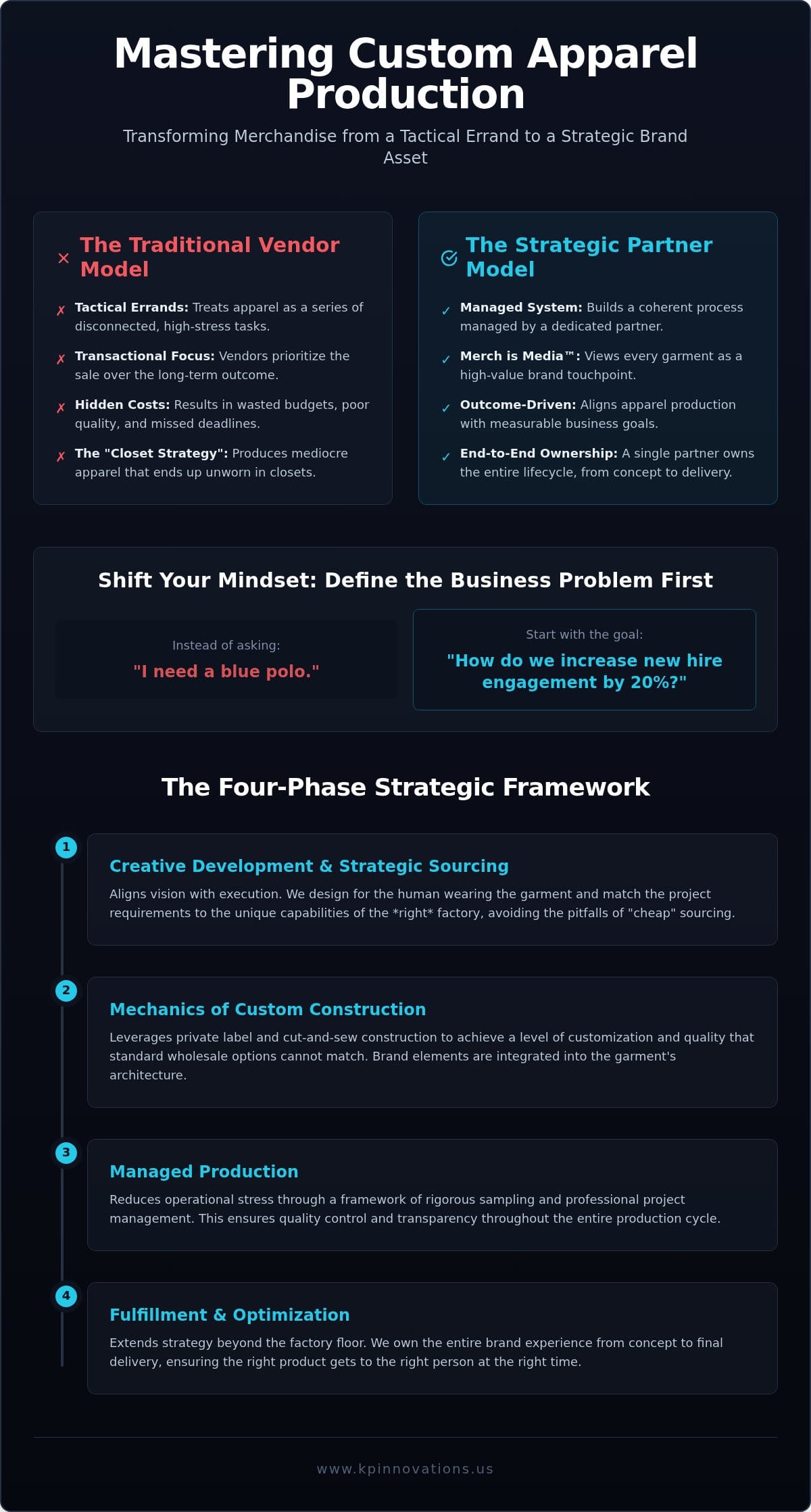
Production isn’t just about needles, thread, and fabric. It’s a strategic system designed to influence your brand’s culture and external reputation. Most companies treat the custom apparel production process as a series of disconnected manufacturing events. They select a garment, apply a logo, and hope for the best. We call this the “Closet Strategy.” You order thousands of items only to have them sit in a back room, collecting dust because nobody actually wants to wear them. That isn’t a production success; it’s a failure of foresight.
At KP Innovations, we operate under the Merch is Media™ philosophy. Every garment you produce is a high-value touchpoint. It’s a piece of media that communicates your brand’s standards to employees, clients, and the public. To ensure your investment actually works, you need a Chief Swag Officer. This isn’t just a title. It’s a strategic role that aligns your production efforts with your overarching business goals, ensuring every stitch serves a purpose.
The Failure of the Traditional Vendor Model
Relying on “just another vendor” is a recipe for inconsistency. Traditional promotional distributors focus on the transaction, not the long-term outcome. This often results in mismatched colors, missed shipping deadlines, and a total lack of transparency in the supply chain. When you try to manage the custom apparel production process internally, you face massive hidden costs. Your team spends hours chasing multiple vendors, auditing quality, and fixing logistics errors that shouldn’t have happened in the first place.
Moving from transactional ordering to long-term program management changes the dynamic. You shift from buying individual items to building a managed system. This approach protects your brand identity and ensures that the quality of your apparel matches the quality of your services. You need a partner who owns the entire lifecycle, from the first design sketch to the final delivery at an employee’s doorstep.
Defining the Business Problem Before the Product
Before we discuss fabric weights or decoration methods, we identify the “job” the garment needs to do. Is the apparel intended for a high-stakes employee recognition program? Is it part of a mandatory uniform program that needs to withstand daily wear? Or is it a premium client gift designed to cement a new partnership? The intended use dictates the entire production path, from sourcing the right factory to choosing the most durable construction methods.
We define the business outcome before we ever look at product specs. Instead of asking for a “blue polo,” we start with a goal: “Create a premium welcome experience that increases new hire engagement by 20%.” When the outcome is clearly defined, the technical specifications follow naturally. This ensures the final product isn’t just a piece of clothing, but a strategic tool used to solve a specific operational challenge.
Phase 1: Creative Development and Strategic Sourcing
The first step in a professional custom apparel production process isn’t placing an order. It’s aligning vision with execution. Many brands skip creative development and jump straight to product selection. This is a strategic error. If a garment doesn’t fit well, feel premium, or look modern, it will never be worn. It becomes a liability rather than a piece of media. Creative development ensures that we design for the human being wearing the garment, not just for the logo being printed on it.
Finding the right manufacturing partner is equally critical. Strategic sourcing is the science of matching your specific project requirements to a factory’s unique capabilities. We don’t just look for a factory; we look for the right factory. Chasing “cheap” sourcing is often the most expensive mistake a brand can make. Lower unit costs frequently hide poor labor standards, inconsistent fabric quality, and high defect rates. These hidden costs eventually surface as late shipments and damaged brand reputations.
Designing for Brand Longevity
Sophisticated brand experiences aren’t built on “logo-slapping.” Real impact comes from integrating brand elements into the garment’s architecture. This might mean custom neck tapes, branded zipper pulls, or unique fabric blends that reflect your company’s identity. We ensure the design is feasible for mass production without losing its aesthetic appeal. A design that looks great on a screen but fails during the custom apparel production process is a waste of resources. Our goal is to create items that employees and clients reach for in their closets every single day.
The Sourcing Matrix: Ethics, Quality, and Capacity
We evaluate factories using a rigorous matrix that goes far beyond price per unit. Transparency in the supply chain is non-negotiable. Your brand can’t afford the risk of unethical labor practices or environmental violations. We prioritize:
- Compliance and Ethics: Verifying factory certifications and labor standards.
- Quality Control: Ensuring consistent fabric weights and decoration precision.
- Production Capacity: Balancing lead times with your specific distribution needs.
Building a reliable program requires a partner who understands these complexities. If you are ready to move beyond basic vendors, our team can help you navigate strategic sourcing to protect your brand and your budget.
Phase 2: The Mechanics of Custom Construction
The custom apparel production process moves from high-level strategy into the tangible mechanics of garment construction. This is where your brand identity is literally woven into the product. To achieve a premium result, we rely on a Tech Pack. Think of this as the architectural blueprint for your apparel. It contains every measurement, stitch type, and fabric specification required to ensure the factory produces exactly what we designed. Without a detailed Tech Pack, you’re leaving your brand quality to chance.
Choosing the right construction method depends entirely on your specific goals. For many, Private Label Apparel offers the perfect balance of customization and efficiency. It allows you to take high-quality blank canvases and re-engineer them to feel like your own. However, when you require total creative control over every seam, panel, and fabric weight, cut and sew manufacturing is the answer. This method allows for proprietary fits and unique blends that standard wholesale options simply cannot provide.
Private Label: Building Your Brand From the Ground Up
Building a brand means owning the small details. Private label production goes beyond a simple logo application. It involves customizing neck labels, hangtags, and even the “hand feel” of the fabric. We curate specific fabric blends to ensure the garment feels expensive and durable. Whether it’s a custom-dyed pantone match or specialized hardware like branded zippers, these elements reinforce the idea that Merch is Media™. A proprietary fit ensures that your team feels confident, turning a simple shirt into a strategic tool for brand elevation.
The Software Layer: Managing Data and Rosters
Operational headaches often stem from poor data management. Spreadsheets are the enemy of a successful custom apparel production process. When managing complex uniform programs, the margin for error is slim. We use a sophisticated software layer to manage employee rosters, sizing data, and personalization requirements. This ensures that every production file is error-free before it ever hits the factory floor. By centralizing this data, we eliminate the stress of manual tracking and ensure that every individual receives exactly what they need, properly fitted and perfectly branded.
Phase 3: The 5 Steps of Production Management
Production management isn’t a linear checklist; it’s a rigorous framework designed to protect your brand’s investment. Once the strategy and construction methods are finalized, the custom apparel production process enters the execution phase. This is where many internal teams lose control, drowning in vendor communications and logistics hurdles. A strategic agency manages this system to ensure that the final product matches the initial vision without compromise.
Our production management framework follows five critical steps to maintain excellence:
- Step 1: Prototyping and Sampling – Creating the “First Article” to verify fit, color, and construction.
- Step 2: Bulk Production – Monitoring the factory floor during the cut, sew, and assembly phases.
- Step 3: Decoration Excellence – Executing the design through screen printing, embroidery, or specialized technical applications.
- Step 4: Quality Control – Implementing AQL (Acceptable Quality Level) standards to ensure every unit meets the benchmark.
- Step 5: Final Audit – A final inspection before the goods are packed for fulfillment.
Prototyping: Eliminating Risk Before Bulk
Skipping the physical sample phase is the fastest way to invite disaster. You can’t judge the “hand feel” of a fabric or the drape of a proprietary fit through a digital mockup. During sample review, we scrutinize fit accuracy, color vibrancy, and the durability of the seams. This phase allows us to make micro-adjustments before the factory commits to thousands of units. The Golden Sample serves as the final, binding contract for quality between the brand and the factory floor.
Quality Assurance vs. Quality Control
It’s vital to distinguish between prevention and detection. Quality Assurance (QA) is the system we put in place to prevent errors from happening, such as auditing factory certifications and verifying Tech Packs. Quality Control (QC) is the actual check that finds errors after production. We implement rigorous inspection points at both the factory and the warehouse levels. This two-tiered approach allows us to handle production variances proactively, ensuring that your brand standards remain uncompromised even when manufacturing challenges arise.
If you’re tired of managing these complexities alone, it’s time to leverage our expertise in strategic sourcing to ensure your next production run is flawless.
Phase 4: Beyond the Box—Fulfillment and Optimization
You’ve spent weeks perfecting the design and construction. The garments are finished. But if they sit in boxes in your office hallway, the strategy has failed. The custom apparel production process only reaches its conclusion when the product is in the user’s hands. Professional fulfillment and logistics transform a manufacturing event into a seamless brand experience. By integrating your production with online company stores, you provide on-demand access that empowers your team and eliminates the need for internal inventory management.
We measure the success of an apparel program with the same rigor as a digital marketing campaign. By tracking adoption rates and sentiment within your team, we turn physical items into quantifiable assets. This data-driven optimization ensures that your merchandise investment isn’t just a cost center; it’s a strategic lever for brand growth. When every delivery is managed through a professional system, you protect the “Merch is Media™” investment from the factory floor to the front door.
The Closet Is Not a Fulfillment Strategy
Many organizations fall into the trap of self-storing apparel in a spare room or a hallway closet. This creates an operational nightmare where marketing or HR teams spend their valuable time packing boxes and chasing tracking numbers. It’s a waste of talent and often leads to a poor recipient experience. Professional warehousing and global distribution ensure that every delivery feels intentional and “white-glove.” Whether it’s a single shirt for a new hire or thousands of units for a global event, the delivery should reflect the same quality as the garment itself. We believe that how a person receives their apparel is just as important as the apparel itself.
Continuous Program Optimization
A strategic approach means your program never actually “ends.” Instead, it evolves based on real-world usage. We use data from your recognition programs and direct employee feedback to inform the next production cycle. Did the team prefer the lightweight French terry or the heavier cotton fleece? Is the fit working for your diverse workforce? This feedback loop allows us to refine fabric choices, styles, and decoration methods over time.
You move from running one-off projects to managing a sophisticated merchandise ecosystem. This transition allows for better inventory forecasting and more efficient production runs. By gathering feedback and analyzing retention metrics, we ensure your apparel program continues to influence culture and loyalty long after the first box is opened. It’s about building a sustainable system that gets better with every order.
Turn Your Apparel into a Strategic Asset
Mastering the custom apparel production process requires moving beyond the mindset of a simple buyer and stepping into the role of a brand architect. By prioritizing creative development and rigorous production management, you ensure that every garment serves a specific business outcome. We’ve explored how a managed system eliminates the “closet strategy” and turns physical items into high-value media that employees actually want to wear.
KP Innovations provides the strategic expertise you need to own the entire merchandise lifecycle. Based in Horsham, PA, our team is trusted by top companies nationwide to manage over 1.2 million products with white-glove precision. We don’t just order shirts; we build ecosystems that influence culture and drive loyalty. It’s time to stop managing vendors and start building a partnership that reflects your brand’s true quality.
Let’s Build a Strategic Apparel Program Together and transform your merchandise into a powerful marketing investment today.
Frequently Asked Questions
How long does the custom apparel production process typically take?
The timeline for the custom apparel production process depends on the level of customization required. Standard decorated blanks typically ship within two to four weeks. However, high-touch private label or cut and sew projects usually require eight to sixteen weeks. This includes phases for creative development, sampling, and bulk manufacturing. We recommend starting your strategy at least one quarter before your target launch date to ensure every detail is managed without stress.
What is a Tech Pack and why is it necessary for my brand?
A Tech Pack is a comprehensive architectural blueprint for your garment. It contains precise measurements, fabric weights, color codes, and stitching instructions. This document is necessary because it removes ambiguity from the manufacturing process. Without a Tech Pack, factories are forced to guess your specifications, which leads to inconsistent quality and costly errors. We use these documents to ensure that the final product matches your brand’s specific standards every time.
What are the minimum order quantities (MOQs) for private label apparel?
Minimum order quantities for private label apparel vary based on the complexity of the garment and the specific factory’s requirements. Generally, custom production runs start between 144 and 500 units per style. These thresholds exist because factories must calibrate machinery and source specific fabric dyes for your project. While higher volumes often reduce the per-unit cost, we help you balance these quantities against your actual distribution needs to avoid wasted inventory.
Should we choose cut and sew or use premium blanks for our program?
The choice depends on your brand goals and timeline. Cut and sew offers total creative control over every seam and proprietary fit, making it ideal for unique brand identities. Premium blanks are a strategic choice when you need faster turnaround times without sacrificing quality. We evaluate your business problem first to determine if the “job” of the garment requires a ground-up build or a high-quality re-engineered blank.
How do you ensure quality consistency across a large bulk order?
We ensure consistency by implementing rigorous AQL (Acceptable Quality Level) standards at multiple inspection points. This process begins with the “Golden Sample,” which serves as the contract for bulk production. Our team monitors the factory floor during the assembly phase and conducts a final audit before fulfillment. By managing the entire system rather than just placing an order, we identify and correct variances before the product ever reaches your team or your warehouse.
Can you manage global fulfillment for our custom apparel?
Yes, our capabilities include global fulfillment and logistics management. We believe the custom apparel production process isn’t finished until the garment is delivered to the end-user. Our system integrates with online company stores to provide on-demand access for your international teams. This approach eliminates the operational headache of internal shipping and ensures a consistent brand experience for every employee, regardless of their physical location in the world.
What is the difference between screen printing and embroidery for custom apparel?
Screen printing uses ink to create vibrant, large-scale graphics with a soft hand feel, making it perfect for t-shirts and casual wear. Embroidery uses thread to create a textured, high-status look that is exceptionally durable. We often recommend embroidery for outerwear and professional uniforms where longevity is a priority. The right choice depends on the garment’s fabric weight and the specific brand experience you want to create for the recipient.
How does a Chief Swag Officer improve the production process?
A Chief Swag Officer shifts your program from transactional ordering to strategic brand management. Instead of you managing multiple vendors and logistics errors, this dedicated partner owns the entire process from concept to delivery. They ensure your apparel aligns with business goals like employee retention or client loyalty. This model reduces your operational stress and guarantees that your merchandise investment is measured with the same rigor as any other marketing channel.