
If your current strategy for custom keychains for business involves ordering the cheapest plastic option from a massive online catalog, you’re not just wasting money; you’re actively devaluing your brand. Most companies treat these items as throwaway giveaways, but we believe that Merch is Media™. A keychain shouldn’t be a generic trinket. It’s a high-frequency brand touchpoint that earns a permanent place in a user’s life through strategic design and intentionality.
You’ve likely felt the frustration of seeing your marketing budget end up in a junk drawer or a trash can. It’s overwhelming to navigate a sea of low-quality vendors, especially when you lack the internal design expertise to make a simple item feel premium. You need a partner who understands that every physical item you distribute is an extension of your brand’s reputation and a tool for building culture.
This article will teach you how to move beyond cheap giveaways and leverage custom keychains as strategic assets that drive real loyalty. We’ll help you identify styles that people actually want to carry, explain the ROI of high-frequency touchpoints, and show you why the Chief Swag Officer model is the most effective way to manage the strategy rather than just the order.
Key Takeaways
- Stop viewing merchandise as a cost center and learn how low-quality items create negative brand experiences that drive users to discard your investment.
- Discover why custom keychains for business are unique high-frequency media assets that offer more consistent brand exposure than traditional digital advertising.
- Learn to design for the “Everyday Carry” mindset by prioritizing minimalist aesthetics and premium materials that users actually want to keep on their person.
- Shift from a vendor-based ordering system to a managed merchandise strategy that treats physical assets with the same rigor and fulfillment precision as any other marketing channel.
Why Your Business Keychains Are Ending Up in the Junk Drawer
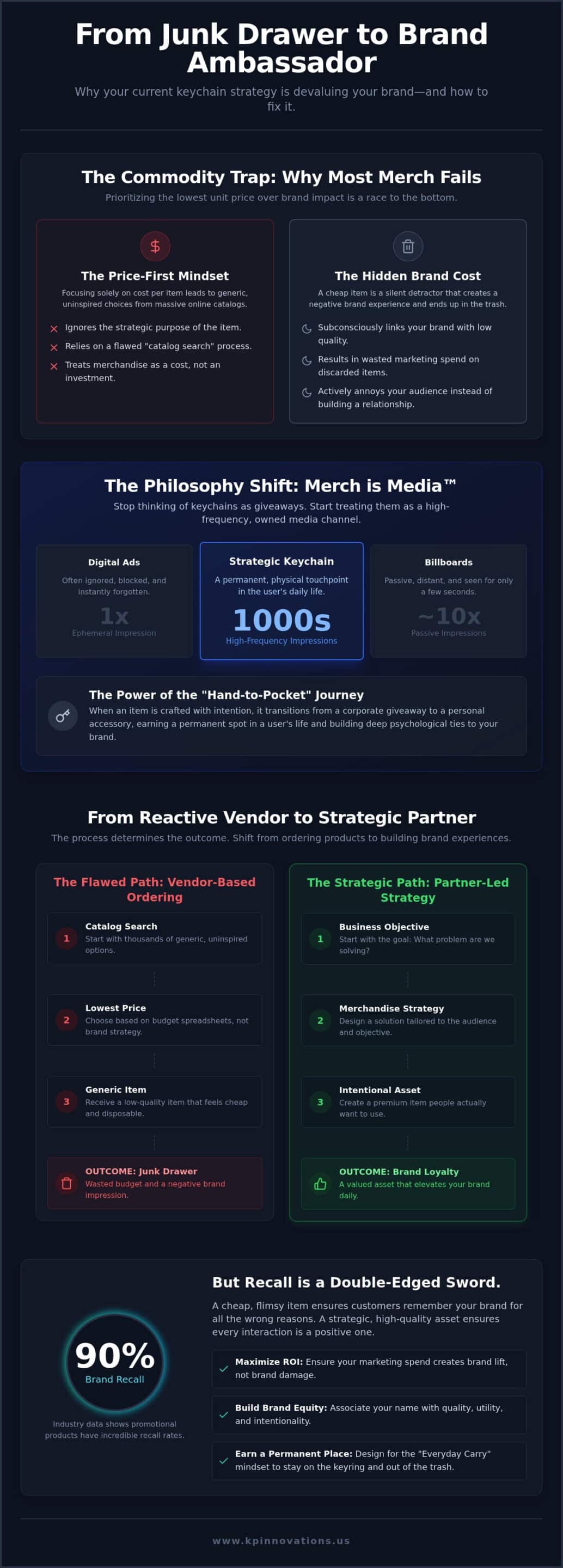
Most organizations fall into the “Commodity Trap.” This happens when procurement teams prioritize the lowest price per unit over the ultimate purpose of the item. When you select custom keychains for business based solely on a budget spreadsheet, you aren’t saving money. You’re likely funding a future trip to the local landfill. This race to the bottom ignores the fact that every physical asset you distribute carries the weight of your brand’s reputation.
Low-quality merchandise creates a friction-filled brand experience. If a client receives a keychain that snaps within a week or features a blurred logo, they subconsciously associate that lack of durability with your core services. This “trash swag” carries a heavy brand cost. It signals that your company doesn’t value quality or detail. Instead of a bridge to a relationship, the item becomes a liability that clutters lives and damages the environment. True brand equity is built through items that people actually want to use, not just items you can afford to give away.
The Hidden Cost of “Cheap” Merchandise
A poorly made item is a silent detractor. While industry data suggests that 90% of consumers remember a brand’s name after receiving a promotional product, that recall is a double-edged sword. If the item is flimsy, the brand perception drops. You’re effectively paying to annoy your audience. This results in significant wasted marketing spend on inventory that never leaves the storage closet or, worse, never leaves the box before being discarded. Every physical item you distribute is a high-stakes brand statement. There’s no neutral merchandise; it either elevates your brand or erodes it.
Moving From Vendor to Strategic Partner
The traditional “catalog search” is a flawed starting point for any campaign. Scrolling through thousands of identical options leads to decision fatigue and uninspired choices. This is why we advocate for an outsourced merchandise department model. Rather than acting as a simple vendor, a strategic partner begins with your business objectives. Strategy-first sourcing ensures that the final product isn’t just something you can put a logo on, but a tool designed to solve a specific challenge. Whether it’s increasing employee retention or improving client recall, the strategy must dictate the product, not the other way around. By treating custom keychains for business as a serious media investment, you ensure they stay on the keyring and out of the trash.
Keychains as Cultural Currency: Applying the Merch is Media™ Philosophy
We view every piece of merchandise as a media channel. This is the core of our Merch is Media™ philosophy. A keychain isn’t just a tool for organization; it’s a broadcast device. Every time a client or employee reaches for their keys, your brand is present. This creates a level of intimacy that a billboard or a social media ad can’t replicate. While digital ads are often ignored or blocked, a physical asset that provides utility earns a permanent spot in the user’s personal environment.
Successful custom keychains for business follow a specific “hand-to-pocket” journey. If the design is clunky or the material feels cheap, the item never leaves the office. It ends up in a desk drawer or the trash. However, if it’s crafted with intention, it enters the user’s personal space and becomes part of their daily identity. This transition from a corporate giveaway to a personal accessory is where true brand loyalty is forged. Finding the right balance of utility and aesthetics requires a strategic approach to sourcing that prioritizes impact over unit price.
The Science of High-Frequency Touchpoints
Consider the “impressions” metric. Most people interact with their keys multiple times every single day. Whether they’re leaving for work, returning home, or running errands, your brand is physically in their hand. Research shows that 90% of consumers who receive a promotional product remember the brand’s name. By providing a high-frequency touchpoint, you’re building deep psychological ties through constant proximity. This physical presence builds a sense of reliability and familiarity that digital channels simply can’t match. It’s a long-term investment in brand recall that pays dividends every time the user touches their keys.
Building Brand Experiences, Not Just Products
Keychains can also serve as powerful tools for influencing internal company culture. They shouldn’t be handed out randomly. Instead, use them to mark significant employee milestones or achievements. A promotion or a five-year anniversary is a significant event, and a custom asset can serve as a physical anchor for that memory. By integrating these items into recognition programs, you improve employee retention and foster a genuine sense of belonging. The item becomes a badge of honor, telling a story about your company’s values and its commitment to its people. When custom keychains for business are used as part of a broader strategy, they transform from simple utility into cultural currency that reinforces your brand’s mission every day.
Strategic Material Selection: Choosing the Right Medium for Your Message
Material selection is often treated as an afterthought. In reality, the material is the message. This is tactile branding. When you distribute custom keychains for business, the physical texture communicates your brand’s standards before the user even looks at the logo. A lightweight, brittle plastic piece feels disposable. A weighted metal or supple leather piece feels like a gift. If you want your merchandise to be viewed as a strategic asset, you must choose a medium that reflects your brand’s weight.
Durability is the foundation of any long-term media asset. If the item breaks, your “broadcast” ends. We’re also seeing a rise in tech-integrated options. Using NFC (Near Field Communication) chips allows a simple keychain to become a digital bridge. One tap can lead a client to a personalized video, a secure portal, or a digital business card. This turns a traditional tool into a smart asset that provides ongoing utility beyond just holding keys.
Metal and Enamel: The Standard for Durability
Metal offers a sense of permanence. The subconscious mind associates weight with value. When choosing enamel, the distinction between hard and soft enamel matters. Hard enamel is polished flat, creating a jewelry-quality finish that resists scratching. Soft enamel has recessed areas, offering a tactile, 3D feel that’s often more vibrant.
Industries like aviation and automotive gravitate toward heavy-duty metal. In these sectors, precision and strength are core values. A rugged, die-struck metal keychain reinforces those traits every time a pilot or driver handles their keys. It isn’t just merchandise. It’s a reflection of the machine it unlocks.
Leather and Fabric: The “Lifestyle” Approach
Leather provides a sophisticated, professional aesthetic. It’s the ideal choice for financial services or consulting firms aiming for a luxury feel. Leather ages with the user, becoming a personal artifact rather than a corporate handout. It feels natural in a professional setting and aligns with high-tier brand positioning.
Alternatively, the “flight tag” style, which is embroidered or woven fabric, has become a staple for tech and SaaS companies. These tags are lightweight and won’t scratch other items in a pocket. This is essential for the “Everyday Carry” (EDC) mindset. Modern professionals curate what they carry. If your custom keychains for business don’t integrate seamlessly into their daily setup, they won’t be used. Fabric and leather offer the flexibility and comfort needed to stay on the keyring for years.
Designing for the “Everyday Carry”: Ensuring Your Brand Stays on the Ring
Modern professionals are highly selective about their “Everyday Carry” (EDC). This subculture focuses on the specific tools and accessories a person chooses to keep on them at all times. If your custom keychains for business are bulky, poorly weighted, or overly loud in their branding, they fail the EDC test. Your goal is to earn a permanent spot on that keyring by respecting the user’s personal aesthetic and physical space. People don’t want neon gimmicks or low-quality plastic; they want items that complement their professional identity.
Minimalism is the key to high-impact design. While a typical vendor might suggest larger logos or distracting colors, we prioritize a “less is more” philosophy. A subtle, debossed logo on premium metal or leather creates an air of sophistication. It invites questions rather than shouting for attention. When your merchandise looks like a high-end retail product, people are proud to carry it. This aesthetic appeal ensures your brand remains a constant companion in their daily life, balancing visibility with true style.
The “Chief Swag Officer” Approach to Design
Internal design teams are often experts at digital layouts or print ads, but they may lack the specific engineering knowledge required for physical product development. This is where creative development becomes essential. Designing a functional asset involves understanding how materials interact, how weight affects the hang of a key ring, and how the item will wear over time. We don’t just slap a logo on a catalog item. We engineer a product that people genuinely love to use.
Functionality That Drives Retention
Utility is a massive driver of long-term retention. A keychain that doubles as a bottle opener, a hex wrench, or a heavy-duty carabiner has a significantly higher chance of staying in use for years. A multi-tool keychain offers a higher ROI than a simple plastic tab because it solves a recurring problem, ensuring your brand is the hero in small, everyday moments.
In the real estate industry, successful professionals use utility keychains to stay top-of-mind long after the closing. By providing a tool that helps with small home repairs or opens a celebratory drink, the agent remains a helpful presence in the client’s life. This ongoing utility transforms a simple gift into a strategic referral engine. To begin building your own functional brand assets, you need a partner who can manage the strategic sourcing of premium materials and innovative designs.
Beyond the Order: A Managed Merchandise Strategy
Many organizations treat the purchase of custom keychains for business as the finish line. In reality, the procurement of the item is only the beginning of its lifecycle as a brand asset. The most common operational failure we see is the “closet strategy.” This occurs when boxes of premium merchandise sit in a storage room, gathering dust because there is no clear plan for distribution. The closet is not a fulfillment strategy. It is a graveyard for marketing capital.
To turn these items into strategic assets, you need a managed system that handles everything from warehousing to global distribution. An outsourced merchandise department treats your physical branding with the same operational rigor as your digital infrastructure. By moving beyond a simple transactional model, you ensure that every item you invest in actually reaches its intended recipient in a professional, timely manner.
Streamlining Logistics for Global Teams
Managing remote or international teams introduces a complex layer of logistics headaches. Taxes, duties, and customs can quickly turn a simple gift into a frustrating experience for the recipient. Leveraging global fulfillment services allows you to bypass these hurdles. We maintain your inventory in strategic locations, ensuring that a new hire in London receives their welcome package with the same ease as a team member in Philadelphia. This level of precision is essential for scaling employee programs without overwhelming your internal operations or HR teams. Warehousing prevents inventory loss and ensures that your brand assets are always ready for deployment.
Measuring the Impact of Your Merch
We believe that merchandise should be measured with the same scrutiny as any other marketing channel. By utilizing company stores, you can decentralize the ordering process while maintaining absolute control over brand standards and budget. This allows regional managers or department heads to order exactly what they need, reducing waste and inventory loss.
Advanced tracking methods, such as unique QR codes or NFC chips integrated into custom keychains for business, allow you to monitor real engagement. You can see how often a digital business card is accessed or how many users visit a specific landing page via their physical asset. This data-driven approach transforms a “giveaway” into a measurable media investment. It is time to stop buying stuff and start building a brand. Talk to a Chief Swag Officer today to see how we can manage your entire merchandise lifecycle.
Transforming Utility into Brand Legacy
Investing in custom keychains for business requires a fundamental shift from a transactional mindset to a strategic one. You’ve seen how the right materials and an “Everyday Carry” design philosophy can turn a simple tool into a permanent brand ambassador. When you treat your merchandise as a high-frequency media channel, you stop wasting budget on items that end up in the trash and start building real cultural currency.
At KP Innovations, we don’t just fill orders; we manage your entire merchandise lifecycle. With access to over 1.2 million strategic products and a dedicated Chief Swag Officer to guide your creative development, we ensure every asset serves a specific business purpose. Our global fulfillment and logistics team manages everything end-to-end. Your brand makes an impact anywhere in the world without adding stress to your internal operations. It’s time to move beyond the commodity trap and start treating your physical assets with the rigor they deserve.
Elevate Your Brand Experience with KP Innovations and discover what happens when your merchandise truly speaks for your brand.
Frequently Asked Questions
Why should my business choose custom keychains over other promotional items?
Custom keychains for business offer a unique advantage through their high-frequency utility. Unlike a notebook that stays on a desk or a garment worn occasionally, keys are a constant daily companion. This ensures your brand earns a permanent place in a user’s personal environment. By choosing a functional item that integrates into the “Everyday Carry” mindset, you create consistent brand exposure that traditional digital channels or static advertisements simply cannot match.
What materials are most durable for a long-term brand presence?
For a long-term brand presence, die-struck metal and hard enamel are the gold standards for durability. These materials withstand daily friction and environmental wear without losing their aesthetic appeal. Premium leather is another excellent choice; it ages gracefully and develops a unique character over time. Selecting these high-grade materials ensures your merchandise remains a functional asset for years, rather than becoming a disposable item that ends up in a landfill.
How do I ensure my keychains don’t look like cheap giveaways?
Avoiding a “cheap” look requires focusing on retail-quality design and tactile branding. Prioritize minimalism by using a subtle, debossed logo rather than an oversized, colorful print. The physical weight of the item also signals value; heavier metal pieces are subconsciously perceived as more premium. By partnering with a strategic agency that understands product engineering, you can create custom keychains for business that feel like a high-end gift rather than a generic promotional giveaway.
Can custom keychains be used for employee recognition programs?
Keychains are ideal tools for marking specific employee milestones and achievements. Instead of a generic certificate, a custom-engineered asset serves as a physical anchor for a promotion or a five-year anniversary. When integrated into structured recognition programs, these items become badges of honor that foster a sense of belonging. They provide a daily reminder of the individual’s value to the organization, reinforcing your internal culture every time they reach for their keys.
What is the “Merch is Media™” philosophy and how does it apply here?
The “Merch is Media™” philosophy treats physical products as powerful broadcast tools rather than just giveaways. In this framework, a keychain is a media channel that influences culture and relationships through constant presence. It earns a spot in the user’s life by providing utility while simultaneously communicating your brand’s mission and values. This strategic approach ensures that every physical item you distribute is measured with the same rigor as any other marketing investment.
How does KP Innovations handle global distribution for my merchandise?
KP Innovations manages global fulfillment through a sophisticated logistics network that handles taxes, duties, and customs end-to-end. We maintain your inventory in strategic global hubs, ensuring that a remote employee in Europe receives the same high-touch experience as one in North America. This white-glove project management removes the operational headache of international shipping, allowing your brand to scale its merchandise programs efficiently across multiple borders without internal friction.
What is the benefit of a managed company store for my brand assets?
A managed company store allows you to decentralize the ordering process while maintaining absolute control over brand standards. Regional managers or department heads can order exactly what they need, which significantly reduces inventory loss and waste. This system treats your merchandise as a scalable asset, ensuring that every piece of physical branding is used intentionally and tracked with precision. It transforms a chaotic ordering process into a streamlined, strategic operation.
How long does the strategic sourcing and production process usually take?
The timeline for strategic sourcing and production depends on the level of deep-level customization required for your specific project. Because we manufacture from the ground up rather than just pulling off-the-shelf items, we prioritize quality and precision over rushed delivery. Your dedicated Chief Swag Officer manages every phase of the process, from creative development to final fulfillment. This ensures that the final outcome meets your strategic objectives and arrives exactly when your brand needs it.