
The corporate closet is where expensive marketing budgets go to die. Most organizations treat custom backpacks for business as a simple line item, yet they wonder why their gear ends up buried in a storage room rather than being worn with pride by a global team. If your current strategy involves crossing your fingers that a logo doesn’t peel or look cheap, you aren’t managing a brand; you’re just accumulating inventory.
We understand the logistical nightmares of shipping to a remote workforce and the sting of seeing low-quality applications fail to reflect your premium positioning. You deserve a partner that treats your merchandise with the same rigor as your most important marketing investments. This guide will teach you how to transform simple storage items into strategic brand assets that drive culture and measurable loyalty.
We’ll explore how to navigate the 2026 textile tariffs and the shift toward quiet utility design. You’ll discover a streamlined process from design to global delivery that ensures your team feels proud to wear your brand in public. It’s time to stop buying swag and start leveraging the Merch is Media™ philosophy to elevate your organization’s internal and external impact.
Key Takeaways
- Discover how the Merch is Media™ philosophy transforms carry-gear into high-impact mobile media placements that drive culture and loyalty.
- Learn to solve the “closet problem” by selecting functional, high-utility designs that employees feel proud to wear in professional and public settings.
- Master the strategic selection of custom backpacks for business by aligning product specifications with specific employee use-cases and global travel requirements.
- Streamline your international logistics with a managed fulfillment lifecycle that eliminates the friction of shipping gear to a remote or global workforce.
- Understand why adopting the Chief Swag Officer™ model allows you to outsource the operational burden while maintaining strategic control over your brand experience.
Why Your Current Backpack Strategy Is Just a Storage Problem
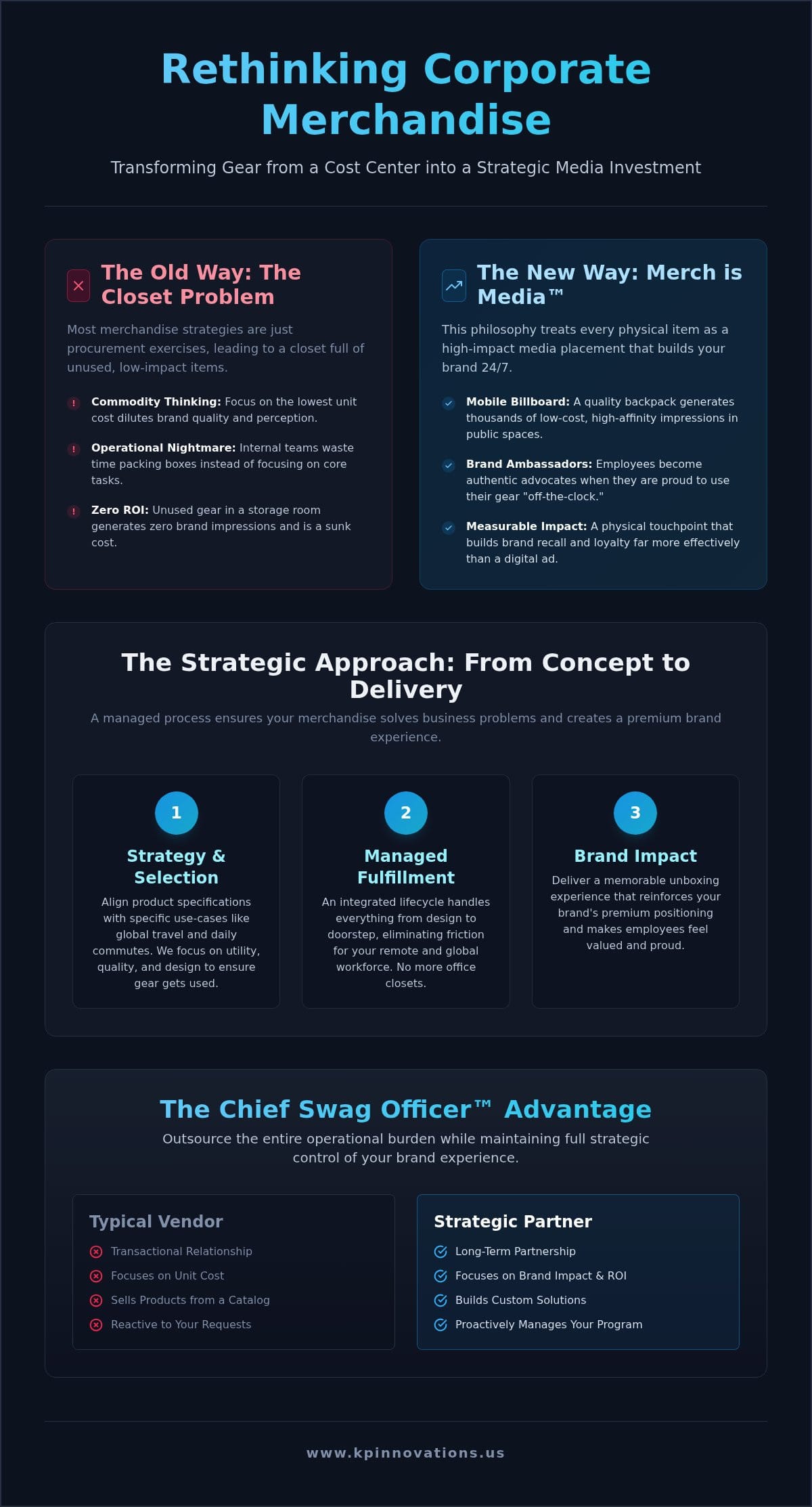
The average corporate storage room is a graveyard of good intentions. Most organizations treat custom backpacks for business as a simple procurement exercise, focusing on the lowest unit cost rather than the long-term impact. This commodity mindset creates a “closet problem” where expensive gear sits in boxes, collecting dust instead of generating brand impressions. When you view merchandise as a line item to be checked off, you miss the opportunity to solve real business problems like employee retention, client loyalty, and brand visibility.
Merchandise is not just “stuff.” It’s a strategic tool. If your gear isn’t being used, it isn’t working. To drive culture, you must move beyond the transactional vendor model. You need a partner who understands that every item you distribute is a reflection of your brand’s standards and ambitions. We help you identify the specific challenges your organization faces, whether it is welcoming a global remote workforce or rewarding high-performers, and use physical products as the solution.
The Failure of Commodity Thinking
Choosing a backpack based solely on the cheapest price point is a recipe for brand dilution. If an employee receives a bag that feels flimsy or looks cheap, they won’t use it in their daily life. This creates a negative psychological loop. It tells your team that your brand doesn’t value quality or their personal comfort. Understanding different Backpack designs and types is essential because a bag that fails to meet the functional needs of a modern professional will never leave the house. Low-quality merchandise is a direct tax on your brand equity that yields zero return on investment.
The Closet Is Not a Fulfillment Strategy
Storing gear internally is an operational nightmare that drains your team’s productivity. When your marketing or HR departments are busy packing boxes and tracking shipments, they aren’t focusing on their core responsibilities. This manual process is prone to error and creates a poor experience for the recipient. Unmanaged inventory also leads to branding drift. Bags with old logos or outdated messaging often linger in the back of the closet, waiting to be accidentally sent to a new hire.
A professional approach requires integrated fulfillment services that manage the entire lifecycle of your gear. By outsourcing these logistics, you ensure that every employee receives their gear on time, regardless of their location. This moves your merchandise from a logistical burden to a managed asset that scales with your company’s growth. Stop letting your brand’s physical presence be limited by the size of your office closet.
Merch is Media™: The Backpack as a Mobile Brand Experience
Every physical item your company distributes is a media placement. This is the foundation of our Merch is Media philosophy. When you invest in custom backpacks for business, you aren’t just buying luggage. You’re purchasing a mobile billboard that represents your brand’s values in every airport lounge, coffee shop, and subway car it enters. Unlike a digital ad that is scrolled past in seconds, a high-quality backpack remains in circulation for years, generating thousands of low-cost, high-affinity impressions.
Research confirms the effectiveness of promotional products in building brand recall and influencing consumer behavior. A backpack is particularly potent because it travels. It moves from the private sphere of the home to the public sphere of the commute, acting as a constant endorsement from the wearer. This isn’t just about visibility; it’s about the quality of the association. A premium bag suggests a premium company. It serves as a durable physical touchpoint that gives a tangible presence to even the most abstract digital brands.
Turning Employees into Brand Ambassadors
The “commuter effect” is a powerful tool for brand growth. In high-traffic urban environments, a single well-designed bag can be seen by hundreds of potential clients or recruits every day. When employees feel proud of their gear, they use it “off-the-clock” during weekend trips or gym visits. This extended exposure turns your workforce into a team of authentic brand ambassadors. They carry your narrative into spaces traditional advertising cannot reach, making your brand a natural part of their daily lifestyle.
Creating a Consistent Brand Narrative
Your merchandise should never be an afterthought. It must align with your broader marketing and PR strategy to tell a unified story of reliability and excellence. Using backpacks to tell a story of quality ensures that your brand’s first physical interaction with a client or new hire is one of substance. It reinforces your commitment to excellence through a tool they will use and appreciate daily.
Achieving this level of impact requires more than just picking a bag from a catalog. It demands a strategic approach to sourcing the right materials and designs that resonate with your specific audience. By treating your carry-gear as a vital media channel, you ensure that every dollar spent on merchandise contributes to long-term brand equity and stronger professional relationships.
Engineering the Perfect Carry: Use-Case Driven Selection
Selecting custom backpacks for business requires more than a cursory glance at a catalog. It demands a technical analysis of how the end-user moves through their professional life. A daily commuter navigating metropolitan transit has different requirements than a global executive traveling through international terminals; to see how premium engineering meets these demands, you can check out ALEON. We analyze these movements to recommend specific features like TSA-friendly laptop sleeves, RFID-blocking security pockets, and ergonomic harness systems. The goal is to provide a tool that solves a specific carry problem rather than just adding another bag to their collection.
The decision between co-branding with retail giants like Tumi or The North Face and developing a private label solution is a strategic one. Retail co-branding leverages existing consumer trust and prestige, creating an immediate association with established quality. Private label manufacturing offers deep-level customization that retail brands cannot match. This ground-up approach allows for unique pocket configurations, specific material choices, and integrated brand signatures that are woven into the product’s DNA. As of 2026, 62% of consumers prefer merchandise made from recycled or eco-friendly materials, making the choice of sustainable fabrics like rPET a vital part of your brand narrative.
Technical features must align with the modern digital workflow. In 2026, quiet utility is the dominant design trend. This means moving away from overly tactical exteriors in favor of clean, minimalist aesthetics with hidden organizational systems. Features like weight sensors or smart security tags are becoming standard for premium programs. We help you navigate these technical specifications to ensure your gear remains relevant and functional in a rapidly evolving corporate environment.
First impressions are permanent. A well-designed onboarding kit sets the tone for a new hire’s entire tenure. We focus on balancing utility with brand pride, ensuring the bag is a tool they actually use for daily office tasks. By integrating these into your employee programs, you transform a simple gift into a cultural cornerstone. It demonstrates that your organization values quality and supports their daily professional needs from day one.
The Executive and High-Value Client Gift
High-value relationships demand a higher tier of merchandise. For executive outreach, we prioritize premium materials like full-grain leather or high-density ballistic nylon. Branding should be sophisticated rather than loud. Tonal embroidery or custom-molded metal badges provide a subtle, luxury feel that resonates with high-level decision-makers. These items are positioned within our client gifting strategies to ensure they are viewed as genuine appreciation rather than promotional clutter.
From Design to Doorstep: Managing the Fulfillment Lifecycle
Designing custom backpacks for business is only half the battle. The true measure of a program’s success lies in the execution of the fulfillment lifecycle. A premium bag loses its strategic impact if it arrives late, damaged, or caught in a customs bottleneck. We provide white-glove project management that oversees every phase of the journey, from initial sourcing to final doorstep delivery. This level of oversight ensures your marketing and HR teams are freed from the tactical burden of logistics, allowing them to focus on high-level strategy.
Navigating the global supply chain in 2026 requires a deep understanding of shifting trade environments. With new U.S. tariffs impacting textile imports from 60 economies, managing costs and compliance is more complex than ever. We manage these variables for you, ensuring that your production remains on schedule and within budget. By acting as your outsourced merchandise department, we handle the friction of global sourcing so you can maintain a consistent brand experience across every region.
The Global Logistics Challenge
Reaching a remote workforce shouldn’t be a logistical headache. Shipping gear to a global team involves navigating diverse duties and customs regulations that can stall a rollout and frustrate recipients. A centralized fulfillment hub is essential for maintaining brand consistency. By utilizing our fulfillment and logistics expertise, you ensure that an employee in London receives the exact same premium brand experience as a colleague in New York. We eliminate the friction of international distribution, making global scale feel local.
Company Stores for On-Demand Access
Managed company stores eliminate inventory risk by providing a structured platform for on-demand access. This system allows managers to reward high-performing teams or welcome new hires without manual intervention from your internal staff. A standard online shop is merely a transactional interface, whereas a program management system is a strategic engine that governs your brand’s physical presence through automated workflows and data-driven inventory control. It transforms your merchandise from a series of disjointed purchases into a managed corporate asset.
Take the stress out of your next program by sourcing your gear through our managed agency model.
The Chief Swag Officer™ Advantage: Outsourcing Your Merch Department
Your marketing department’s primary objective is to build brand equity and drive revenue. When these high-value professionals spend their time managing inventory and manual logistics, your organization loses its competitive edge. Outsourcing your merchandise department to a strategic partner ensures that your investment in custom backpacks for business is managed with the same rigor as your digital ad spend. We move beyond the transactional vendor relationship to provide a managed system that protects your brand and scales your impact.
Transitioning to a managed system allows for measurable results and improved employee sentiment. Instead of guessing how much unused inventory is sitting in a storage room, you gain access to data-driven insights into distribution and usage. This accountability ensures that every backpack serves as a strategic asset rather than a sunk cost. By treating merchandise as a vital part of the brand experience, you build long-term loyalty that influences both internal culture and external relationships.
Strategic Guidance Over Order Taking
A Chief Swag Officer does more than place orders; they identify strategic opportunities your internal team might overlook. This role involves proactive sourcing and trend forecasting to ensure your gear remains relevant in a rapidly changing market. While standard vendors might just offer a bag from a catalog, a strategic partner anticipates shifts toward sustainable materials like rPET and the “quiet utility” aesthetic before they become industry requirements. This foresight keeps your brand ahead of the curve and ensures your merchandise reflects a sophisticated, forward-thinking culture.
A Managed Approach to Recognition
Integrating premium backpacks into structured recognition programs amplifies their emotional and professional impact. A backpack is a tool for celebrating milestones and reinforcing company values. Professional program management allows you to scale this impact across global teams without increasing your internal administrative workload. It ensures that recognition is consistent, timely, and perfectly aligned with your overall brand narrative.
Your brand deserves more than a vendor who simply fulfills a request. It deserves a strategic agency that owns the entire lifecycle of your merchandise program. By partnering with experts who understand that Merch is Media™, you transform physical products into powerful vehicles for connection and growth. Stop managing products and start managing your brand experience.
Elevating Your Brand Strategy Through Intentional Merchandise
Transitioning from a transactional mindset to a strategic one is the first step in solving the persistent closet problem. By viewing custom backpacks for business as mobile media placements rather than simple storage, you ensure your investment drives both culture and visibility. We’ve discussed how use-case driven selection and global fulfillment remove the operational friction that typically stalls brand growth. It’s time to stop accumulating inventory and start building brand equity through the Merch is Media™ philosophy.
Your team shouldn’t be packing boxes or chasing lost shipments across international borders. With access to 1.2 million premium products and a managed logistics system, your organization can scale its impact without draining internal resources. Every physical touchpoint is an opportunity to reinforce your narrative of quality and reliability. By adopting a managed agency model, you turn everyday tools into powerful engines for long-term loyalty and connection.
Partner with a Chief Swag Officer™ to elevate your brand experience. We’re ready to help you manage the entire lifecycle of your merchandise and ensure your brand impact is measured with the rigor it deserves.
Frequently Asked Questions
How do I choose between a retail brand and a custom-built backpack?
Choosing between a retail brand and a custom-built backpack depends on your strategic goals. Retail brands provide instant prestige through established consumer trust. Custom-built solutions allow for deep-level customization of features and materials. With access to 1.2 million products, we help you navigate this choice by analyzing your brand narrative and end-user needs. Whether you need a recognized name or a unique private label design, we ensure the final product reflects your organization’s high standards.
Can you handle individual shipping to remote employees globally?
We provide comprehensive global fulfillment for remote teams across the world. Our logistics team manages international shipping, duties, and customs regulations to ensure a seamless delivery experience. This eliminates the operational burden on your internal staff and ensures every employee receives their gear regardless of their location. By centralizing distribution through our hub, we maintain brand consistency and provide a white-glove service that reaches your entire workforce without the typical logistical headaches.
What is the minimum order quantity for high-end custom backpacks?
Minimum order quantities are determined by the specific product and the level of customization required for your program. We focus on strategic partnerships where custom backpacks for business are integrated into long-term culture or recognition initiatives. Our model is designed for organizations that need a managed system rather than a transactional vendor. We work with you to establish quantities that support your brand’s growth while minimizing the risk of unused inventory sitting in a closet.
How does a managed company store help with backpack distribution?
A managed company store streamlines distribution by providing an on-demand platform for your team. It removes the need for manual tracking and internal storage of gear. Managers can use the system to reward high-performers or welcome new hires with just a few clicks. This automated approach ensures that your brand’s physical presence is governed by a strategic program management system rather than a series of disjointed, manual tasks that drain your team’s productivity.
What are the most popular backpack features for business travelers in 2026?
The most popular features for business travelers in 2026 focus on quiet utility and seamless tech integration. This includes TSA-friendly laptop sleeves, RFID-blocking security pockets, and hidden organizational compartments. Many premium programs now require sustainable materials like recycled polyester to align with corporate responsibility goals. We prioritize minimalist designs that offer high-functioning utility without an overly tactical appearance. These features ensure the bag remains a valuable tool for professionals navigating high-traffic urban environments.
How do we ensure our logo looks professional on different fabrics?
Lead times for a fully custom-designed program vary based on the complexity of the design and the sourcing requirements. Fully custom projects involve several phases, including creative development, prototyping, and global production. We manage the entire timeline to navigate potential supply chain disruptions and tariff changes. Our goal is to provide a structured, predictable process that ensures your gear is ready for its intended launch, whether for an onboarding program or a major corporate event.
How do you measure the success of a corporate merchandise program?
We apply the Merch is Media™ philosophy to measure success by tracking brand impact and employee sentiment. This involves evaluating the frequency of use, brand recall, and the reduction of operational waste from unused inventory. We move beyond simple order fulfillment to ensure your merchandise drives culture and measurable loyalty. By treating your merchandise program with the same rigor as a traditional marketing investment, we provide the data needed to justify and optimize your brand’s physical presence.