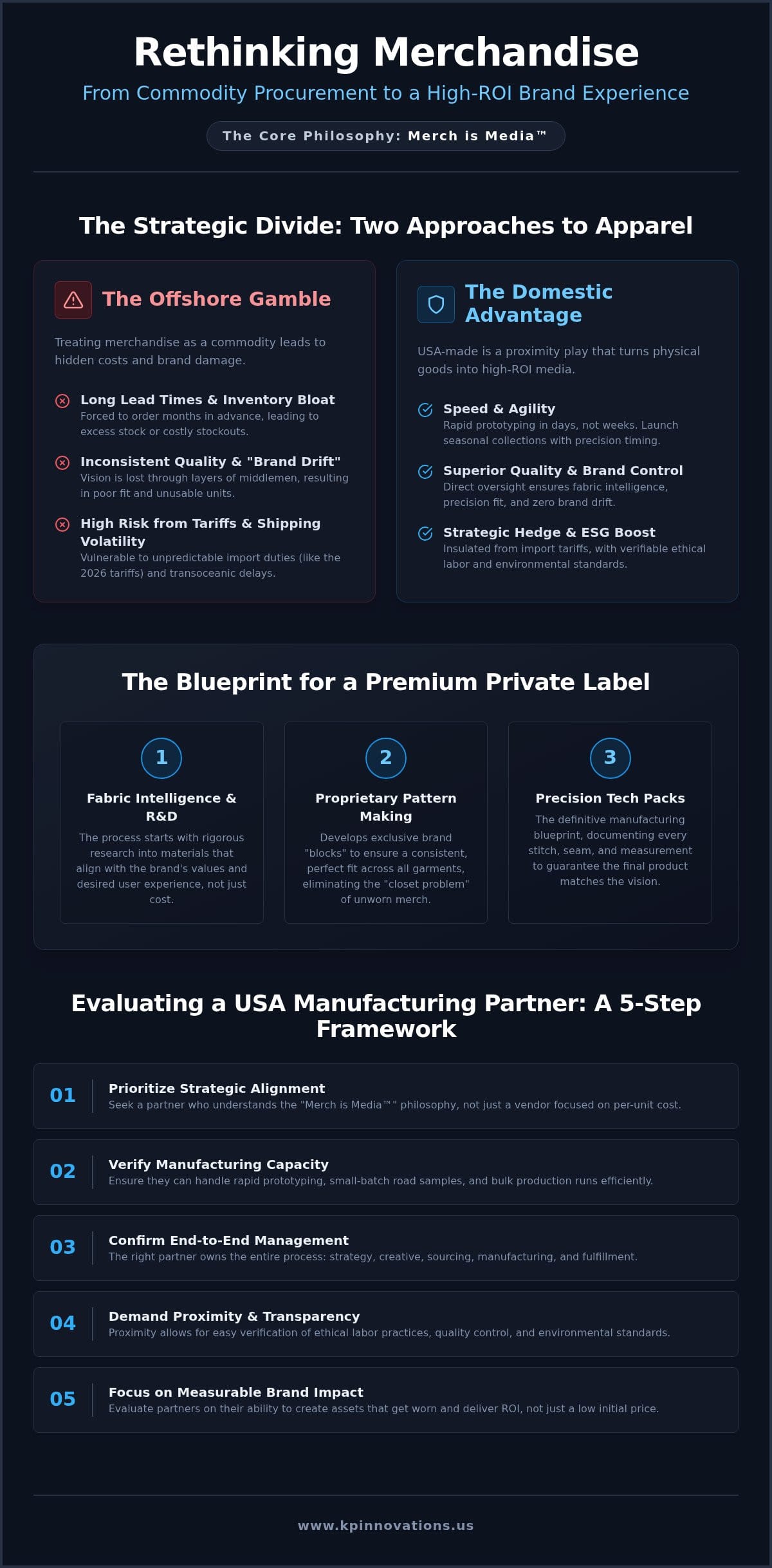
USA Made Promotional Apparel: Strategic Guide (2026)
We know the frustration of offshore vendors who overpromise and underdeliver, leaving you with a closet full of merch that nobody actually wears. You need a partner who manages the entire process from design to global fulfillment while ensuring your brand influences culture and loyalty. This strategic guide explores how to leverage domestic manufacturing to build a premium private label line with faster speed-to-market. We’ll show you why shifting to a domestic-first model solves operational headaches and ensures your brand impact is measured with the same rigor as any other marketing investment. By the end, you’ll understand how to turn your apparel program into a sophisticated tool for client elevation.
Key Takeaways
- Shift your perspective from commodity procurement to a brand experience strategy that uses domestic proximity to eliminate quality degradation and brand drift.
- Navigate the 2026 supply chain by leveraging usa made promotional apparel as a strategic hedge against high tariffs and volatile transoceanic shipping.
- Master the mechanics of private label manufacturing, from sourcing intelligent fabrics to managing small-batch road samples and bulk production.
- Evaluate potential partners using a 5-step framework that prioritizes strategic alignment and manufacturing capacity over simple unit cost.
- Streamline your distribution through integrated fulfillment and company stores that transform physical items into measurable, high-ROI brand assets.
Why ‘Made in USA’ is a Strategic Choice, Not Just a Label
Stop viewing your apparel program as a procurement task. When you treat merchandise as a commodity, you’re essentially gambling with your brand’s reputation. The shift from simple procurement to a brand experience strategy requires a partner who understands that usa made promotional apparel is a cultural touchpoint. The Made in USA label is certainly a badge of quality, but its true strategic value lies in the control it offers over your narrative. By manufacturing domestically, you eliminate the “brand drift” that happens when your vision is filtered through layers of offshore middlemen and disconnected factories.
We operate on the philosophy that Merch is Media™. This means every hoodie or t-shirt you distribute is a physical representation of your company’s values. If that garment is poorly constructed or fits awkwardly, it ends up in the back of a closet. This “closet problem” is the ultimate killer of ROI. Domestic manufacturing allows for a level of fabric intelligence and fit precision that ensures your apparel actually gets worn. When your team and customers proudly wear your brand, your media reach expands. If they don’t, your investment is wasted.
The Hidden Costs of Off-Shore Vendor Relationships
The lowest per-unit price is often a trap. While offshore vendors might look better on a spreadsheet, the real cost of long lead times and inventory bloat is staggering. When you’re forced to order months in advance, you’re essentially guessing your future needs. This leads to excess stock that gathers dust or stockouts that kill momentum. Communication barriers and time zone gaps also create a high risk to your brand identity. A minor misunderstanding in fabric weight or color matching can result in thousands of unusable units. In 2026, the volatility of global shipping and tariffs makes these distant relationships even more precarious for your bottom line.
Proximity as a Competitive Advantage in 2026
Proximity is synonymous with speed and precision. Working with a domestic partner allows for rapid prototyping, which means you can see, feel, and approve samples in days rather than weeks. This agility lets you stay ahead of market trends and launch seasonal collections with surgical timing. To identify these shifts as they happen, platforms like influ.site provide real-time fashion intelligence on emerging looks and creators. Beyond speed, domestic production significantly boosts your Environmental, Social, and Governance (ESG) scores. It’s much easier to verify ethical labor practices and environmental standards when the factory is a short flight away. Your US-based partner acts as a strategic extension of your creative team, providing the transparency and responsiveness needed to turn physical items into powerful brand assets.
The Mechanics of Domestic Apparel Manufacturing: Beyond the Sewing Machine
Most brands mistakenly believe that apparel manufacturing begins at the sewing machine. In reality, the machine is the final step in a rigorous research and development process. For usa made promotional apparel to function as a strategic asset, you must first master the technical foundation. This starts with a comprehensive understanding of private label apparel development, where every stitch is calculated to solve a specific brand challenge rather than just filling a rack.
Pattern Making and the Science of the Perfect Fit
Generic, off-the-shelf patterns are the primary reason most corporate merchandise ends up in the donation bin. These templates don’t account for brand-specific silhouettes or the diverse needs of a professional workforce. We prioritize the creation of proprietary blocks that belong exclusively to your brand. This ensures that your garments maintain a consistent fit across different product lines and production runs. Tech pack development acts as the definitive blueprint for manufacturing precision, documenting every measurement, seam type, and trim detail to ensure the final product matches the initial vision perfectly.
When your apparel fits correctly, it builds a sense of loyalty and pride in the wearer. This isn’t just about aesthetics; it’s about the employee or customer experience. A well-fitted garment is a garment that gets worn, which is the only way to achieve a true return on your investment. By owning your patterns, you move from being a buyer of clothes to a creator of a brand identity. To complement this bespoke approach, you can discover Embroidery By Shotzy for high-quality custom embroidery that ensures your brand’s visual identity is executed with technical precision.
Fabric intelligence is where your brand positioning meets physical reality. Navigating the domestic mill network requires a sophisticated sourcing strategy that balances durability with a premium hand-feel. We look for materials that won’t pill after a few washes or lose their structural integrity in the dryer. This longevity is what transforms a simple t-shirt into a long-term media asset that continues to represent your company for years.
Domestic sourcing also provides the transparency needed to verify that your claims align with the FTC’s ‘Made in USA’ Standard. This standard requires that “all or virtually all” of the product is manufactured within the United States. By working closely with domestic mills, you gain a level of quality control that is simply impossible to maintain with distant offshore vendors. If you want to move beyond basic vendor lists and build a truly custom program, you should refine your sourcing approach to prioritize these technical mechanics and material R&D.
Navigating the 2026 Supply Chain: Domestic vs. Nearshore Production
The 2026 supply chain isn’t just complex; it’s volatile. With apparel imports from China declining by 52.9% in the first quarter of 2026, brands are scrambling to find stability. Investing in usa made promotional apparel provides a necessary hedge against this uncertainty. While offshore vendors might offer a lower initial unit price, that figure doesn’t account for the 2026 tariff landscape or the hidden costs of transoceanic shipping. It’s a strategic proximity play that prioritizes brand security over short-term savings.
A 14-day reorder cycle from a domestic facility beats an 8-week wait for a shipping container every time. If your merch arrives after the cultural moment has passed, you’ve failed the “Merch is Media™” test. This is why we often suggest a hybrid model. Use the US for R&D and rapid prototyping, then utilize nearshore production for high-volume needs. Remember, the closet is not a fulfillment strategy. Planning for distribution must happen during the production phase, not as an afterthought. You don’t want to solve your logistics problems after the goods have already been sewn.
Managing Tariffs and Landed Costs Strategically
Section 301 duties and other 2026 trade policies have fundamentally changed the math for apparel procurement. You have to calculate the total landed cost, which includes logistics, duties, and the cost of capital tied up in inventory. Nearshoring in regions like the Dominican Republic complements a domestic strategy by offering duty-free entry under CAFTA-DR. When blending these production sources, you must strictly adhere to the FTC’s ‘Made in USA’ Standard to maintain brand integrity and legal compliance. This ensures your labels are as accurate as your strategy.
Speed to Market: The Ultimate Growth Lever
In a world of viral trends and sudden seasonal shifts, speed is your most valuable currency. Domestic production allows you to respond to market demands in real-time, drastically reducing the risk of overstock. Dead inventory is a drain on your resources and a failure of strategy. Effective production management ensures that your timelines are met and your brand remains relevant. By shortening the distance between the factory and the end user, you turn your supply chain into a competitive advantage. High-quality usa made promotional apparel ensures that your speed doesn’t come at the expense of the premium feel your brand requires.
How to Evaluate a USA Clothing Manufacturer: A 5-Step Framework
Selecting a partner for your usa made promotional apparel requires more than a simple vendor checklist. You need a strategic partner who views your clothing line as a vehicle for brand experience. This evaluation process moves beyond counting sewing machines and into assessing a manufacturer’s ability to scale with your ambitions. A reliable partner manages everything from the initial R&D to the technology stack that powers your distribution. This ensures your brand impact is measured with the same rigor as any other marketing investment.
Assessing factory capacity is critical. You need a facility capable of producing high-fidelity road samples for leadership review while maintaining the muscle for large-scale bulk production. We recommend looking for partners who facilitate in-person fittings or NYC-style fit sessions. These sessions are where technical design meets human experience, ensuring that the final product doesn’t just look good on a mannequin but feels premium on your team. Additionally, evaluate their technology integration. A manufacturer that lacks ERP connectivity or the ability to support online company stores will eventually become a bottleneck in your supply chain. You need a partner who can sync with your inventory management systems to provide real-time visibility.
Step 1: Audit the Strategic Alignment
Does the manufacturer understand your brand’s cultural mission? If they don’t grasp your vision, they’ll struggle to develop a private label clothing line that resonates with your audience. You aren’t looking for a factory foreman who just monitors output; you’re looking for a partner with a Chief Swag Officer mentality. This role ensures that every garment produced is an intentional piece of media that supports your long-term loyalty and relationship goals. They should act as an outsourced merchandise department that owns the entire system from strategy to fulfillment.
Step 2: Verify Sourcing and Compliance Standards
In 2026, ethical labor practices and environmental certifications are mandatory for brand safety and corporate responsibility. You must test the transparency of their supply chain to ensure every material meets your internal standards for sustainability and durability. Quality Control is a multi-stage audit process, not a final check. This rigorous approach identifies potential issues during the cutting and sewing phases rather than after the boxes are sealed. To secure a partner that meets these high-performance benchmarks, you should audit your sourcing strategy to prioritize strategic alignment over simple unit cost.
Manufacturing is the foundation of a successful clothing line, but distribution is where the strategy lives. If your usa made promotional apparel never makes it into the hands of your target audience, it remains a cost center rather than a brand builder. A truly strategic approach requires viewing your gear through the lens of fulfillment and logistics. This ensures that the premium quality you’ve invested in actually reaches your team and customers in a way that reinforces your high-status positioning. Without a plan for the “last mile,” even the best-made garment fails to deliver a return.
The Chief Swag Officer™ Approach to Apparel
Most companies treat apparel as a series of one-off orders. We challenge this conventional thinking by implementing a “Chief Swag Officer” model. This outsourced merchandise department owns the entire system, moving you from simply ordering shirts to managing a vital brand asset. Success depends on rigorous program management that oversees every detail from initial creative to final inventory depletion. By centralizing this authority, you ensure that your merchandise program influences culture and relationships with the same consistency as your digital marketing. You need a partner who manages the system so you can focus on the business.
Global Fulfillment and Strategic Distribution
Streamlining distribution is essential for maintaining brand momentum. Building company and team stores allows you to offer a retail-grade experience to your employees and clients. This isn’t just about launching a website. It’s about a managed service that handles warehousing and white-glove delivery for corporate programs. When you integrate your usa made promotional apparel into broader employee programs, you create tangible touchpoints that drive loyalty and internal pride. This managed approach eliminates the logistical friction that often kills internal initiatives.
The final outcome is a measurable brand impact. By treating your apparel program as a strategic investment, you can track engagement and adoption rates with precision. You aren’t just buying clothes. You’re deploying a media strategy that lives in the real world. This holistic management ensures that your brand narrative remains cohesive across all channels, turning physical items into powerful tools for long-term growth and cultural influence.
Securing Your Brand’s Future through Strategic Sourcing
The 2026 landscape demands more than just a vendor; it requires a strategic partner who understands that apparel is a vital cultural touchpoint. By prioritizing usa made promotional apparel, you secure a hedge against global supply chain volatility while ensuring your brand identity remains intact through technical precision. We’ve explored how moving beyond the “closet problem” requires a focus on fabric intelligence and managed distribution systems that turn physical items into strategic assets.
Your merchandise should be measured with the same rigor as any other marketing investment. This is why a brand-first methodology is essential for building long-term loyalty and cultural influence. It’s time to stop treating procurement as a simple line item and start viewing it as a competitive advantage. When you own your manufacturing process and distribution, you secure a level of quality and control that offshore vendors simply cannot match.
Partner with KP Innovations for a strategic approach to apparel manufacturing. Our Chief Swag Officer™ managed service provides the global fulfillment capabilities and expertise needed to own your entire system from design to delivery. We are ready to help you elevate your brand and build a program that truly performs.
Frequently Asked Questions
What are the typical MOQs for clothing manufacturers in the USA?
Minimum Order Quantities (MOQs) for domestic manufacturers typically range from 50 to 144 units per style, depending on the complexity of the garment. This lower threshold allows brands to test market viability without the risk of massive inventory bloat. While overseas vendors often require thousands of units, US-based facilities prioritize agility and small-batch production. This flexibility is essential for creating high-quality usa made promotional apparel that aligns with seasonal launches and specific cultural moments.
How long does the garment prototyping process take domestically?
The domestic prototyping process generally takes between 7 and 14 days from the finalization of the tech pack. This rapid turnaround is a significant advantage over offshore vendors, where shipping alone can add weeks to the timeline. Proximity allows your creative team to conduct in-person fit sessions and approve physical samples quickly. This speed ensures that your brand remains responsive to market trends while maintaining the rigorous quality standards necessary for a premium private label line.
Why is USA-made apparel more expensive than overseas production?
Domestic production costs reflect higher labor standards, strict environmental regulations, and the premium quality of US-sourced materials. You aren’t just paying for a garment; you’re investing in a supply chain that adheres to the FTC’s ‘Made in USA’ standard. This investment reduces the hidden costs of long lead times, high tariffs, and inventory risk. When viewed through the Merch is Media™ philosophy, the higher unit price is justified by the increased brand loyalty and cultural impact.
Can a US manufacturer help with fabric sourcing and tech packs?
Strategic partners provide comprehensive support for fabric sourcing and tech pack development as part of a managed service. This goes beyond simple manufacturing to include material R&D and technical design. By developing proprietary patterns and sourcing intelligent fabrics, you ensure a consistent fit across your entire product range. This level of involvement transforms your apparel from a simple procurement item into a sophisticated brand asset that meets your specific strategic objectives and quality benchmarks.
What is the difference between CMT and Full Package manufacturing?
CMT stands for Cut, Make, and Trim, where the factory provides only the labor while you supply all materials and patterns. Full Package manufacturing is a more comprehensive solution where the partner manages the entire system, including fabric sourcing, technical design, and final production. Most brands benefit from the Full Package model because it places the operational burden on the manufacturer. This allows your team to focus on brand strategy rather than managing individual supply chain components.
How do I protect my apparel designs when working with a factory?
Protecting your intellectual property requires a combination of legal safeguards and strategic partner selection. You should always execute a comprehensive Non-Disclosure Agreement (NDA) before sharing proprietary tech packs or patterns. Ensure your manufacturing contract explicitly states that all designs and specialized blocks remain the property of your brand. Working with a reputable strategic agency rather than an anonymous factory provides an additional layer of security, as their business model depends on long-term partnership and trust.
What should I look for in a domestic manufacturing contract?
A domestic manufacturing contract should clearly define lead times, quality control standards, and intellectual property ownership. It’s essential to include specific Acceptable Quality Levels (AQL) to ensure consistency across bulk production runs. You should also outline dispute resolution processes and payment terms that protect your capital. A well-structured agreement acts as a blueprint for the relationship, ensuring that your usa made promotional apparel program is managed with the same professional rigor as any other marketing investment.
How does nearshoring in the Dominican Republic differ from USA manufacturing?
Nearshoring in the Dominican Republic utilizes the CAFTA-DR trade agreement to offer duty-free entry, which is a strategic hedge against high tariffs. While it offers lower labor costs than domestic production, it lacks the immediate proximity and the specific “Made in USA” label. USA manufacturing remains the superior choice for rapid prototyping and small-batch reorders that require a 14-day turnaround. Many brands use a hybrid model, leveraging the US for R&D and the DR for high-volume fulfillment.