
What if the branded merchandise for businesses you’re handing out today is actually eroding your brand equity? It’s a heavy question, but with global employee engagement hitting an 11-year low of 20% in 2025, a cheap plastic pen won’t bridge the connection gap. You likely already know the frustration of opening a supply closet only to find boxes of dusty, inconsistent apparel that no one wants to wear. It feels like a sunk cost because, for most organizations, it is.
We believe it’s time to stop acting like a buyer and start thinking like a broadcaster. This guide will show you how to transform your physical goods from forgotten items into a high-impression media channel that drives culture and long-term loyalty. We’ll explore the Chief Swag Officer model and the strategic shifts required for 2026 to ensure your merchandise program functions as a measurable asset rather than an operational headache. By moving beyond the catalog, you can build a system that prioritizes quality, streamlines logistics, and finally treats your brand with the respect it deserves.
Key Takeaways
- Shift your perspective from viewing branded merchandise for businesses as a cost center to treating physical goods as a high-impression media channel.
- Identify why relying on unmanaged inventory and “the closet” damages your reputation and how to operationalize your program for consistency.
- Explore the move from standard off-the-shelf items to private label apparel that reflects the true quality of your brand.
- Learn how the Chief Swag Officer model replaces fragmented vendor relationships with a strategic partnership that manages your entire system.
- Gain insights on measuring the impact of your merchandise with the same strategic rigor applied to any other media investment.
The Commodity Trap: Why Most Branded Merchandise for Businesses Fails
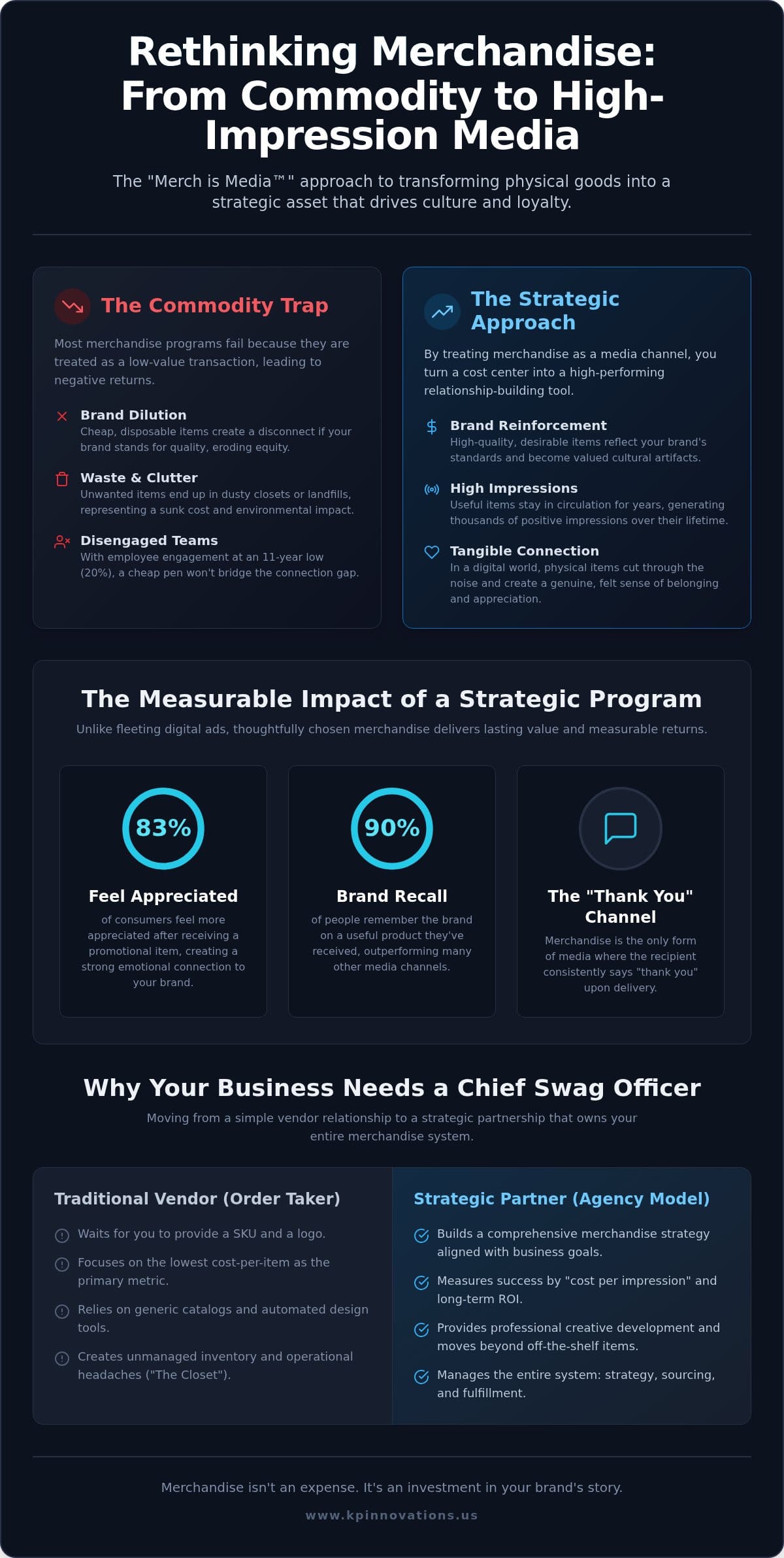
For many organizations, the term “swag” has become synonymous with clutter. It represents the drawer full of plastic pens that don’t write and the thin t-shirts that shrink after one wash. When Promotional merchandise is treated as a low-value giveaway, it stops being a tool for connection and starts being a liability. The hidden cost of cheap merchandise isn’t just the invoice price; it’s the dilution of your brand reputation and the environmental impact of items destined for a landfill. If your brand stands for quality, handing out disposable items creates a jarring disconnect for your audience.
Most branded merchandise for businesses fails because it’s approached as a transaction rather than a strategy. If your process involves browsing a generic catalog and picking the cheapest option, you aren’t building loyalty. You’re creating waste. To determine if your current program is a cost center or an asset, ask yourself: would your customers or employees actually pay money for this item? If the answer is no, your program is likely stuck in the commodity trap. It’s an expense that yields no return because it fails to respect the recipient’s time or taste.
The Difference Between a Vendor and a Strategic Agency
The industry is flooded with vendors who act as simple order-takers. They wait for you to provide a SKU and a logo, then they hit “print.” A strategic agency operates differently by building a comprehensive merchandise strategy that aligns with your broader business goals. While many vendors offer a basic “Design Lab” tool, these automated platforms are no substitute for professional creative development. Real impact requires a partner who understands your brand’s visual identity and ensures consistency across every touchpoint. Professional project management removes the stress of unmanaged inventory and ensures that every piece of merchandise reflects your high standards, regardless of the vendor or factory involved.
Identifying the ROI of Physical Brand Assets
Measuring success by the lowest cost-per-item is a flawed metric. Instead, sophisticated brands look at the “cost per impression” and the long-term lifespan of the asset. Consider these factors when evaluating your ROI:
- Circulation: High-quality items stay in use for years, providing thousands of impressions over their lifetime.
- Engagement: Recent industry research indicates that 83% of consumers feel appreciated after receiving a promotional item. This emotional connection is a measurable marketing win.
- Brand Recall: 90% of people remember the name of a brand on a useful product they’ve received.
When you invest in quality, you ensure your branded merchandise for businesses stays in the hands of your audience. This shift in perspective turns a line-item expense into a high-performing media channel that people actually want to keep.
Merch is Media™: Treating Physical Goods as a Strategic Channel
“Merch is Media™” isn’t just a catchy phrase; it’s a fundamental shift in how high-growth organizations view their physical touchpoints. While most marketing leaders spend millions on digital ads that consumers actively try to avoid, branded merchandise for businesses represents a unique opportunity. It’s the only media channel where the recipient consistently says “thank you” upon delivery. This physical interaction creates an immediate, positive brand association that digital impressions simply cannot replicate.
In an era of digital fatigue, physical objects possess a tactile advantage. They cut through the noise of overflowing inboxes and endless scrolling by occupying real space in a person’s life. This is particularly vital for remote teams. When employees work miles from the head office, a well-designed piece of apparel or a functional desk item becomes a tangible bridge to the company’s mission. Smart brands also leverage these assets to drive digital engagement. Creating a high-quality “unboxing” experience encourages recipients to share their new gear on social media, effectively turning your employees and clients into brand advocates. To achieve this level of impact, you need a partner who understands the nuances of strategic sourcing and global logistics.
Building Brand Equity Through Product Selection
Product selection should never be arbitrary. Every item you distribute is a reflection of your brand’s core values. If your company prioritizes sustainability, choosing plastic-heavy, disposable items creates a conflict that erodes trust. Premium brands require a premium merchandise strategy that focuses on durability, utility, and aesthetic appeal. You aren’t just buying products; you’re selecting tools that solve specific problems, such as increasing employee retention or deepening client relationships. For example, high-quality interactive tools from Really Fun Games can transform a standard giveaway into a meaningful experience that fosters genuine connection. Merch is Media™ is the strategic marketing investment of transforming physical goods into a high-impression channel that builds measurable brand equity and lasting loyalty. When you move away from the “logo on a thing” mentality, you begin to see your merchandise program as a vital extension of your brand’s story.
For high-tier brands, the standard apparel blank is often the weakest link in their visual identity. Most branded merchandise for businesses relies on pre-manufactured shirts and hoodies where the only customization is a logo slapped on the chest. This approach ignores the fact that apparel is a tactile experience. If a garment is itchy, ill-fitting, or loses its shape after two washes, it won’t be worn. When your team or your clients leave your gear in the back of the closet, your “mobile billboard” effectively goes dark. You aren’t just losing an impression; you’re signaling that your brand doesn’t value quality.
True differentiation requires moving beyond the catalog. Private label apparel allows you to build a garment from the ground up, ensuring every detail reflects your brand’s sophisticated standards. By controlling the fabric choice, the fit, and the finish, you create items that people actually choose to wear in their daily lives. This level of intentionality transforms a simple uniform or giveaway into a retail-quality asset that reinforces your brand’s position in the market.
Private Label vs. Standard Promotional Apparel
The choice between off-the-shelf blanks and custom manufacturing often comes down to the intended impact. Standard options are functional for one-time events, but they lack the prestige required for long-term brand building. When you decide to invest in private label clothing, you gain access to unique stitching, custom neck labels, and bespoke fits that distinguish your brand from the competition. For high-volume uniform programs, this strategy ensures that your branded merchandise for businesses maintains a consistent, professional appearance that standard blanks can’t match. It moves the conversation from “what’s available” to “what’s ideal.”
Manufacturing for Brand Longevity
Taking control of the manufacturing process through “cut and sew” gives you total design authority. You aren’t limited by a vendor’s existing inventory or color palettes. This process allows for precise pantone matching and specific fabric weights that align with your brand’s functional needs. Beyond aesthetics, this approach ensures ethical sourcing and rigorous quality control throughout the supply chain. While the initial investment in premium apparel may be higher, the ROI is found in durability. High-quality garments stay in circulation longer, reducing the frequency of re-orders and ensuring that your brand is represented by items that look as good in year two as they did on day one.
The Closet Is Not a Fulfillment Strategy: Operationalizing Swag
Many companies treat their office supply closet as a makeshift distribution center. This is a recipe for operational friction. When branded merchandise for businesses is managed in-house, it usually falls on the shoulders of an already overextended office manager or marketing coordinator. The result is a disorganized pile of miscounted inventory and inconsistent branding. Decentralized ordering, where different departments buy from different vendors, leads to wasted spend and a fragmented brand identity. A modern brand strategy requires professional fulfillment and logistics to ensure that every touchpoint is executed with precision.
Transitioning from manual tracking to automated systems is the only way to scale. If your team is still counting t-shirts by hand or hunting for lost boxes, you aren’t running a merchandise program; you’re managing a headache. Operationalizing your swag means moving beyond the closet and into a centralized system that protects your brand equity and your bottom line. It’s about creating a predictable, managed process that reflects the sophistication of your organization.
The Power of Integrated Company Stores
Moving to digital company stores streamlines the ordering process for HR and marketing teams. These platforms allow for real-time inventory tracking and centralized budget allocations. You can empower regional managers to order what they need while ensuring that only approved, high-quality assets are available. This maintains brand standards across global offices without requiring constant corporate oversight. It transforms an administrative burden into a streamlined self-service system that supports your internal culture and external growth.
Global Distribution and Inventory Management
Shipping physical goods across borders involves more than just a postage stamp. International shipping and customs regulations can stall a campaign or result in unexpected fees. By outsourcing the entire logistics system, you leverage global fulfillment and warehousing capabilities that reduce overhead. We utilize a “just-in-time” inventory model for corporate merchandise. This ensures you have what you need without paying for excessive storage space. This level of operational rigor ensures that your brand reaches its destination on time, every time. To build a program that scales across every office, you need a partner who understands strategic sourcing and global distribution.
Why Your Business Needs a Chief Swag Officer
Managing a comprehensive merchandise program is a complex operational challenge that goes far beyond selecting items from a website. Most organizations struggle with fragmented systems where different departments use different vendors, leading to inconsistent quality and wasted budget. A Chief Swag Officer (CSO) solves this by acting as your outsourced merchandise department. This model ensures that one dedicated partner owns the entire lifecycle of your branded merchandise for businesses, from the initial strategy and creative development to global sourcing and fulfillment.
By centralizing these efforts, you move away from the stress of transactional buying. The CSO oversees every program under one roof, whether it’s employee recognition, uniform programs, or high-level client gifting. This consolidation creates a measurable and scalable brand experience that allows your internal teams to focus on their core responsibilities. You gain a strategic partner who views every physical item as a high-impression media asset. We apply the same rigor to your merchandise program that you would apply to any other significant marketing investment, ensuring that every dollar spent contributes to long-term brand loyalty.
Consolidating Your Brand Voice
One of the greatest risks to brand equity is “vendor fatigue.” When you manage multiple suppliers, it’s nearly impossible to maintain a unified brand voice across different product categories. A CSO eliminates this friction by establishing a long-term roadmap for your brand’s physical assets. This ensures that a technical item, such as a portable charger, carries the same level of quality and design intent as a bespoke executive gift. By maintaining these high standards across all categories, you build a cohesive narrative that reinforces your market position every time a product is used.
Partnering for Strategic Growth
KP Innovations functions as a seamless extension of your marketing and operations teams. We provide the strategic oversight necessary to move from reactive ordering to proactive brand building. Our approach shifts the focus from simple procurement to building belief and trust with your audience. This partnership provides you with the expertise needed to navigate supply chain volatility and global logistics while ensuring your brand remains protected. It’s time to stop managing vendors and start managing your brand’s physical presence with strategic intent. Connect with a Chief Swag Officer to audit your program and discover how to turn your merchandise into a high-performance media channel.
Transform Your Physical Presence Into a Strategic Media Asset
The shift toward 2026 requires a departure from the “logo on a thing” mentality. By embracing the Merch is Media™ philosophy, you turn everyday items into high-impression touchpoints that actually influence culture and loyalty. We’ve explored how moving away from the “closet” toward a managed system ensures your branded merchandise for businesses remains consistent, scalable, and impactful. Whether you’re deploying private label apparel or a global recognition program, the goal is always the same: building belief through quality.
As a strategic partner to top companies nationwide, KP Innovations provides the white-glove project management you need to own the entire lifecycle of your program. We offer access to over 1.2 million products and handle everything from creative design to global fulfillment. It’s time to stop managing vendors and start building a measurable brand experience. Elevate your brand experience with KP Innovations and discover the power of a dedicated Chief Swag Officer. Let’s create something lasting together.
Frequently Asked Questions
What is the difference between branded merchandise and promotional products?
Branded merchandise for businesses represents a strategic shift from transactional giveaways to cultural assets. While promotional products are often viewed as disposable items for a single event, branded merchandise focuses on long-term utility and brand alignment. It’s the difference between a cheap plastic item and a retail-quality piece of apparel that someone chooses to wear. One is a cost; the other is a high-impression media channel.
How do I ensure my branded merchandise doesn’t look cheap?
Quality starts with a design-first mindset rather than a budget-first one. You can avoid a “cheap” appearance by prioritizing retail-inspired fits, durable materials, and subtle branding. We focus on a Red Dot level design approach that treats every item as a product people actually want to keep. By selecting items with high perceived value, you ensure that your brand is represented by goods that reflect your organization’s commitment to excellence.
Can you manage global fulfillment for international teams?
Yes, we provide comprehensive global fulfillment and warehousing capabilities to support teams across the world. Managing international distribution involves navigating complex customs regulations and logistics challenges that usually stall in-house efforts. Our system ensures that your items reach their destination efficiently, regardless of the recipient’s location. This allows you to maintain a consistent brand experience for every employee, whether they are based in Horsham or a remote global office.
What are the benefits of a private label apparel program for businesses?
Private label apparel provides total design control, allowing you to build garments from the ground up rather than relying on standard blanks. This approach eliminates the limitations of off-the-shelf inventory, offering unique fits, custom labels, and bespoke stitching. It turns your team’s clothing into a true brand extension. When you control the manufacturing process, you ensure ethical sourcing and superior durability, which significantly increases employee adoption and long-term brand visibility.
How do online company stores help manage corporate spending?
Online company stores centralize the procurement process and eliminate decentralized, rogue spending across different departments. These platforms allow marketing and HR leaders to set budget allocations and manage inventory in real-time. By providing a curated selection of pre-approved items, you ensure brand consistency while reducing the administrative burden of manual order tracking. It’s a scalable solution that provides transparency into your merchandise spend while protecting your visual identity.
What is a ‘Chief Swag Officer’ and why does my company need one?
A Chief Swag Officer is your dedicated partner who owns the entire merchandise program lifecycle, from strategy to fulfillment. Most companies suffer from vendor fatigue because they manage multiple suppliers for uniforms, gifting, and events. A CSO consolidates these fragmented efforts under one strategic roof. This model provides the high-touch support needed to transform physical goods into measurable media assets, allowing your internal teams to focus on their primary business objectives.
How do you measure the ROI of branded merchandise programs?
We measure ROI by shifting the focus from cost-per-item to cost-per-impression and long-term engagement. Since 90% of people remember a brand on a useful product, we track how quality items stay in circulation to drive repeated visibility. Successful programs also result in higher employee retention and stronger client relationships. By treating your branded merchandise for businesses as a media channel, you can analyze its impact with the same rigor as any other marketing investment.
Does KP Innovations offer sustainable or eco-friendly merchandise options?
We offer a wide range of sustainable options that align with your brand’s environmental values. Sustainability is a significant trend in 2026, and we help you select products made from recycled or reusable materials that don’t compromise on quality. Our sourcing strategy prioritizes items with a long lifespan, which reduces waste and ensures your brand is associated with purposeful touchpoints. Every product choice is an opportunity to reinforce your commitment to responsible business practices.