
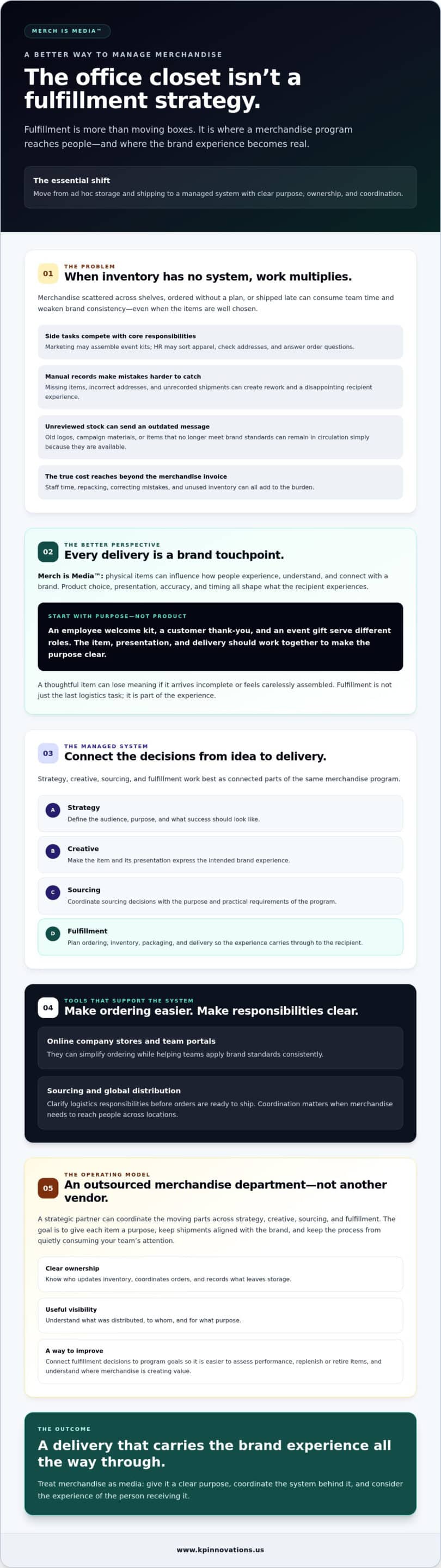
The office closet isn’t a fulfillment strategy. When merchandise is scattered across shelves, ordered without a plan, or shipped late, it stops supporting the brand experience and starts creating work. Promotional product fulfillment services should do more than move boxes. They should help your team manage merchandise with a clear purpose, from ordering through delivery.
If you’re tired of tracking inventory internally, watching budget sit unused, or worrying whether every team represents the brand consistently, the answer isn’t simply finding another vendor. It’s building a managed system with a partner who can coordinate the moving parts.
This guide explains how to move from ad hoc storage and shipping to a strategic fulfillment model. You’ll learn what to look for in a partner, how company stores can simplify ordering, and what to consider when planning global distribution. Most importantly, you’ll see how to connect fulfillment decisions to brand consistency and program outcomes. That’s the Chief Swag Officer mindset: merchandise isn’t just inventory to manage. It’s a brand experience to design, deliver, and improve.
Key Takeaways
- Unmanaged merchandise can consume team time and weaken brand consistency, even when the items are well chosen.
- Fulfillment is part of the brand experience, not just the final step in moving inventory.
- Online company stores can simplify ordering while helping teams apply brand standards consistently.
- Coordinating sourcing and global distribution means clarifying logistics responsibilities before orders are ready to ship.
- Promotional product fulfillment services can support an outsourced merchandise program that treats merchandise as media and evaluates its impact.
Why ‘The Closet’ Is Not a Promotional Product Fulfillment Strategy
A closet full of merchandise can look like a ready supply of brand materials. Without clear ownership, inventory records, and a plan for who receives what, however, it can become a drain on marketing, HR, and operations. Promotional merchandise supports many marketing and promotional purposes. Its impact depends not only on what a company selects, but also on how consistently and thoughtfully the items reach people.
That’s why promotional product fulfillment services should be part of the merchandise program, not treated as a box-moving task. A cabinet, stockroom, or warehouse holds inventory. A strategy determines what belongs there, how it will be used, and whether it still represents the brand.
The Hidden Operational Drain on Your Team
When packing and shipping become side tasks, they compete with employees’ core responsibilities. A marketing leader may spend an afternoon assembling event kits instead of planning a campaign. An HR team may sort apparel, check addresses, and answer order questions instead of focusing on employee programs.
Manual processes also make mistakes harder to catch. A missing item, incorrect address, or unrecorded shipment can mean rework and a disappointing recipient experience. When orders and inventory are spread across emails, spreadsheets, and memory, it’s difficult to see what was distributed, to whom, and for what purpose. That makes it harder to assess how the program is performing.
The Cost of Brand Dilution and Inconsistency
Unmanaged inventory tends to linger. Old logos, outdated campaign materials, or items that no longer meet current brand standards can remain in circulation simply because they’re available. Without a review process, teams may distribute merchandise that sends a dated or inconsistent message.
The shipment itself is part of the experience. Packaging, accuracy, timing, and the care taken with a kit all shape how an employee, customer, or event attendee receives the brand. A thoughtful item can lose its meaning if it arrives incomplete or feels carelessly assembled. Merch is Media™, so every delivery is a brand touchpoint, not just a fulfillment record.
The DIY approach also carries costs that may not appear on a merchandise invoice: staff time, repacking, correcting mistakes, and unused inventory. A more useful system connects stock to specific programs, assigns responsibility for updates, and records what leaves storage. That makes it easier to identify items to replenish or retire and understand where merchandise is creating value.
KP Innovations provides managed fulfillment and logistics services as part of a broader merchandise strategy. The aim isn’t simply to move inventory out of a room. It’s to give each item a purpose, make each shipment reflect the brand, and keep the process from quietly consuming your team’s attention.
Merch is Media™: Redefining Fulfillment as Brand Experience
Fulfillment is often treated as the final operational step: pack the items, ship the order, close the task. But delivery is when a merchandise program reaches its audience. An accurate, well-considered shipment can reinforce the intention behind an item. A rushed or incomplete one can undermine it.
Merch is Media™ is the strategic use of physical items to influence how people experience, understand, and connect with a brand. From product choice to presentation, merchandise can express what a company values and how it builds relationships with employees, customers, and partners.
Shift from Logistics to Strategic Impact
Start with the audience and purpose, not the product. An employee welcome kit, a customer thank-you, and an event gift each serve a different role. The item, presentation, and delivery process should work together to make that purpose clear. That’s the difference between applying a logo and creating a coherent brand experience.
Making that connection requires coordination across strategy, creative, sourcing, and fulfillment. When those functions operate in isolation, a strong concept can lose consistency before it reaches the recipient. Connect merchandise strategy to fulfillment outcomes, define what success should look like, then plan the practical details around it.
Promotional product fulfillment services can support this broader system, but a partner’s role needn’t stop at processing orders. A strategic partner considers how decisions made upstream affect the recipient’s experience and the program’s goals. That’s the shift from hiring a vendor for a task to working with an outsourced merchandise department that helps manage the whole program.
The Recipient Experience Is Part of the Message
Thoughtful kitting can make a shipment feel considered rather than transactional. Choose items for a specific audience, arrange them with care, and make sure the contents fit the moment. The point isn’t elaborate packaging for its own sake. It’s to remove friction and help the recipient feel that the gesture was intended for them.
For employees, merchandise can support a sense of shared identity when it’s tied to meaningful moments, such as welcoming a new colleague or recognizing a contribution. For customers and partners, a relevant gift can help sustain a relationship. These outcomes aren’t automatic. They depend on relevance, consistency, and follow-through.
To assess a program, connect each shipment to its purpose. Track who it serves, what experience it is intended to create, and how recipients respond. If you’re reviewing the products behind that experience, explore strategic sourcing as one way to align merchandise with your audience and brand.
Streamlining the System: Online Company Stores and Team Portals
Ordering merchandise shouldn’t require a chain of emails, a spreadsheet, and several rounds of approval for every request. An online company store or team portal gives employees and partners a central place to select pre-approved items, while helping the organization manage what’s available and who can order it.
The value isn’t technology for its own sake. It’s a simpler, more consistent process. A portal can bring approved products, brand standards, and ordering rules into one experience, reducing back-and-forth among employees, HR, marketing, and vendors. A managed company store can support this approach, but its setup should reflect the organization’s needs.
Eliminate Manual Ordering Friction
Before choosing a portal, map the current order journey. Who requests merchandise? Who approves it? Which items are appropriate for each team or purpose? Clear answers help determine what users should be able to order and where approval is still needed.
Consider how the store should work alongside existing HR and marketing systems. Don’t assume every platform will connect automatically. Define what information needs to move between systems, such as employee eligibility, budget ownership, or order details, then confirm how a potential solution handles it. The goal is a practical workflow, not another tool that creates manual work.
For uniform programs, a portal can help employees find approved apparel and follow a consistent ordering path. For recognition programs, it can provide a structured way to access eligible items. In both cases, clear choices and rules reduce confusion without leaving every request to individual email threads.
Use Inventory and Reporting to Make Better Decisions
A portal is only as useful as the information behind it. Accurate inventory records and clear reporting can help teams monitor demand, identify frequently ordered items, and spot stock that isn’t moving. Set a review schedule so the catalog and available quantities stay aligned with program needs.
That visibility can help teams prepare for known moments, such as a company event or employee onboarding cycle. It won’t eliminate every supply challenge, but it can make low inventory easier to notice before a planned order becomes urgent. Usage patterns can also inform future sourcing decisions, helping teams assess whether existing choices remain useful and relevant.
Reporting gives leaders a stronger basis for evaluating merchandise spend. Track orders by program, audience, and purpose, then compare that activity with the outcomes the program is meant to support. Promotional product fulfillment services are easier to manage when ordering, inventory, and distribution are connected to useful records. The result is a clearer operating system: easier access for users, more control for program owners, and better information for the next decision.
Global Reach, Local Touch: Sourcing and Logistics Management
A merchandise program may serve employees, customers, and partners in different locations, but global distribution adds decisions that shouldn’t wait until a shipment is ready. Product selection, quality expectations, delivery destinations, and responsibility for international shipping details all need to be considered together.
Strategic sourcing starts with the item’s purpose and the people receiving it. The lowest-priced option may seem efficient, but if it doesn’t meet expectations or align with the brand, the purchase can create waste and weaken the experience. The right choice fits the audience, intended use, brand standards, and program goals.
Strategic Sourcing and Quality Assurance
With access to more than 1.2 million products, KP Innovations can help organizations consider a broad range of options. A large selection is useful when guided by clear criteria. Before choosing an item, define the quality needed for its intended use, the brand details that must remain consistent, and the information required to assess the supplier.
Companies can establish checks for quality consistency and request information about relevant ethical standards when reviewing manufacturers. Set expectations during sourcing, then review them before committing to a program. Quality control shouldn’t be an assumption. Include it in the decision process, from reviewing product details to checking the finished item against the approved direction.
Global Distribution Without Guesswork
International shipments raise destination-specific questions about shipping requirements, documentation, and applicable duties. Don’t assume these details are identical across countries or that a fulfillment partner automatically handles every step. Before launch, clarify who will confirm requirements, prepare information, coordinate the shipment, and communicate with recipients if plans change.
Consistency matters across borders, too. Recipients in different locations should receive merchandise that follows the same brand standards, even when delivery plans vary. Define what must remain consistent, such as approved artwork and presentation, and what may need to adapt to local delivery needs.
Fulfillment services connect global sourcing with local delivery by coordinating the movement of selected merchandise to its intended recipients.
White-glove project management keeps the details connected: sourcing decisions, quality expectations, the delivery plan, and the recipient experience. Promotional product fulfillment services are most useful when they support the whole process instead of treating each shipment as an isolated task.
To evaluate options against your brand and program requirements, explore strategic sourcing.
Your Outsourced Merchandise Department: The Chief Swag Officer Model
A vendor completes a transaction. A strategic partner helps determine whether the transaction should happen, what it needs to accomplish, and how to learn from the result. That distinction matters when merchandise touches employee culture, customer relationships, and brand perception across multiple teams.
The Chief Swag Officer model treats merchandise as a program, not a series of disconnected orders. It brings planning, creative direction, sourcing, and fulfillment into a coordinated system. For a growing company, that structure can help keep decisions aligned as audiences, programs, and distribution needs change.
Beyond Vendor Management to Strategic Partnership
A useful partner won’t simply accept every request. They’ll ask who the merchandise is for, what experience it should create, and whether the proposed item fits the goal. Those questions help teams avoid repeating familiar purchases without considering whether they still serve the brand or audience.
Dedicated program management can connect decisions across departments and maintain continuity from planning through delivery. KP Innovations works as an extension of a company’s marketing function, coordinating merchandise work while internal teams retain ownership of their business priorities. The aim is a reliable system that can adapt as programs grow, rather than a vendor relationship focused only on individual orders.
Measure the Investment, Not Just the Order
Merch is Media™ means treating physical items as brand communication. To assess that investment, define the intended outcome before choosing the item, then track measures related to it. A single metric rarely tells the whole story, so select indicators suited to each program.
- Employee recognition: Track participation, recipient feedback, and changes in workforce measures your organization already monitors. Employee recognition programs can be reviewed alongside retention data, while avoiding assumptions that merchandise alone caused a change.
- Client gifting: Record who receives gifts, the relationship purpose, follow-up, and relevant outcomes such as continued engagement or account activity. These measures can help assess whether client gifting supports the relationships it was designed to strengthen.
- Program operations: Review ordering patterns, unused inventory, and fulfillment issues to identify where the process needs adjustment.
These measures shift the conversation from “What did we spend?” to “What was the program designed to do, and what evidence do we have that it helped?” Promotional product fulfillment services are more valuable when they’re part of that feedback loop. The result is a merchandise system leaders can review, refine, and scale with clearer intent.
Build a Merchandise Program That Moves Your Brand Forward
A closet full of merchandise isn’t a strategy. A stronger program connects product choices, ordering, inventory, and delivery to a clear purpose. Online company stores can reduce ordering friction, while thoughtful fulfillment helps each shipment reflect the brand consistently.
The larger opportunity is to treat merchandise as media: a way to shape employee and customer experiences, not just another line of spend. That takes a coordinated system and a partner who can help manage it over time. KP Innovations brings a strategic Chief Swag Officer model, white-glove project management, and access to over 1.2 million products to support that work.
Promotional product fulfillment services can become a strategic brand asset when they’re connected to the goals behind the merchandise and reviewed for how well they serve them. Start with the audience, purpose, and standards your program needs to uphold. Then build a process that can adapt as your organization grows.
Explore strategic sourcing with KP Innovations to take a considered next step toward a merchandise program that works harder for your brand.
Frequently Asked Questions
What are promotional product fulfillment services?
Promotional product fulfillment services coordinate the steps that get merchandise from inventory to its intended recipients. Depending on the provider and program, that can include storing items, managing orders, packing shipments, and arranging delivery. The goal is to connect logistics to the purpose of the merchandise, whether it supports employee programs, customer relationships, or an event. Clarify which tasks a provider handles before defining the program.
How does a company store simplify the fulfillment process?
A company store gives employees or other approved users a central place to order pre-approved merchandise. Instead of handling requests through separate emails, teams can use a defined catalog and ordering process. Stores can support rules, such as which items are available to specific groups, when those rules are built into the setup. KP Innovations offers managed online company and team stores. Confirm which features fit your workflow.
Can you handle global shipping for corporate merchandise?
KP Innovations provides global fulfillment capabilities for corporate merchandise. Before planning international distribution, confirm the destinations, delivery expectations, and which party is responsible for shipping documentation and any applicable duties or destination requirements. These details can vary by shipment, so clarify responsibilities with your fulfillment partner early. A coordinated plan can help maintain a consistent brand experience while accounting for local delivery needs and communicating realistic expectations to recipients.
What is the “Merch is Media™” philosophy?
“Merch is Media™” means treating physical merchandise as a way to communicate a brand and shape experiences, rather than as an item with a logo alone. A useful item can express recognition, welcome a new employee, or reinforce a customer relationship. Its impact depends on relevance and delivery as well as design. The philosophy encourages teams to define the purpose of merchandise and consider how they’ll assess whether it served that purpose.
How do you ensure brand consistency across 1.2 million products?
Access to over 1.2 million products provides choice, not a reason to use every item or assume every option fits your brand. Consistency starts with clear standards for artwork, colors, intended audiences, and approved uses. Narrow the catalog to choices that meet those requirements, then review the final selection before ordering. Ask your partner how approvals and product details are managed so the process supports consistent brand expression.
What is the difference between a fulfillment vendor and a strategy agency?
A fulfillment vendor typically focuses on completing defined logistics tasks. A merchandise strategy and brand experience partner considers how those tasks connect to program goals, audience needs, brand standards, and future decisions. KP Innovations uses a Chief Swag Officer model to coordinate merchandise as a strategic program. That means asking why an item is being used and how the process can support the intended employee or customer experience.
How do you handle custom kitting and assembly for new hire kits?
Start by defining the kit’s purpose, approved contents, presentation requirements, recipient information, and delivery plan. Then confirm with your fulfillment partner whether the requested assembly and any special handling are within the agreed scope. KP Innovations provides white-glove project management and fulfillment services, but specific kitting requirements should be discussed and confirmed for each program. Clear instructions and an approval process help keep kits aligned with the intended new-hire experience.
What reporting is available for inventory and usage tracking?
Reporting depends on the store and fulfillment setup, so ask providers to specify which records and reports they can supply. Useful information may include orders by item or program, available inventory, distribution activity, and usage over time. Agree on who can access the data and how often it will be reviewed. Connecting these records to program goals can help teams identify changing demand, plan future orders, and explain merchandise decisions to leadership.