
What if your corporate gift strategy was measured with the same rigor as your digital ad spend? For most organizations, gifting is a reactive scramble involving low-quality items and a “closet” fulfillment method that drains resources without proving value. You likely feel the frustration of sending generic merchandise that eventually ends up in a junk drawer rather than in a client’s hands. It’s a common pain point for leaders who want their brand to stand for quality but feel stuck in a loop of logistical headaches and uninspired products.
You already know that a physical touchpoint is one of the most powerful ways to influence culture and loyalty. We’re here to help you bridge the gap between that potential and your current reality. You’ll learn how to transform your gifting from a series of transactions into a fully managed system that drives measurable ROI. We’ll examine why the “Merch is Media™” philosophy is the key to 2026 success; ensuring every item you send reinforces your brand identity and secures long-term relationships. This guide provides a roadmap for moving beyond the vendor model to a strategic partnership that treats every gift as a high-stakes brand asset.
Key Takeaways
- Shift from a transactional mindset to the “Merch is Media™” philosophy to treat every gift as a high-impact brand investment.
- Eliminate the hidden costs of the “closet strategy” by implementing a scalable corporate gift strategy managed by a strategic partner.
- Focus on custom creative development and high-retention items that solve specific business problems rather than just distributing generic products.
- Leverage the “Chief Swag Officer” model to outsource the operational complexity of strategy, sourcing, and global logistics.
- Define success through measurable KPIs like employee retention and brand loyalty instead of focusing solely on cost-per-item metrics.
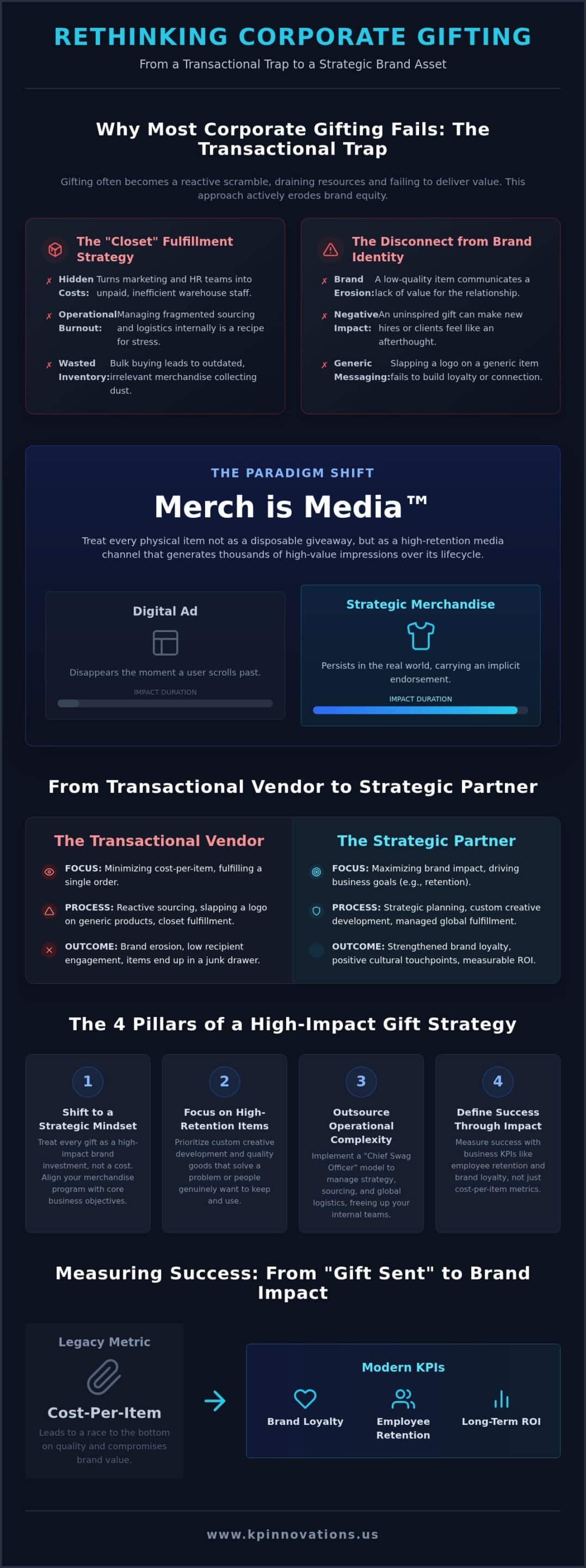
Why Most Corporate Gifting Fails: The Transactional Trap
Many organizations fall into the transactional trap by prioritizing the purchase of physical items over the cultivation of meaningful experiences. When you treat merchandise as a commodity, you ignore the foundational principles of the gift economy, where the true value lies in the reinforced social bond rather than the item’s price tag. A successful corporate gift strategy recognizes that the gift is actually a medium for a message. If that message is generic or low-effort, it doesn’t just fail to impress; it actively erodes the brand equity you’ve worked so hard to build.
The closet is not a fulfillment strategy. Relying on an office storage room creates a hidden drain on your most expensive resources: your people. This approach turns your marketing and HR teams into unpaid warehouse staff, pulling them away from high-value strategic work to handle tape and cardboard. Beyond the local mess, global logistics for growing companies present a minefield of customs duties, international shipping regulations, and lost packages. Without a professional fulfillment system, your gifting program becomes a source of stress instead of a tool for growth.
The Operational Burden of In-House Gifting
Soft costs are the silent killers of ROI. When high-salaried marketing directors or HR leaders spend their afternoons packing boxes, you aren’t saving money; you’re misallocating talent. Fragmented sourcing across multiple uncoordinated vendors further complicates the issue. It leads to inconsistent branding and shipping delays that frustrate recipients. Bulk buying might seem economical on a spreadsheet, but it often results in wasted inventory and outdated merchandise that no longer aligns with your current brand identity. Managing these moving parts internally is a recipe for operational burnout.
The Disconnect Between Gifting and Brand Identity
Slapping a logo on a generic plastic item doesn’t build loyalty. In fact, low-effort gifts can communicate that you don’t value the relationship. This brand erosion is particularly dangerous with high-value clients who expect a level of sophistication that matches your professional services. The psychological impact on employees is equally significant. A low-quality “welcome” gift can make a new hire feel like an afterthought rather than a valued addition to the culture. Your corporate gift strategy must treat merchandise as a vital part of the brand experience. A vendor fulfills a request for a product, while a strategic partner manages a system that protects and elevates the brand.
Shifting the Paradigm: Understanding Merch is Media™
Most organizations view merchandise as a line item to be minimized. This transactional mindset is a missed opportunity. While a digital ad disappears the moment a user scrolls past, physical merchandise persists. We believe that physical items are actually a high-retention media channel. This is the core of our Merch is Media™ philosophy. When you invest in a high-quality custom apparel item, you aren’t just buying a shirt. You are purchasing a billboard that walks, talks, and generates thousands of impressions over its multi-year lifecycle. This shift in perspective is the foundation of a modern corporate gift strategy that treats every item as a strategic brand asset rather than a disposable giveaway.
Measuring the ROI of your merchandise requires looking at the long-term impact. A premium jacket worn twice a week for three years offers a lower cost-per-impression than almost any digital marketing campaign. More importantly, these impressions are high-value. They happen in the real world, during face-to-face interactions, and carry the implicit endorsement of the person wearing the item. Moving beyond a simple vendor relationship allows you to design items that people actually want to keep. This durability ensures your brand remains a constant presence in the lives of your clients and employees.
Merchandise as a Cultural Touchpoint
Internal culture is built through shared identity and a sense of belonging. Using private label apparel and custom-designed goods allows your team to wear their company pride in a way that feels authentic. Generic, low-quality items often end up hidden in a closet, but a well-designed piece of merchandise serves as a physical manifestation of your company values. It tells your employees that they are part of something elite and professional. This is especially vital for distributed teams. A physical gift is often the only tangible connection a remote employee has to the home office. It bridges the geographic gap with a sense of shared mission.
The Psychology of the Strategic Gift
Psychology heavily influences how a gift is perceived and valued. The “Endowment Effect” demonstrates that people naturally place a higher value on items they own, particularly those that feel exclusive or personalized. When a gift arrives at a significant milestone, it triggers a powerful emotional response. Strategic timing is everything. Whether it is a work anniversary, a major project completion, or a client lifecycle event, the timing of the gift reinforces the relationship. For a deeper look at this, see our meaningful recognition guide. To execute this at scale, you need a partner who excels at strategic product sourcing to find items that truly resonate.
The 4 Pillars of a High-Impact Gift Strategy
A high-impact corporate gift strategy requires more than just a software platform. It demands a holistic approach that integrates four critical pillars: strategy, creative development, sourcing, and fulfillment. When these elements align, your merchandise stops being a cost center and starts functioning as a strategic asset. Strategy ensures every gift maps to a business goal like client retention or cultural alignment. Creative development elevates the item from a commodity to a brand experience. Sourcing provides the quality and ethical standards your brand requires. Finally, fulfillment ensures that the physical connection is made with precision, regardless of where the recipient is located.
By treating these pillars as a unified system, you move beyond the limitations of a vendor-client relationship. You aren’t just buying products; you’re building a managed program that protects your brand identity and drives ROI. This structured methodology allows you to scale your gifting efforts without sacrificing the quality or the personal touch that makes a gift meaningful. It’s about moving from a reactive scramble to a proactive, results-oriented engine for brand growth.
Strategic Sourcing and Private Label Apparel
True brand distinction comes from moving beyond off-the-shelf items. While many vendors simply slap a logo on a pre-made product, we focus on manufacturing from the ground up. This level of control allows for deep customization that reflects your brand’s unique identity. It’s the difference between a generic giveaway and a piece of private label apparel that employees actually wear on the weekend. For those looking to build a brand from the stitches up, our private label clothing starter guide offers a roadmap for this superior approach. In 2026, supply chain integrity and quality control aren’t optional; they’re the baseline for protecting your reputation.
Creative Development and Brand Experience
The value of a gift is often determined before the recipient even sees the product. We design the unboxing experience to maximize emotional impact, ensuring that the first physical touchpoint feels intentional and premium. Our creative development services focus on turning promotional items into coveted lifestyle products. This process involves custom designs that resonate with your audience’s aesthetic preferences, ensuring the items are kept and used. When you move beyond the logo, you create merchandise that people value. This strategic approach transforms a simple transaction into a lasting brand impression that influences loyalty and culture.
Implementing the Chief Swag Officer Model
Managing a comprehensive corporate gift strategy shouldn’t be a side project for your marketing or HR teams. Most growing organizations reach a point where fragmented gifting becomes a logistical liability. This is where the Chief Swag Officer model becomes essential. Instead of hiring an internal team to manage a dozen different vendors, you partner with an outsourced department that owns the entire system. This partner provides the strategy, creative direction, and operational backbone needed to treat merchandise as a high-stakes media investment.
Centralization is the key to operational efficiency. When your uniform programs, employee recognition, and client gifting are managed under one roof, you gain a level of visibility that is impossible with a vendor-only approach. The Chief Swag Officer acts as a strategic lead, overseeing the workflow from initial project management through to global distribution. This model ensures that every physical item leaving your organization meets your brand standards and serves a specific business objective—whether that’s a custom apparel line for staff or a sophisticated handover gift, such as luxury branded candles from Cadeau + Bliss, for a high-value real estate client. It moves your team away from tactical box-packing and toward strategic brand elevation.
Rogue spending is a common symptom of a broken merchandise program. Different departments often order their own items from various vendors, leading to inconsistent branding and wasted budget. Implementing streamlined company store solutions solves this problem by centralizing all approved merchandise in one digital portal. This gives managers and team leads the autonomy to order what they need while ensuring every item remains on-brand. It also automates the recognition process, allowing you to reward performance without the manual administrative burden.
Managed Fulfillment and Global Logistics
The “last mile” is often where a merchandise program succeeds or fails. Sending a premium item to a remote employee or an international client requires precision logistics that go beyond standard shipping. Our white-glove fulfillment services manage the entire lifecycle of your inventory. You no longer need to wonder what you have in stock or when to restock. Real-time inventory management ensures your programs never stall due to supply chain gaps. By outsourcing these complex logistics, you ensure that the right gift arrives at the right time, every time, regardless of global boundaries.
To truly scale your brand impact, you need a partner who can navigate the complexities of strategic global sourcing and logistics.
Measuring Success: From “Gift Sent” to Brand Impact
To truly understand the value of your investment, you must look beyond the initial invoice. A successful corporate gift strategy isn’t measured by how cheaply you can buy a product. It’s measured by the long-term brand equity and behavioral shifts it creates. While a vendor focuses on the cost-per-item, a strategic partner focuses on the cost-per-impression and the resulting ROI. You need to track metrics that actually move the needle for your business, such as employee retention rates, recruitment social reach, and client lifetime value (LTV); using professional dashboard templates from Biz Infographs can help you visualize these KPIs for your leadership team.
Data should drive your merchandise choices. By integrating recognition program management, you can use internal surveys and engagement data to validate which items resonate most with your team. High-quality gear doesn’t just sit in a drawer; it turns employees into brand advocates who proudly represent the company in their personal networks. This organic advocacy is a powerful recruitment tool that traditional advertising cannot replicate. You aren’t just giving a gift; you’re providing the tools for your team to tell your brand story.
Future-Proofing Your Strategy for 2026
The expectations for 2026 are clear: sustainability and technological integration are no longer optional. Sustainable sourcing is a requirement for the modern workforce, and eco-conscious gifting reflects a brand’s commitment to global responsibility. We’re also seeing the rise of “phygital” experiences, where physical gifts connect directly to digital brand platforms through embedded technology. This ensures your gifting remains relevant in an increasingly hybrid world. Transitioning to a strategic agency model is the only way to scale these complex programs while maintaining the precision and brand integrity required for high-growth organizations.
Elevating Your Brand Beyond the Transactional Scramble
Your brand deserves more than a storage room full of generic items. By shifting to a “Merch is Media™” mindset, you transform physical products into powerful assets that drive long-term culture and loyalty. We’ve explored how a managed corporate gift strategy eliminates operational waste and ensures every item sent aligns with your high-stakes business objectives. The era of the simple vendor is over. The future belongs to strategic partners who own the entire system from design to global distribution.
As a Premier U.S. Promotional Product Supplier, KP Innovations provides the white-glove project management and access to over 1.2 million products you need to scale with confidence. It’s time to stop managing logistics and start building a brand experience that lasts. We’re ready to help you move beyond the transaction and into a future of measurable impact. Let’s build a program that treats your merchandise with the same rigor as any other marketing investment.
Partner with KP Innovations to build your strategic merchandise department.
Frequently Asked Questions
What is a corporate gift strategy and why is it different from buying swag?
A corporate gift strategy is a deliberate system that aligns physical touchpoints with specific business objectives, such as employee retention or client acquisition. This differs from buying generic merchandise because it treats every item as a high-retention media channel. Instead of reactive purchasing, a strategy ensures that every product reinforces your brand identity and influences culture. It moves the focus from the unit price to the long-term impact on relationships and brand equity.
How do you measure the ROI of a corporate gifting program?
Measuring ROI requires moving beyond simple cost-per-item metrics to track behavioral outcomes. You should analyze data points like employee retention rates following recognition programs and the increase in client lifetime value through strategic gifting cadences. Additionally, track qualitative wins, such as when custom apparel appears in organic social media posts. By treating merchandise as a media investment, you can measure cost-per-impression and its direct correlation to your organization’s growth and cultural health.
What are the benefits of an outsourced “Chief Swag Officer” model?
The Chief Swag Officer model provides your brand with a dedicated merchandise department that owns the entire lifecycle of your program. This outsourced partnership eliminates the operational burden on your internal marketing and HR teams, allowing them to focus on high-value tasks. By centralizing strategy, creative development, and global logistics, this model ensures brand consistency and reduces rogue spending. It transitions your organization from a vendor-based transactional approach to a long-term, results-oriented merchandise strategy.
How can we ensure brand consistency across international offices?
Ensuring brand consistency across global offices requires a centralized management system and a unified sourcing strategy. By utilizing an online company store, you can offer a curated selection of pre-approved, high-quality items to all departments regardless of their location. This eliminates fragmented purchasing from local vendors that might not meet your brand standards. Combined with global fulfillment services, this approach ensures that every recipient receives the same premium experience, protecting your brand identity on an international scale.
Why is custom-manufactured apparel better than off-the-shelf branded clothing?
Custom-manufactured apparel, or private label clothing, allows for deep-level customization that off-the-shelf products cannot match. When you build a garment from the ground up, you control the fabric, fit, and every design detail to reflect your unique brand identity. This results in higher-quality items that people actually want to keep and wear. Unlike generic branded clothing, custom apparel feels like a premium lifestyle product, significantly increasing its value as a long-term media asset for your brand.
What should be included in a modern employee recognition program?
A modern employee recognition program should prioritize high-quality items that solve specific cultural problems. It must go beyond simple anniversaries to celebrate milestones, project completions, and peer-to-peer achievements. The program should also focus on the unboxing experience to maximize emotional impact. By integrating custom apparel and awards into a managed system, you create a physical manifestation of your company values. This strategic approach ensures that recognition feels intentional and authentic, directly influencing employee morale and brand advocacy.
How does a managed company store simplify the gifting process?
A managed company store simplifies the process by automating the selection and distribution of branded merchandise. It provides a digital portal where managers and team leads can order pre-approved items without manual administrative oversight. This system tracks real-time inventory and provides visibility into spending across different departments. By centralizing your corporate gift strategy through a store, you eliminate the logistical headache of manual fulfillment and ensure that your brand remains consistent across every internal and external touchpoint.
What are the logistical challenges of global corporate gifting in 2026?
Global gifting in 2026 involves navigating complex international customs regulations, duties, and “last-mile” delivery challenges for remote teams. Success requires a partner with a robust global fulfillment network that can handle these logistics with precision. Organizations must also manage the rising demand for sustainable sourcing and eco-conscious packaging. Without a managed system, these operational hurdles often lead to lost packages and inconsistent experiences, which can damage high-value relationships and drain your internal resources.