
A crooked logo or a pilling fabric isn’t just a manufacturing error; it’s a direct tax on your brand’s equity. When custom gear arrives with inconsistent sizing or poor stitching, the cost goes far beyond the invoice. It leads to brand dilution and wasted budgets on items your team will never actually wear. Quality is your brand’s first impression. Implementing a rigorous system for quality control for custom apparel is the difference between a box of generic products and a strategic asset that builds culture.
You likely understand that your merchandise serves as a physical touchpoint for your values, yet managing multiple vendors often creates operational friction that’s hard to overcome. This article will show you how to transform garment inspection from a tactical chore into a strategic brand preservation system that protects your investments. We’ll explore a repeatable framework for apparel excellence, from initial sourcing to final fulfillment, ensuring your merchandise consistently reflects your premium market position and serves as a high-impact tool for client elevation.
Key Takeaways
- Understand why garment quality failures act as a direct tax on your brand equity and how to move beyond the hidden costs of disposable merchandise.
- Implement a 3-phase framework for quality control for custom apparel that shifts oversight from reactive inspection to proactive production management.
- Discover the fundamental differences between “order taker” vendors and strategic agencies that take full ownership of your brand experience.
- Master the 2026 construction standards for fabric integrity, including specific benchmarks for pilling, shrinkage, and seam strength.
- Learn how to transition from reactive ordering to managed merchandise programs through strategic sourcing that prevents failures at the source.
Why Poor Quality Control for Custom Apparel is a Brand Risk
Strategic quality control is about more than just ensuring a box arrives without holes. It’s the active preservation of your brand’s reputation. Many vendors focus solely on accuracy, checking if the logo matches the digital proof. However, true quality control for custom apparel involves a deeper commitment to the physical integrity of the product. By applying standard quality_control principles, brands can move from reactive damage control to proactive equity protection.
When you treat merchandise as a strategic asset, you realize that Merch is Media™. Every garment you distribute is a broadcast of your brand’s standards. A crooked logo or a fraying hem isn’t just a minor defect; it’s a broken promise. This leads to the “Closet Strategy” failure, where low-quality items are relegated to the back of a wardrobe or a landfill. This waste represents a total loss of your marketing reach and a direct dilution of your brand identity. Sub-par apparel also erodes employee trust. If you ask your team to represent the company while providing them with garments that fit poorly, it sends a message that their comfort is secondary to cost-cutting.
The Psychology of the Recipient
The way a fabric feels against the skin immediately signals a brand’s value to the recipient. If a shirt is scratchy or loses its shape after one wash, the wearer associates that lack of reliability with your company. High-quality merchandise influences culture by providing a tactile experience of excellence that employees and clients actually want to incorporate into their daily lives. Durability creates a lasting impression of stability. When a garment lasts for years, your brand remains a consistent part of the recipient’s personal story.
Financial Impact of “Cheap” Sourcing
Choosing a vendor based solely on the lowest quote often results in the highest total cost of ownership. Strategic sourcing through a managed system accounts for the operational drain of re-orders, customer service friction, and the replacement of sub-par goods. “Cheap” is an expensive illusion when the product fails to perform its primary job: representing your brand with distinction.
- Price-first vendors prioritize volume over longevity, leaving you to manage the fallout of defects.
- Strategic agencies focus on the ROI of a worn garment versus a discarded one, ensuring high-impact results.
- Operational friction from managing multiple low-tier vendors eats into internal productivity and increases stress.
Investing in robust quality control for custom apparel ensures your budget builds long-term brand equity rather than temporary clutter. This proactive approach allows you to focus on growth while your merchandise works to elevate your professional standing in the market.
The 3-Phase Strategic Quality Control Framework
Quality is never an accident. It’s the result of a deliberate, multi-stage process that begins long before the first stitch is sewn. We utilize a 3-phase strategic framework that transforms quality control for custom apparel from a simple checklist into a comprehensive brand preservation system. This methodology ensures every item serves as a strategic asset rather than a liability.
Phase 1: Setting the Standard (Sourcing & Specs)
A successful project relies on a precise blueprint. We utilize comprehensive tech packs that define every detail, from fabric weight and thread count to exact measurements for each size. Relying on vague descriptions leads to inconsistent fit and disappointed recipients. Pre-production samples are a non-negotiable step in this phase. They allow you to touch, feel, and wear the garment before mass production begins, ensuring total alignment with your brand standards. Developing a robust sourcing strategy acts as the foundation for everything that follows.
Phase 2: Active Production Oversight
Standard vendors often wait until an order is finished to look for problems. Our approach involves active production management through inline inspections. By reviewing garments during the manufacturing process, we catch potential errors in stitching or logo placement before they impact the entire run. Precision in color is equally critical. We demand Pantone-level accuracy rather than settling for “close enough” shades. This rigor ensures your corporate identity remains consistent across different materials and production batches, maintaining the integrity of your quality control for custom apparel.
Phase 3: Post-Production Fulfillment and Audit. The final phase focuses on the recipient’s experience. Once production is complete, we conduct a brand experience audit during the fulfillment process. This includes verifying individual packaging standards and reviewing logistics to ensure professional delivery. Final spot checks for loose threads or packing debris prevent small errors from overshadowing your brand message.
Managing these complex phases requires specialized expertise. A Chief Swag Officer acts as your strategic partner, overseeing every detail so your team doesn’t have to manage the stress of production friction. This professional oversight ensures that the final product reflects your brand’s high ambitions. If you want to elevate your merchandise from generic products to strategic tools, consider how a managed sourcing model can protect your brand equity.
Vendor vs. Strategic Agency: Who Owns Your Quality?
Responsibility for your brand equity shouldn’t end when the invoice is paid. Standard vendors operate on an “Order Taker” model. Once the transaction is settled and the goods are shipped, their obligation ends. They view quality control for custom apparel as a hurdle to clear rather than a standard to uphold. Their focus remains narrow, often limited strictly to the “imprint area.” If the logo is visible, they consider the job done. This ignores garment longevity, fit consistency, and how the item actually feels to the end-user.
A strategic agency operates with a different philosophy. They take ownership of the entire brand experience because they understand Merch is Media™. When your merchandise is your media, you need a producer, not just a printer. A strategic partner moves beyond the basic product catalog to build a strategic merchandise program tailored to your specific goals. They act as a guardian of your professional standing, ensuring every item reinforces your market position.
The Limitations of Standard Vendors
Standard vendors lack the infrastructure for creative development. They don’t ask how a garment fits into your five-year brand strategy. Instead, they provide off-the-shelf items with minimal customization. This vendor-led sourcing ignores your long-term objectives. It results in generic items that fail to build the culture you’re aiming for. Without deep-level customization, your brand is forced to fit into their inventory rather than the inventory being manufactured to fit your brand. This lack of control often leads to failures in quality control for custom apparel that only become visible after the items are distributed.
The Chief Swag Officer Advantage
Choosing The Chief Swag Officer Model provides you with an outsourced merchandise department. A strategic agency manages the entire system, from the first design sketch to global fulfillment. This model eliminates the operational friction caused by managing multiple low-tier suppliers. You gain a partner that treats your merchandise as a strategic asset. By focusing on the system rather than just the order, a strategic agency ensures every piece of apparel drives lasting impact and reduces your internal stress.
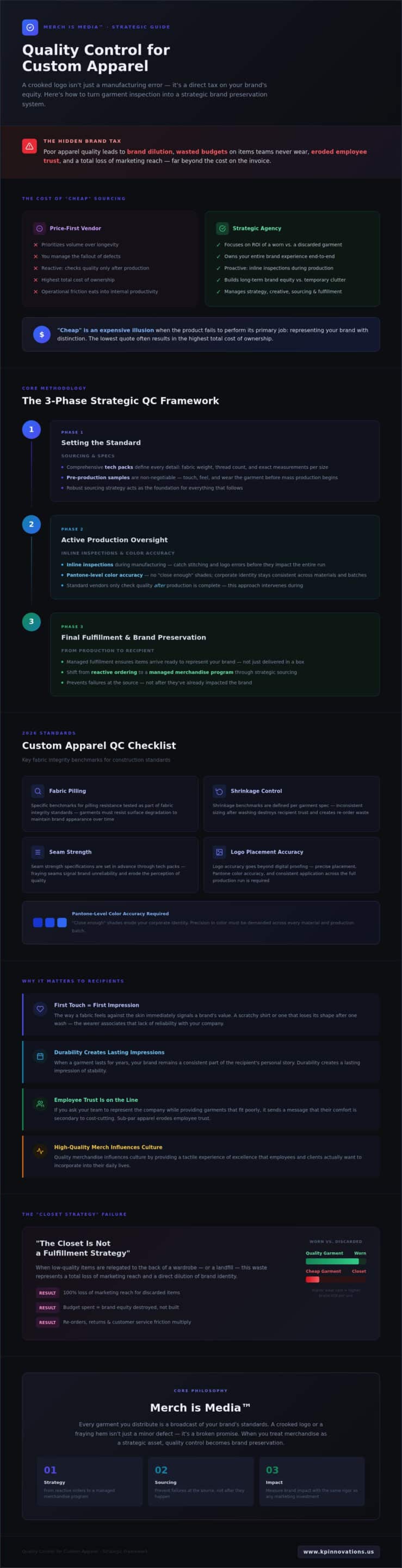
The Ultimate 2026 Custom Apparel QC Checklist
Standard checklists often focus exclusively on whether the logo is the right color. In a strategic merchandise program, that’s just the baseline. A rigorous 2026 standard for quality control for custom apparel requires a more holistic view of the garment’s lifecycle. We evaluate every item against five critical pillars to ensure it meets the “retail-ready” promise your brand requires. This proactive approach eliminates the stress of receiving a shipment that doesn’t align with your high ambitions.
- Fabric Integrity: We test for specific weight benchmarks, pilling resistance, and shrinkage rates to ensure the fit remains consistent after multiple uses.
- Construction Standards: This includes checking seam strength to prevent popping, ensuring hem alignment is perfectly horizontal, and trimming all loose threads for a polished finish; you can learn more about White Wear to see how these standards are maintained in professional workwear.
- Decoration Precision: Beyond color, we audit ink opacity to prevent fabric bleed and check embroidery tension to avoid unsightly puckering around the logo.
- Fulfillment Experience: The brand impact begins with the unboxing. We inspect packaging quality to ensure it matches your brand’s premium positioning.
- Sustainability & Compliance: Every garment must meet ethical sourcing requirements and hold relevant material certifications to protect your corporate social responsibility goals.
Tactile and Visual Inspection Points
A garment might look perfect on a hanger but fail in the real world. We recommend a mandatory “Wash Test” for pre-production samples. This process identifies if the fabric twists or if the decoration degrades under standard laundry conditions. Alignment is another critical failure point. We use precise jigs to ensure logo placement is centered and level; avoiding the crooked logo disasters that plague standard vendors. The final fabric hand-feel must be soft and consistent, ensuring the recipient actually wants to wear the item rather than discarding it. For examples of creative, high-quality printed merchandise that people love to wear, you can discover WhimSpin and their unique collections. This level of quality control for custom apparel transforms a simple product into a lasting brand asset.
Quality control doesn’t end at the factory gate. The way an item is folded and protected during shipping influences the recipient’s first impression. We audit for packaging consistency to ensure every box reflects your brand’s attention to detail. Accuracy in size distribution and individual kit fulfillment is vital to prevent operational friction during large-scale rollouts. Utilizing professional Fulfillment & Logistics services ensures that the final step of the journey is as polished as the first. To secure this level of excellence for your next project, you need to partner with experts who prioritize strategic sourcing from the ground up.
Sourcing for Brand Longevity: Your Next Steps
Moving from reactive ordering to a strategic merchandise program is the final step in protecting your brand equity. Most businesses treat apparel as a series of one-off transactions, which inevitably leads to inconsistent results and operational friction. By contrast, a strategic approach integrates quality control for custom apparel into the very beginning of the supply chain. This shift ensures that every garment produced isn’t just accurate to a digital proof but is built to endure. Your apparel should be a physical extension of your brand’s promise, requiring a system that prioritizes longevity over low-cost convenience.
The role of professional sourcing is critical in preventing QC failures before they occur. Instead of hoping a vendor’s stock item meets your standards, you can specify every detail of the manufacturing process. Building your apparel from the ground up allows for a level of precision that off-the-shelf products simply cannot match. It gives you the power to own the strategy while inviting a partner to own the complex system of production and oversight. This partnership allows your internal team to focus on high-level growth while we manage the granular details of garment excellence.
Building Your Private Label Line
Transitioning from generic blanks to a fully custom private label line is how high-growth brands distinguish themselves. This move eliminates the limitations of standard inventory and allows for deep-level customization in fabric, fit, and finish. Managing the complexity of global production requires a dedicated partner who understands the nuances of factory audits and logistics. For those ready to explore this path, our Private Label Clothing: A Founder’s Starter Guide provides a roadmap for navigating these sophisticated manufacturing choices. This transition ensures that your quality control for custom apparel remains under your direct influence throughout the entire development cycle.
The Outcome: Merchandise That Matters
The ultimate goal is to transform physical items into strategic business assets. When your merchandise is high-impact and durable, it builds a culture of pride among employees and fosters deep loyalty with customers. You can measure this impact through increased garment usage and the long-term visibility of your brand in the marketplace. High-quality apparel serves as a constant, tactile reminder of your company’s commitment to excellence. By moving away from disposable products and toward intentional assets, you ensure your marketing budget delivers a measurable return on investment. It’s time to elevate your brand experience with strategic sourcing and secure the professional standing your company deserves.
Elevate Your Merchandise Strategy Today
Transforming your apparel from a tactical expense into a strategic brand asset requires more than a simple inspection. It demands a rigorous, repeatable system that prioritizes longevity and recipient experience. By implementing a multi-phase framework and moving beyond standard vendor catalogs, you ensure your brand promise remains intact through every wash and wear. Mastering quality control for custom apparel is the ultimate key to building a culture of excellence that resonates with every employee and client who wears your gear.
You don’t have to manage this complex production system alone. Our Chief Swag Officer model provides dedicated project management and access to over 1.2 million strategic products. We provide white-glove global fulfillment to ensure your vision is realized with absolute precision. Let us manage your strategic sourcing and QC to reduce your operational friction and protect your brand equity. Your high ambitions deserve a partner that values quality and detail as much as you do. We’re ready to help you build something that lasts.
Frequently Asked Questions
What is the most common quality control failure in custom apparel?
Decoration misalignment and inconsistent sizing are the most frequent failures. These errors often stem from a lack of rigorous production management. When a logo is crooked or a medium fits like a small, it creates immediate brand dilution. We prevent these issues by treating merchandise as a strategic asset. Our project management team conducts thorough inspections to ensure every garment meets your high ambitions and professional standards.
How many samples should I request before a bulk apparel order?
You should request at least two distinct samples. The first is a pre-production sample to verify the design, fit, and material choice. The second is a top-of-production sample pulled directly from the manufacturing line. This ensures the final bulk order matches the approved standard. Requesting multiple samples is a core part of effective quality control for custom apparel, allowing you to audit the product before global fulfillment begins.
What is a tech pack, and why is it necessary for quality control?
A tech pack is a comprehensive blueprint that contains every technical specification for your garment. It includes detailed measurements, fabric types, trim details, and construction methods. Without this document, manufacturers are forced to guess, which leads to operational friction and defects. We utilize tech packs to establish a clear standard for your private label apparel, ensuring every piece is built from the ground up for your brand.
How does fabric weight (GSM) affect the quality of custom clothing?
Fabric weight, measured in grams per square meter (GSM), dictates the garment’s thickness and durability. A higher GSM typically indicates a heavier, more opaque fabric, which is often perceived as more premium for hoodies or outerwear. Conversely, a lower GSM is ideal for lightweight, breathable summer gear. Selecting the correct weight is a strategic decision that influences the Merch is Media™ impact and ensures your team actually wears the items.
What is the difference between inline and final inspection in garment manufacturing?
Inline inspection occurs during the production process to catch defects while they’re still fixable. This might involve checking the first 10% of a run for stitching errors. Final inspection is a statistically significant audit performed after the entire order is finished and packaged. While both are essential, inline oversight is the most proactive way to manage quality control for custom apparel and avoid the stress of a failed bulk shipment.
How can I ensure my brand colors are accurately represented on different fabrics?
Always provide precise Pantone Matching System (PMS) codes rather than relying on digital proofs. We recommend requesting lab dips, which are small fabric swatches dyed to your specific color. Since different materials absorb ink and dye at varying rates, this physical verification is the only way to guarantee consistency across your entire merchandise program. This level of precision protects your brand identity from the risk of “close enough” color matching.
Why is the “hand-feel” of a garment considered a quality metric?
The tactile experience of a garment determines its perceived value and longevity. If a fabric feels scratchy or stiff, recipients are likely to discard it, leading to wasted budgets and landfill-bound products. A premium “hand-feel” signals that your brand prioritizes quality and recipient comfort. This metric is essential for creating high-impact merchandise that builds culture and serves as a strategic asset for your business rather than a temporary giveaway.
What are the ethical implications of quality control in apparel sourcing?
Strategic quality control involves auditing the entire supply chain for ethical compliance. This includes verifying that factories provide safe working conditions and that materials hold certifications like OEKO-TEX or GOTS. Ensuring your sourcing is ethical protects your brand from reputational risk and legal liabilities. We manage this complexity by vetting global production partners, allowing you to focus on growth while we ensure your apparel meets the highest standards of social responsibility.