
A new label can make a garment look like yours. It can’t, by itself, make the whole experience feel like your brand. Custom apparel relabeling is a brand-control decision, not just a tag swap. What you can change depends on the garment and the production partner.
Starting with an existing garment can be a practical way to put your brand on apparel. But it may not give you control over fit, fabric, construction, or every detail wearers notice. If the labels, packaging, and garment tell different stories, the result can feel pieced together rather than intentional.
This article explains what custom apparel relabeling can involve, where its limits may be, and how it differs from private label production. You’ll learn how to choose an approach for your brand and intended use, then coordinate sourcing, production, and fulfillment as one connected experience. Because merch is media, every choice around the garment helps shape how people encounter your brand.
Key Takeaways
- Custom apparel relabeling can help align a garment with your brand, but clarify what the label change will and won’t affect.
- Assess garment suitability, label options, other branding, and distribution as separate decisions before coordinating production.
- Compare relabeling with private label production based on the control your project needs. Don’t assume one approach is always faster or less expensive.
- Use a planning checklist to review garment suitability, brand consistency, approvals, and project ownership.
- Connecting sourcing, creative, production coordination, and fulfillment can help apparel feel like one coherent brand experience. The Chief Swag Officer model offers an outsourced merchandise-department approach.
Custom Apparel Relabeling: Why a Tag Change Is Really a Brand Decision
Custom apparel relabeling means changing a garment’s labels so they reflect a brand rather than the original source. The available approach depends on the garment, supplier, and project requirements. It’s related to the broader idea of a white-label product: a product made by one party and presented under another company’s brand.
A label change doesn’t automatically change the garment itself. Its design, fit, materials, and construction may stay as they are. Set expectations accordingly: a new brand identifier can change how a garment is presented, but it can’t make an existing garment fit or perform differently.
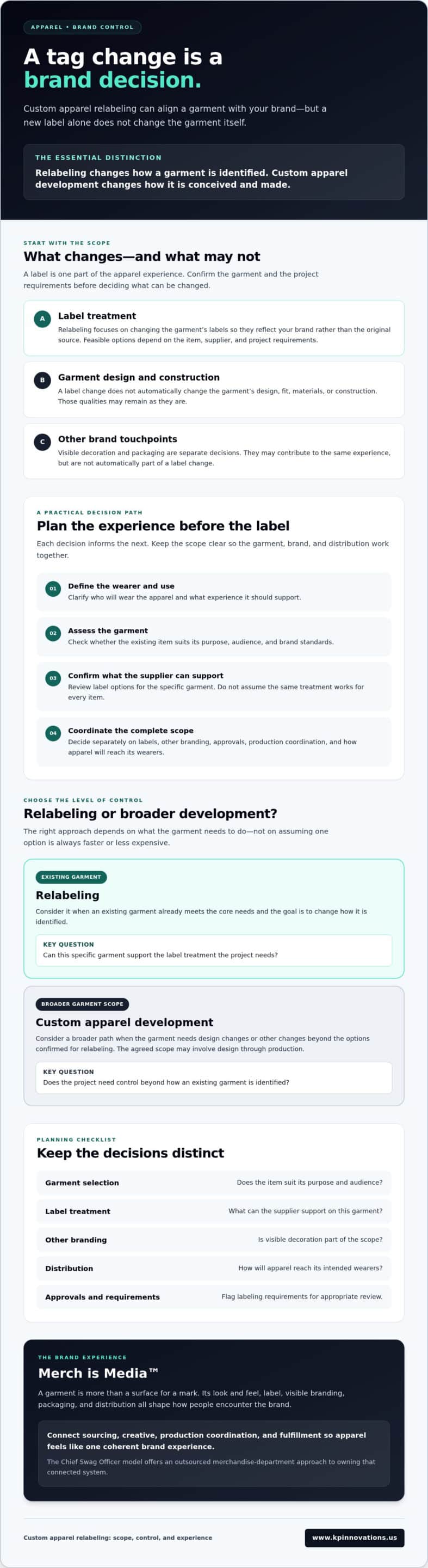
Relabeling changes how a garment is identified; custom apparel development changes how the garment is conceived and made. The right scope depends on what the brand needs the apparel to do.
What does custom apparel relabeling mean?
Relabeling focuses on the garment’s labels. External decoration, such as visible branding, and packaging are separate elements. They may contribute to the same brand experience, but they aren’t automatically included in a label change. Before setting the scope, confirm what can be changed on the specific garment. Options depend on the item, supplier, and project requirements, so don’t assume every garment can accommodate the same treatment.
Why a garment label shapes the brand experience
A label is one part of how people encounter apparel, often at close range as they wear or handle it. Employees may wear a garment at work; customers or recipients may wear it in other settings. The garment’s look and feel, visible branding, and packaging all contribute to the experience.
That experience should suit the audience and use. Apparel for a team may need to fit its work context, while a garment given to a customer or event guest may serve a different purpose. The label should make sense within that broader context, not simply carry a logo.
This is the Merch is Media™ perspective: apparel isn’t just a blank surface for a mark. It’s a repeated brand touchpoint that can influence how people feel about an organization and their connection to it. Treating the label as one deliberate part of the whole helps avoid a mismatch between the garment, the audience, and the message.
How Apparel Relabeling Works: Garments, Labels, and Project Boundaries
A well-scoped relabeling project starts with the intended experience, not a preferred label treatment. Define why the apparel is needed and who will wear it. Then assess whether a candidate garment suits that use, confirm which changes are feasible, and coordinate the approved work through production and distribution.
The garment’s suitability determines which relabeling options are worth considering. Ask a project partner to review the specific item and confirm what the supplier can support. Don’t assume a label change is possible or that the same options will apply to different garments.
What should a team assess before relabeling?
Begin with the wearer and use case. Apparel for employees in a work setting may call for different choices than a gift for customers or event attendees. Consider the garment’s intended use, the brand standards it needs to reflect, and the experience you want the wearer to have.
Then separate the project decisions so a label change doesn’t obscure other needs:
- Garment selection: Does the existing item suit its purpose and audience?
- Label treatment: What changes can the supplier support for this garment?
- Other branding: Is visible decoration part of the scope, or is the project limited to labels?
- Distribution: How will the apparel reach its intended wearers?
Ask a qualified project partner to confirm feasibility before approving a plan. Flag any labeling requirements that may apply so the appropriate people can review them. This keeps project decisions separate from legal conclusions and helps surface questions early.
Where relabeling stops and custom development begins
Relabeling may suit a project when an existing garment already meets its core needs and the goal is to change how it’s identified. If the garment needs a different design or other changes beyond the confirmed options, the project may call for broader custom apparel development.
That broader path can involve design through production, with the details determined by the agreed scope. For more context on private label apparel and the choices involved, see Private Label Clothing: A Founder’s Starter Guide. The distinction is practical: relabeling works within the limits of an existing garment, while custom development starts with a wider set of design decisions.
For a sourcing plan that accounts for garment fit, supplier options, and project needs, explore apparel sourcing support.
Relabeling vs. Private Label Apparel: Choose the Right Level of Control
The key question isn’t which approach sounds more customized. It’s how much influence your brand needs over the garment itself. Custom apparel relabeling changes how an existing garment is identified, if the item and supplier support the requested changes. Private label apparel can involve a broader design-to-production scope, depending on the project.
Neither route is automatically cheaper, faster, or better. Compare the control you need with the decisions and coordination each approach requires.
| Decision area | Relabeling | Private label apparel |
|---|---|---|
| Garment choice | Starts with an existing garment that must suit the intended use. | May allow a broader role in shaping the garment, subject to project scope. |
| Design scope | Centers on changing garment labels; confirm any other changes separately. | Can extend across design and production decisions. |
| Brand control | Influences how the garment is identified, without necessarily changing its design, fit, materials, or construction. | Offers more potential influence over the garment’s development. |
| Coordination | Requires alignment on garment suitability, feasible label changes, and distribution. | May require coordination across a wider set of design and production decisions. |
| Suitable project situation | An existing garment meets the core need, and the requested brand change is feasible. | The project needs more influence over the garment than a label change can provide. |
When relabeling may fit the project
Relabeling may make sense when a candidate garment already works for its audience and use. For example, a team may have found an existing garment that fits its intended role and brand standards, with the main open question being how the garment will be identified. Before committing, review the actual garment, validate its suitability, and ask the supplier or project partner to confirm label options and feasibility. Don’t assume inventory, order quantities, timing, or costs.
When a broader private label approach may fit better
If the brand needs more influence over design and production, a label change may not address the real requirement. Private label development can involve a wider process, from design through production, with the exact scope confirmed for each project. That doesn’t mean every apparel project needs custom manufacturing. Identify which garment decisions are essential before choosing a path. Private Label Clothing: A Founder’s Starter Guide offers broader context on this design-to-production route.
Whichever direction you choose, assess the production partner against the decisions your project requires. Choosing the Right Apparel Factory is a useful lens for thinking through that evaluation. For apparel projects that require production coordination, production management support can be part of the wider project plan.
A Practical Checklist for Planning Custom Apparel Relabeling
A clear plan connects the garment to the people who will wear it and the process that gets it to them. Use this checklist to set direction before approving design details or starting production.
- Define the wearer and purpose. Is the apparel for an employee program, a uniform program, client gifting, or another business use? Describe the setting, intended wearer, and experience the garment should create.
- Set success criteria. Decide what the project needs to achieve before choosing a garment. Criteria might include suitability for the intended use, alignment with brand standards, and a clear distribution plan.
- Assess garment suitability. Review the specific garment against the project’s purpose. Ask a qualified project partner to confirm whether the requested label changes are feasible for that item. Don’t assume the same options apply to different garments.
- Check brand consistency. Consider how the label relates to visible branding and packaging. Confirm that each element supports the same intended experience rather than treating the label as the whole brand expression.
- Confirm requirements and approvals. Identify labeling questions that may need review by an appropriately qualified professional. Assign an approver for brand decisions and document the approved garment, label scope, and other requested elements before production proceeds.
- Assign ownership through distribution. Name who owns garment selection, brand approval, production decisions, and distribution. Decide how finished apparel will be stored, ordered, or delivered based on the program’s needs.
Define the wearer, purpose, and success criteria
Start with the wearer’s experience, not the label. A uniform program and a client gift serve different purposes, so the garment and brand expression should reflect that difference. Merchandise strategy can help teams clarify the purpose and decision criteria; creative development can then support a consistent brand expression.
Coordinate approvals, production, and distribution
Clear ownership reduces uncertainty as a project moves from review to production. Give each decision a responsible owner, and make sure the people approving the brand experience understand what the supplier has confirmed as feasible. For broader apparel planning, Private Label Clothing: A Founder’s Starter Guide offers related context on design and production.
Use the checklist to bring garment choices and project requirements into one sourcing conversation. Discuss apparel sourcing for your project.
Make Apparel Relabeling Part of a Managed Brand Experience
A relabeling decision affects more than the garment. It sits within a chain of connected choices: why the apparel is needed, which garment can meet that need, how the brand should appear, what production can support, and how the finished items will reach the intended people. Treating these as separate conversations can leave teams coordinating multiple handoffs without a clear owner for the overall experience.
A managed approach brings workstreams together while keeping decisions and responsibilities visible. The goal isn’t to assume every project needs every service. Align the scope with the business purpose, then coordinate the relevant steps.
What a strategic apparel partner should help coordinate
Start with the project objective and intended wearer. Coordinate garment decisions with brand direction, confirm sourcing options, and establish which production steps fall within the agreed project scope. Creative decisions should support the same audience and purpose as the garment selection.
Fulfillment planning connects those decisions to the recipient. For an employee program, consider how employees will access or receive apparel. For client gifting, the delivery experience may be part of how the relationship is expressed. The right plan depends on the program, but consider distribution before production is complete rather than treating it as an afterthought.
KP Innovations’ Chief Swag Officer model is an outsourced merchandise-department approach. It brings strategic oversight to merchandise work that might otherwise be split among internal teams and separate vendors. Clear project ownership can help reduce disconnected handoffs, though the outcome depends on each project’s needs and scope.
Turn relabeling into a deliberate brand touchpoint
Before finalizing a project, consider the complete wearer experience. Does the garment suit its intended use? Does the label fit the brand and feel consistent with other branding and the way the apparel will be distributed? These questions matter whether the project supports a uniform program, employee recognition, or client gifting. The garment is one part of the experience, not the whole message.
That’s the practical meaning of Merch is Media™: apparel carries the brand into a real interaction with an employee, customer, or partner. Thoughtful coordination can help make that interaction feel intentional, from the initial sourcing decision through fulfillment.
For help assessing apparel options and project needs, explore sourcing support.
Make the Next Apparel Decision Deliberate
A label can identify a garment with your brand, but it can’t change what the garment is. The right path depends on whether an existing item meets the project’s needs or whether your brand requires broader influence over design and production. Either way, clarify the wearer experience, confirm what’s feasible, and give someone ownership of the connected decisions.
That coordination matters because apparel is part of how people experience your organization. KP Innovations approaches merchandise through the Merch is Media™ philosophy, with private label apparel projects managed from design through production. Its white-glove project management can extend from design to global fulfillment, and its sourcing access includes over 1.2 million products.
For teams considering custom apparel relabeling, start by defining the intended use and assessing garment options against it. Explore sourcing support for your apparel program and bring the project’s requirements into one conversation. With a clear purpose and coordinated plan, apparel can become a more intentional part of your brand experience.
Frequently Asked Questions
What is custom apparel relabeling?
Custom apparel relabeling means changing a garment’s labels to reflect a brand, subject to what the garment, supplier, and project can support. It can affect how the garment is identified, but it doesn’t necessarily change its design, fit, materials, or construction. Treat the label as one part of the brand experience, alongside the garment itself, any visible branding, and how the apparel reaches its intended wearer.
Is relabeling the same as private label clothing?
No. Relabeling generally starts with an existing garment and focuses on changing its brand identification, if that change is feasible. Private label clothing can involve a broader design-to-production process, with the scope confirmed for each project. The distinction is the level of influence over the garment: relabeling works within an existing item’s boundaries, while private label development may give a brand more input into how the garment is developed.
Can any garment be relabeled?
No. The garment’s suitability and the supplier’s capabilities determine whether relabeling options are available. Don’t assume every garment can accommodate the same changes or that a label treatment confirmed for one item will work for another. Before committing, have a qualified project partner review the specific garment and confirm feasibility with the supplier. This helps set a realistic scope before the project is approved.
What should a business consider before relabeling apparel?
Start by identifying who will wear the apparel, where it will be used, and what experience it should create. Then assess whether the garment fits the intended use and brand standards. Confirm feasible label changes, decide whether other branding or packaging is in scope, and assign owners for approvals, production decisions, and distribution. If labeling requirements may apply, seek review from an appropriately qualified professional rather than assuming they’re covered by a label change.
When should a brand choose custom apparel instead of relabeling?
Consider broader custom apparel development when the existing garment can’t meet the project’s core needs or the brand needs more influence over design and production. If the existing item is suitable and the main goal is to change its brand identification, relabeling may be worth exploring. Compare options against the intended wearer experience and project scope. Neither approach is automatically faster, less expensive, or better for every use.
How can a company manage an apparel relabeling project?
Give one owner responsibility for connecting the project’s purpose, garment selection, brand approvals, sourcing, production coordination, and distribution planning. Confirm what the supplier can support before finalizing production decisions, and make sure the fulfillment plan reaches the intended recipients. KP Innovations’ Chief Swag Officer model takes an outsourced merchandise-department approach, coordinating merchandise work across a broader program. Its private label apparel expertise spans design through production.