
With private label corporate apparel, a creative concept may look clear while leaving key production details open, from measurements and construction to labels and colorways. A tech pack is not the finish line. It is the handoff that helps determine whether the idea can be produced consistently.
Unclear instructions can lead to avoidable sample revisions, approval delays, or garments that don’t feel consistent across teams. A useful tech pack turns decisions into clear instructions, but the document alone can’t define who coordinates sourcing, sampling, approvals, production, and fulfillment. Those responsibilities need to be clear, too.
This article explains what a production-ready tech pack should clarify, what to ask a prospective apparel partner about files and revisions, and how to connect garment choices to the people who will wear them. You’ll also learn how to assess whether a partner can support the wider apparel process without assuming they provide standalone tech pack creation. The goal is a dependable program where each apparel decision supports a consistent brand and wearer experience.
Key Takeaways
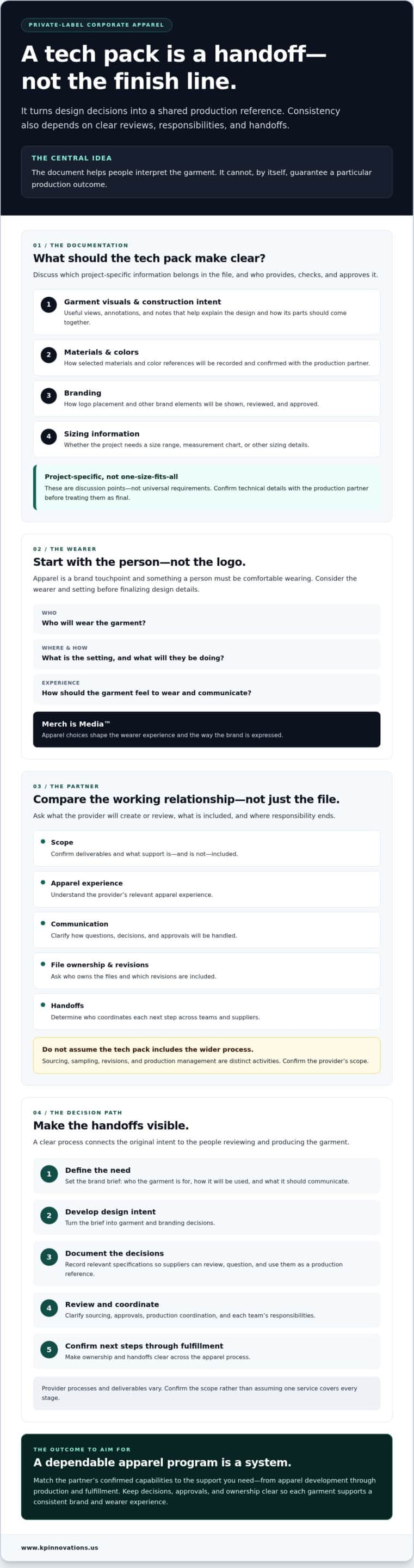
- Assess whether an apparel tech pack clearly communicates garment visuals, construction intent, materials, colors, branding, and sizing information relevant to your project.
- Compare private label corporate apparel partners by scope, apparel experience, communication, file ownership, and how they handle handoffs.
- Use clear checkpoints to define needs, confirm deliverables, review documentation, approve decisions, and coordinate next steps across teams.
- Consider how apparel choices shape the employee experience and brand perception, not just how a logo appears on a garment.
- Look for a partner whose confirmed capabilities match the support you need, from apparel development through production and fulfillment.
Private Label Corporate Apparel: What Tech Pack Creation Services Actually Do
A garment idea can be clear to the team that imagined it and still leave a supplier guessing. If design intent lives in scattered emails, sketches, and conversations, different people may interpret the same garment differently. Technical documentation gives everyone a shared reference point.
An apparel tech pack is a set of documents that communicates a garment’s design and relevant specifications to the people developing or producing it. It functions as a technical specification, a documented description of requirements rather than just an attractive concept image. Depending on the project, it may bring together garment visuals, construction intent, materials, colors, branding, and sizing information.
That clarity supports alignment, but documentation can’t guarantee a particular production outcome. Results also depend on how decisions are reviewed, interpreted, sourced, and coordinated. Before engaging a provider, ask what they’ll create or review, what files and revisions are included, and where their responsibility ends.
How does a tech pack fit into private-label apparel development?
The work often begins with a brand brief and design intent: who the garment is for, how it will be used, and what it should communicate. Concept development turns that direction into design decisions. Technical documentation records those decisions in a form a supplier can review, question, and use as a production reference.
From there, sourcing identifies potential materials or suppliers, while production coordination manages relevant approvals and handoffs. These are distinct activities, even when one partner supports several of them. Provider processes and deliverables vary, so confirm the scope rather than assuming a tech pack service includes sourcing, sampling, revisions, or production management.
Why corporate apparel needs more than a logo placement
Start with the wearer and the setting. A garment intended for a customer-facing team may need to support a different workday and brand expression than apparel used for an internal event. Consider who will wear it, what they’ll be doing, and how the garment should feel to wear before finalizing design details.
Those choices shape the questions behind the documentation: which design elements matter, how branding should appear, and what sizing information the team needs to review. In private label corporate apparel, the garment is a brand touchpoint as well as something a person must be comfortable wearing. For broader context on developing private-label clothing, see the private label clothing starter guide.
What Should Apparel Tech Pack Creation Services Include?
A useful tech pack is defined by the decisions it captures, not by how many pages it contains. For private label corporate apparel, use a checklist to discuss the information your project needs rather than assuming every garment requires the same template. The aim is to make the design understandable to the people reviewing and producing it, while keeping responsibility for each input clear.
Which garment details should buyers discuss with a provider?
Ask how the documentation will show the garment from useful views and explain construction intent. Then confirm which project-specific details belong in the file and who will provide, check, and approve them.
- Visuals and construction: What views, annotations, or notes will help communicate the design and how its parts should come together?
- Materials and colors: How will selected materials and color references be recorded, and who confirms that the references are appropriate for the production partner?
- Branding: How will logo placement or other brand elements be shown, reviewed, and approved?
- Sizing: Does the project call for a size range, measurement chart, or other sizing information?
These are discussion points, not universal requirements. Confirm technical details with the production partner before treating them as final. If responsible sourcing is part of your evaluation, ask how a provider assesses suppliers and supports your expectations. The Fair Labor Association’s ethical manufacturing standards offer a reference for labor practices.
How should sizing, revisions, and approvals be handled?
Agree in writing on deliverable formats, who owns the files, how revisions are requested, and which people have approval authority. Clarify whether sizing information is needed and who verifies it. Each change should have a clear reviewer and a defined route to the production partner, so teams aren’t relying on disconnected messages or outdated documents.
Before work begins, map the handoffs: who supplies design inputs, who checks the documentation, who approves changes, and who communicates the approved version to the supplier. These responsibilities may sit with different people or partners, so make ownership explicit.
Supplier selection and documentation work together: a clear file still needs a production partner that understands the project’s requirements. For additional context on sourcing, review the apparel sourcing page and ask what support is available for your specific project.
How to Compare Apparel Tech Pack Creation Services Before You Choose
A polished sample file doesn’t tell you who will keep a corporate apparel project moving. Compare providers on the work they own, the decisions they support, and what happens after documentation is delivered. This helps distinguish a file-only service from broader support that may involve supplier communication or production coordination.
Scope: Does the provider create documentation only, or also review and update it as the project develops? Ask which deliverables and revision rounds are included, and what falls outside the agreed scope.
Apparel experience: Can the provider explain how its process accounts for your garment type, wearer, and intended use? Request a sample process or anonymized deliverable if they’re able to share one.
Communication: Who is your main contact? How are questions, changes, and approvals shared among your team and the supplier?
Ownership: Who owns the technical files, and who maintains the approved version? Clarify how you’ll receive files and whether you can continue using them with another partner.
Handoffs: Does supplier communication or production follow-up come with the service, or is that a separate responsibility? Identify who coordinates each transition before work starts.
What questions reveal the provider’s real scope?
Ask who creates, reviews, and updates the documentation at each stage. Then pin down the boundaries: What counts as a revision? Who approves changes? How are final decisions communicated to production partners? Clear answers make accountability easier to assess than a broad promise of support.
Don’t compare providers as if their services are identical when one offers a technical file and another may coordinate additional project work. Evaluate each proposal against the same needs and record what is included, what is separate, and who owns every handoff.
How do you assess fit for a corporate apparel program?
Test the provider’s process against the people who will wear the garments. Consider their roles, work conditions, and the brand requirements each garment needs to serve. A process that captures input from marketing, HR, operations, and wearers can help teams make connected decisions rather than treating each garment as an isolated order.
Creative development helps translate brand intent into an apparel concept before production details are settled. Ask whether this work is part of the provider’s scope, and confirm which services are available for your project.
For private label corporate apparel, the right fit isn’t necessarily the provider with the longest service list. It’s the one whose confirmed scope, communication, and handoffs match how your organization needs to make decisions and carry them through.
From Tech Pack Review to Production: Build a Clear Decision Process
A reviewed tech pack is a decision point, not an automatic green light. Before work moves forward, align on the garment’s purpose, confirm who owns each next step, and record what the team has approved. A clear process helps keep brand intent, wearer needs, and production conversations connected without assuming a particular timeline or outcome.
Use this sequence to organize the work:
- Define the need. Document who the garment is for, how it will be used, and any distribution or ongoing program needs.
- Confirm scope. Clarify which partner handles documentation, supplier communication, approvals, and production follow-up.
- Review the documentation. Check that the project’s agreed design and technical decisions are reflected accurately.
- Approve decisions. Assign a decision-maker to consolidate feedback and identify the approved version.
- Coordinate next steps. Confirm who shares approved information with the production partner and how later changes will be handled.
Which stakeholders should review corporate apparel requirements?
Involve people with different responsibilities at the right checkpoints. Marketing or brand owners can assess whether the concept reflects the company. HR or program owners can consider the employee experience and how the apparel will be issued. Operations can flag practical needs tied to use and distribution. Representative wearers can offer input on whether the garment suits the realities of their work.
One person should be accountable for gathering feedback and resolving conflicting direction. Keep a written record of the intended use, key decisions, open questions, and approval owner. That gives contributors a clear way to participate without turning every preference into a competing instruction.
How can buyers prevent gaps between approval and production?
Identify the exact file or documentation version the team approves, who receives it, and how revisions will be communicated. Also agree in advance who coordinates with suppliers and follows up on production questions. Don’t assume those responsibilities are included in a documentation engagement; confirm the handoff with each provider.
For projects that need coordination beyond the technical file, ask what project management and fulfillment support may apply. For private label corporate apparel, a dependable handoff is part of the brand experience: each decision should reach the people responsible for carrying it forward.
Need to clarify how supplier coordination fits into your apparel program? Review the apparel sourcing page and confirm the project scope with your partner.
Choose a Corporate Apparel Partner That Owns the Whole System
A tech pack can clarify a garment’s requirements, but it can’t decide whether that garment belongs in an onboarding program, how it connects to other employee apparel, or who will coordinate production and fulfillment. A standalone technical deliverable may suit a project with a defined concept and an experienced team ready to manage the next steps. If apparel is part of a broader employee or brand experience, consider whether you need a partner to coordinate more of the work.
That distinction matters because clothing is more than a place to put a logo. It’s a brand touchpoint employees wear and experience. The Merch is Media perspective considers merchandise as part of how a brand expresses itself and builds relationships, not simply as an item to order.
When is a broader apparel partner a better fit?
Broader support may be useful when apparel connects to onboarding, uniforms, recognition, or teams working across locations. In those programs, product and brand decisions can intersect with production coordination and fulfillment. Shared ownership can help keep those activities connected, but the specific responsibilities still need to be agreed for each project.
KP Innovations offers private-label apparel expertise from design through production, along with project management and fulfillment. The supplied information doesn’t identify standalone tech pack creation as a named service. Confirm directly whether the team can create, review, or coordinate technical documentation for your project, and what files, revisions, and related responsibilities are included.
What should you confirm before starting a project?
Before work begins, align on the intended audience, garment purpose, key stakeholders, and who has authority to approve decisions. Then clarify the operational details in writing:
- Whether tech pack creation or review is available for the project.
- Which technical files and revisions are included, and what format you’ll receive.
- Who owns each project responsibility, from supplier discussions to production handoffs.
- Any applicable fees, how they’re determined, and what falls outside the agreed scope.
A partner should be able to distinguish what’s confirmed from what needs project-specific review. That clarity helps your team assess the right level of support without assuming a technical document includes supplier coordination or production management.
If you’re evaluating apparel development alongside the broader program, review the apparel sourcing page and ask KP Innovations which project support applies to your needs.
Build an Apparel Program That Carries Your Brand Forward
A tech pack is useful when it captures decisions clearly and supports a well-defined handoff. But dependable private label corporate apparel takes more than a technical file: it connects garment choices to the wearer experience and makes responsibilities across the wider program clear.
As you evaluate partners, look beyond the document. Confirm exactly what technical files and revisions are available, who owns approvals, and whether project management and fulfillment support match your needs. KP Innovations supports private-label apparel from design through production, with white-glove project management and fulfillment. Confirm directly whether tech pack creation or review is available for your specific project and what the scope includes.
To plan your apparel program, contact KP Innovations about your apparel needs and clarify the support your project calls for. With thoughtful decisions and clear ownership, apparel can become a consistent, meaningful part of your brand experience.
Frequently Asked Questions
What is an apparel tech pack?
An apparel tech pack is a set of project-specific documents that communicates a garment’s design and production requirements to the people developing or making it. Its contents depend on the garment, provider, and production process. Before treating a file as ready for production, ask which details it covers, who provides and checks them, and how the team records approvals and revisions. Clear documentation supports alignment, but doesn’t replace communication.
What should a clothing tech pack include?
A clothing tech pack may document design views, construction intent, materials, colors, branding, measurements, sizing, and other project-specific details. Not every garment needs the same information, and this list isn’t a universal technical standard. Ask the provider who creates each part, which file formats you’ll receive, who approves the information, and how updates reach production partners. Confirm technical requirements with the partner responsible for production.
Do I need a tech pack for private-label corporate apparel?
You may need clear technical documentation when a garment is being developed or customized, but the right scope depends on the product and supplier process. First define how the apparel will be used and which details need to remain consistent. Then ask a prospective partner whether documentation is needed, who prepares it, and what decisions it will support. That conversation can help identify the right level of documentation before work proceeds.
What is the difference between a tech pack and a clothing design?
A clothing design communicates the visual concept and intended look. A tech pack organizes relevant design and product decisions into information for development and production. The boundary between these deliverables can vary by provider. Ask whether creative development, technical documentation, supplier coordination, and production management are separate services or included in a broader project. Defining those roles helps your team understand which partner owns each decision and handoff.
Can a tech pack guarantee that a garment will match the design?
No, a document alone can’t guarantee that a garment will match a design. Clear specifications can help teams align, but results also depend on supplier interpretation, approvals, materials, and production processes. Ask how the provider checks understanding, handles changes, and communicates approved decisions. Confirm any quality-control steps or commitments directly with the responsible partner. Don’t assume they’re part of a tech pack service unless they’re stated in the project scope.
How do I choose apparel tech pack creation services for a corporate program?
Compare the documented scope, apparel experience, revision process, approval ownership, supplier communication, and related services. Consider whether you need a file alone or support across more of your private label corporate apparel program. KP Innovations supports private-label apparel from design through production, with project management and fulfillment. Confirm directly whether tech pack creation or review is available for your project, what deliverables are included, and how the work connects to your production needs.