
Corporate branded merchandise isn’t just an inventory problem. It’s a brand experience that needs an owner. When purchases happen one request at a time, even thoughtful items can arrive without a clear purpose, while approvals, stock, distribution, and reporting create operational strain.
Teams often need merchandise for employees and customers, but disconnected orders make it difficult to connect each choice to a business goal or deliver a consistent experience. The answer isn’t simply to order more carefully. It’s to manage merchandise as media, a tangible way to express what your brand stands for and how it treats people.
This article explains how to build a corporate branded merchandise program that links decisions to employee and customer experiences. It covers how to coordinate strategy, creative, sourcing, ordering, and fulfillment, and how to create a repeatable process for review and improvement. We’ll look at what program ownership involves, where operational friction tends to emerge, and how a Chief Swag Officer model can bring the moving parts under one accountable approach.
Key Takeaways
- Define the audience, purpose, and intended experience before considering products.
- Use different briefs for recognition, uniforms, customer relationships, and events.
- Evaluate merchandise partners by how they coordinate the program, not by product count alone.
- Build a clear process from business brief through fulfillment, with decision owners at each handoff.
- Give corporate branded merchandise clear ownership and review the program regularly.
Corporate Branded Merchandise Is More Than an Order
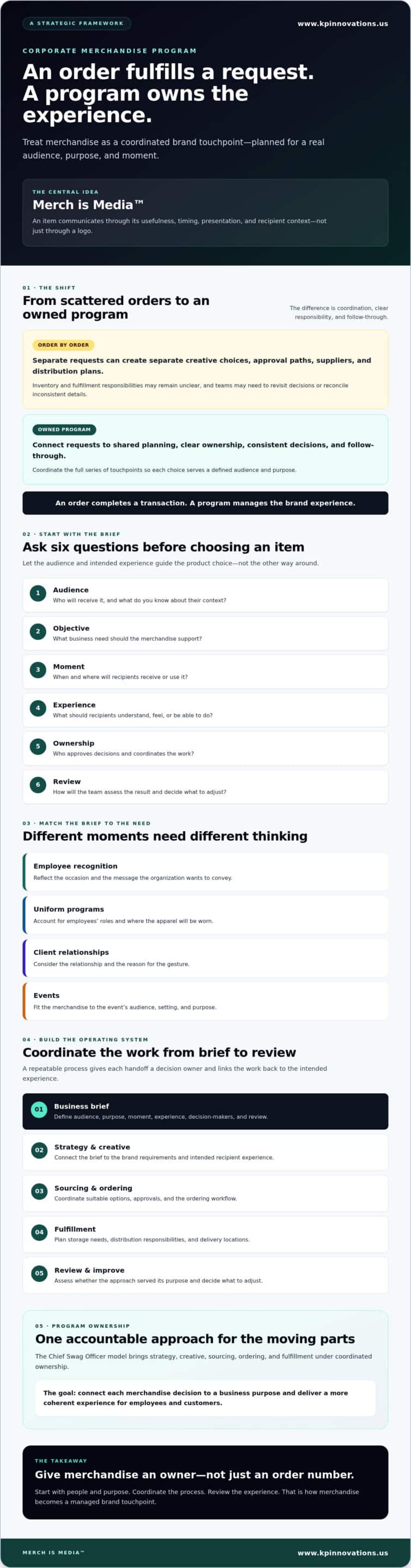
A team requests shirts for an event. HR orders welcome items for new employees. Sales sends gifts to clients. Each purchase may make sense on its own, but without someone responsible for the full experience, the choices can feel disconnected and the work gets spread across teams.
Corporate branded merchandise is best understood as a set of physical brand touchpoints chosen for a particular audience and purpose. The item matters, but so do the reason it’s selected, when it arrives, how it’s presented, and whether it suits the recipient’s context. That’s the thinking behind Merch is Media™: an item communicates through its use and context, not just through a logo.
A merchandise program is a coordinated system for choosing, creating, distributing, and reviewing branded items in service of a defined audience and purpose. A one-time order addresses an immediate request. A program connects requests to shared planning, clear ownership, consistent decisions, and follow-through.
What makes merchandise a brand experience?
Usefulness, timing, presentation, and recipient context shape how an item is received. For employee onboarding, a practical item selected with a new hire’s first days in mind serves a different role than one chosen only because it can carry a logo. For client gifting, the relationship and occasion should guide the choice and presentation. Neither context guarantees a particular response; both call for decisions made from the recipient’s perspective.
Why do disconnected orders create operational friction?
Separate requests can mean separate creative choices, approval paths, suppliers, and distribution plans. Teams may need to revisit decisions or reconcile inconsistent details, while inventory and fulfillment responsibilities remain unclear. Without an owner coordinating the work, it’s harder to create a consistent experience across teams and occasions.
The distinction is simple: an order completes a transaction; a program manages a series of brand touchpoints. For foundational terminology, the article “What Are Promotional Products?” provides a starting point. Promotional merchandise also offers a neutral overview of the category, its common uses, and its role in marketing. The strategic question is what each touchpoint is meant to communicate and who is responsible for making the experience coherent.
Start with the Audience and Purpose, Not the Product Catalog
A catalog can help you compare options, but it can’t tell you what employees, customers, or event guests need from the experience. Define that experience first, then select an item to support it. For corporate branded merchandise, the brief should lead the product choice, not the other way around.
Use this planning framework before discussing quantities or formats:
- Audience: Who will receive the item, and what do you know about their context?
- Objective: What business need should it support?
- Moment: When and where will recipients receive or use it?
- Experience: What should recipients understand, feel, or be able to do?
- Ownership: Who approves decisions and coordinates the work?
- Review: How will the team assess whether the approach served its purpose?
Which business need should the merchandise program serve?
Different needs call for different briefs. Employee recognition should reflect the occasion and the message the organization wants to convey. Uniform programs need to account for employees’ roles and where the apparel will be worn. Client relationship efforts should consider the relationship and reason for the gesture. Event merchandise should fit the event’s audience, setting, and purpose. For recognition planning, see employee recognition programs.
Before selecting an item, ask: after receiving it, what should the person understand, feel, or be able to do? The answer helps distinguish an item that supports a real need from one chosen mainly because it can carry a logo. The Promotional Products Association International can provide broader industry context, but your audience and objective should guide your own decisions.
What belongs in a useful merchandise brief?
Keep the brief practical and specific. Capture:
- The audience, objective, and intended recipient experience
- Brand requirements and the moment or setting for distribution
- Decision-makers, approvers, and responsibilities
- Storage needs, ordering workflow, and delivery locations
- How the team will review the result and decide what to adjust
These details help teams compare suitable options without letting a product catalog set the strategy. For additional selection guidance, look for the article “How to Choose the Right Merchandise for Your Brand.” If product selection is the next challenge, a sourcing approach that begins with the brief can help keep the requirements at the center of the discussion.
Compare Merchandise Partners by Program Ownership, Not Product Count
A large catalog may offer choice, but it doesn’t tell you who will turn a business need into a clear brief, coordinate approvals, or manage fulfillment. When comparing providers of corporate branded merchandise, look at the work each one takes responsibility for, not just the number of products they can show you.
A product supplier helps you obtain an item; a program partner coordinates the decisions and handoffs that make merchandise work as a connected brand experience. Use this comparison to identify the level of ownership your team needs, then confirm the actual scope with each provider.
| Program responsibility | Order-taking | Project support | Strategic program ownership |
|---|---|---|---|
| Discovery | Responds to a product request | Clarifies project details | Connects the brief to audience and business goals |
| Creative coordination | Applies supplied artwork | Coordinates revisions and approvals | Aligns creative decisions with the intended experience |
| Sourcing and production | Provides product options and order updates | Coordinates sourcing and production communication | Manages these steps within the agreed program scope |
| Fulfillment | Fulfills the order as scoped | Coordinates project distribution | Plans fulfillment across recurring program needs |
| Ongoing management | Addresses new orders as they arise | Supports projects individually | Reviews the program and coordinates adjustments |
These are useful distinctions to investigate, not fixed industry definitions. Catalog breadth alone doesn’t establish fit, product quality, availability, or which services a provider includes. Ask what is covered, what your team must supply, and who owns each handoff.
What questions reveal a partner’s actual scope?
Ask who translates business goals into a brief and coordinates creative approvals. Clarify who manages sourcing, production communication, inventory, and distribution, and how responsibilities change if plans or stakeholders change. Finally, ask how often the work is reviewed and who recommends adjustments. Specific answers help distinguish a product quote from coordinated program support.
How should leaders assess operational fit?
Start with your team’s capacity, recipients’ locations, how often orders recur, and whether different audiences have different needs. If employees or teams need a consistent way to place repeat orders, a company store for centralized ordering may be relevant. A managed program doesn’t have to add complexity. Clear ownership can reduce ambiguity by showing who decides, approves, orders, and follows through.
Build a Corporate Merchandise Program from Brief to Fulfillment
A reliable process makes ownership visible at every handoff. Your internal team doesn’t need to manage every task, but it should decide who sets the objective, approves the brand direction, confirms the audience, and signs off on the final plan.
Move through the work in sequence:
- Business brief: Define the audience, purpose, recipient experience, distribution context, and project constraints. Name a decision owner and the people who need to approve.
- Planning: Turn the brief into requirements. Confirm how items will be ordered, stored, and distributed, and what information the team needs before moving forward.
- Creative: Align the design with brand guidelines and intended use. Identify who reviews artwork and who gives final approval.
- Sourcing: Evaluate suitable categories and options against the brief, not just preference. Confirm project-specific availability and details before finalizing decisions.
- Production: Establish who tracks production communication, approvals, and updates, and how changes will be escalated.
- Fulfillment and review: Coordinate delivery with the recipient experience in mind. After distribution, gather feedback and decide what to retain or adjust for the next cycle.
What happens during strategy, creative development, and sourcing?
Strategy translates audience and purpose into requirements before anyone compares product categories. Creative development gives stakeholders a clear way to review and approve the visual direction. Sourcing checks options against those agreed needs. The handoff matters: sourcing should work from an approved brief, while the internal team remains accountable for brand decisions and final approval. Explore merchandise strategy services as one part of this coordinated sequence.
How do production, distribution, and review complete the program?
Production oversight and fulfillment shape the same experience. Confirm who communicates updates, handles approved changes, and coordinates delivery locations. Actual timelines, product availability, and logistics depend on project-specific details, so verify them as the work is planned. For recurring needs, a company store may support controlled access and ordering, while fulfillment can coordinate distribution.
Keep the review practical. Ask recipients and internal teams what worked, where ordering or delivery created friction, and whether the experience matched the brief. Use those observations to adjust the next cycle. Centralized program management can clarify responsibilities without removing your team’s role in setting priorities and approvals. If sourcing is a key handoff, learn about KP Innovations’ sourcing services.
Make Merchandise a Managed Brand Asset with KP Innovations
When strategy, approvals, sourcing, production, and fulfillment are treated as connected work, the next question is who keeps them aligned. KP Innovations approaches corporate branded merchandise as a managed brand experience, not a sequence of isolated orders. Its “Merch is Media™” philosophy recognizes that what a company puts into people’s hands communicates through the item, its use, and the moment it arrives.
What does a Chief Swag Officer bring to the program?
The Chief Swag Officer model gives the merchandise system a clear coordination point. It’s not a product category or simply another name for ordering. It describes long-term program ownership across strategy, creative, sourcing, and fulfillment, with the aim of connecting decisions and handoffs instead of leaving each team to manage its requests alone. Learn more about the Chief Swag Officer model.
That ownership matters because a merchandise program touches multiple functions. Marketing may set brand requirements, HR may shape employee experiences, and operations may need to coordinate ordering or distribution. A designated partner can help bring those needs into one process while internal stakeholders retain their role in setting priorities and approving decisions. Review can then consider more than whether an order was completed: Did the experience fit the audience and purpose? Were responsibilities clear? What should change next time?
KP Innovations serves businesses nationwide and provides access to over 1.2 million products. Its services include strategy, creative development, sourcing, program management, production management, fulfillment, company stores, and custom apparel. Global fulfillment is also part of its stated capabilities. Which services make sense depends on the organization’s needs and the scope of its program.
What should a first conversation establish?
Start with the people and the purpose, not a product list. Bring the audiences you need to serve, the business objectives behind the work, the challenges with current requests or distribution, and where recipients are located. It’s also useful to identify existing approval steps, ordering patterns, and internal decision-makers.
With that context, a sourcing discussion can focus on options that fit the brief and the program’s practical requirements. Product availability and logistics are project-specific, so confirm those details as needs are defined. The goal is to understand scope and ownership before choices are made.
To explore the process, review KP Innovations’ merchandise sourcing services.
Give Your Merchandise Program Clear Ownership
Corporate branded merchandise works best when choices begin with the audience and purpose, not the product catalog. A clear brief helps teams align the experience, approvals, sourcing, and fulfillment. When evaluating a partner, look beyond product count to understand who coordinates the program and follows through.
KP Innovations approaches merchandise as a managed brand experience. The Chief Swag Officer model supports long-term program ownership, while project management can coordinate work from design through global fulfillment. With access to over 1.2 million products, the focus is on matching options to the needs established in the brief, not letting the catalog set the direction.
A more coherent approach starts with a practical conversation about your audiences, objectives, existing challenges, and distribution needs. From there, sourcing can follow a clearer understanding of what the program must support. Explore merchandise sourcing with KP Innovations.
Each thoughtful decision helps connect merchandise to the experience your organization wants to create. Clear purpose and ownership make the next step more considered and easier to coordinate.
Frequently Asked Questions
What is corporate branded merchandise?
Corporate branded merchandise is a physical item customized with a company’s brand and selected for a particular audience or purpose. It can include promotional products, custom apparel, awards, or event materials. A strategic program goes beyond adding a logo: it considers why the item is being used, who will receive it, and how it fits the larger brand experience. The item is a tool; the intended experience guides the choice.
How can corporate merchandise support a company’s brand experience?
Merchandise supports a brand experience through the moment it marks, the way it is presented, and whether it fits the recipient’s needs. An onboarding item, for example, can help introduce an employee to the organization, while an event item serves a different purpose and audience. The idea behind “Merch is Media™” is that an item communicates through its use and context. It should reinforce an intentional experience, not rely on logo placement alone.
How do you choose corporate branded merchandise for employees or customers?
Start by defining the recipient, business objective, occasion, and experience you want to create. Consider what the person should understand, feel, or be able to do after receiving the item. Then document brand requirements, distribution details, storage or ordering needs, and decision owners. Only after those questions are clear should you compare product options. Recognition, uniforms, customer gifting, and events call for different briefs, even if they share a brand.
Is a merchandise supplier different from a merchandise strategy partner?
A supplier may focus on fulfilling a specific product request. A merchandise strategy partner can also help connect that request to an audience, objective, creative direction, sourcing, production, fulfillment, and ongoing review. The actual scope varies by provider, so ask who owns each decision and handoff. Product access alone doesn’t establish program ownership. A clear agreement on responsibilities helps you understand whether support covers one order or coordinated work across recurring needs.
How can a company manage branded merchandise across multiple teams?
Assign clear ownership for the overall program, then establish how teams submit requests, who approves brand and budget decisions, and who coordinates ordering and distribution. A shared brief and defined workflow can help marketing, HR, operations, and other stakeholders work from consistent requirements. For recurring needs, an online company store or fulfillment support may be appropriate. The right setup depends on your audiences, ordering patterns, locations, and internal capacity.
What should a corporate merchandise program include?
A corporate merchandise program should connect a business brief to planning, creative development, sourcing, production oversight, fulfillment, and review. It should also identify the intended audience and experience, decision-makers, approval steps, ordering process, and distribution context. Not every organization needs the same level of support in every stage. The useful question is whether responsibilities are clear and whether each stage follows from the purpose set in the brief.
How do you evaluate whether corporate branded merchandise is working?
Evaluate it against the objective established in the brief. Ask recipients whether the item felt relevant and useful, and ask internal teams whether approvals, ordering, storage, and distribution worked as intended. Review what created friction and whether the experience reflected the brand as planned. Choose measures that fit the program’s purpose, and use the findings to adjust future decisions. Avoid assuming an item alone caused a business outcome.
To plan a merchandise program around your audience, objectives, and distribution needs, contact KP Innovations about sourcing your branded merchandise.