
Searching for a promotional products supplier near me can be a practical first step, but proximity alone won’t make merchandise work harder for your brand. A nearby address may help with access. A strategic partner connects each order to a larger purpose, from the first idea through sourcing and fulfillment.
It’s reasonable to want fewer product choices to sort through and less coordination landing on your team. But merchandise is more than an item with a logo. Merch is Media™: a brand experience that can shape how employees and customers feel about your organization. The right partner helps make that experience intentional and manageable.
This article explains how to assess a merchandise partner by more than location, including their ability to connect strategy, creative, sourcing, and fulfillment. KP Innovations, based in Horsham, Pennsylvania, serves companies nationwide through its Chief Swag Officer model, bringing those moving parts together so your team can focus on the experience, not the handoffs.
Key Takeaways
- Before comparing products, define the business need the merchandise program should support.
- Choose a promotional products supplier near me based on the ownership, coordination, and fulfillment your program requires, not location alone.
- Assess whether a partner can connect strategy, creative development, sourcing, and fulfillment instead of leaving handoffs to your team.
- A local supplier may fit a focused, location-specific project, while a nationwide partner can support broader program needs.
- Build merchandise around employee, client, uniform, or recognition experiences, then evaluate the program against its intended purpose.
Searching for a Promotional Products Supplier Near Me? Start With the Business Problem
A deadline is approaching. Your team needs merchandise for an event, employee welcome, or client relationship, and finding products quickly can feel like the whole task. But the harder work may be choosing items that fit the brand, coordinating customization, and getting the right merchandise to the right people.
A promotional products supplier near me may offer convenient access, but convenience alone doesn’t clarify who will guide decisions or manage the work. A supplier can help source products and arrange customization. Program ownership goes further: it connects merchandise to a business goal and coordinates the strategy, creative, sourcing, and fulfillment behind it.
Merchandise is media when useful items create intentional brand experiences. That perspective shifts the question from “What should we order?” to “Who is this for, and what experience should it create?”
Why a nearby supplier search often signals a bigger need
The immediate need is often clear communication and project coordination, not simply a nearby address. Marketing may be planning an event while HR welcomes employees and operations manages uniforms. If each team places separate orders, they may also end up managing separate timelines, approvals, and delivery details.
A one-time request can become a recurring need across teams, events, and client relationships. Without shared ownership, internal staff may be left coordinating every handoff themselves. Start by identifying the business problem, the people involved, and where the process currently creates extra work. Then decide what role merchandise should play.
Local supplier or merchandise partner: what is the difference?
Location can make access easier for a focused, local project, but proximity doesn’t define the service model. An order-taking vendor responds to a product request. A merchandise partner helps shape the request, develop the creative direction, source items, and coordinate fulfillment as connected parts of a program.
That distinction matters when merchandise touches several teams or needs to support a consistent brand experience over time. KP Innovations uses a Chief Swag Officer model to provide outsourced ownership across the merchandise program. For a foundational overview of the category, see What Are Promotional Products? A Complete Guide to Branded Merch, alongside this neutral definition of promotional products.
How to Evaluate a Promotional Products Supplier Near You
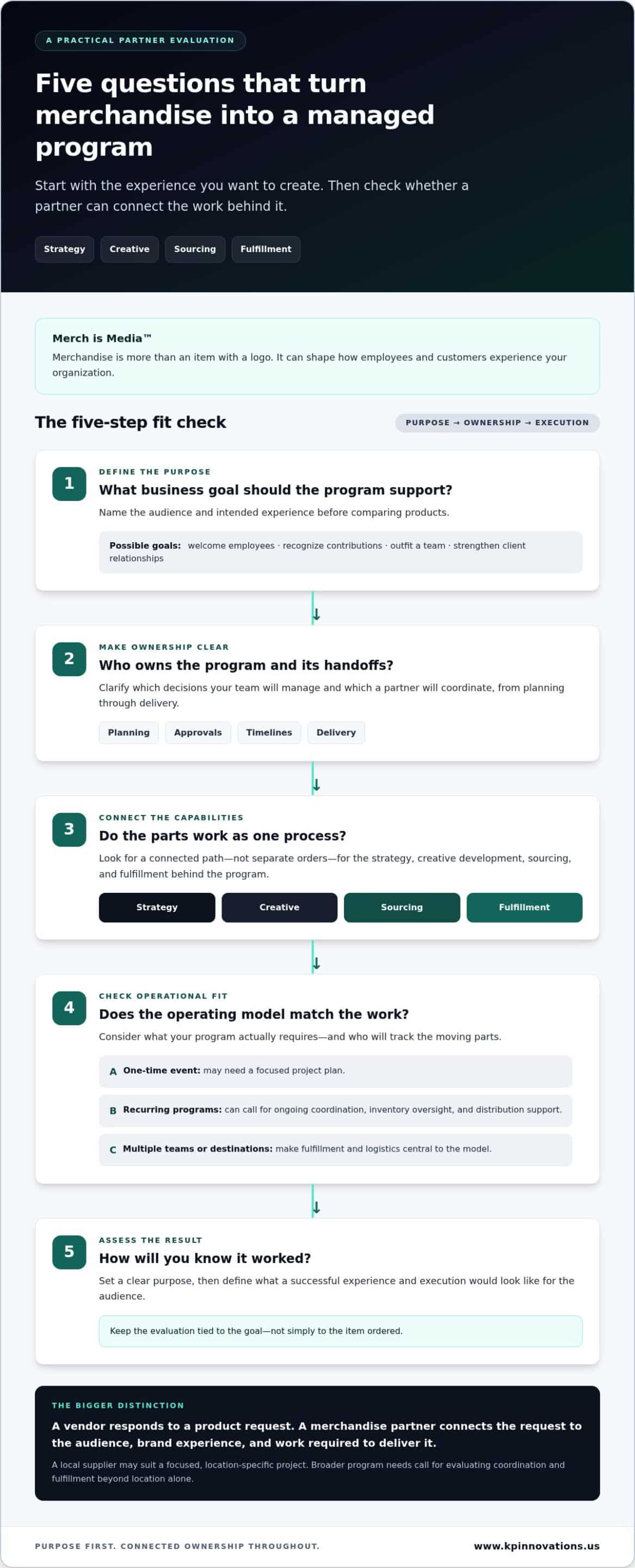
A useful evaluation goes beyond location and product range. Whether you’re comparing options for a single project or looking for a promotional products supplier near me to support ongoing needs, use these five questions to test strategic and operational fit:
- 1. What business goal should the program support? Define the audience and intended experience first. Is the goal to welcome employees, recognize contributions, outfit a team, or strengthen client relationships?
- 2. Who owns the program? Clarify which decisions and handoffs your team will manage and which a partner will coordinate, from planning through delivery.
- 3. Do the capabilities connect? Look for a process that brings strategy, creative development, sourcing, and fulfillment together, rather than treating each step as a separate order.
- 4. Does the operating model fit? Consider recurring coordination, inventory needs, and delivery to multiple teams or destinations. The approach should make responsibilities clear and reduce the details your staff has to track.
- 5. How will you assess the result? Set a clear purpose for the program, then decide what a successful experience and execution would look like for its audience.
What should a merchandise partner manage beyond product sourcing?
A partner should connect the merchandise objective to the audience, brand experience, and intended business outcome. Creative development gives that objective form; sourcing translates the direction into a workable program. When these steps are connected, product choices serve a clear purpose instead of becoming a collection of unrelated items.
KP Innovations provides white-glove project management across the process, from design through fulfillment. Its Chief Swag Officer model represents dedicated ownership of the merchandise program, not just support for individual orders. For broader industry context and resources, the Promotional Products Association International (PPAI) is a useful reference.
How can you assess operational fit for your organization?
Map the work your team handles today. A one-time event may need a focused project plan. Recurring employee or client programs can call for ongoing coordination, inventory oversight, and distribution support. Multiple teams or delivery destinations make fulfillment and logistics central parts of the operating model.
Look for clear ownership of timelines, approvals, and handoffs. Ask how the process will keep decisions moving and who will coordinate each stage. When a partner manages those moving parts, marketing, HR, and operations can spend less time chasing order details and more time on their core responsibilities. If sourcing is a key part of your evaluation, explore strategic sourcing support.
Local Supplier or Nationwide Partner? Compare the Fit for Your Business
“Near me” can be a useful starting point, but it shouldn’t decide the full partnership. A local footprint may suit a project centered on one office or a nearby audience. If merchandise supports teams and recipients across locations, look for a partner whose program management and fulfillment can serve a wider geographic reach.
| Consideration | Local supplier | Nationwide partner |
|---|---|---|
| Access | A nearby presence may be useful for a focused local project. | Coordination can support teams operating in different places. |
| Program scope | May fit a defined, one-location need. | Can align merchandise needs across teams and ongoing programs. |
| Fulfillment needs | May fit a project with a single local destination. | Can coordinate fulfillment and logistics for multiple destinations. |
| Geographic reach | Centered on a local audience or location. | Can serve organizations with broader geographic needs. |
When does working with a local promotional products supplier make sense?
A local supplier may be a good fit when a project is concentrated in one place, such as merchandise for a local event or a single workplace. Proximity can be one practical factor. Still, it doesn’t automatically ensure consistent brand execution or clarify who owns creative decisions, coordination, and delivery. Match the partner to the project’s requirements, not just its address.
When can a nationwide merchandise partner be a better fit?
A nationwide partner may suit organizations coordinating merchandise across multiple teams, locations, or delivery destinations. The value is not simply geographic reach. It’s having sourcing, project management, and fulfillment work together, so local teams aren’t left managing disconnected parts of a broader program.
KP Innovations is based in Horsham, Pennsylvania, and serves companies nationwide. Its work brings sourcing, project management, fulfillment, and logistics into the merchandise process. That model can support a business with local needs today and a broader program across its organization.
Think of merchandise as part of the experience people have with your brand, wherever they encounter it. Explore the Merch is Media™ philosophy to consider how merchandise can contribute to culture, loyalty, and relationships. The right choice isn’t always local or nationwide. It’s the partner whose reach and ownership fit the work.
From Sourcing to Fulfillment: Build a Merchandise Program That Runs
A merchandise program works best when each decision follows from the business objective. Instead of starting with a product, start with the audience and experience you want to serve. Then build a process that carries that intent through sourcing, production, and delivery.
Program ownership connects product decisions to consistent brand experiences. It keeps the purpose visible as work moves from planning to execution, rather than leaving each department to manage its own orders and handoffs.
What does a managed merchandise process look like?
A coordinated process can move through these stages:
- Set the objective. Identify the audience, need, and experience the program should support.
- Develop the creative direction. Translate the objective into a coherent expression of the brand.
- Source with purpose. Select merchandise that fits the audience, intended use, and creative direction.
- Manage production. Coordinate decisions and project details as the work moves toward completion.
- Plan fulfillment. Organize how merchandise will be stored or distributed to its intended destinations.
Project management connects these stages, clarifying decisions and handoffs along the way. For programs involving warehousing or distribution, fulfillment and logistics belong in the operating plan from the start, not as an afterthought once items are ready.
How do you keep recurring merchandise needs organized?
Recurring needs call for consistent ownership. Employee onboarding, client gifting, uniforms, and recognition each serve a different purpose, so they shouldn’t be treated as interchangeable orders. A recognition program can acknowledge meaningful contributions. Uniforms can support a consistent workplace presence. Client gifts can help strengthen professional relationships.
Company stores provide a structured way for teams to access pre-approved merchandise, connecting repeat requests to an established program. This can help when departments or locations have ongoing needs and the organization wants a shared approach to selection and ordering.
The right operating model depends on what your teams need to manage and how often those needs recur. KP Innovations brings sourcing, production management, and fulfillment into a managed merchandise process. If sourcing is a central challenge, explore strategic merchandise sourcing as part of building a program that supports your brand beyond a single order.
Choose a Promotional Products Partner That Owns the Bigger Picture
The right partner depends on what your business needs merchandise to do, how complex the program is, and how much ownership your team needs to hand off. A promotional products supplier near me may fit a focused order. A broader, recurring program may call for dedicated support that connects decisions across the full lifecycle.
KP Innovations’ Chief Swag Officer model is designed to function as an outsourced merchandise department, not simply a source for individual products. It brings strategy, creative, sourcing, and fulfillment into one coordinated program. That gives teams a clearer way to manage merchandise while keeping decisions connected to the brand experience they want employees and clients to have.
What does a Chief Swag Officer bring to the relationship?
A dedicated merchandise partner connects the purpose of a program to how it’s developed and delivered. Instead of asking internal teams to coordinate every handoff, one partner can guide decisions across strategy, creative, sourcing, and fulfillment. The result is a more coherent experience, with merchandise choices tied to the audience and objective rather than made in isolation.
This reflects the Merch is Media™ philosophy: merchandise can shape culture, loyalty, and relationships through the experiences it creates. Its value isn’t only in the item itself, but in how thoughtfully it represents the organization.
What is a useful first step toward a better merchandise program?
Before choosing individual items, write down the details that will shape the program:
- Audience: Who will receive or use the merchandise?
- Objective: What experience or business need should it support?
- Internal owner: Which teams are involved, and who currently coordinates the work?
- Operational challenge: Where do approvals, sourcing, storage, or delivery create friction?
- Recurring needs: Which programs repeat across departments or locations, and where must items be distributed?
This snapshot helps distinguish a standalone order from a program that needs ongoing ownership. It also gives your team a practical starting point for aligning merchandise decisions with the experience you want to create.
Explore merchandise sourcing with KP Innovations to take the next step toward a program built around your audience, objectives, and operational needs.
Build a Merchandise Program With Purpose
Choosing a promotional products supplier near me is a starting point, not the whole decision. Match your partner to the business goal, the complexity of your program, and the coordination your team needs. A supplier can source items; a strategic partner connects those choices to creative direction, project management, and fulfillment.
KP Innovations approaches merchandise as media: intentional brand experiences that can strengthen culture, loyalty, and relationships. Through its Chief Swag Officer model, the team supports the work from design through global fulfillment, with access to more than 1.2 million products. Based in Horsham, Pennsylvania, KP Innovations serves companies nationwide.
Start by clarifying who the merchandise is for, what it should accomplish, and where your current process creates extra work. Then build a program around those needs rather than starting with a product list.
Explore strategic merchandise sourcing with KP Innovations and take a more purposeful approach to your merchandise program. The right partnership can help turn each decision into a considered brand experience.
Frequently Asked Questions
How do I find a promotional products supplier near me?
Start by defining what the merchandise needs to accomplish, then look for a partner whose role includes more than sourcing. Compare how they handle strategy, creative, project coordination, and fulfillment, and whether their operating model fits your team’s needs. A promotional products supplier near me may offer proximity, but location alone doesn’t establish program ownership. KP Innovations is based in Horsham, Pennsylvania, and serves companies nationwide.
What should I look for in a promotional products supplier?
Look for a partner that understands your business goal and can coordinate the work required to support it. Consider whether strategy, creative development, sourcing, project management, and fulfillment connect within a clear process. An employee recognition initiative, for example, may involve different decisions and delivery needs than merchandise for a client event. The right fit depends on your audience, program scope, and how much coordination your internal team can own.
Is a local promotional products supplier better than a nationwide partner?
Neither is automatically better. A local supplier may suit a project focused on one workplace, event, or nearby audience. A nationwide partner may be a stronger fit when a program involves multiple teams or locations and requires coordinated sourcing and fulfillment. Consider project ownership and distribution needs alongside proximity. KP Innovations, based in Horsham, Pennsylvania, serves companies nationwide, supporting organizations whose merchandise needs extend beyond one local market.
Can a promotional products supplier manage sourcing and fulfillment?
Yes. KP Innovations coordinates merchandise sourcing and fulfillment as part of its broader project management approach, from design through global fulfillment. This connects product decisions with production management, logistics, and distribution instead of leaving your team to coordinate each handoff separately. Start by outlining the audience, purpose, and delivery needs so the process can be shaped around the program rather than a product list.
How does a merchandise strategy partner differ from a product distributor?
A product distributor primarily helps source and supply merchandise. A merchandise strategy partner takes a broader role by connecting the business objective to creative direction, sourcing, project coordination, and fulfillment. That approach treats items as tools for creating a considered brand experience, rather than isolated orders. KP Innovations follows the philosophy that “Merch is Media™,” recognizing that merchandise can influence culture, loyalty, and relationships.
What does a Chief Swag Officer do?
A Chief Swag Officer provides dedicated ownership for a company’s merchandise program. Rather than having marketing, HR, and operations manage separate tasks and handoffs, the model coordinates the program across strategy, creative, sourcing, and fulfillment. The goal is to connect individual merchandise decisions to business needs and the experience recipients have with the brand. KP Innovations uses this model as an outsourced merchandise department for companies.
Can a promotional products partner support teams in multiple locations?
Yes. A partner with nationwide reach can coordinate merchandise needs across teams and locations, including sourcing, project management, fulfillment, and logistics. This is useful when a program serves employees, clients, or events in more than one place. KP Innovations serves companies nationwide from its base in Horsham, Pennsylvania, and provides fulfillment and logistics services to support merchandise programs across broader geographic needs.