
A merchandise order can arrive on time and still fail your brand. When choices are split across teams, suppliers, and workflows, no one may own the full experience. A merch production partner should do more than process a purchase order. The right partner connects decisions about strategy, creative, sourcing, and fulfillment to the people and purpose behind each program.
It’s understandable to focus first on the item and deadline. But Merch is Media™: what people receive, how it feels, and whether it reaches them smoothly all shape their experience of your brand. If inventory, distribution, and repeat orders remain internal coordination tasks, it can be difficult to deliver a consistent experience.
This article explains what a strategic partner should manage, from program strategy and creative through sourcing, production management, fulfillment, and online ordering. You’ll learn how to assess whether a partner model fits your needs and how an outsourced “Chief Swag Officer” can bring those responsibilities into one connected program. The goal is merchandise that serves employees, customers, and your brand, not another order your team has to coordinate.
Key Takeaways
- Map ownership across strategy, creative, sourcing, production coordination, and fulfillment so responsibilities don’t fall between teams.
- Choose a merch production partner by the work it owns and the needs of your program, not by product count alone.
- Use a scorecard to compare strategic alignment, customization, process visibility, and distribution against your audiences and recurring use cases.
- Clarify where your team makes decisions and approvals, and where your partner coordinates the work from brief to delivery.
- Explore how the Chief Swag Officer model can bring merchandise responsibilities together as a managed program.
A merch production partner should solve more than the next order
When marketing, HR, and operations handle merchandise separately, responsibility can splinter. One team chooses an item, another approves the design, and someone else must manage storage and distribution. Individual orders may get completed, but the overall experience can feel inconsistent while the coordination burden stays inside the company.
A single-order vendor relationship can work well for a specific purchase with a clear brief. Ongoing program ownership is different: it connects decisions across orders and keeps business goals, audiences, and workflows in view. A merch production partner coordinates the work behind an order; an end-to-end program partner connects that work to the purpose and experience of the broader merchandise program.
What does a merch production partner actually do?
The work follows a sequence: clarify the business objective and audience, develop the creative direction, source options that support the use case, coordinate production, and manage fulfillment. Your team stays involved where its knowledge matters, including setting priorities, reviewing creative, and approving decisions. The partner organizes the handoffs and keeps each stage aligned with the program’s goals and operating needs.
For example, if the goal is to welcome new employees consistently, start by defining what the welcome experience should communicate. Creative decisions shape how the pieces work together. Sourcing matches options to the brief, production management coordinates the order, and fulfillment gets it to the intended recipients. Agreeing on ownership at each handoff helps the program work as a connected experience rather than a series of separate purchases.
Why merchandise belongs in the brand experience
Promotional merchandise is often treated as a physical item used to promote a company. But an item also carries the meaning of the moment in which it’s received and used. For an employee, it may be part of joining a team or recognizing a contribution. For a customer, it may reinforce a relationship after an event or milestone. The product is a tool; the experience gives it context.
That’s the idea behind Merch is Media™. Merchandise communicates through tangible interactions, so the choice, presentation, and delivery should support the brand experience the organization intends to create. Explore the Merch is Media™ philosophy to see how physical merchandise can play a deliberate role in employee and customer relationships.
What an end-to-end merch production partner manages
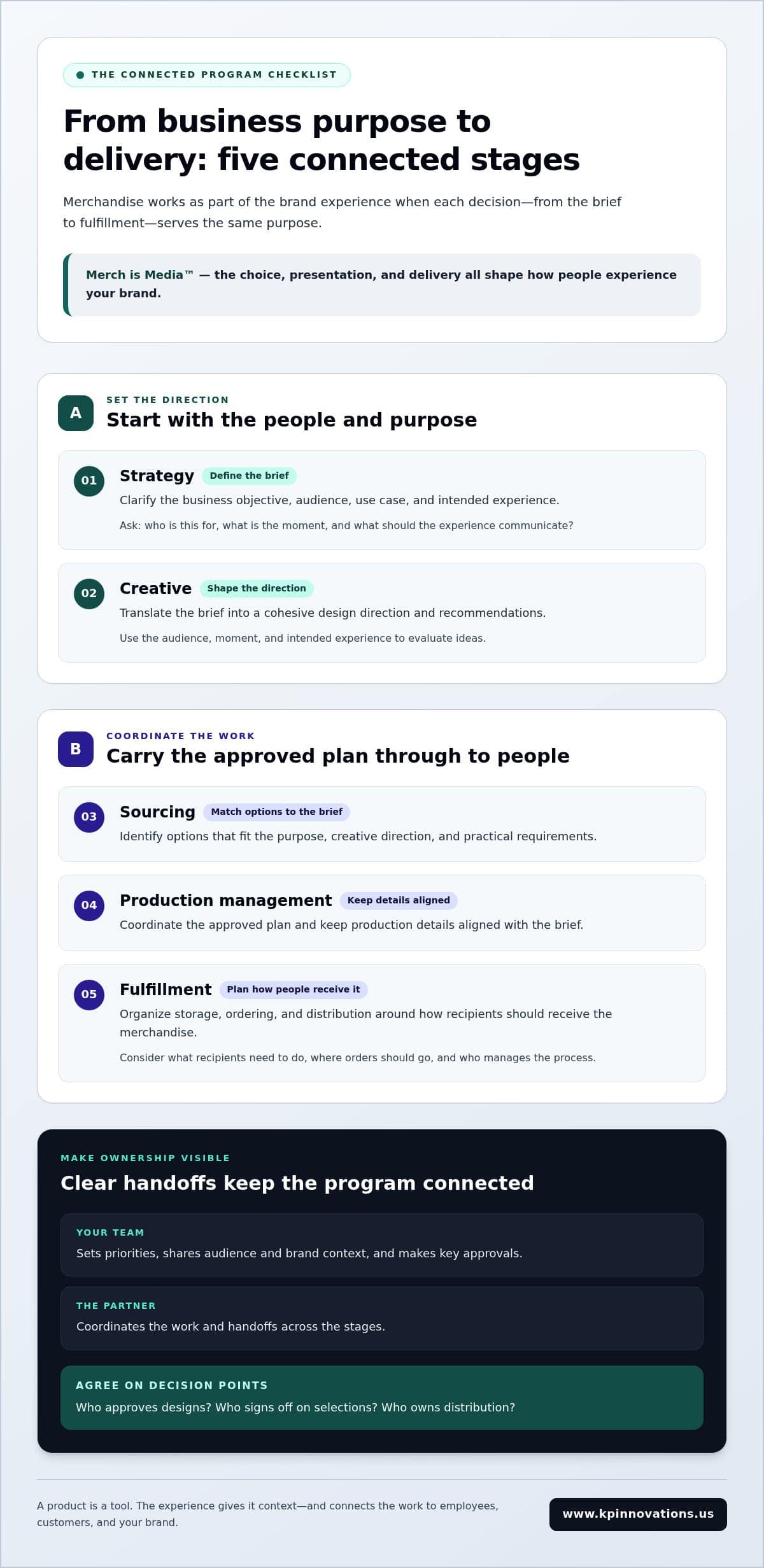
A managed program follows a clear path from the reason merchandise is needed to the way it reaches people. Each stage has a distinct purpose, but the stages should work together:
- Strategy: Define the business objective, audience, use case, and intended experience.
- Creative: Translate the brief into a cohesive design direction and recommendations.
- Sourcing: Identify options that fit the purpose, creative direction, and practical requirements.
- Production management: Coordinate the approved plan and keep production details aligned.
- Fulfillment: Organize storage, ordering, and distribution around how recipients should receive the merchandise.
A managed merchandise program connects strategy, creative, sourcing, production, and fulfillment so every stage serves the same business purpose. The partner coordinates the work and handoffs; your team sets priorities, shares audience and brand context, and makes key approvals. Define who approves designs, who signs off on selections, and who owns distribution. Clear decision points keep stakeholders involved without asking every team to manage each transition.
Start with strategy and creative direction
Begin with the people and purpose, not a product shortlist. Is the merchandise intended to welcome new employees, recognize a milestone, support a customer relationship, or serve another business need? Define the audience, moment, and intended brand experience first. Then use them as criteria for evaluating ideas.
Creative development turns that direction into a coherent approach, so selections feel connected rather than like unrelated items carrying the same logo. Your team provides brand guidance and approves the direction; the partner develops and coordinates the work. Merchandise strategy services can help translate goals into program decisions before sourcing begins.
Coordinate sourcing, production, and fulfillment
Sourcing is more than locating an item. It connects the approved brief to suitable options, while production management coordinates the steps needed to carry the selection and creative direction through production. The U.S. Chamber of Commerce offers practical considerations for finding the right factory; a broader merchandise program also needs clear ownership of the stages before and after manufacturing.
Fulfillment planning connects merchandise to the way people will order or receive it. A centralized distribution plan may suit one program, while recurring ordering or multiple audiences may call for a different workflow. Decide what recipients need to do, where orders should go, and who will manage the process. A structured sourcing approach connects options to the brief instead of treating each selection as an isolated transaction.
With owners and approvals defined at each stage, teams can see where decisions belong and who coordinates the work. This can reduce the handoffs your internal teams manage while keeping your team involved in the choices that matter.
Compare merch partner models by ownership, not product count
A large catalog can offer choice, but it doesn’t show who will shape the program, coordinate production, or manage what happens after an order is placed. Compare partner models by the responsibilities they take on and the work your team will still need to own.
The meaningful comparison is responsibility owned, not catalog size alone. These models serve different needs. The right fit depends on your program’s complexity and how much coordination your organization wants to retain.
Responsibility
Product-focused sourcing
Manufacturer-led production
Strategic program partnership
Strategy and creative
Usually defined by the buyer.
Often starts with an established brief or product concept.
Connects the brief and creative direction to program goals.
Sourcing and production
Focuses on identifying products for a specific order.
Centers on making the specified product and coordinating its production.
Coordinates sourcing and production as parts of a broader program.
Fulfillment and ongoing ownership
May cover order delivery; broader distribution and future orders remain with the company.
Depends on the agreed scope; ongoing program needs may stay internal.
Can connect fulfillment and recurring program needs with the preceding decisions.
When a product vendor or production-only model fits
A defined purchase with a clear audience, approved design, and straightforward delivery requirements may not need ongoing program ownership. A product-focused vendor can support sourcing for that order; a production-led relationship can suit a defined manufacturing brief. In either case, your team retains coordination outside the agreed scope, such as setting the strategy, aligning stakeholders, or planning later orders. That division of work can make sense when those responsibilities are limited and clearly assigned.
When a strategic merchandise partner fits
Consider connected program ownership when merchandise serves different audiences, recurs throughout the year, or involves several teams. Without a clear owner, marketing, HR, and operations may each manage separate decisions and handoffs. A strategic partner can connect strategy, creative, sourcing, production coordination, and fulfillment while your team retains approvals and business direction. The Chief Swag Officer model puts this outsourced-owner approach into practice.
Consolidated ownership doesn’t automatically remove work or complexity. It gives coordination a defined home and makes responsibilities easier to see. A merch production partner is a better fit when that ownership addresses a real need in your operating model, not simply because it offers more services.
Use this scorecard to evaluate a merch production partner
Before reviewing proposals, write down who the merchandise is for, what each program needs to accomplish, who must approve decisions, and whether orders will recur. Include employee, customer, gifting, uniform, or recognition use cases that apply. This gives you a consistent basis for comparing what each partner will own, rather than judging proposals by product selections alone.
Use this scorecard to assess the fit. For each area, note whether ownership is clear, shared, or still internal:
- Ownership: Are strategy, creative, sourcing, production management, and fulfillment responsibilities clearly assigned?
- Strategic alignment: Does the proposed approach connect merchandise to a defined audience, purpose, and intended brand experience?
- Customization: Can the creative and merchandise direction reflect your organization’s needs, rather than defaulting to a generic selection?
- Process visibility: Are decision points, approvals, communications, and changes explained so your team knows when it needs to act?
- Distribution: Does the plan account for how merchandise will be stored, ordered, and delivered to the people who need it?
- Ongoing program ownership: Is there a defined way to support recurring needs, or does responsibility return to your team after each order?
A strong fit isn’t necessarily the partner that takes on every task. It’s the one whose responsibilities match your workflow, with clear boundaries for the decisions and approvals your team retains.
Questions that reveal who owns each responsibility
Look for specific ownership across the full workflow. Who develops the strategic brief and creative direction? Who coordinates sourcing and production? Who manages fulfillment, stakeholder communication, approvals, and changes? The answers should show where information moves and who is accountable at each handoff. Compare those responsibilities with your internal capacity. If your team is already stretched coordinating approvals or distribution, make sure the operating model assigns those tasks clearly.
Match the operating model to your program
A one-time order with a defined purpose may need a limited scope. Recurring employee programs, client gifting, uniforms, or recognition involve ongoing needs and may call for connected ownership. If employees or teams need to order from an approved selection, a company store can support managed merchandise ordering.
Use the scorecard to identify where coordination currently sits and where you want it to sit. Then explore a sourcing partnership that connects merchandise choices to your program goals and operating needs.
How KP Innovations turns merch production into an owned program
KP Innovations approaches merchandise as a strategy and brand experience program, not simply a product order. That distinction matters when employee, customer, and operational needs intersect. Through the Chief Swag Officer model, KP Innovations provides outsourced ownership that connects planning and execution, giving merchandise a clearer purpose and a more consistent place in the brand experience.
What the Chief Swag Officer model changes
A dedicated owner brings strategy, creative, sourcing, production management, and fulfillment into a coordinated program. Your team sets goals, shares brand and audience knowledge, and makes key approvals. KP Innovations manages the connections between those decisions and the work that follows. This gives responsibilities a clearer home across teams while keeping your organization involved in important choices.
The model is designed for more than the next order. KP Innovations draws from a selection of over 1.2 million products while keeping the focus on what each audience and use case calls for. White-glove project management supports projects from design through global fulfillment. The Chief Swag Officer outsourced ownership model brings merchandise responsibilities together under one coordinated program.
Turn the decision into a focused first conversation
You don’t need a fully formed product list to begin. Start with a clear view of the program:
- Audiences: Who will receive or order the merchandise, such as employees, customers, or event participants?
- Goals: What should the experience communicate or support?
- Needs: Which merchandise programs matter, including gifting, uniforms, recognition, or other recurring uses?
- Fulfillment challenges: Where do storage, ordering, distribution, or internal handoffs create friction?
These details help establish the right scope and priorities. KP Innovations manages projects from design through global fulfillment, connecting decisions about merchandise to how it’s produced and delivered. That means a merch production partner can be evaluated not just on what it can source, but on how it takes ownership of the work around it.
Start with the needs that matter most to your organization. Discuss your merchandise sourcing needs and explore how sourcing can support a more connected program.
Make merchandise ownership part of the plan
The right merch production partner is accountable for more than an individual order. Look for a model that connects your program’s goals with creative, sourcing, production, and fulfillment, while making clear where your team provides direction and approvals. Then assess whether that ownership fits your audiences, recurring needs, and internal workflows.
KP Innovations brings this approach to life through the Chief Swag Officer model. With access to a selection of over 1.2 million products, white-glove project management from design through global fulfillment, and company and team stores for pre-approved merchandise ordering, the focus stays on building a connected program around your brand experience.
Merch is Media™. Each item and interaction can play a purposeful role in how employees and customers experience your brand. Identify the needs you want your merchandise program to serve, then explore merchandise sourcing with KP Innovations. Start a conversation about the experience you want your merchandise program to create.
Frequently Asked Questions
What does a merch production partner do?
A merch production partner coordinates the work needed to turn a business goal into merchandise that reaches its intended audience. Depending on the scope, that can include strategy, creative development, sourcing, production management, and fulfillment. The key is clear ownership across stages, including how approvals and handoffs work. A merch production partner should connect operational decisions to the experience the company wants employees or customers to have.
How is a merch production partner different from a promotional products vendor?
A promotional products vendor may focus on sourcing and supplying items for a defined order. A merch production partner can take broader responsibility for connecting the order to program goals, creative direction, production coordination, and fulfillment. These models serve different needs. A vendor can suit a straightforward purchase, while ongoing program ownership can help when several teams or recurring needs require coordination.
When should a company hire a merchandise strategy partner?
A company should consider a merchandise strategy partner when orders are spread across teams, audiences, or recurring programs and internal coordination is becoming difficult to manage. This can include employee recognition, uniforms, customer gifting, or event merchandise. A partner can help clarify the purpose of each program and coordinate connected responsibilities. For a single, well-defined order with a clear brief, a narrower sourcing relationship may be enough.
Can one partner manage merchandise from creative development through fulfillment?
Yes. A partner can coordinate creative development, sourcing, production management, and fulfillment within an agreed program scope. KP Innovations manages projects from design through global fulfillment, with white-glove project management connecting the stages. Your organization provides direction and approvals, while the partner coordinates the work between them. Defining responsibilities at the outset helps teams understand who manages decisions, communication, and distribution.
How do I evaluate a merch production partner for an employee or customer program?
Evaluate the partner against your program’s real needs, not just its product range. Define the audience, purpose, and recurring use cases, then assess ownership of strategy, creative, sourcing, production, and fulfillment. Look for clear approval points, communication responsibilities, and a distribution plan that fits how employees or customers will receive merchandise. The right model should complement your team’s capacity and support a consistent brand experience.
What should a company prepare before starting a merchandise project?
Prepare an outline of who the merchandise is for, what the program should accomplish, and how recipients should receive or order it. Identify internal stakeholders, decision-makers, brand guidance, and current challenges with storage, distribution, or repeat ordering. You don’t need to select products first. A clear audience and use case give the partner a useful foundation for recommending a direction and coordinating next steps.
How can a company store support a recurring merchandise program?
A company store can give employees or team members a place to order from a pre-approved merchandise selection. This can support recurring programs by connecting approved choices with an online ordering process, rather than requiring every request to begin from scratch. Stores can be useful for ongoing apparel or employee merchandise needs. Their role should fit the program’s audience, ordering process, and fulfillment approach.