
What if a box did more than deliver a collection of branded items? Corporate swag boxes can make a brand feel thoughtful and present, but only when the contents fit the people receiving them and the reason for sending them. Otherwise, the package risks becoming desk clutter, while collecting addresses, managing inventory, personalizing contents, and shipping add work for your team.
That tension is familiar: you want employees or clients to feel recognized, not handed a generic assortment. The answer isn’t simply adding more products. It’s treating merchandise as media, a brand experience that can strengthen relationships when every choice has a purpose.
This article explains how to plan a box around a defined audience, occasion, and business goal, then connect creative choices with sourcing and fulfillment. You’ll learn how to make the unboxing feel considered while managing the details as part of an ongoing merchandise program, not a one-time giveaway. The result is a package that contributes to a larger brand experience.
Key Takeaways
- Define the relationship moment first, then choose items that support it.
- Use audience insight, brand identity, and occasion to shape the unboxing experience.
- Compare one-time boxes, recurring programs, and company stores by personalization, inventory ownership, and distribution needs.
- Align marketing, HR, and operations on key decisions before sourcing and production begin.
- Build corporate swag boxes into a broader merchandise program so each package supports an ongoing business purpose.
Corporate Swag Boxes Should Solve a Relationship Problem
A box full of logoed items can look complete and still miss the point. If the recipient can’t see why those items were chosen, the package may feel like leftovers rather than a meaningful gesture.
A corporate swag box is a curated group of items chosen for a specific audience, business moment, and intended experience. Start with the purpose, then use products to express it. This builds on the familiar role of Promotional merchandise, but shifts the focus from distributing objects to shaping how someone experiences your brand.
What should a corporate swag box accomplish?
Start by naming one recipient group and one moment. Are you welcoming a new employee, recognizing a team achievement, thanking a client, or helping people feel connected at an event? These goals aren’t interchangeable. An onboarding package should help someone feel prepared and included. A client thank-you should acknowledge the relationship. An event package should support the gathering’s purpose, not simply carry its logo.
Describe the response you want before listing possible contents. Should the recipient feel welcomed, appreciated, equipped, or part of a shared effort? That intention gives your team a practical filter: each item and presentation choice should reinforce the desired feeling or action. If an element doesn’t serve the moment, leave it out.
Why does the unboxing experience matter?
The package creates a first impression before the recipient uses anything inside. Presentation sets the tone. Relevance shows that the gesture was designed with its audience in mind. Usefulness gives the items a reason to stay in someone’s daily routine rather than becoming desk clutter.
Consider a new employee receiving a box that introduces the team, offers useful tools for the work ahead, and reflects the company’s identity. That experience communicates more than a logo on several unrelated items. The details work together to make the welcome feel intentional.
This is the idea behind Merch is Media™: merchandise carries a brand message through tangible, repeated interactions. A thoughtfully designed box is one touchpoint in that broader experience. Its impact depends not on how many items it contains, but on whether the choices make the recipient feel understood and connect the gesture to a real relationship.
Merch Is Media: Build the Box Around the Brand Experience
A merchandise choice keeps communicating after delivery. A recipient may use, see, or share an item over time, so the box can carry a brand message beyond its first impression. That is the principle behind Merch is Media™: purposeful merchandise makes the brand experience tangible in everyday life.
A logo alone doesn’t create a coherent experience. A mix of unrelated items may display the same mark without saying anything meaningful about the organization. The creative direction should connect what recipients encounter with what the brand wants them to understand or feel.
How do you make the box feel specific to its recipients?
Start with the recipient’s context, not a standard contents list. Consider their role, location, relationship to the organization, and how they’ll receive or use the package. A distributed employee, an event attendee, and a long-standing client may all recognize the same brand, but their needs and relationship to it differ.
Choose a clear creative concept that brings the experience together. For example, a box intended to help a remote team feel connected might express shared identity through its message, visual treatment, and practical choices. Don’t assume every recipient will like the same things. Make deliberate choices for a defined audience, and adapt when different groups have different needs.
This connection between brand values and the recipient’s experience matters inside the organization, too. Harvard Business Review’s discussion of employee brand engagement emphasizes grounding engagement in what the company stands for. Merchandise can support that connection when its concept reflects the organization’s identity rather than relying on a logo alone.
What belongs in the concept before product sourcing begins?
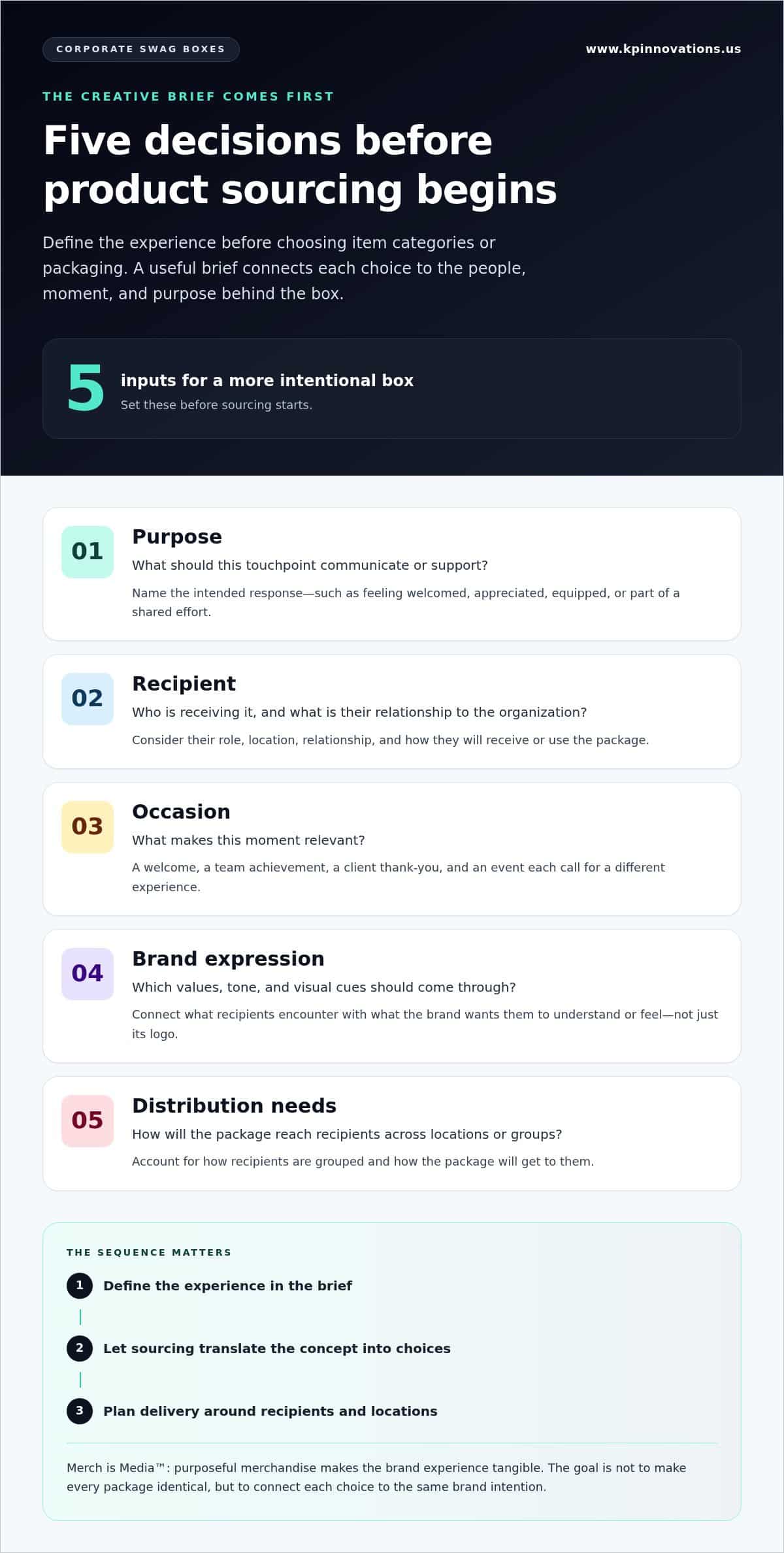
Set the creative brief before choosing item categories or packaging. Those are expressions of the idea, not the idea itself. A useful brief establishes:
- Purpose: What should this touchpoint communicate or support?
- Recipient: Who is receiving it, and what is their relationship to the organization?
- Occasion: What makes this moment relevant?
- Brand expression: Which values, tone, and visual cues should come through?
- Distribution needs: How will the package reach recipients across locations or groups?
With those decisions in place, sourcing can serve the experience instead of driving it. Strategic merchandise sourcing translates a defined concept into considered choices. For corporate swag boxes, the goal isn’t to make every package identical; it’s to make each choice feel connected to the same brand intention.
Compare Swag Box Approaches by Experience, Choice, and Operations
The right format depends on how often you’re sending merchandise, how much choice recipients need, and who will coordinate inventory and delivery. A one-time box, a recurring program, and a company store can each serve a purpose. Match the operating model to the experience you want to create.
| Approach | Audience fit and personalization | Inventory and distribution | Repeatability |
|---|---|---|---|
| One-time curated box | Best for a defined audience and shared moment; one selection creates a coordinated experience. | Contents and delivery are planned for a specific distribution; recipient differences need consideration. | Designed for a particular occasion or campaign, then revisited for the next need. |
| Recurring program | Supports an ongoing audience or series of moments; creative can follow shared guidelines while adapting to the occasion. | Requires planning for replenishment, inventory, and repeated distribution. | Built to support recurring needs with consistent program management. |
| Company store with recipient choice | Recipients choose from available options, offering choice rather than one centrally curated unboxing. | Ordering and fulfillment follow the store program’s setup and distribution approach. | Can support ongoing merchandise access through a company or team store. |
When is a curated box the right format?
A curated box fits a shared milestone, welcome moment, or coordinated campaign when recipients should receive a consistent selection. That consistency can make the experience feel unified. Before choosing this format, account for differences in recipient needs, locations, and delivery requirements. One concept may work across a group, but the plan still needs to address how each person will receive the package.
When might a company store or ongoing program fit better?
If merchandise needs recur, a managed program can create a repeatable way to plan and distribute it. A store adds recipient choice, changing the experience: people select from available options instead of opening the same curated package. Company store programs support ongoing merchandise distribution when access and choice matter. Let the format follow the need, rather than assuming every audience wants the same thing.
For corporate swag boxes and related merchandise, KP Innovations coordinates sourcing and fulfillment within a wider program, connecting the selected approach to its audience and operational needs. The goal is to manage the system around the brand moment, not treat each shipment as an isolated order.
Plan Corporate Swag Boxes From Brief to Delivery
A strong concept can still become a difficult project if decisions about recipients, approvals, and delivery happen too late. Planning corporate swag boxes as a coordinated workflow helps marketing, HR, and operations align the experience with the work required to deliver it.
What should a corporate swag box brief include?
Before selecting items, capture the objective, recipient group, occasion, brand direction, and distribution model. Identify who owns approvals and who makes decisions about creative, contents, recipient information, and delivery. Clear ownership helps teams resolve questions before production begins, rather than revisiting choices after work is underway.
Creative development turns that brief into a cohesive experience. It gives the concept a point of view, then guides decisions about product categories, packaging, and messaging. A practical sequence is:
- 1. Define the need: State what the program should support and why this moment matters.
- 2. Describe the audience: Identify recipients and relevant differences in role, location, or relationship.
- 3. Set the creative direction: Agree on the brand expression and experience the package should create.
- 4. Source and prepare: Select items and packaging that fit the brief, then coordinate production details.
- 5. Plan fulfillment: Confirm recipient data, shipping destinations, timing, and who is responsible for each handoff.
How can teams make distribution easier to manage?
Treat delivery as part of the concept, not a final task. Packaging affects how a box is prepared and shipped. Recipient information and destinations shape how orders are organized. Timing determines when teams need accurate addresses and approved contents. Bring these details together early so operations can identify dependencies before fulfillment begins.
A single coordinated distribution may suit a defined campaign. Ongoing needs may call for warehousing, planned fulfillment, global distribution, or an online company store that supports repeat ordering. The right structure depends on the audience, frequency, and degree of recipient choice. Managed merchandise fulfillment connects delivery planning to the wider program.
KP Innovations coordinates strategy, sourcing, production management, and fulfillment, helping teams carry a box from brief through delivery. For merchandise sourcing support, start with the audience and purpose, then build the selection around them.
Make Swag Boxes Part of a Managed Merchandise Program
A box creates more value when it supports a defined program rather than standing alone. Connect it to onboarding, recognition, client gifting, or another ongoing business need. That connection helps teams plan with purpose and learn from each cycle instead of treating every package as a separate project.
For example, an onboarding box can be one part of a broader employee experience, while recognition merchandise can support a program with clear milestones. The contents may change, but the strategy, creative direction, sourcing, production management, and fulfillment should work together. That’s how corporate swag boxes become part of a managed merchandise system.
What does an outsourced merchandise department manage?
A dedicated partner can coordinate work that often crosses marketing, HR, and operations. Strategy defines the program’s purpose and audience. Creative development translates that direction into a cohesive experience. Sourcing identifies merchandise that fits the brief, while production management and fulfillment carry the plan through delivery. The Chief Swag Officer model brings these connected workstreams under one managed-partner approach, rather than leaving each team to coordinate separate pieces on its own.
How can leaders assess whether the program is working?
Start with the objective, then choose measures that show whether the program is meeting it. Useful indicators might include participation in a recognition program, recipient feedback on relevance, or operational measures such as order accuracy and fulfillment issues. The right measures depend on the purpose; a welcome initiative and a client gifting program shouldn’t necessarily be assessed in the same way.
Review results with the teams responsible for the experience and the process. Look for patterns in feedback, participation, and recurring coordination challenges. Use those observations to refine the audience, creative, sourcing decisions, or distribution plan in the next cycle. This makes improvement practical without assuming a box guarantees a particular brand outcome.
KP Innovations coordinates merchandise programs from strategy through fulfillment, helping teams connect each package to the relationships and experiences it’s meant to support. Build a strategic sourcing plan around your program’s purpose, audience, and operational needs.
Turn the Next Box Into a Brand Moment
Corporate swag boxes make the strongest impression when they’re built around a real relationship need, not a list of items. Define the audience and occasion, then shape the creative experience around what recipients should feel or do. A coherent concept gives every choice a role and connects the package to the brand.
The format matters, too. A curated box can bring a shared moment to life, while a recurring program or company store may better support ongoing distribution and recipient choice. Whichever approach you take, connect the box to a broader merchandise program and review participation, recipient feedback, and operational performance to guide future decisions.
KP Innovations supports companies nationwide from Horsham, Pennsylvania, with access to more than 1.2 million products and project management from design through global fulfillment. Treating merchandise as media means managing the full experience, not just selecting what goes inside. Explore strategic merchandise sourcing and build a more purposeful approach to your next brand moment. Your next box can do more than arrive. It can help strengthen a relationship.
Frequently Asked Questions
What should you put in a corporate swag box?
Choose items that serve the box’s audience, occasion, and purpose. For a welcome, consider what helps a new employee feel prepared and part of the organization. For client gifting, focus on the relationship and the message you want to convey. Practicality, presentation, and brand fit matter more than the number of items. Each choice should support a coherent experience, not simply add another logo to the package.
How do you make corporate swag boxes feel personal?
Make the choices reflect who will receive the box and why you’re sending it. Consider the recipient’s role, location, relationship to the organization, and the moment being recognized. A personal touch can come through in a relevant message, thoughtful presentation, or selection tailored to a defined group. Avoid assuming one package will suit every audience. Personalization works best when it feels connected to the relationship, not added as decoration.
Are corporate swag boxes useful for employee onboarding?
Yes, a thoughtfully planned box can help welcome new employees and introduce the organization’s identity. It should support the onboarding experience, not substitute for the information, tools, and relationships people need to start their roles. Consider what a new hire should feel or understand, then align the package’s contents and message with that goal. Consistent planning can make the welcome feel intentional across the team.
What is the difference between a swag box and a company store?
A swag box is a curated package prepared for a specific audience or moment. A company store gives employees or other approved recipients a place to order from a defined selection of merchandise. The box creates a shared unboxing experience; a store prioritizes access and recipient choice. Some organizations use a box for a milestone and a store to support ongoing merchandise distribution.
How do you manage swag box fulfillment for a distributed team?
Plan distribution alongside the box’s contents. Determine who will gather and maintain recipient information, confirm shipping destinations, coordinate timing, and oversee fulfillment. For a one-time campaign, a defined shipment plan may be sufficient. Ongoing needs may call for warehousing, global distribution, or an online company store. Bringing these decisions together early helps teams coordinate responsibilities and address delivery requirements before packages are ready to ship.
How much should a company spend on corporate swag boxes?
Set a budget based on the program’s purpose, audience, quantity, customization, packaging, and distribution needs. There isn’t one appropriate spend for every box, and a larger assortment doesn’t automatically create a more meaningful experience. Decide what the recipient should take away, then prioritize choices that support that outcome. Include fulfillment in the planning so the budget reflects the full program, not just the items inside the package.
Can corporate swag boxes support client gifting?
Yes. A box can help mark a client milestone, express appreciation, or reinforce a relationship when its contents and message feel relevant to the moment. Start with what you want the gesture to communicate, then shape the selection and presentation around the recipient and your relationship. A considered package feels more intentional than a generic assortment and can make merchandise a tangible part of the client experience.