
What if the most responsible tech giveaway is the one people actually keep using? Choosing eco-friendly swag for tech companies takes more than picking an item with a green label. Tech audiences expect useful, well-considered merchandise, and broad material claims can raise more questions than they answer.
Generic giveaways can feel disconnected from your brand, while sustainability terms may not explain what a product is made of or how its claims are supported. Even a thoughtful product choice can fall short if quantities, storage, and delivery are treated as afterthoughts.
This guide shows how to review product claims, choose merchandise for a specific audience and purpose, and plan the program around the recipient experience. Merchandise is media: a brand touchpoint that can shape how employees and customers experience your company. With a Chief Swag Officer approach, strategy, creative, sourcing, and fulfillment work together so each item has a clear role.
Key Takeaways
- Choose eco-friendly swag for tech companies by matching each item to a real audience need, not just a sustainability label.
- Assess environmental claims with specific supporting evidence, and consider how useful life and end-of-use options affect the decision.
- Compare material claims alongside durability, recipient usefulness, packaging, and disposal context.
- Plan quantities and delivery around actual events, onboarding, and replenishment needs to avoid mismatches between inventory and audience.
- Connect strategy, creative, sourcing, production, and fulfillment so merchandise supports a consistent brand experience.
Why Eco-Friendly Swag for Tech Companies Needs More Than a Green Label
A green label may sound reassuring, but it doesn’t tell you whether an item will be useful, how long it may stay in use, or what happens when it is no longer needed. Eco-friendly swag for tech companies calls for a more considered decision: one that fits the audience and purpose, with claims supported by evidence.
Merchandise shows up in real moments. It might welcome a new employee, support a customer relationship, help an event attendee remember an interaction, or become part of someone’s daily work setup. An item that fits the moment can reinforce the experience your company wants to create. A poorly matched giveaway can become clutter, whatever its packaging says.
A product claim describes an item; a responsible merchandise program considers the evidence, use, and journey behind each choice. That means looking beyond what an item is made from. Ask whether it makes sense for the person receiving it and the context in which they’ll use it.
What makes tech company merchandise meaningfully more responsible?
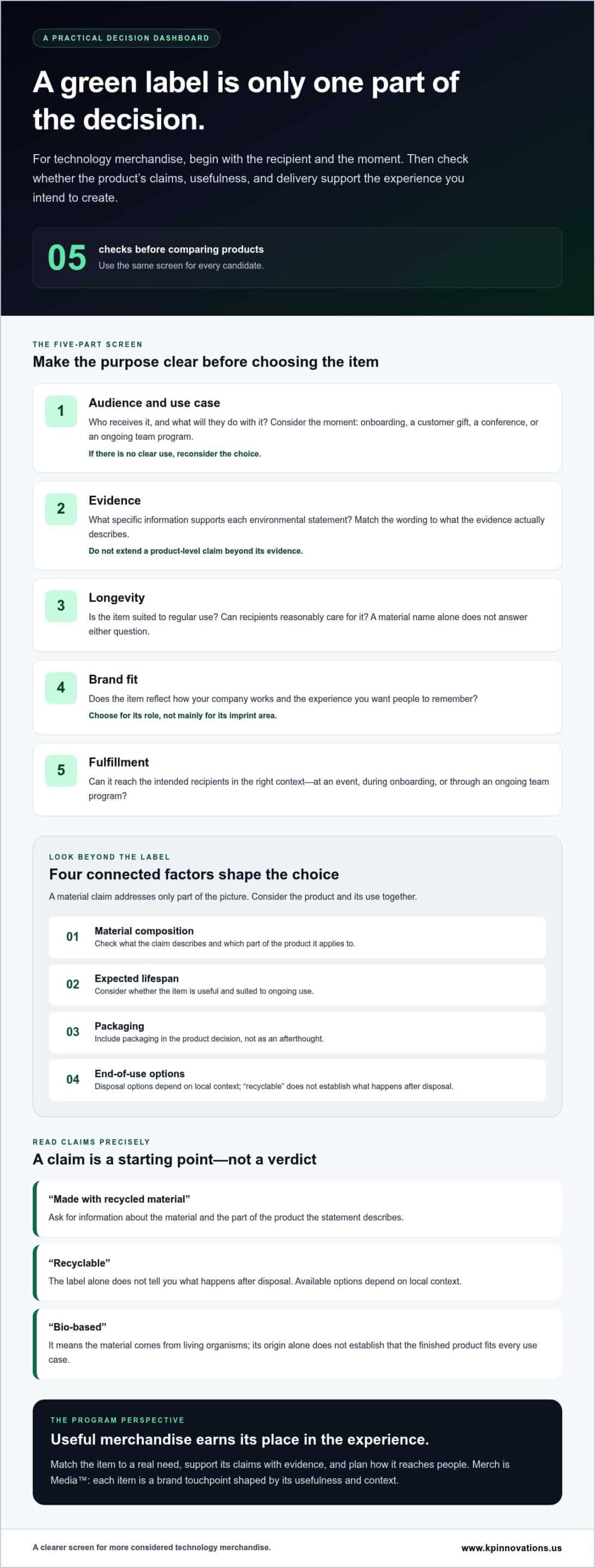
Consider four connected factors: material composition, expected lifespan, packaging, and end-of-use options. A recycled-material claim addresses only part of the picture. “Recyclable” doesn’t establish what happens after disposal, since options depend on local context. Bio-based materials come from living organisms. Even so, a material’s origin alone doesn’t establish that a finished product is the right choice for every use case.
Match the evidence to the claim. A statement about recycled content calls for information about the material and the part of the product it describes. A durability claim should be supported by relevant product information, not inferred from a material name. Treat labels as a starting point for evaluation, not as a verdict.
Why generic giveaways often miss the mark
Technology audiences don’t all work the same way. A remote employee setting up a home workspace, an engineer at a conference, and a customer receiving a thank-you gift have different needs. Consider the recipient, their work habits, and the moment of delivery before choosing an item. A good fit has a role beyond providing space for a logo.
That’s the difference between a purposeful brand touchpoint and an item chosen mainly for its imprint area. Merchandise becomes part of the brand experience through its usefulness and context, not just its visual identity. This is the idea behind Merch is Media™: merchandise can carry meaning through the moment it supports. Start with the audience and experience, then narrow the product choices.
For onboarding, choose items that help a new hire during their first days rather than assembling a standard assortment by default. For events, consider what attendees can use during the experience or take into their routine afterward. Those questions make sustainability part of the brief, not a label added after the product is chosen.
How to Evaluate Eco-Friendly Swag for a Technology Audience
A practical screen keeps the decision grounded in the recipient’s experience. Apply these five checks before comparing decoration, quantity, or a product’s environmental language. A candidate needs to work for its audience and have supportable claims. Sustainability is not a substitute for usefulness.
Start with the audience and the moment
An employee welcome kit, customer gift, conference item, and ongoing team program each have a different job. Define the moment you want to support first. Then consider whether recipients work remotely, travel between offices, collaborate in person, or carry items through an event. These details help narrow the product category before visual branding enters the conversation.
Technology companies also vary in how their teams and customers work. A merchandise program for tech and SaaS teams should reflect its actual audiences rather than assume everyone wants the same thing. An event handout may need to be easy to carry. An onboarding item should have a useful role in the employee’s first days. Define the intended experience before selecting products.
Use a five-part screen
- Audience and use case: Who will receive the item, and what will they do with it? If there’s no clear answer, reconsider the choice.
- Evidence: What specific information supports each environmental statement? Keep the wording within what the evidence actually shows.
- Longevity: Is the item suited to regular use, and can recipients reasonably care for it? A material claim alone doesn’t answer these questions.
- Brand fit: Does the item reflect how your company works and the experience you want people to remember?
- Fulfillment: Can the item reach its intended recipients in the right context, such as an event, onboarding, or an ongoing team program?
Use the same questions to compare options. A practical item with a clearly documented claim may be a stronger fit than one whose appeal rests mainly on a sustainability label. Utility is a requirement, not a concession. When recipients can use an item in their work or routine, it has a clearer purpose in the program.
Evidence: What does the claim specifically describe? Program implication: Use precise wording and don’t extend a product-level claim beyond its evidence.
Use and care: Does the item fit recipients’ routines, and is care practical? Program implication: Poor fit or inconvenient upkeep can undermine its intended usefulness.
Brand and delivery: Does it suit the company and arrive at a relevant moment? Program implication: Align the item and fulfillment plan with the recipient experience.
Bring these criteria together in the sourcing brief so product selection and evidence review support the same goal. Strategic merchandise sourcing connects audience needs, product claims, and program requirements in one decision process.
How to Compare Materials and Trade-Offs Without Greenwashing
Material is one part of a merchandise decision, not a complete measure of its environmental impact. A useful comparison also considers whether recipients will use the item, how long it may remain useful, what packaging it requires, and what options exist when it reaches the end of its use. The right balance depends on the audience and context, not on which label sounds most responsible.
Recycled content alone doesn’t describe an item’s full lifecycle. It tells you something about its material, not its usefulness, lifespan, packaging, or end-of-use path. Assess eco-friendly swag for tech companies through specific claims and practical trade-offs, not one headline label.
What to examine in recycled and renewable material claims
Start by defining exactly what the claim says. Recycled content describes material used to make an item. Recyclability is a separate claim about whether material can be processed after use. Reuse describes another possible use, while renewable or bio-based describes a material’s source. None of these statements proves the others or establishes that a finished product is environmentally superior.
Look for evidence that applies to the finished item and supports the specific wording under consideration. A general statement about a material or supplier shouldn’t become a broader claim about every component or the product’s overall impact. Refer to a standard or certification only when documentation shows that the specific product meets the relevant requirements. If the evidence supports a narrow statement, keep the language narrow.
Compare the claim with the use case
Use this table to structure a sourcing discussion. It doesn’t rank materials; it identifies the questions that make a comparison more meaningful.
| Claim or factor | Evidence to examine | Intended use | Trade-off to investigate |
|---|---|---|---|
| Recycled content | Documentation describing the material in the finished item | A product with a clearly stated recycled-material claim | Which parts the claim covers, and whether other components differ |
| Recyclable | Information supporting the claim and describing relevant disposal context | An item recipients can sort or dispose of appropriately | Whether the intended disposal route is practical for recipients |
| Renewable or bio-based | Evidence identifying the material and the scope of the claim | A product selected for a specific audience and purpose | How the finished item, packaging, and use context affect the choice |
| Durable and reusable | Product information relevant to expected use and care | An item suited to repeat use in work or daily routines | Whether recipients will actually use and maintain it |
When durability and reuse matter more than a label
An item suited to ongoing use may serve a recipient better than a novelty with a compelling material description but little practical purpose. That’s a selection consideration, not a promise of reduced impact. A remote team member, conference attendee, and customer receiving a gift may each value different kinds of usefulness. Choose based on how the item could fit into that person’s routine.
Compare candidates on the same terms: what the claim means, what supports it, who will use the item, and how it will be handled after use. A consistent comparison gives the merchandise program a clearer basis for decisions.
How to Plan Sourcing, Distribution, and Measurement
A thoughtful item can still miss its purpose if the program around it is fragmented. Treat sourcing, production, inventory, and delivery as connected steps, guided by the audience and business goal in the brief. That structure helps prevent mismatched quantities, unsupported environmental language, and merchandise that reaches people at the wrong moment.
Build a brief that keeps the program focused
Start with a brief that gives everyone the same decision criteria. Record who will receive the merchandise, when they’ll receive it, and what experience it should support. An employee onboarding kit, customer gift, and event distribution plan have different requirements. Specify brand and decoration needs, sustainability priorities, packaging considerations, and how recipients will get their items.
Define the evidence required for any environmental statement before approving creative. Product descriptions and design language can then stay aligned with what the supporting information shows. Strategy should guide the shortlist, not follow it. A clear merchandise strategy connects the business objective and recipient experience to sourcing decisions.
Then map the operational journey:
- Brief and creative: Set the audience, use occasion, brand requirements, and evidence standard.
- Sourcing and production: Compare suitable options, review claims, and coordinate approved decoration and production.
- Inventory and distribution: Plan where merchandise will be held and how it will reach event attendees, new hires, customers, or distributed teams.
- Replenishment: Use actual distribution and remaining stock to inform future orders rather than relying on an old estimate.
Estimate quantities around known audiences, scheduled events, onboarding plans, and expected replenishment needs. Where practical, separate planned demand by use occasion. This makes it easier to see whether inventory is serving the right groups or sitting unused because initial assumptions didn’t match actual distribution.
Track whether the merchandise program is working
Choose measures that relate to the goal in the brief. For onboarding, review participation and recipient feedback. For an event, compare how much merchandise was distributed with what remains. For an ongoing team program, track repeat requests and inventory use. These indicators can show what to adjust, but the number of items handed out is not proof of impact.
Keep interpretation disciplined. Positive feedback may suggest that an item fits its audience, but it doesn’t by itself prove increased loyalty. Inventory movement doesn’t establish reduced environmental impact. Record what you can measure, note its limits, and use the findings to improve the next program cycle.
For eco-friendly swag for tech companies, operational ownership connects the product decision to its full journey, from the brief through delivery and review. Explore strategic sourcing support to bring audience needs, product choices, and program requirements into one coordinated process.
Make Eco-Friendly Tech Swag Part of a Managed Brand Experience
A merchandise program is more than a series of purchasing decisions. Each item reaches someone in a real context: an employee joining the team, a customer receiving a gift, or an attendee taking something useful from an event. The Merch is Media™ philosophy starts there. Merchandise is a brand touchpoint, so its purpose, presentation, and delivery all shape the experience.
What a strategic sourcing partner brings to the process
Product selection should follow the goal, not lead it. First identify the audiences and experiences the program needs to support. Then translate those priorities into product criteria, evidence requirements, brand expression, and fulfillment needs. This keeps sustainability connected to the full brief instead of treating it as a label added after an item has already been chosen.
Each part of the work needs to stay connected. Strategy defines the objective and criteria. Creative development shapes how the item represents the brand. Sourcing identifies options that fit the brief. Production management coordinates the approved work, while inventory planning and fulfillment help merchandise reach its intended recipients. Coordinating these decisions lets teams consider the recipient experience alongside product information.
From a one-time order to a coherent merchandise program
A single order can meet an immediate need. Ongoing ownership connects that order to future employee, customer, and event experiences. A repeatable program can establish shared guidelines for product selection, creative, claim review, distribution, and replenishment. Teams can learn from previous orders and adjust as audiences or needs change, rather than rebuilding decisions from scratch for every occasion.
Company stores provide a structured way to present approved merchandise, while fulfillment supports distribution to employees, customers, or event recipients. These capabilities work best when they serve a defined program: who can access items, which occasions they support, and how inventory is managed. A store or shipment alone doesn’t create a strategy. The value comes from coordinating access and delivery with the experience the merchandise is meant to support.
That’s the role of a Chief Swag Officer: ongoing ownership of the merchandise system, not simply placing an order. A dedicated partner can align strategy, creative, sourcing, production management, inventory, and fulfillment as connected responsibilities. The result is a more intentional program, with decisions tied to audience needs and brand goals. It doesn’t guarantee a specific environmental or business result, but it creates a clearer process for making choices, supporting claims, and learning from each distribution cycle.
If your team is ready to connect merchandise goals with product selection and fulfillment, discuss strategic sourcing with KP Innovations.
Build a Merchandise Program That Moves Your Brand Forward
Your next merchandise decision can do more than fill an event table or complete a welcome kit. Use it to shape a useful, considered experience for the people who matter to your business. That’s the strategic potential of eco-friendly swag for tech companies: not a label on an item, but a thoughtful choice within a program that reflects your brand.
KP Innovations supports this work with strategic sourcing, creative development, program management, and fulfillment. Teams can access a catalog of over 1.2 million products, with white-glove project management from design through global fulfillment. The goal is to connect each decision to the audience and experience you want to create, then manage the details that bring it to life.
Give your program a clear starting point and an owner who can carry it forward. Discuss a strategic sourcing program with KP Innovations and take the next step toward merchandise that earns its place in your brand experience.
Frequently Asked Questions
What makes swag eco-friendly?
There isn’t one universal score that makes an item eco-friendly. Make the decision more consistent by documenting the purpose of the merchandise, the criteria used to compare options, and why the selected item met those criteria. Keep that record with the approved product description. It gives future teams a clear reference and helps prevent sustainability language from becoming broader each time the item is reordered.
How can a tech company choose sustainable merchandise employees will actually use?
Before committing to a full program, gather employee input on a small, representative selection of proposed items. Ask which they’d choose and what might keep them from using an item, such as inconvenient care or a poor fit with their routine. This brings employee perspective into the decision before purchasing is set. For eco-friendly swag for tech companies, early input can help distinguish a welcome gesture from something employees are unlikely to value.
Are recycled materials always the most eco-friendly choice?
No. Don’t treat a material category as an automatic ranking. Compare options that serve the same purpose, such as two items intended for the same audience and occasion. Then consider whether each meets the program’s practical requirements and whether its stated attributes are supported. Comparing like with like makes the trade-offs easier to explain and reduces the risk of choosing an item simply because one material label sounds more persuasive.
What should a company ask when evaluating eco-friendly merchandise claims?
Alongside reviewing product documentation, decide how the claim will appear wherever the item is presented. Is the wording on the product page, internal order form, packaging, and event signage consistent with the evidence? Assign someone to approve the language and retain the approved version with the product record. This helps prevent a narrow, accurate statement from becoming a broader claim during design or distribution.
Can eco-friendly tech swag be customized for a company’s brand?
Yes. A company can use its logo, colors, or a message to make merchandise recognizable and relevant to its brand. Decide how prominent the branding should be and where it belongs before approving creative. For an employee item, a subtle identity may suit the intended experience; for an event, clearer brand recognition may be part of the goal. Keep environmental statements separate from visual claims unless each is supported.
How can a company measure whether its merchandise program is effective?
Make measurement useful by assigning an owner, recording the program’s starting point, and setting a regular review date. Tie the review to the original goal, whether that’s supporting onboarding, an event, or a customer touchpoint. Note changes in context, such as a different distribution method, so results aren’t compared as if conditions were identical. Use findings to make a specific decision for the next cycle, rather than treating measurement as reporting for its own sake.