
What looks like an apparel problem may actually be an employee experience problem. Uniforms are one of the most visible ways people experience your brand, yet corporate uniform program management often gets split among HR, operations, procurement, and local teams. The result is familiar: inconsistent ordering, unclear choices, and apparel that doesn’t fit the realities of employees’ roles.
It makes sense to focus first on garments, inventory, and distribution. But those details should support a bigger goal: a consistent, role-appropriate experience employees can navigate with confidence. Comfort and clarity matter to the people wearing the apparel, while consistency shapes the signals customers and colleagues see. KP Innovations views uniforms through a “Merch is Media™” lens: what employees wear helps express the culture and brand they represent.
This article explores how to manage uniforms as a connected program, not a series of disconnected orders. You’ll learn how clear ownership across strategy, creative, sourcing, program administration, and fulfillment can reduce friction, support different roles and locations, and keep the experience adaptable as teams and business needs change.
Key Takeaways
- Define the employee and business needs your uniform program should serve before selecting apparel or ordering.
- Use corporate uniform program management to connect strategy, creative, sourcing, production management, and fulfillment under clear ownership.
- Set central brand guardrails while allowing uniform choices to reflect different roles and team needs.
- Compare ad hoc ordering, internal ownership, and a managed partner based on coordination effort, employee experience, and adaptability.
- Build the program in stages, then review how its processes and choices support employees as business needs evolve.
Corporate Uniform Programs Start With an Employee Experience Problem
Orders arrive through different teams. Employees in similar roles wear noticeably different apparel. When someone needs a replacement, no one is sure who owns the reorder. These are visible uniform problems, but they often point to a deeper issue: no shared system for making decisions and managing the experience.
Corporate uniform program management means coordinating the decisions and operations behind employee apparel, from defining who needs what to managing how people access and reorder approved items. It connects separate tasks under a clear purpose. In the broader sense, program management aligns related activities with organizational goals. For uniforms, that means treating apparel choices, ordering, and fulfillment as connected parts of one program. KP Innovations manages uniform programs with that perspective.
A managed program is not occasional apparel purchasing. It gives uniform decisions an owner, a purpose, and a process employees can understand.
Why uniforms are more than a clothing decision
Employees experience a uniform during the work itself, not just when it’s selected. Fit affects whether apparel feels appropriate for the person wearing it. Function matters because a customer-facing role and an operational role may involve different daily tasks. Clear guidance helps employees understand which options suit their role and how to obtain them.
Uniforms also communicate. A consistent look can express expectations around how a team presents itself, while role-appropriate differences can make those expectations practical. For example, a front-desk employee’s apparel may help customers recognize who can assist them. An operations team’s apparel may need to suit the work setting and the tasks employees perform. Neither example requires every employee to wear identical items. The goal is a coherent system that connects brand expression with everyday needs.
This is where the idea that “Merch is Media™” becomes tangible. Apparel carries brand cues into daily interactions, so choices about appearance and access are part of the employee experience, not simply purchasing details.
Where informal uniform ordering creates friction
Without clear ownership, teams may make the same decisions independently. One location chooses its own apparel; another uses a different approach. Employees may receive unclear instructions about what to wear, where to order, or how replacements work. A manager may handle a reorder one time, while another team assumes HR is responsible the next.
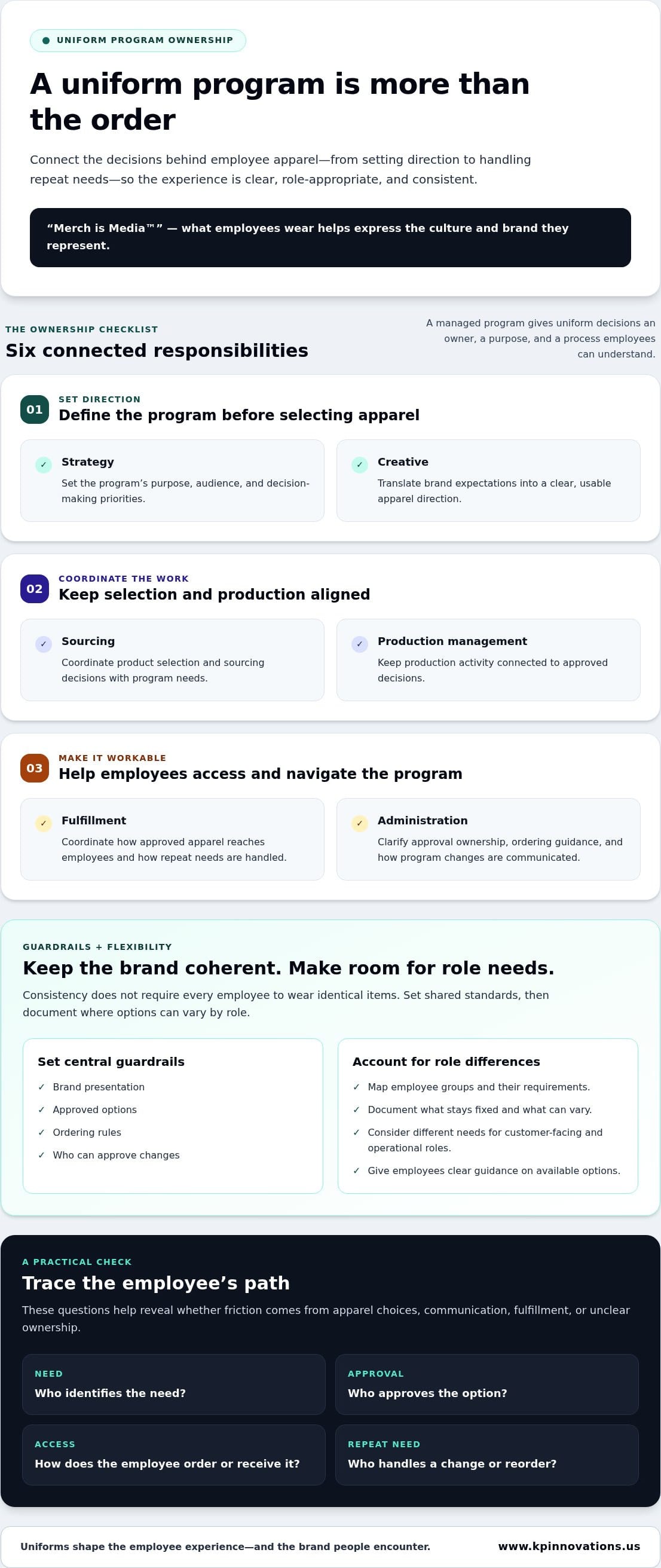
These issues can look like a product problem: inconsistent items, missing sizes, or uncertainty about what is approved. But replacing apparel alone won’t resolve unclear decision rights or scattered processes. Start by tracing the employee’s path: Who identifies the need? Who approves the option? How does the employee order or receive it? Who handles a change or reorder?
Those questions reveal whether the friction comes from apparel choices, communication, fulfillment, or ownership. Addressing the source helps create a uniform experience employees can follow, rather than asking them to navigate disconnected decisions on their own.
What Corporate Uniform Program Management Should Actually Own
A uniform program needs more than a person who places orders. It needs clear ownership of the decisions that shape the experience, and a way to keep those decisions connected as teams and needs change. Corporate uniform program management should coordinate strategy, creative, sourcing, production management, and fulfillment, while clarifying who sets direction and who handles day-to-day administration.
This is a decision framework, not simply a bundle of services. A uniform program management approach connects recurring choices, from defining the purpose of the program to keeping approved options and ordering processes aligned. The owner helps leaders distinguish between standards that should stay consistent and decisions that need room to reflect role or team requirements.
- Strategy: Set the program’s purpose, audience, and decision-making priorities.
- Creative: Translate brand expectations into a clear, usable apparel direction.
- Sourcing: Coordinate product selection and sourcing decisions with program needs.
- Production management: Keep production activity connected to approved decisions.
- Fulfillment: Coordinate how approved apparel reaches employees and how repeat needs are handled.
- Administration: Clarify approval ownership, ordering guidance, and how program changes are communicated.
Set program guardrails without ignoring role needs
Central guardrails create coherence. They can define brand presentation, approved options, ordering rules, and who has authority to approve changes. But consistency doesn’t require every employee to wear the same apparel. A customer-facing role and a role centered on operational work may have different needs, even within the same organization.
Build flexibility into the program deliberately. Map employee groups, identify where requirements differ, and document which choices are fixed and which can vary by role. That gives teams a clear path to appropriate options without turning every local request into a separate program. It also helps employees understand what’s available to them and how decisions are made.
Connect sourcing and fulfillment to the employee journey
Sourcing decisions affect more than what gets selected. They shape how consistently the program can be maintained, how options are planned around employee needs, and how straightforward ordering feels. If sourcing is disconnected from program design, approved choices may be difficult to manage over time. Coordinated sourcing keeps those decisions tied to the experience the program is meant to deliver.
Fulfillment completes the handoff from program decisions to employees. When ordering guidance, approvals, and distribution are coordinated, employees have a clearer route to access the apparel intended for their role. KP Innovations’ uniform sourcing process connects selection with the wider program, rather than treating each order as an isolated transaction.
The practical test is simple: can employees understand what to choose and how to get it, while internal teams know who owns each decision? If not, the program needs clearer connections between its parts, not just another round of apparel purchasing.
Choosing a Uniform Program Model: Orders, Internal Ownership, or a Managed Partner
There isn’t one right operating model for every organization. The choice depends on how much coordination the program requires, how much internal capacity is available, and how consistently employees need to access apparel. A simple purchasing process may be enough for occasional needs. As decisions recur across roles or locations, the work calls for clearer ownership.
These models solve different problems. An apparel supplier provides apparel and fulfills orders. A program management partner coordinates the broader system, including the decisions, sourcing, employee access, fulfillment, and adjustments that connect those orders over time.
| Model | Ownership | Employee experience | Coordination effort | Ability to adapt |
|---|---|---|---|---|
| Ad hoc purchasing | Often shared or situational | Can vary by order or team | Low to start, but repeated decisions fall to internal staff | Flexible, though consistency may be harder to maintain |
| Internally managed program | Assigned to internal owner or team | Can be clear when guidance and access are maintained | Requires ongoing internal coordination | Can respond to business needs, depending on available capacity |
| Managed strategic partner | Shared with a dedicated program partner | Designed around defined access and role needs | Coordination is built into the managed relationship | Program decisions can be reviewed as needs change |
The easiest ordering process isn’t automatically the best uniform program; convenience matters only if it supports clear ownership and a consistent employee experience. An ordering tool can reduce steps for an employee, but it won’t decide who approves changes, how role needs are handled, or how the program evolves.
When occasional ordering becomes an operating burden
Look for repeated one-off decisions, unclear approvals, and employees who aren’t sure how to access approved apparel. These signals suggest that the process lacks ownership, not necessarily that it needs a wider product selection. The right model depends on the organization’s needs and internal capacity. Some teams can manage the work internally; others may benefit from shared program ownership.
How to evaluate a managed uniform program
Assess who connects strategy, sourcing, employee access, fulfillment, and ongoing adjustments. Then consider whether the process preserves shared brand direction while making room for role-based choices. Uniform program strategy gives those decisions a foundation, helping the organization set priorities before individual orders or exceptions arise.
For leaders comparing models, map the decisions that recur and identify who owns each one today. If ownership changes from order to order, or employees face different access rules across teams, the work may be ready for a more defined structure. That doesn’t require the same solution everywhere. It does require a deliberate choice about who keeps the program connected as needs change.
Build a Corporate Uniform Program in Clear, Manageable Stages
A reliable program takes shape through connected decisions, not a single launch announcement. A staged approach helps leaders move from the current situation to a working process, while making responsibilities clear at each step. It also makes corporate uniform program management easier to adjust as roles, teams, and business needs change.
- Discovery: Map employee groups, locations, current apparel, ordering and distribution processes, and decisions without a clear owner. Note where employees or managers encounter confusion.
- Program design: Set the program’s purpose and define its guardrails. Decide which brand standards apply across the organization, where role-based options are appropriate, who approves changes, and how employees will access approved choices.
- Sourcing: Align apparel selection with the program’s goals and employee needs. Keep sourcing decisions connected to the approved direction and consider how choices will be managed over time.
- Launch: Prepare employee instructions, ordering access, and fulfillment responsibilities before introducing the program. Make sure internal teams know where questions and exceptions should go.
- Administration: Maintain the process after launch. Coordinate ordering, changes, employee access, and communication so the program doesn’t depend on informal workarounds.
- Review: Revisit the program at planned intervals and when business needs change. Use employee feedback and process observations to identify what should stay consistent and what may need adjustment.
A uniform program succeeds when ownership is clear and employees can use the process with confidence. Apparel choices matter, but a well-planned program also makes the rules, access, and support understandable to the people who rely on it.
Plan a launch employees can understand
Before launch, make the practical answers easy to find: who is eligible, how to place an order, where program information lives, and whom to contact with a question. Employees shouldn’t have to piece together instructions from separate messages or rely on a manager’s memory.
Keep the guidance consistent without assuming every role or location has identical needs. A clear core process can accommodate differences in approved options or local administration. The goal is a launch employees can follow, with enough structure to reduce uncertainty and enough flexibility to fit the organization.
Review the program and improve its operation
Choose internal indicators that reflect the program’s own goals. Order patterns may reveal where access or guidance is unclear. Employee feedback can surface practical issues with the process, while repeated questions or approval delays can point to ownership gaps. These signals help teams focus on useful adjustments without relying on generic benchmarks.
Review should lead to decisions, not just reporting. Identify what needs attention, assign an owner, and communicate any changes to affected employees. To connect program design with apparel selection, plan uniform sourcing around your program’s goals.
How KP Innovations Manages Uniform Programs as Brand Experience
KP Innovations is a Merchandise Strategy & Brand Experience Agency. The company helps organizations make uniform decisions with the people wearing the apparel and the brand they represent in view. That shifts the conversation from “Which items should we order?” to “What should this experience communicate, and what will make it workable for employees?”
“Merch is Media™” captures why that shift matters. A uniform is part of the everyday experience employees have of their organization, and part of the impression they create in interactions with others. A strategic partner helps leaders consider those signals deliberately, instead of treating each apparel request as a standalone transaction.
What an outsourced merchandise department changes
An outsourced merchandise department gives uniform decisions a strategic home alongside the organization’s wider merchandise priorities. That broader view helps leaders consider whether apparel feels coherent with other brand touchpoints, while accounting for differences in employee roles and operating contexts. It helps make the uniform program feel intentional to employees, not simply coordinated on paper.
Through the Chief Swag Officer model, KP Innovations acts as a dedicated partner for the merchandise experience. Internal teams have a partner for questions about how uniforms should represent the organization and how the experience can respond as needs shift. Employees remain central to those decisions because they encounter the apparel and the process firsthand.
Move from disconnected orders to a managed program
A strategic partnership helps organizations make uniform decisions in context. Rather than letting each request define the brand experience on its own, leaders can consider how apparel choices relate to the culture they want to express and the realities of employees’ work. The program can then evolve with the organization without losing sight of those priorities.
That perspective turns uniforms into more than a repeated purchasing task. It creates space to shape an employee experience that feels considered and aligned with the organization’s identity. To explore how sourcing can support that experience, explore a strategic sourcing partnership.
Make Your Next Uniform Decision a Strategic One
Use the next program change as a chance to test whether your current setup still serves employees. Can they find the right options, understand how to access them, and know where to take questions? If not, capture those friction points before placing another order. A routine replacement or team change can become a useful opportunity to refine the experience and clarify what needs attention.
That’s the practical value of corporate uniform program management: it connects apparel decisions to the way employees experience the organization at work. KP Innovations manages merchandise projects from design through global fulfillment, keeping the work connected as program needs take shape and evolve.
Ready to make your uniform program easier for employees to navigate and your teams to manage? Explore strategic sourcing for your uniform program.
Frequently Asked Questions
What is corporate uniform program management?
Corporate uniform program management is the governance of uniform-related decisions over time, including how changes are recorded and communicated. A practical tool is a decision log that captures what was approved, who approved it, and what prompted the decision. This gives new managers useful context, helps teams avoid reopening settled questions, and makes it easier to revisit a choice when the organization’s needs or priorities change.
How is a uniform program different from ordering uniforms in bulk?
A bulk order addresses a purchasing event; a uniform program also plans for what happens between orders. For example, leaders can define what triggers a replacement order, how a new employee gets access, and how a discontinued option is handled. Planning these scenarios ahead of time helps teams respond consistently instead of creating a new process each time an employee joins, changes roles, or needs a replacement.
Who should own a corporate uniform program?
One person or team should be accountable for the program, with a clear route for involving other decision-makers. A responsibility map can distinguish who recommends changes, who approves them, and who communicates decisions. For example, an operations lead might flag a role-specific need, while the accountable owner coordinates review and records the outcome. This keeps input broad without leaving employees unsure about who makes the final call.
How do you make a uniform program work across multiple locations?
Use version control for program guidance so each location can identify the current instructions and remove outdated copies. Assign a local point person to report recurring questions or issues, then review those updates centrally. For example, if one location sees repeated confusion about an ordering step, the program owner can determine whether the guidance needs clarification for everyone or whether the issue is specific to that location.
How can employees be included in uniform program decisions?
Invite employees to test the experience before a major change is finalized. Ask them to walk through a sample ordering task and note where instructions, choices, or next steps are unclear. Include people from different roles, and provide a way to share feedback privately for topics employees may not want to raise in a group. Then tell participants what changed as a result, so the feedback process feels meaningful.
What should leaders measure in a uniform program?
Start by setting a baseline for the specific issue the program is meant to address, then compare observations after a change. For instance, if the goal is clearer ordering, record the types of questions employees raise before revising instructions and review them afterward. Break findings down by relevant role or location when practical. This can reveal where an adjustment helped and where more investigation is needed, without relying on generic targets.
Can a uniform program support both brand consistency and role-specific needs?
Yes. A useful way to balance them is to define a small set of brand elements that remain consistent, then document which choices can vary by role. Put the distinction into a simple decision guide: employees and managers can see what is fixed, what is flexible, and how to request an exception. This makes the boundary between brand direction and practical variation easier to apply in everyday decisions.