
What should a power bank do for your brand beyond keeping a device charged? Custom branded power banks can support a memorable brand moment when they’re chosen for a specific audience and purpose. Without that intent, even a useful item can become another giveaway people don’t remember.
It’s easy to see the appeal: a portable charger meets a practical need and gives a brand a place in someone’s day. But a logo alone doesn’t create a meaningful experience. Merch Is Media™: the item, the moment it arrives, and the way it’s distributed all shape what people take away from it.
This article explains how to make power banks part of a thoughtful merchandise program. Define the audience and use case, connect creative and sourcing decisions to that purpose, and plan production and fulfillment as one coordinated effort. When strategy, creative, sourcing, production, fulfillment, and reporting work together, merchandise can act as a brand channel, not just a product order.
Key Takeaways
- Define who the item is for and what experience it should support before choosing a product.
- Match custom branded power banks to a clear moment, such as employee recognition, a customer interaction, an event, or client gifting.
- Compare options based on audience fit, customization, distribution, and program ownership, not specifications alone.
- Connect the brief, creative, sourcing, production management, and fulfillment to keep the experience consistent from planning through delivery.
- Give the item a role in a broader merchandise program, with intentional distribution and reporting to inform future decisions.
Custom Branded Power Banks: Why the Moment Matters More Than the Logo
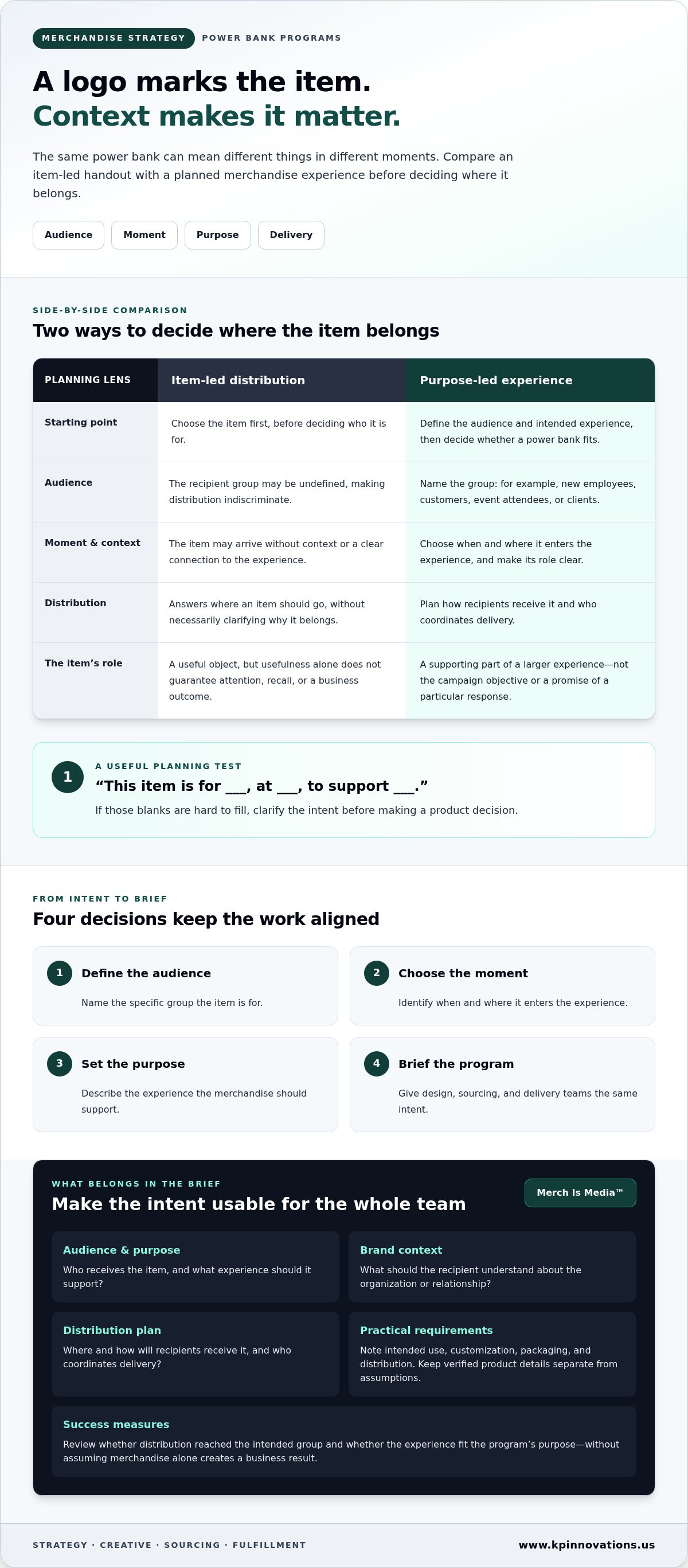
Choosing an item before deciding who it’s for can turn a practical idea into a poor fit. A power bank may make sense for people who rely on mobile devices during a particular workday or event, but that doesn’t make it right for every employee, customer, or client. Start with the experience you want to support, then decide whether the item belongs in it.
Custom branded power banks are business merchandise customized to contribute to a brand experience. Customization is only one part of the decision. The audience, timing, presentation, and purpose determine whether the item feels considered or simply distributed.
A power bank included in a new employee’s welcome experience carries a different meaning from one handed out without context at a crowded event. The item may be identical, but the relationship around it is not. Usefulness can earn an item a place in someone’s routine, but it doesn’t guarantee attention, recall, or a business outcome.
A logo marks an item; a planned merchandise experience gives it a reason to matter. That distinction is central to the Merch Is Media™ philosophy: merchandise is part of how people encounter a brand, not just a surface for its identity.
What makes a power bank a considered brand touchpoint?
A considered touchpoint connects a real audience need with a relevant interaction. For example, a company could include a power bank in an employee welcome experience when it fits the other tools and materials the employee receives. An event team could consider one for attendees moving between sessions. These examples are prompts for planning, not promises about how recipients will respond.
Evaluate three parts of the experience:
- Relevance: Does the item make sense for this audience and context?
- Timing: Will it arrive at a moment when its role is clear?
- Presentation: Does the way it’s introduced connect it to the experience?
When those elements align, the product has context. Without them, even a practical choice can feel generic.
Why a giveaway alone is not a merchandise strategy
Distributing an item answers a logistics question: where should it go? A merchandise strategy also asks why it belongs, who it is meant to reach, and what experience it should support. If the audience is undefined, distribution can become indiscriminate. That weakens the connection between the item and the brand, even when the item itself is useful.
Merch Is Media™ offers a more deliberate way to think about merchandise. Treat each item as a communication choice shaped by purpose, audience, and context, rather than assuming that a logo creates meaning. Before approving a purchase, write a one-sentence brief: “This item is for ___, at ___, to support ___.” If those blanks are hard to fill, clarify the intent before making a product decision.
How to Define the Audience and Purpose for Custom Branded Power Banks
A clear plan starts before product comparisons. Define the audience, choose the moment, set the purpose, then brief the program. This sequence keeps the item in a supporting role and gives creative, sourcing, and distribution decisions a shared direction.
- Define the audience. Name the specific group, such as new employees, existing customers, event attendees, or clients.
- Choose the moment. Identify when and where the item will enter the experience.
- Set the purpose. Describe what the merchandise should support, such as a thoughtful welcome or a useful addition to a client interaction.
- Brief the program. Document the decisions so the teams responsible for design, sourcing, and delivery can work from the same intent.
Match the item to an employee, customer, or event moment
Consider what the recipient is experiencing. In onboarding, a power bank could be part of a broader welcome experience for a new employee. For client gifting, it could accompany a note tied to the relationship instead of arriving as an unexplained object. In a campaign, it might support a specific interaction. At an event, its role should make sense within the attendee experience.
These are distinct use cases, not interchangeable distribution lists. Clarify who receives the item and what the organization wants the moment to communicate. The power bank can support that experience, but it isn’t the campaign objective or a promise of a particular response.
Write a useful merchandise brief before sourcing
A useful brief gives the people shaping and delivering the program enough context to make consistent decisions. Include:
- Audience and purpose: Who will receive the item, and what experience should it support?
- Brand context: What should the recipient understand about the organization or relationship?
- Distribution plan: Where and how will recipients receive it, and who is coordinating delivery?
- Practical requirements: What matters for the intended use, customization, packaging, and distribution? Keep verified product details separate from assumptions.
- Success measures: What will the team review afterward, such as whether distribution reached the intended group or the experience fit the program’s purpose?
These measures help teams learn without assuming merchandise alone creates a business result. A focused Merchandise Strategy process can turn the audience, moment, and purpose into a brief that guides the work. If you’re comparing related item categories, apply the same audience-first questions to portable chargers rather than starting with features. Then use the brief to guide Product Sourcing, so options are considered in the context of the experience and distribution plan.
How to Compare Custom Branded Power Bank Options Without Chasing Specs
Once the audience and purpose are clear, compare options against the brief rather than letting a specification sheet set the agenda. A feature matters only if it supports the planned use and can be verified for the item under consideration. Separate confirmed details from assumptions, and keep the recipient’s experience in view throughout the decision.
The best-fit item isn’t the one with the longest specification list; it’s the one that fits the use case and can be delivered as intended.
Compare options by audience fit and planned use
Use the same criteria for each option so the team can make a considered comparison. Start with the recipient and setting, then assess customization, distribution, and ownership. A product that suits one program may not suit another: an item selected for a client interaction can have a different role from one included in an employee experience. Let the purpose, not the product’s popularity, guide the decision.
- Audience fit: Does the item make sense for the people receiving it and the context they’re in?
- Intended moment: Is its role clear in the experience, whether it’s part of a welcome, event, or client interaction?
- Customization needs: What brand presentation is required, and which options are supported by sourcing information?
- Distribution: How will the item reach the intended recipients, and what needs coordination?
- Program ownership: Who is responsible for keeping the brief, creative, production details, and delivery aligned?
This framework helps teams identify trade-offs without treating every listed feature as equally important. If a detail hasn’t been verified for the item being considered, keep it out of the product facts and resolve it during Product Sourcing.
Evaluate sourcing and brand presentation together
Specifications should be factual. Don’t infer capacity, charging standards, materials, compatibility, or performance from a category description or image. Record only information supported by product documentation or sourcing details, and distinguish it from requirements the team hopes to meet. This keeps assumptions from turning into promises.
Then consider how the creative direction will translate into the recipient’s experience. A logo is one choice; the overall presentation should fit the brand context and the moment. Product Sourcing identifies suitable options against the brief, while Production Management coordinates the approved item and creative through production. These are connected steps, but they solve different parts of the work.
With Product Sourcing, options are considered in relation to the program, not selected on specifications alone. That keeps the decision anchored to audience fit, verified information, and a delivery plan the team can manage.
Plan a Custom Branded Power Bank Program From Brief to Fulfillment
A strong program doesn’t end when a product is selected. The approved brief should guide creative, sourcing, production, and delivery, with clear ownership at each handoff. That matters when custom branded power banks are part of recurring merchandise activity. Without shared direction, teams can make decisions that no longer fit the original audience or purpose.
Use a defined sequence to keep the work connected:
- Approve the brief. Align stakeholders on the audience, intended experience, distribution plan, practical requirements, and how the program will be evaluated.
- Develop the creative direction. Translate the brief into a brand presentation that suits the recipient and moment.
- Source product options. Find options that fit the agreed requirements, using verified product information rather than assumptions.
- Manage production. Coordinate the approved product and creative through production, keeping decisions and updates connected.
- Plan fulfillment. Organize how items will be handled and delivered to their intended recipients.
Coordinate creative development, sourcing, and production
Creative Development turns the approved brief into a direction for how the brand will appear in the recipient’s experience. Product Sourcing identifies options that fit the planned requirements. Production Management oversees production within the merchandise lifecycle. Each function has a distinct role, but all need the same source of truth: the brief and its approved decisions.
Clear handoffs help prevent avoidable disconnects. The sourcing decision should reflect the creative requirements, and production should follow the approved direction rather than an outdated version. Assign ownership for approvals, changes, and communication so marketing, HR, sales, and operations can stay aligned, especially when programs repeat.
Plan distribution and evaluate the program
Fulfillment covers the operational work of preparing merchandise for distribution, including warehousing, kitting, shipping, and tracking. Connect those activities to the intended recipients and the experience described in the brief. A coordinated delivery process supports consistency, but it can’t guarantee a particular reaction or business result.
Program Management keeps coordination and reporting connected across workstreams. Before distribution begins, decide what the team will review afterward. Measures might address whether items reached the intended audience, whether the planned experience was delivered, or what the team learned for a future program. Set measures to fit the purpose. Don’t invent benchmarks or treat distribution volume as proof of impact.
When one partner coordinates the lifecycle, teams have a clearer view of decisions, responsibilities, and next steps across recurring activity. To connect product options to your approved brief, plan Product Sourcing around your program requirements.
Make Custom Branded Power Banks Part of a Larger Merchandise Program
A power bank can have a place in a merchandise program without becoming the whole program. It might support one employee, customer, event, or client experience, while other items serve different moments. The value comes from designing those choices to work together, not expecting one product to carry every brand interaction.
Think about the full experience around the item. What else does the recipient receive? How does each element fit the occasion and the relationship? A power bank may be a practical part of a welcome or client gift, while apparel, recognition items, or print materials serve other purposes across the organization. A broader plan gives each item a defined role and helps teams make merchandise decisions with a consistent point of view.
Why one partner can simplify a recurring merchandise program
Recurring activity involves connected work across strategy, creative, sourcing, production, fulfillment, and reporting. When handoffs lack a clear owner, decisions can drift from the original purpose or become difficult to coordinate across programs. One point of ownership keeps the brief and its decisions connected, while giving marketing, HR, sales, and operations a shared view of the work.
KP Innovations’ outsourced merchandise department model is the Chief Swag Officer. It brings connected merchandise workstreams under a strategic partner rather than treating each request as a standalone product order. That distinction matters: product delivery addresses an order, while program ownership also considers why the item is being used, how it fits the brand experience, and what the team can learn from the program.
This approach reflects the Merch Is Media™ philosophy. Merchandise is a brand channel shaped by the item, its context, and the way it reaches people. A power bank can contribute to that channel, but it shouldn’t replace the broader plan or be expected to create results on its own.
Turn the next sourcing decision into a clear first step
Before starting a sourcing conversation, bring the key parts of the program into focus. A short working brief can capture:
- Audience: Who is the item intended for?
- Moment and purpose: Where does it fit, and what experience should it support?
- Creative direction: How should the brand show up in that context?
- Sourcing and distribution: What requirements should guide the product decision, and how will it reach recipients?
- Evaluation: What will the team review afterward to understand whether the program followed its intent?
This is a more useful starting point than requesting a product without context. KP Innovations can be your strategic merchandise partner, connecting the brief to creative, sourcing, production, fulfillment, and reporting. To discuss your next program, start a conversation about your merchandise sourcing needs.
Make Your Next Merchandise Decision More Intentional
A single merchandise decision can prompt a wider question: what should people consistently recognize about the way your organization shows up? The answer can help your team build a point of view that lasts beyond one campaign or gift. It also gives future decisions a meaningful reference instead of leaving each request to start from scratch.
For custom branded power banks, consider what you want the item to represent in the relationship, not just what it does. Bring that thinking into a practical sourcing conversation and shape the decision around your organization’s priorities.
Discuss your custom power bank sourcing needs. Make the next brand moment a deliberate part of your merchandise strategy.
Frequently Asked Questions
Are custom branded power banks a good fit for business merchandise?
They can be a good fit when recipients have a clear reason to value a portable charging item in their work or event context. Custom branded power banks aren’t automatically right for every audience. Consider whether the item fits the recipient’s routine and the experience you’re shaping. If an unrelated item could serve the same purpose just as well, revisit the choice before moving forward.
What should a company consider when sourcing custom branded power banks?
Start with the program requirements, then compare documented product information and customization options. Consider where and how recipients will receive the item, how the brand presentation should fit the occasion, and what information stakeholders need to approve the choice. Keep verified product details separate from assumptions so the team can assess options using consistent criteria.
Can custom branded power banks support employee onboarding?
Yes. A power bank can be one part of an onboarding experience if it fits the employee’s role and the way they’ll participate in work. For a distributed team, consider how the item will arrive alongside other welcome materials and whether its purpose is clear. The goal is to support a thoughtful welcome, not to rely on one item to shape how a new employee feels about the organization.
Can custom branded power banks be used for client gifting?
Yes, if the choice fits the relationship and the reason for giving. A power bank could accompany a personal note or another relevant gesture instead of arriving without context. For ongoing gifting, consider how the gift fits the relationship stage and whether the experience reflects the way your organization works with that client. The item can support the interaction, but it isn’t a substitute for the relationship itself.
How can a business assess whether a power bank belongs in its merchandise program?
Ask whether the item has a distinct role in the experience and whether your team can explain that role to recipients. Then consider whether the item would still make sense for this audience and occasion without the logo. Review relevant feedback or past distribution records if available. Those inputs can help teams refine future choices without assuming the product alone created a particular result.
Can a company store be used to manage branded merchandise ordering?
Yes. An Online Company Store can present approved merchandise and apparel for self-serve ordering, with budgeting and reporting as part of the store program. It gives teams a shared channel for managing orders instead of relying on separate requests and informal lists. A power bank can be considered as part of the broader merchandise program, with the store supporting how approved items are organized and ordered.