
What if the value of branded merch isn’t in how many items you hand out, but in what people do next? That’s the question behind how to measure the impact of branded merch. A distribution count tells you what left the warehouse. It doesn’t show whether an item strengthened a relationship, prompted a conversation, or supported a business goal.
Measurement can feel difficult because merchandise often plays a supporting role across brand experiences. Teams may track different signals without agreeing on what success means. The answer isn’t to credit an item with every sale or interaction. It’s to connect each program’s purpose with relevant audience behavior, then assess the results carefully.
This guide explains how to choose measures that fit a program, build a practical measurement plan, and use what you learn to improve future work. From recipient response and brand recall to business outcomes such as referrals or repeat business, the goal is to gather useful evidence without overstating causation. Because Merch Is Media™, measurement belongs in the strategy from the start, not just in a tally after an event.
Key Takeaways
- Learn how to measure the impact of branded merch by choosing indicators that reflect each program’s objective, rather than relying on a single measure of success.
- Use a clear sequence to define what you want to learn, select evidence, interpret the results, and refine the next program.
- Match awareness, engagement, and business goals with relevant signals, while keeping audience response distinct from outcomes such as referrals or repeat business.
- Document baselines, ownership, assumptions, and attribution limits before launch so your team can interpret findings with care.
- See how an outsourced Chief Swag Officer model can connect strategy, execution, reporting, and ongoing improvement.
Why measuring branded merch impact takes more than counting items
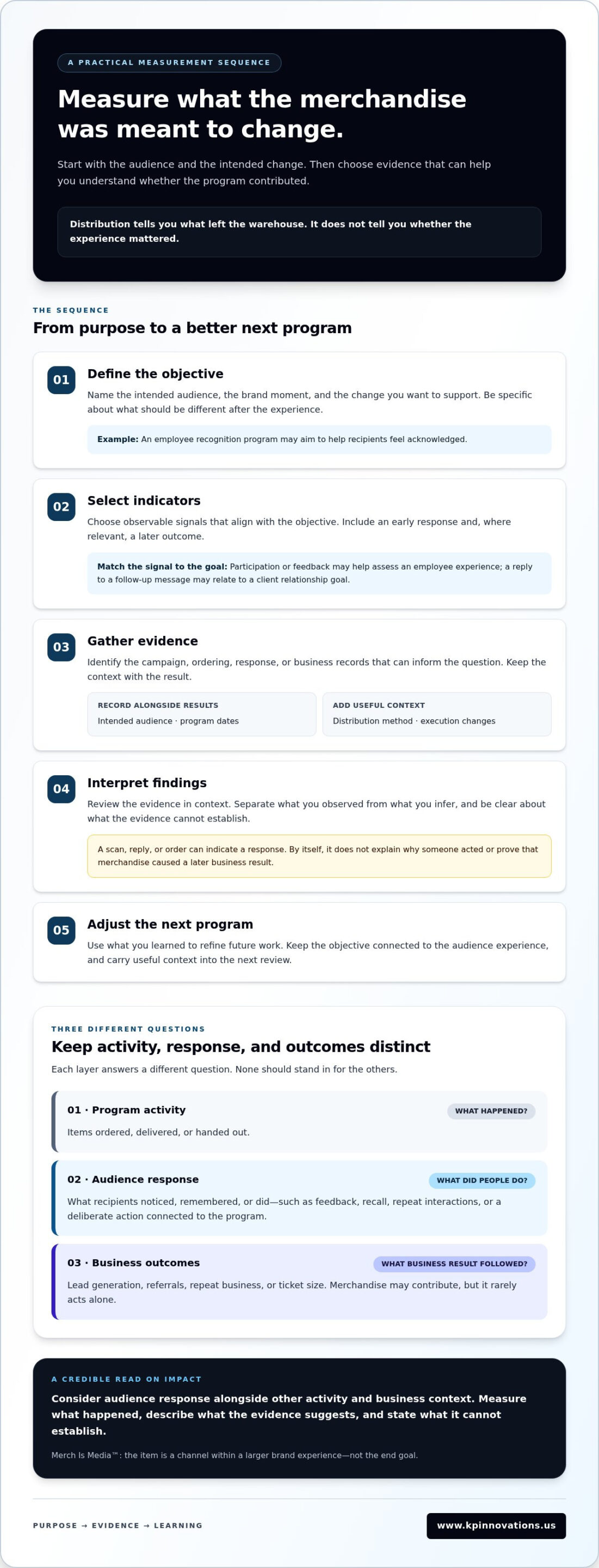
A shipment report can confirm that merchandise was produced and delivered. It can’t tell you whether the experience mattered to the people who received it. To understand how to measure the impact of branded merch, separate three layers: program activity, audience response, and business outcomes. Each answers a different question, and none should stand in for the others.
Distribution is activity: items ordered, delivered, or handed out. Audience response is what recipients notice, remember, or do. Business outcomes include lead generation, referrals, repeat business, or ticket size. A program may contribute to those outcomes, but merchandise rarely acts alone. Timing, audience, message, and other brand interactions also shape what happens.
What does branded merchandise impact actually mean?
Impact means evidence that a program supported its stated objective. That objective might be improving an employee’s recognition experience, helping event attendees remember a brand, or creating a thoughtful moment with a client. The intended change could involve awareness, experience, relationship, or behavior. Define it around a specific audience and moment, not simply the item being distributed.
This is the practical meaning of Merch Is Media™: the item is a channel within a larger brand experience, not the end goal. A useful Merch Is Media perspective starts with what the audience should experience and takes shape through the item, its timing, and the context around it. Promotional merchandise can serve different purposes, but its presence alone doesn’t establish whether a particular program was relevant or memorable.
Why distribution counts are an incomplete measure
Units ordered and handed out help teams manage inventory and delivery. They don’t show whether recipients wanted the item, used it, remembered the brand, or took a next step. The same item count can represent very different experiences: a relevant welcome gift for new employees is not equivalent to an unwanted giveaway left behind after an event. While consumer shops like Koolthings prove how merchandise succeeds when tied to genuine affinity and interest, corporate programs must also ensure their items carry real personal value to avoid being discarded.
Relevance and timing change the meaning of distribution data. A delivery record confirms that a package arrived; it doesn’t confirm that the recipient opened it or found it useful. Evidence of response might include feedback, recall, repeat interactions, or a deliberate action connected to the program. Those signals still need context. A response can show engagement, but it doesn’t by itself prove that merchandise caused a later purchase.
That distinction keeps reporting credible. Measure what happened, identify what the evidence suggests, and be clear about what it can’t establish. A program’s contribution is easier to understand when audience response is considered alongside other activity and business context, rather than credited with every outcome that follows.
How to measure the impact of branded merch in a clear sequence
A repeatable process keeps measurement tied to the reason a program exists. Start with the audience and intended change, then decide what evidence can reasonably show whether the program contributed. This prevents teams from choosing easy-to-report numbers first and trying to justify them later. It also gives marketing, HR, and operations a shared basis for reviewing results.
Start with a measurable objective and audience
Make the objective specific enough to guide decisions. Instead of “increase engagement,” name the audience, the brand moment, and the response you hope to see. For example, an employee recognition program might aim to help recipients feel acknowledged, while a client touchpoint might be designed to encourage a follow-up conversation. The objective should shape the experience before items are sourced.
Objective-setting is part of Merchandise Strategy. It connects the business purpose to the audience experience and the choices that follow. Ask what should be different after the moment, and what observation would provide credible evidence of that change. A clear objective doesn’t guarantee an outcome. It gives the team a focused basis for learning.
Choose indicators and gather evidence
Select a small set of indicators that directly relate to the objective. A response to a follow-up message may be relevant to a client relationship goal; participation or feedback may help assess an employee experience. Use records that match the question, and note what each source can and can’t tell you. More data isn’t automatically more useful.
Keep the measurement context with the result: intended audience, program dates, distribution method, and any relevant changes in execution. This makes comparisons more meaningful and helps explain gaps in the evidence. A scan, reply, or order can indicate a response, but it doesn’t by itself explain why someone acted or establish that merchandise caused a later business result.
Use this sequence to keep the work manageable:
- Define the objective. State the intended audience, brand moment, and change you want to support.
- Select indicators. Choose observable signals that align with the objective, including an early response and, where relevant, a later outcome.
- Gather evidence. Identify the campaign, ordering, response, or business records that can inform the question.
- Interpret findings. Review the evidence in context, distinguishing what was observed from what you infer.
- Adjust the next program. Use what the team learned to refine the experience, execution, or measurement approach.
For example, if a program is intended to prompt client follow-up, track the response signal separately from later repeat business or referrals. The first may appear sooner; the latter can be influenced by many interactions over time. Consider timing and other contributing factors before describing a connection as impact. That care makes how to measure the impact of branded merch a practical discipline, not a claim of automatic attribution.
Once the objective is clear, sourcing can serve the experience rather than drive it. Thoughtful Product Sourcing can align item choices with the audience, moment, and intended response.
Which branded merch metrics fit awareness, engagement, and business outcomes?
The right metric depends on the job the program is meant to do. A useful way to approach how to measure the impact of branded merch is to match each objective with an observable signal and an evidence source. Treat these as options, not universal benchmarks: an indicator is useful only when it relates to the audience, moment, and purpose of the program.
Match indicators to the intended brand moment
For awareness, exposure can help describe whether an item had a chance to be seen. It doesn’t prove recognition or recall. If recall matters, use a survey that asks what people remember, and distinguish unaided recall from recognition prompted by brand cues. Search activity or direct traffic may offer context, but other campaigns and external events can influence those signals too.
For Employee Programs, participation or feedback is meaningful only in relation to the intended experience. If the aim is recognition, for instance, ask whether recipients felt acknowledged rather than treating distribution as proof of appreciation. At an event, a scan or follow-up response can indicate interaction. It’s more informative when the action reflects the intended next step, not just curiosity.
Connect commercial outcomes without overstating attribution
Lead generation, repeat business, referrals, and ticket size are business outcomes worth examining when they fit the program’s objective. Compare available records with the program’s timing and audience. Look for relevant patterns, such as whether event attendees who received merchandise later responded to follow-up, while recognizing that a pattern alone doesn’t establish cause.
Sales conversations, service quality, pricing, broader marketing, and existing relationships may also affect commercial results. Record these factors where possible and describe merchandise as a potential contributor, not the sole driver. Strong measurement gives decision-makers a clearer view of what the evidence supports, what remains uncertain, and which indicators deserve attention in future programs.
Build a measurement plan your team can use and improve
A measurement plan is most useful before a program begins, while there’s still time to shape the experience and decide how evidence will be gathered. Keep it practical. A concise brief can align teams on the objective, who will collect information, and what conclusions the results can reasonably support.
Create a measurement brief before the program starts
Document the intended audience, the brand moment, the objective, the indicators you’ll track, and where evidence will come from. Establish a baseline where relevant, such as existing participation, feedback, or business activity. Note the measurement period and any assumptions, including which audiences or interactions fall outside the review.
Assign an owner to each measure. The person coordinating an Employee Program may gather participation and feedback, while a sales or account team may provide relevant client records. Also state what the evidence cannot show. For example, a positive response after a client gift may indicate engagement, but it doesn’t prove the gift alone drove a later transaction.
Review findings and apply them to the next program
Compare results with the original objective, not an unrelated benchmark. Review what the team observed, what may have influenced it, and where evidence is incomplete. A consistent format makes it easier to compare similar programs or brand moments over time. Document differences in audience, timing, or execution to prevent false comparisons.
Use a simple review sequence:
- Check the evidence. Confirm the records match the intended audience, period, and indicator.
- Interpret in context. Separate observed response from possible contribution and note other relevant influences.
- Choose an adjustment. Decide what to retain, change, or investigate in the next program cycle.
Keep reporting concise and decision-focused. Marketing may need to understand audience response, HR may focus on employee experience, operations may need to address execution, and leadership may want to see how the program relates to broader goals. A shared summary should make the evidence and its limitations clear to each group without turning every signal into a claim of ROI.
Consistent ownership helps this process continue beyond a single campaign. Program Management connects planning, execution, and reporting so teams can carry learning from one merchandise program into the next. That coordination supports a more dependable view of how to measure the impact of branded merch over time.
As the plan informs program design, align sourcing decisions with the audience and intended brand moment. Explore Product Sourcing as part of a measurement-led program.
Make merchandise measurement part of a strategic partnership
A product transaction typically ends with the item delivered. A strategic merchandise program has a longer horizon: it connects the intended audience experience to planning, execution, reporting, and what the team learns next. That distinction matters because measurement is more useful when it informs the program from the start, not when it appears as a tally after everything is over.
What changes when one partner owns the merchandise program?
KP Innovations’ outsourced Chief Swag Officer model brings coordinated ownership across Merchandise Strategy, Creative Development, Product Sourcing, Production Management, Fulfillment, Program Management, and reporting. Each part can inform the next. The objective guides the experience; execution creates the brand moment; reporting captures relevant evidence that can shape future decisions.
A traditional vendor may focus on products and delivery. A strategic partner connects those activities to the program’s purpose and helps the team maintain continuity across moments. For example, Recognition Programs, Uniform Programs, and Client Gifting have different audiences and goals, but each can be planned and reviewed as part of a broader merchandise program. Consistent ownership makes it easier to carry learning forward rather than restarting from a purchase order each time.
This approach doesn’t mean every outcome can be attributed to merchandise. It means the team can define what it intends to support, coordinate the work around that intention, and report what the evidence suggests. Merch Is Media™ is a useful lens: the item is one part of a brand experience, and its value depends on how it fits the audience, context, and relationship.
Turn measurement into the next brand moment
Findings should inform a specific decision. If recipients respond to a recognition experience but feedback suggests the timing felt disconnected from the achievement, the next program can adjust the moment and review whether the experience feels more relevant. If client follow-up is the goal, the team can examine responses alongside account context before deciding what to refine. Neither observation proves the item caused a later business result.
That discipline keeps measurement grounded. Audience response, execution, and commercial outcomes are related, but business results can also reflect sales conversations, service, broader marketing, and existing relationships. Use the evidence to identify possible contribution, acknowledge limitations, and decide what to retain, change, or investigate. Over time, this makes the answer to how to measure the impact of branded merch more useful: it becomes a repeatable learning practice tied to real program decisions.
When insights point to a different audience need or brand moment, Product Sourcing should reflect that learning rather than default to familiar choices. Explore Product Sourcing as part of a merchandise program built around clear objectives, coordinated execution, and ongoing review.
Make the next brand moment more intentional
Measurement earns its value when it changes what your team does next. Use what you learn to make future merchandise experiences more relevant to the people they’re meant to reach, and keep reviewing how those moments fit into broader business efforts. That’s a more useful way to approach how to measure the impact of branded merch: as an ongoing practice that sharpens decisions, not a final score assigned to an item.
With its outsourced Chief Swag Officer model, KP Innovations connects merchandise planning and execution with reporting on business outcomes such as lead generation, repeat business, referrals, and ticket size. These outcomes have multiple influences, so the goal is to understand merchandise’s potential contribution, not promise it can produce results on its own.
Bring your objectives and audience into the process from the start. Explore Product Sourcing with KP Innovations as part of a strategic merchandise program built around your brand experience.
Frequently Asked Questions
Can you measure branded merchandise impact without a promo code?
Yes, a promo code isn’t required to assess a program. If you’re determining how to measure the impact of branded merch, you might add a campaign-specific question to an inquiry form, review account notes for relevant conversations, or ask recipients what they recall afterward. Choose a source that fits the audience and objective. Record other likely influences too, so a rise in inquiries isn’t automatically credited to merchandise.
Is ROI the only way to measure branded merchandise?
No, ROI is useful for some commercial objectives, but it can’t represent every kind of value. For an onboarding experience, a team could examine whether new employees use the resources provided or share feedback about the welcome. For an event, the quality of follow-up conversations may matter more than immediate revenue. Choose evidence that reflects the goal, and describe experience measures separately from financial return.
What happens if a branded merchandise campaign has several touchpoints?
Consider merchandise within the full sequence of brand interactions. For a conference, that might include an invitation, an on-site conversation, an item received, and a later email. Keep a simple campaign record showing which audiences encountered each touchpoint and when. If a prospect later responds, the record helps the team discuss how the interactions worked together without assigning the entire response to one item.
How can a company measure employee merchandise programs?
Start by identifying the employee moment the program is designed to support, such as onboarding, a milestone, or team recognition. Then tailor a short feedback prompt to that moment. For instance, ask a new hire whether the welcome experience helped them feel prepared for their first week. Review responses by program purpose, and use recurring feedback to improve relevance, timing, or communication.
Can branded merchandise be compared with digital advertising?
Yes, if the comparison focuses on a shared objective and makes each channel’s role clear. For example, an event campaign might use digital advertising to encourage registration and merchandise to support conversations on site. Compare relevant audience actions within the same campaign context, rather than treating an ad click and an in-person interaction as identical signals. Report what each channel contributed to the experience.
How often should a company review branded merchandise impact?
Set review points around when useful evidence is likely to appear, rather than choosing a cadence for convenience alone. An event team might review attendee responses after follow-up, then revisit account activity later if relationship outcomes matter. For an employee program, feedback may be most useful after recipients have had time to experience it. Make each review answer a decision question, such as what to adjust next.