
A thoughtful investor gift is a signal of a relationship, not a return on capital. The best venture capital and investor gift ideas reflect the connection behind the exchange: venture capitalists support portfolio companies, limited partners commit capital to funds, and founders build lasting relationships with both. A relevant, well-considered gesture can mean more than an expensive one.
It’s easy to treat gifting as a quick choice between an item and a logo. But venture capital relationships often develop over years, so a gift matters most when it feels personal, appropriate, and connected to the people or work being recognized.
This article explains how venture capitalists, limited partners, funds, founders, and investors can approach gifting, and how to choose a gesture that fits each relationship. You’ll learn what makes a gift feel considered, how context and timing shape the choice, and how a thoughtful merchandise program can contribute to a broader brand experience.
Key Takeaways
- Match the gesture to the relationship: a founder, limited partner, and business partner may value different kinds of recognition.
- Personalization works best when it reflects shared context, not just a name or logo.
- Consider how timing, company policies, and the purpose of the gift affect whether it feels appropriate.
- Build a consistent gifting approach around the experience you want recipients to remember, rather than choosing items in isolation.
- Thoughtful merchandise can support a broader relationship strategy when it expresses your organization’s values with care.
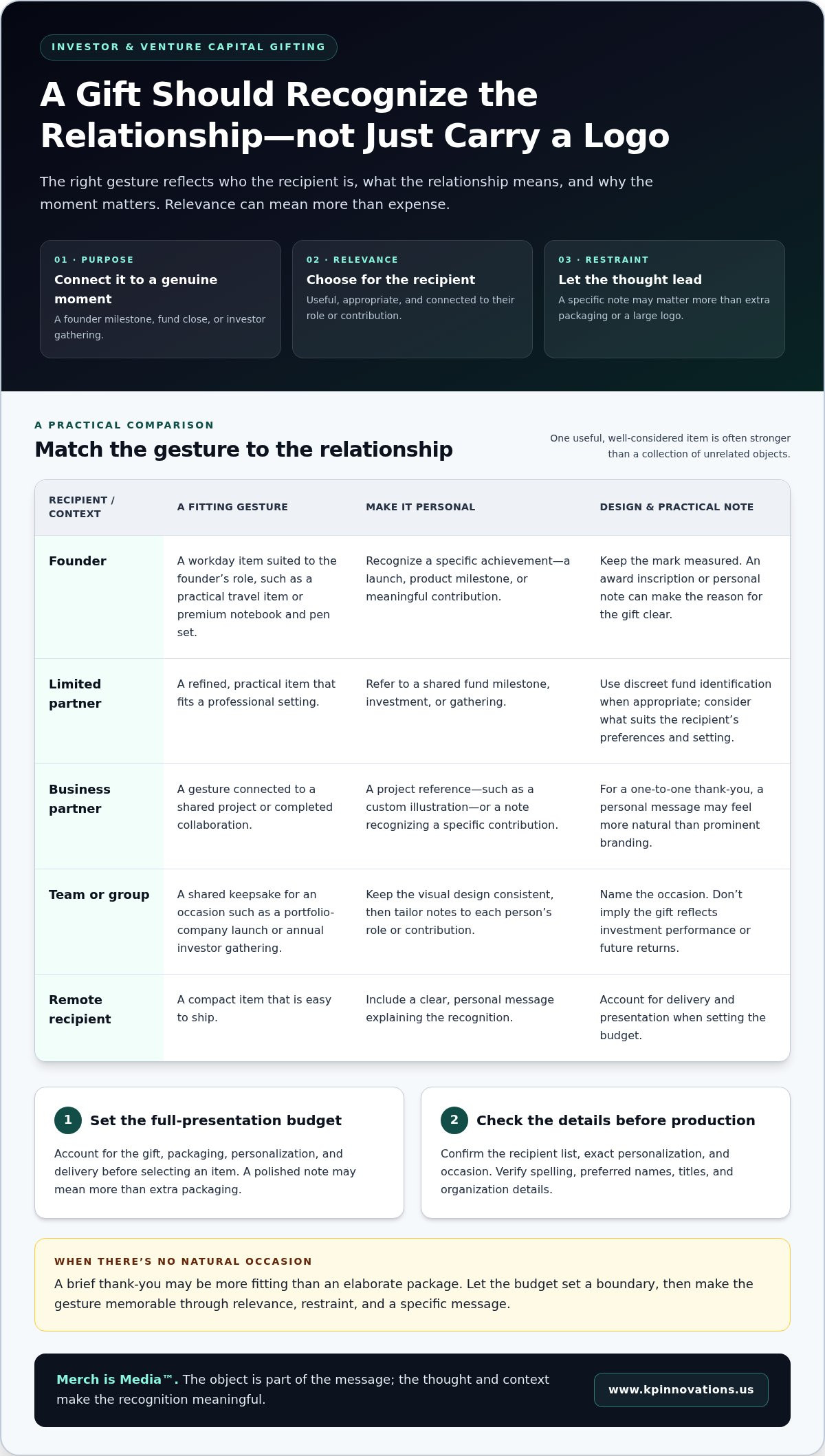
Start with the recipient and occasion: a founder milestone, investor meeting, and limited partner gathering each call for a different gesture. Choose something relevant to the relationship, useful beyond the event, and appropriate for the fund’s culture.
For an individual recipient, consider a premium notebook and pen set, a compact desk accessory, or a carefully selected food gift. A founder who travels frequently may appreciate a practical travel item; a limited partner who hosts meetings might value an elegant office piece. Choose one useful item rather than a collection of unrelated objects. Every detail should feel intentional, not added just to fill a box.
For a shared occasion, such as a portfolio-company milestone or annual investor gathering, a modest gift paired with a personal note can make a stronger impression than a generic logo item. Mention the company’s launch, a successful partnership, or a specific contribution. The note provides context; the object makes the recognition tangible. Don’t suggest that a gift reflects investment performance or future returns.
- For a founder: Select a workday item that suits the founder’s role, then add a note recognizing a specific achievement.
- For a limited partner: Choose a refined, practical item for a professional setting, with discreet fund identification if appropriate.
- For a team: Pair a shared keepsake with a message that names the occasion, such as a portfolio-company launch.
- For a remote recipient: Prioritize compact, easy-to-ship items and include a clear, personal message.
Before choosing, decide whether your budget covers the gift alone or the full presentation. Packaging, personalization, and delivery all shape the recipient’s experience, so account for them before selecting an item. A polished note may mean more than extra packaging.
Keep the design restrained. A fund name or portfolio-company mark may suit an event, while a personal message may feel more natural for a one-to-one exchange. With venture capital and investor gift ideas, the object is only part of the message. Consider what the recipient will remember: the item’s usefulness, the thought behind it, and the relationship it acknowledges.
Connect the gift to a genuine moment. A new fund close, a founder’s major company milestone, or a meaningful investor gathering gives the gesture a clear purpose. When there’s no natural occasion, a brief thank-you may be more fitting than an elaborate package. Let the budget set a boundary, then make the gift memorable through relevance, restraint, and a specific message.
What personalized gifts are appropriate for investors and business partners?
Personalization should show attention, not just add a name. For example, a gift recognizing a founder’s product launch could include a note that names the milestone and the recipient’s contribution. That specific detail connects the gesture to the relationship. A generic logo on an unrelated item rarely carries the same meaning.
Choose personalization based on who will receive the gift and why. A limited partner may value a discreet reference to a shared fund milestone, while a portfolio-company founder may appreciate recognition of a product or team achievement. For a business partner, a custom illustration of a meaningful project may feel more considered than prominent branding. Keep the recipient’s preferences and professional setting in mind.
- For a founder: Add a brief inscription to an award that recognizes a launch, product milestone, or meaningful contribution.
- For a limited partner: Use a restrained fund mark or a note reflecting a shared investment or gathering.
- For a business partner: Personalize an item with a project reference, such as a custom illustration of a completed collaboration.
- For a group: Keep the design consistent, then personalize individual notes with each recipient’s role or contribution.
Use names carefully. Confirm spelling, preferred names, titles, and organization details before production. A misspelled name on an engraved item can undermine an otherwise thoughtful gesture. If recipients have different roles, keep the visual design consistent but tailor the message. For example, thank a founder for building the product and an advisor for making a specific introduction.
Personalization includes presentation, too. A message inside the package can explain why you chose the item, while a custom sleeve or card can connect it to a fund event. Keep logos proportionate to the gift’s purpose. For a one-to-one thank-you, a short handwritten note may feel more personal than a large company mark. For a portfolio gathering, consistent branding can create a shared experience.
Before production, settle three details: the recipient list, the exact personalization, and the occasion each message should recognize. This simple review helps prevent mismatched names, irrelevant references, and inconsistent designs. For a collection of gifts tied to different portfolio companies, thoughtful gift sourcing can help align each choice with its recipient and context.
Personalized venture capital and investor gift ideas work best when customization means more than decoration. A founder’s milestone, a partner’s contribution, or a shared project gives the message substance. Choose a useful item, keep branding measured, and make the wording specific to the relationship. The recipient should understand why you chose that particular gesture.
What gifts do venture capitalists commonly dislike or consider inappropriate?
A gift can miss the mark if it creates obligation, discomfort, or extra work. An elaborate package sent during active fundraising, for instance, may seem tied to an investment decision. Keep the purpose clear: thank someone for a relationship or recognize a genuine milestone. Don’t present a gift as a reason to invest, approve a deal, or provide access.
An expensive gesture can also feel awkward. A luxury watch or extravagant trip may be disproportionate to a routine business exchange, especially when the recipient doesn’t know the sender well. The issue isn’t just the item, but the signal it sends about influence, expectations, or judgment. A modest, relevant gesture is often easier to accept without feeling indebted.
- Skip overly personal items: Fragrance, clothing in specific sizes, or home décor may presume familiarity the relationship hasn’t established.
- Avoid divisive themes: Political slogans, religious messages, or jokes about a competitor can make a professional gift uncomfortable.
- Think twice about food and drink: Wine can conflict with someone’s preferences; specialty foods may involve allergies or dietary restrictions.
- Limit conspicuous branding: A large logo across a premium item can make a gift feel like advertising rather than recognition.
Novelty items can become clutter. A desk toy shaped like a rocket may suit a playful launch event, but feel generic if it has no connection to the recipient. A bulky gift can also burden someone traveling from a conference or investor meeting. Choose something easy to use or carry, and easy to decline gracefully.
Timing changes how a gesture is received. Sending a gift immediately before a pitch, board vote, or financing decision can invite the wrong interpretation. A note sent after a completed collaboration, portfolio milestone, or annual gathering provides clearer context. For group occasions, present gifts consistently rather than singling out one decision-maker without explanation.
Before sending a gift, take three practical steps: identify the occasion, consider the recipient’s preferences, and review the message for implied expectations. “Thank you for your guidance on the product launch” is more appropriate than a note hinting at a future introduction. These checks distinguish thoughtful venture capital and investor gift ideas from gestures that feel transactional.
Make the gift easy to receive. Confirm the recipient’s name and business address, don’t demand public acknowledgment, and don’t ask for a social post or endorsement in return. A concise thank-you card can accompany a useful item without creating another task. Respectful restraint often communicates better judgment than an elaborate presentation.
What are the U.S. rules and etiquette for giving gifts to investors
In the United States, start with the recipient organization’s written gift policy. A venture fund, portfolio company, bank, or public institution may set different limits and approval steps. Don’t assume a personal relationship overrides an employer’s requirements. If the policy requires approval or prohibits gifts, follow it before choosing or sending anything.
Keep courtesy separate from influence. A thank-you after a completed board presentation differs from a gift offered during fundraising or before an investment decision. For example, sending a package to a partner evaluating your company could create an appearance of pressure. Choose a neutral moment and explain the purpose in the accompanying note.
Consider the recipient’s role and organization before deciding how to proceed. A limited partner at a private fund, an employee of a financial institution, and a government employee may face different internal requirements. The organization’s compliance or ethics team can explain its policy and approval process. If the gift relates to a pending transaction, get guidance before sending it.
- Review the policy: Look for rules covering gifts, meals, event invitations, disclosure, and approval.
- Identify the recipient’s role: Confirm their employer and whether they participate in a decision involving your fund or company.
- Document the purpose: Record the recipient, date, occasion, gift description, and business reason.
- Keep the exchange transparent: Use a clear note and avoid private arrangements that could appear to conceal the gesture.
Etiquette depends on the setting, too. At an investor conference, a modest, consistent item for attendees may be more appropriate than a conspicuous gift for one decision-maker. For a one-to-one exchange, tie a direct thank-you to a specific contribution so the reason is clear and no favor is implied. Don’t request a referral, endorsement, or investment in return.
If a policy is unclear, pause rather than guess. Ask the appropriate compliance contact about the recipient’s eligibility, required approvals, and how the organization records gifts. This is especially useful when a fund manager is dealing with a bank, public agency, or company with formal procurement controls. Keep the response with the gift record.
A practical U.S. approach is to review the policy, assess the timing, document the purpose, and maintain transparency. A note recognizing a completed portfolio-company launch, for example, has clear business context. A gift offered before an investment vote does not. Apply the same checks for founders, limited partners, and business partners to support trust and avoid unnecessary uncertainty.
Are there tax or compliance limits on business gifts in the United States
Tax treatment and gift acceptance are separate questions. A gift may suit a business relationship but still require internal review or careful bookkeeping. For example, a fund manager sending a thank-you to a limited partner should record the occasion, recipient, item, and business purpose. That record helps the organization classify the expense and explain its decision later.
There’s no single practical gift limit for every U.S. recipient and organization. A private fund, portfolio company, financial institution, and public body may each have different policies covering permitted gifts, approvals, disclosure, and reporting. The recipient’s employer policy matters alongside the sender’s accounting process, especially when an investment or procurement decision is active.
For tax records, distinguish a physical gift from other spending. A meal, event ticket, charitable contribution, and packaged item may receive different accounting treatment. Don’t group them under a vague “relationship expense” description. Document what was provided, who received it, why it was given, and how it relates to business. Consult the organization’s tax professional about unusual or high-value cases.
- Classify the expense: Record whether it was a gift, meal, event expense, or another category.
- Capture the context: Note the recipient, date, occasion, and business purpose.
- Review recipient policy: Check whether approval, disclosure, or refusal applies before delivery.
- Keep supporting records: Retain receipts, approvals, and relevant correspondence with the expense file.
Take extra care with compliance review around fundraising, investment decisions, procurement, or board matters. A gift sent before a financing decision could be interpreted differently from a thank-you after a completed collaboration. Document why a portfolio-company milestone prompted recognition, for example, and avoid connecting the gesture to an expected investment, introduction, or vote.
Good records help a fund make consistent decisions. A standard internal form can capture the recipient’s organization, gift description, approval status, occasion, and delivery date. If a recipient declines the gift, record that outcome instead of sending a substitute without reviewing the policy. Consistent records help staff handle founder appreciation, limited-partner events, and partner recognition with the same care.
Use the recipient’s written policy and your organization’s accounting process as the starting point. For a gift program serving founders and investors, plan the selection and documentation together. Coordinate thoughtful gift sourcing with recipient context and internal review, so each choice supports the relationship and its recordkeeping.
When reviewing your accounting process, consider how fund obligations shape the surrounding context. Venture capital funds invest capital in startups and return capital to limited partners after portfolio-company exit events such as IPOs, M&A sales, or secondary transactions. Venture capital funds are often bound by limited partnership agreements to return invested capital and gains to limited partners after a set period, often ten years. Venture capital firms earn carried interest as a percentage of a business’s profits, and commonly focus on specific business sectors or geographic areas when considering investments. These fund structures make clear documentation useful, but do not replace review of the recipient’s policy or the organization’s tax treatment.
KP Innovations: Promotional Products
KP Innovations treats merchandise as media: a way to create memorable brand experiences and strengthen relationships over time. Rather than treating each gift as a one-off purchase, the company acts as a strategic partner, shaping and managing the merchandise program around its purpose and audience.
For fund managers recognizing founders, limited partners, or business partners, Promotional Products, Custom Apparel, and Awards & Recognition Items can support different occasions. The right choice connects the item to the experience you want people to remember.
If you’re ready to shape a more intentional investor gifting program, contact KP Innovations to discuss an approach suited to your brand and audience.
Make the Next Gift Part of the Relationship
A gift can do more than mark a moment. It can express how your fund wants founders, limited partners, and business partners to experience the relationship over time. Treat each choice as part of a broader brand experience, with a clear purpose and consistent point of view.
That perspective can help fund managers move from one-off decisions to a more intentional gifting program. Consider who the gesture is for, what it should communicate, and how it fits the occasion. Those decisions give venture capital and investor gift ideas a stronger role than simply adding a logo to an item.
KP Innovations can connect merchandise choices to the intended recipient and experience. Its Promotional Products, Custom Apparel, and Awards & Recognition Items can support different moments of recognition and relationship-building. The focus is thoughtful selection, not merchandise for its own sake.
Explore merchandise sourcing with KP Innovations and take a considered next step toward a gifting approach that reflects your fund’s relationships.
Frequently Asked Questions
What are thoughtful gift ideas for venture capital investors?
Choose something connected to the investor’s interests or work, such as a carefully selected book about a sector they follow. Add a short inscription explaining why you chose it. For an investor who mentors founders, a small collection of founder stories can recognize that contribution. Make the connection clear in your message rather than relying on a logo to explain the gift.
What are the best professional gifts for startup investors under $50?
Consider a well-chosen paperback, a quality phone stand, or locally roasted coffee. These options suit a professional setting without requiring personal knowledge of clothing sizes or home décor. A card naming the occasion can make the gesture specific. For example, thank an investor for a useful introduction or thoughtful feedback instead of sending an item with a generic message.
What luxury gifts do venture capitalists appreciate?
Luxury gifts are most fitting when craftsmanship and usefulness matter more than display. A refined leather folio or handcrafted pour-over coffee set may suit an investor who uses those items regularly. Keep personalization subtle, such as initials inside the folio rather than a prominent logo. Let the recipient’s preferences and workplace culture guide the choice, especially for gifts shared with colleagues.