
Sustainable merchandise fulfillment depends on coordinating the warehouse, packaging, suppliers, and delivery choices rather than treating shipping as a final step. A 3PL can put those decisions into practice by packing orders to fit, following clear handling instructions, and aligning delivery options with the program’s priorities. The aim is to reduce unnecessary materials and movement while protecting the merchandise.
That takes more than choosing a recyclable mailer. Packaging must suit the order, supplier claims need credible support, and shipping choices should account for the trade-offs among speed, distance, and emissions. A change that seems greener on paper can create more waste if it damages products or requires repackaging.
This guide explains how brands can assess order patterns, choose practical packaging, and build responsible supplier relationships with fulfillment partners. It also explains what carbon-neutral shipping means and how delivery choices fit into the wider picture. Use this framework to make fulfillment decisions that support both the brand experience and environmental goals.
Key Takeaways
- Use order patterns to choose packaging that protects merchandise without adding unnecessary materials, then test changes in the fulfillment environment.
- Understand whether a carbon-neutral shipping approach reduces emissions, compensates for them, or combines both.
- Choose recyclable or compostable packaging based on how it works for the product and the customer’s disposal options.
- Make sustainability claims more credible by assessing supplier practices and using relevant certifications to support specific claims.
- Compare delivery options by considering route, speed, and transport method together, rather than assuming one choice is always greener.
1. Sustainable packaging collaboration between brands and 3PLs
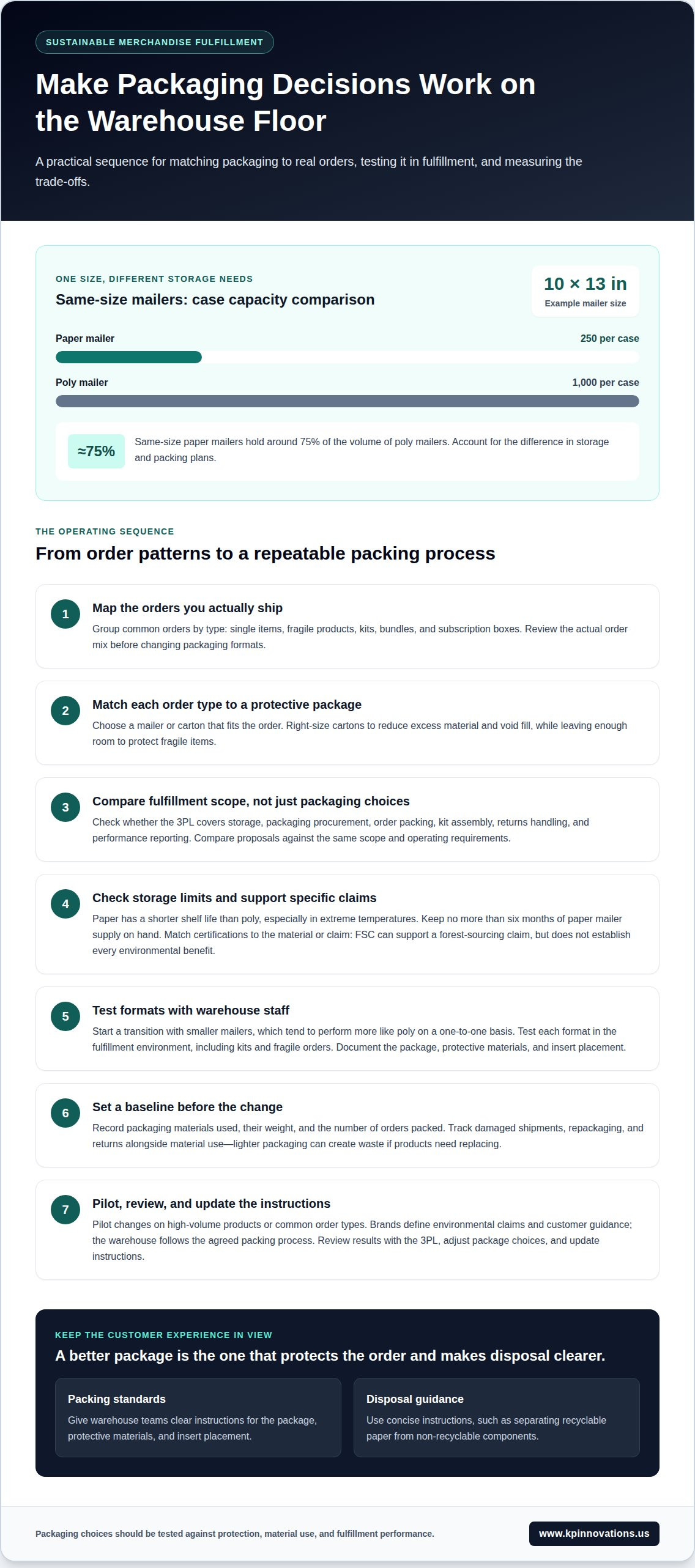
Sustainable merchandise fulfillment starts with packaging rules that brands and warehouse teams can execute consistently. Map common orders, then match each type with a protective mailer or carton. For example, a 10-by-13-inch paper mailer holds 250 per case, while the same-size poly mailer holds 1,000. Paper mailers hold around 75% of the volume of same-size polymailers, so storage and packing plans need to account for the difference.
Fulfillment providers differ in scope, not just packaging options. Compare storage, packaging procurement, order packing, kit assembly, returns handling, and performance reporting. Rates depend on the program and are provided after a quote request, so compare proposals against the same scope and operating requirements. Documented packing instructions help warehouse teams apply selected standards consistently.
For U.S. packaging and fulfillment, match certifications to the specific material or environmental claim. FSC can support a claim about forest sourcing, but no certification by itself establishes every environmental benefit. Regulations depend on the packaging material and the claim, so describe environmental attributes precisely and do not treat voluntary certification as a substitute for applicable requirements.
Storage capacity and supply constraints can affect which packaging works in practice. Paper has a shorter shelf life than poly, especially in extreme temperatures, so keep no more than six months of paper mailer supply on hand. Test a transition with smaller mailers first, as they tend to perform more like poly on a one-to-one basis. Right-size cartons to reduce excess material and void fill while leaving enough room to protect fragile items. Review the actual order mix before changing formats.
Kits, bundles, and subscription boxes often need different packaging from single-item orders. One format may not protect a fragile item, fit a multi-product kit, and suit a recurring box. Group orders by type, then test each format with warehouse staff. Clear instructions should specify the package, protective materials, and insert placement. Add concise disposal guidance to inserts or order communications, such as separating recyclable paper from non-recyclable components.
Measure results against a consistent baseline: record the packaging materials used, their weight, and the number of orders packed. Track damaged shipments, repackaging, and returns alongside material use, since a lighter package can create waste if products need replacing. Compare the same measures after a packaging change. This gives operations teams a practical view of waste, protection, and fulfillment performance.
Set responsibilities before rollout: brands define the environmental claims and customer instructions, while the warehouse applies the agreed packing process. Pilot changes on high-volume products or common order types in the actual fulfillment environment. Review performance with the 3PL, adjust package choices, then update instructions. A defined fulfillment and logistics process connects packaging decisions with daily operations and customer delivery.
2. What is Carbon-Neutral Shipping?
Carbon-neutral shipping describes an approach that eliminates shipping emissions or compensates for emissions produced. These are different methods, so explain which one applies. A shipment can still generate emissions when a company funds offsets. Clear customer communication distinguishes direct reductions from compensation and avoids implying that transportation has no environmental impact.
Start by mapping shipments from origin to destination, including transport mode and package weight. Compare routes and delivery methods using consistent shipment data, and record how emissions are estimated. This creates a useful baseline for future comparisons. The figure alone does not explain performance: also describe whether reductions came from route changes, transport choices, or compensation.
For international fulfillment, align shipping terms with the customer experience before orders leave the warehouse. Consider DDP shipping alongside responsibility for charges, how those charges are communicated, and the delivery expectations shown to recipients. Clear checkout and shipment messaging can reduce confusion. Keep the language consistent across sales, fulfillment, and customer service teams.
For U.S. recipients, compare shipping from a central location with fulfillment closer to delivery destinations. A company sending orders across the United States can review destination patterns, transport modes, and delivery speed together. Consolidating orders may reduce separate shipments, while regional fulfillment can shorten some routes. Base the comparison on actual order destinations, not assumptions drawn from a map.
Global shipping adds route choices and handoffs. For each destination, record the shipment’s origin, transport mode, distance, package weight, and delivery service. These details help teams compare options and identify where air transport or separate shipments affect the overall footprint. A global plan should also account for recipient expectations, since slower delivery can affect the customer experience.
Carbon offsets are one part of the conversation, not a substitute for reviewing transport choices. A brand may offer customers a carbon-offset charge of a few dollars at checkout, but the presentation should explain what the charge supports. Do not describe an offset as a reduction in the shipment’s own emissions. Distinguish the shipping choice, estimated emissions, and compensation in customer-facing language.
Review performance across both environmental and operational measures. Compare shipment routes, transport modes, delivery time, and customer experience using the same method over time. Then identify changes the business can control, such as consolidating compatible orders or selecting a different delivery option. Supplier sourcing decisions also shape the broader program; responsible supplier sourcing can help connect merchandise choices with fulfillment priorities.
3. Choosing recyclable and compostable packing materials
“Recyclable” and “compostable” describe different end-of-use pathways. A paper mailer may enter a local paper recycling stream, while compostable packaging needs suitable composting conditions. Before choosing either, identify the material, explain how customers should dispose of it, and consider the collection options where orders are delivered. Clear disposal instructions are more useful than a broad sustainability label.
Material combinations can complicate disposal. A paper package with a plastic window, coating, or adhesive may be handled differently from plain paper. Ask suppliers to identify every component and provide precise material descriptions. Then tailor the customer instructions to the package: name the recyclable part, explain what to separate, and avoid claiming the entire package is recyclable when only one component is.
Compostable packaging also needs specific, understandable guidance. State whether a package is intended for commercial composting or another disposal route, and do not imply it belongs in every household compost pile. Where local collection is limited, consumers may have no practical way to compost it. Choose packaging based on real disposal access, not just the material’s label.
For merchandise, consider recycled content alongside the item’s intended use. A reusable bottle made with recycled materials, for example, should serve a clear purpose in an employee or customer program. Describe the material claim accurately and consider whether recipients are likely to keep and use the item. Reuse delivers value when the product fits an existing habit or need.
Organic cotton and recycled fibers offer distinct sourcing choices. One tote example uses 100% organic cotton, while a polo example uses half-recycled polyester. Those descriptions communicate material composition, not a complete environmental assessment. Compare the intended use, durability needs, supplier documentation, and end-of-life options before choosing. Avoid claims that suggest a material alone makes an entire merchandise program sustainable.
Create a simple review for each proposed material. Record the material and its stated recycled or organic content, identify relevant certifications, and match disposal instructions to the finished package. For example, compare a paper mailer with a mixed-material mailer for the same order type. This keeps decisions specific and helps replace unsupported phrases such as “eco-friendly” with precise descriptions.
Finally, test materials in real operations before adopting them more widely. Confirm that packing teams can use them consistently and that they protect merchandise in transit. After rollout, track customer questions, damage, and confusion about disposal. These signals help brands refine sustainable packaging practices and select materials that work for warehouse operations and consumer use.
4. Ethical supplier partnerships and avoiding greenwashing
A sustainability claim is only as credible as the evidence behind it. In 2024, 90 percent of global consumers wanted companies to care about social and environmental issues. That expectation makes supplier selection part of a brand’s mission, not simply a purchasing decision. Start by defining the claims the merchandise program intends to make, then identify which supplier records can support each one.
Review the product’s full supply chain with suppliers. Ask for material descriptions, manufacturing locations, relevant certifications, and documentation for the specific item. A certificate can help verify a claim, but it should match both the product and the claim. FSC, GOTS, and Fair Trade are examples of certifications that can support verification in sustainable merchandise programs.
Ethical sourcing involves more than choosing a material labeled recycled or organic. Review suppliers’ descriptions of production and labor practices, and link each statement to a document or certification. For example, if a product description mentions recycled content, request documentation identifying the material and its share of the item. Keep the supporting record with the product specification so future teams can use accurate, consistent language.
Manufacturing claims need clear boundaries. A supplier’s statement about one facility does not automatically cover every factory or subcontractor in the supply chain. Map the partners that make, decorate, and pack the item, then record what evidence applies to each stage. If a production location changes, revisit the claim before reusing existing copy. This helps prevent broad promises from outlasting their supporting evidence.
Watch for language that turns one attribute into an overall environmental promise. “Compostable” describes a specific material or disposal pathway, not every item in a shipment or every customer’s disposal options. State exactly which component is compostable and provide guidance for its intended route. Likewise, describe recycled content precisely instead of calling an entire product sustainable without explaining why.
Make verification part of the buying process. Before approving a new item, compare its claims with supplier documentation, note any certification, and approve the customer-facing wording. Keep the record with the product details. If a supplier cannot support a claim with relevant evidence, remove it or narrow its scope rather than relying on a broad sustainability statement. This creates a more transparent program, with sourcing decisions aligned to the brand’s stated mission.
5. Lower-impact delivery options
Transportation is the number one contributor to greenhouse gas emissions in the United States. Businesses can reduce fulfillment emissions by matching inventory locations to recipient destinations, consolidating compatible orders, and comparing delivery routes and transport modes. Consider delivery speed alongside shipment distance: choosing the fastest option by default can add unnecessary air transport when recipients can wait longer for orders.
In the U.S., prioritize fulfillment centers that can document renewable-energy use, recycling practices, and lower-emission shipping options. Compare each facility’s actual capabilities and shipment routes, since its location alone does not establish its environmental impact. Ask for operational details such as energy sourcing, material recovery processes, and available carrier services, then weigh them against where orders need to go.
Electric vehicles are a lower-emission option for passenger transport only when their electricity comes from zero-emission sources. That distinction matters when assessing local delivery fleets. A delivery provider’s use of electric vehicles does not by itself show that every shipment is zero-emission. Consider the vehicle, the electricity powering it, and the route before describing the option to customers.
Inventory placement can shape a delivery route before an order is packed. Map recipient destinations, then compare whether centralized storage or regional fulfillment suits the order pattern. For example, a business shipping across the United States can assess which location serves each cluster of recipients without splitting orders unnecessarily. Avoid moving inventory between facilities unless the operational benefit justifies the added transport.
Packaging and delivery decisions are connected. A right-sized shipment can reduce unused space, while bundling items can send them as one order instead of several separate packages. For fragile merchandise, retain enough protective material to prevent damage and replacement shipments. Compare package dimensions, product protection, and delivery route together rather than treating carrier choice as the only environmental decision.
Track performance using consistent shipment records. For each order, capture its origin, destination, transport mode, delivery speed, and whether it traveled with other items. Review the details by destination group and delivery option. If a slower service changes emissions estimates, also consider customer expectations and program deadlines. This gives operations teams specific trade-offs to assess instead of relying on a general “green shipping” label.
Use these findings to align supplier, inventory, and delivery decisions. Align merchandise sourcing with delivery priorities by considering product origin, packaging, and fulfillment needs together. A documented comparison helps teams explain why they selected a route or service, and keeps environmental claims tied to the actual shipping process.
KP Innovations: Promotional Products
KP Innovations helps organizations connect merchandise choices with the experience they want employees and customers to have. When packaging, product selection, and delivery decisions need to work as one program, a strategic partner can help align those details with brand priorities.
Through Promotional Products, Custom Apparel, Awards & Recognition Items, Print & Display Materials, and Fulfillment & Logistics Services, KP Innovations supports merchandise programs guided by the principle “Merch Is Media™.” Each item and its delivery can contribute to a relationship, rather than being treated as an isolated purchase. For teams planning a program or refining how merchandise reaches recipients, KP Innovations can bring product and fulfillment considerations together.
To discuss your merchandise program, contact KP Innovations or visit www.kpinnovations.us.
Make Your Next Merchandise Program More Intentional
Your next merchandise program is an opportunity to make sustainability part of the brand experience, not a separate operational promise. Set a clear priority before selecting items: responsible sourcing, thoughtful delivery, recipient usability, or a combination suited to the program. Use that priority to guide decisions and evaluate what recipients actually experience.
Sustainable merchandise fulfillment works best when the merchandise and its journey tell a consistent story. KP Innovations can help teams bring that perspective to Promotional Products, Custom Apparel, and Awards & Recognition Items, connecting choices with the people the program is designed to reach. Every item should have a clear role and a reason for its selection. The goal is merchandise that supports a relationship, not a shipment that simply checks a box.
If you’re ready to shape your next program, discuss sourcing choices with KP Innovations and consider how they can support the experience you want to create. A thoughtful next step can turn sustainability from an intention into a clearer plan for your brand.
Frequently Asked Questions
Bringing it All Together – How Does a Sustainable 3PL Operate?
A sustainable 3PL turns a brand’s environmental priorities into repeatable warehouse decisions. It coordinates inventory, packing, carrier selection, and reporting, while assigning clear ownership when an order needs an exception. For example, a damaged-item replacement should follow the same packaging and delivery standards as the original shipment. Teams can evaluate performance through agreed measures and review whether daily execution matches the program’s stated priorities.
What is Carbon-Neutral Shipping?
Carbon-neutral shipping means addressing transportation emissions through direct reductions, compensation, or both. For a useful claim, define what the calculation covers, such as delivery from warehouse dispatch to recipient, and explain whether it includes offsets. Keep the description consistent across checkout, shipment communications, and reporting. This gives customers a clearer understanding of the claim without suggesting delivery produces no emissions.
What packaging materials make merchandise fulfillment more sustainable?
Options include recycled or recyclable paper packaging, compostable materials, and reusable containers when returns make reuse practical. The right choice depends on the merchandise and how recipients can handle the package after delivery. For example, a reusable container suits a program with an established return process; without one, reuse may be difficult to achieve. Compare the complete package, including labels, coatings, closures, and inserts.
What are the costs of sustainable packaging and green shipping options in the United States?
There is no single cost that applies across U.S. fulfillment programs. Packaging material, package size, storage needs, order volume, delivery speed, and route all affect the total. Offset contributions and specialized handling can also change a program’s budget. A specific price depends on the case and is provided after a quote request; compare options using the same order profile and service requirements.
What steps should a business take to switch to sustainable merchandise fulfillment?
Start by assigning owners from procurement, operations, and customer experience, then select one recurring order type for a pilot. Document the current packing and delivery process, choose a specific change, and agree on how to measure success before rollout. For example, a team could test one packaging format for a standard onboarding kit. Review staff feedback and recipient questions before extending the change to other programs.
What are the risks and trade-offs of sustainable packaging, including product damage and delivery costs?
Packaging that uses less material may not protect fragile merchandise well enough, leading to damage, replacements, and additional shipments. A larger protective package can also affect storage needs and delivery charges. For a delicate recognition item, test how it moves inside the package and inspect it after transit before adopting the format broadly. Balance material reduction against product protection, packing time, and the cost of avoidable reshipments.