
When lanyards and badges are treated as separate orders, identification can feel disconnected from the event or team experience. A managed brand-experience program considers how people will use them and what the details communicate. Ordering options vary: some custom printed lanyards and ID-card options have a minimum of one, while others require larger runs.
That difference matters when you’re preparing for an event, onboarding a small team, or testing a design before a wider rollout. Choose a quantity that suits the job, then consider how the badge holder, printing method, and displayed information will work together.
This guide explains which options can be ordered individually, what to consider when choosing badge holders, and how custom printing can support clear identification and a consistent brand experience. It also covers how lanyards and name badges can contribute to an event or team experience, rather than simply serving as handouts.
Key Takeaways
- Identification needs vary: some lanyard and ID-card options can be ordered as a single unit, while minimum quantities vary by style.
- Plan badge holders around how people will wear and use identification at the event or on the team.
- Choose one-color or full-color printing based on the design’s priorities, from a simple mark to a more detailed visual.
- Coordinate lanyards and name badges to make identification clear and consistent with the wider brand experience.
- Plan quantities, holder choices, and artwork together so identification works as part of a managed merchandise program, not as separate items.
Can I order only one unit?
Yes. Some lanyards and identification cards have a minimum order of one, while other styles require a larger run. Choose a quantity that fits the experience you’re planning: one item may meet an individual need, while an event order should cover everyone who needs clear identification.
Minimum quantities set a boundary for ordering, not a target for your event or team. Knowing the minimum early helps you decide whether a style suits your audience and distribution plan.
Minimum Order Quantities
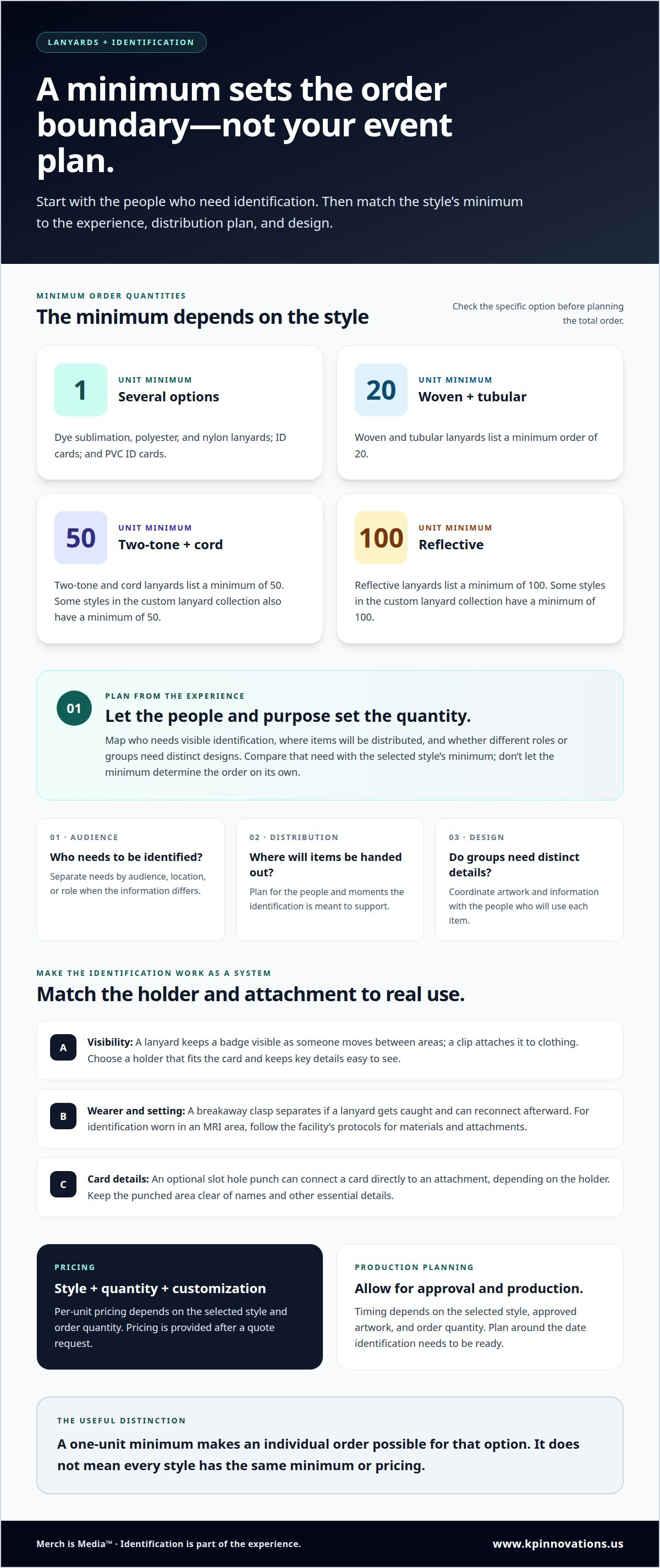
Dye sublimation, polyester, and nylon lanyards each list a one-unit minimum. Woven and tubular lanyards list a minimum of 20; two-tone and cord styles list a minimum of 50. Reflective lanyards list a minimum of 100. ID cards and PVC ID cards each list a one-unit minimum. The custom lanyard collection includes styles with minimums of 50 or 100.
Plan for the people who need identification, then compare that need with the style’s minimum. A one-unit-minimum option may suit a small team’s immediate needs. For a larger event, account for the selected style’s minimum when planning distribution.
Quantity and Pricing Options
Minimum quantities and per-unit pricing depend on the selected style and order quantity. Pricing is provided after a quote request, with style, quantity, and customization among the relevant factors. A one-unit minimum makes an individual order possible for that option; it doesn’t mean every style has the same pricing.
For an event, plan around the people and moments the items support. Consider who needs visible identification, whether different roles or groups need distinct designs, and how items will be handed out. These decisions define a useful quantity and prevent the minimum from driving the order by itself.
Larger orders also affect production planning. Timing depends on the selected style, approved artwork, and order quantity. Allow time for design approval and production, especially when items need to be ready for a specific distribution date. The goal is to have identification ready when people arrive.
Before settling on a quantity, map out distribution: who receives an item, where distribution happens, and whether each group needs a distinct design. Compare the resulting need with the selected style’s minimum. This ties the order to the attendee or team experience and gives it a clear purpose.
How should badge holders fit into an identification program?
Start with the identification task: who needs to be recognized, what information should be visible, and where will people use the badge? A merchandise partner can plan these needs across audiences and locations, then guide holder and attachment choices. Aim for a system that helps people navigate an event or workplace, rather than choosing each component in isolation.
Badge Styles and Wearing Options
Consider how people will use their identification throughout the day. A lanyard keeps a badge visible as someone moves between event areas; a clip attaches it to clothing. Choose a holder that fits the card and keeps key details easy to see. At a school check-in, for example, staff roles may need to stand out to visitors.
Plan bulk orders around distribution, not just a total quantity. Separate needs by audience, location, or role when groups require different information. This aligns quantities and designs with actual use, helping event staff and attendees receive the right identification without unnecessary variations.
Breakaway and MRI-Safe Options
A breakaway clasp separates if a lanyard gets caught and can reconnect afterward. Consider it in relation to the wearer’s tasks and surroundings, such as a workplace where staff move around equipment. Choose an attachment to suit how people work, not just the event’s visual design.
Identification worn in an MRI area has distinct operational requirements. Follow the facility’s protocols when selecting materials and attachments for that setting. Treat it as a separate use case from a conference or general workplace badge, and plan around the environment where it will be worn.
Material choices can also reflect an organization’s priorities. Recycled or other considered materials may support a sustainability objective, while the holder still needs to serve its identification purpose. Let the intended use guide material choices so they support the experience.
An optional slot hole punch can connect a card directly to an attachment, depending on the holder design. Position it so the punched area doesn’t interfere with names or other essential details. This small production choice affects how the badge hangs and how easily people can read it.
For a cohesive program, map audience groups, information needs, and distribution points across events and workplaces before finalizing the order. Then choose a holder style, attachment, and material to suit. This turns purchasing into an operational plan, with each choice supporting the people using the identification and the wider event or team experience.
Custom printing and branded products
Businesses need more than a source for custom printed lanyards and badges. A well-managed merchandise program starts with the moment the item should improve, such as welcoming guests or helping staff feel identifiable, then coordinates the strategy, design, and delivery.
Custom Product Requirements
Define the experience before specifying the item. At an event, guests may need to recognize hosts quickly; in a workplace, people may need to distinguish between teams. These goals determine what the badge communicates and how the lanyard supports it. Customization should make interactions more useful, not simply add a logo.
Give the design a clear hierarchy. At a conference, the event identity might appear on the lanyard, while the badge carries a person’s name and role. Giving each surface a distinct purpose avoids competing messages and helps attendees know what to notice first.
Product Specifications
Specifications turn the experience goal into a design that can be produced consistently. Define the badge format, print area, attachment, and information that must remain readable. A staff member greeting visitors, for example, may need a prominent role label. Make sure details support recognition where people need it.
Consider the full environment, too. An item used at a registration desk has a different purpose from one worn throughout a multi-day event. Match the format and printed content to how long people will use it, where conversations happen, and what information helps those interactions feel clear.
Production and Shipping
Production and delivery planning determine whether items are ready when needed. The schedule depends on the product, approved artwork, quantity, and destination. For an event, work backward from when staff and guests need their items, allowing time for design review, production, packing, and delivery.
Distribution planning matters as much as the destination. If items are going to separate offices or event locations, organize quantities by recipient group and delivery point. This helps each team get the materials it needs. An event kit may also include banners or stickers, with each piece supporting a defined touchpoint.
Before production begins, align the creative brief, specifications, and delivery plan. Decide what the design should help people notice, what information they need, and where they’ll encounter the item. When these choices work together, custom printing becomes part of a considered brand experience, not decoration added at the end.
Full-color and one-color custom printing
Custom printing choices affect how clearly a lanyard carries a brand in everyday use. Common methods include one-color screen printing and full-color sublimation. The suitable method depends on the material and design.
Imprint Color Options
A one-color imprint uses a single ink color for a logo or short message. It can suit a simple mark, such as a black company name on a light lanyard. Full-color printing accommodates designs with several colors or more detail. Compare the artwork, contrast, and intended viewing distance before choosing.
Color count alone doesn’t determine the best result. A compact logo may read more clearly in one color, while a detailed event graphic may benefit from full color. Consider whether attendees will see the lanyard across a room or close up at a registration desk.
Logo File and Color Guidance
Start with the cleanest version of the logo available, then match its colors to the product material. A small, detailed mark may lose clarity when reduced to a narrow imprint area. Simplifying fine lines or small lettering can help keep the design readable on a lanyard.
Review the logo against the chosen background color before production. A dark logo on a dark strap may lack contrast, while a lighter imprint could stand out more clearly. Keep the approved artwork consistent across the lanyard and badge so the set feels coordinated.
Printing methods affect how artwork is applied. Screen printing generally places an ink design on the surface and may suit simpler graphics. Dye sublimation uses heat to transfer printed color into compatible material, making it an option for designs with broader color coverage. The material and product construction determine which method fits.
Material matters, too. Polyester is a common lanyard material, while other options may call for different printing approaches. Don’t assume every fabric supports the same method or finish. Compare the material, artwork, and imprint area together rather than selecting each in isolation.
Lanyard color and width also influence legibility. A bright strap can make a color logo prominent, while a neutral background may help detailed artwork stand out. A wider strap offers more visible space than a narrow one, but the right choice depends on the design and how people will wear it.
Use a practical review sequence: select the lanyard material, choose a background color, then assess the logo’s contrast and detail. Match one-color or full-color printing to the artwork, then review the complete design at its intended size. This helps branded colors look intentional across the finished set.
Custom printed lanyards and name badges
A lanyard and name badge work together as an identification experience. They help people recognize who’s attending, who’s working, and where to go next. At a conference, a readable name badge can support introductions, while a lanyard keeps it visible as people move between sessions.
Plan the pair around its purpose. A staff badge may need a name and role; an attendee badge may need a name and organization. Make the most useful information prominent and avoid crowding it with extra design elements. The lanyard can carry the event identity, while the badge provides the details people need.
Material and format affect the impression. A plastic badge holder can protect a printed card during repeated handling, while a recycled lanyard can bring material choices into the brand story. Choose for the setting: a multi-day conference, school event, and client meeting may each call for different levels of visibility and formality.
Comfort matters during long events. A lanyard worn throughout a full day should feel appropriate for the audience and activity. For a busy venue, consider how the badge sits while people walk, sit, and speak with others. A breakaway feature may also be part of the lanyard specification when the wearing environment calls for it.
Think beyond the item itself. A name badge can help guests find staff, identify teams, or navigate registration. Pairing lanyards with banners and other event materials can create a clearer visual system, especially when attendees move between check-in, meeting rooms, and presentation areas. Consistent visual cues connect each touchpoint.
For a coordinated result, align the badge information, lanyard artwork, and distribution plan before production. Decide which details change by person and which stay consistent across the group. A shared event design can carry the brand, while each badge displays an individual name and role. This supports both recognition and practical use.
Custom printed lanyards and name badges work best when their design serves the experience, not just the logo. A clear system helps people identify one another and understand the setting. If your program also includes apparel or event displays, coordinate those choices so each item supports the same brand experience.
Plan sourcing for a coordinated event set around the people using it, the information they need, and the impression each item should leave.
KP Innovations: Custom Apparel
KP Innovations helps businesses connect event merchandise with the broader brand experience. If lanyards and name badges are part of a larger event or team program, consider how they work alongside custom apparel, promotional products, and print and display materials.
Coordination matters when employees, attendees, or customers encounter several branded items at once. A consistent approach helps each item feel like part of the same experience, rather than a separate purchase. KP Innovations can support businesses with coordinated merchandise programs that include awards and recognition items.
Bring your event or team purpose, audience, and product needs into the conversation. Contact KP Innovations to discuss how your merchandise can support the experience you want to create.
Make the Next Brand Touchpoint Count
Decide what you want people to experience when they wear or receive your branded items. Clear identification can make an event easier to navigate, while a coordinated set can extend that experience beyond the badge. Treat custom printed lanyards and badges as part of a larger brand system, not an isolated order.
For a team or event program, connect the lanyards and badges with relevant promotional products, custom apparel, or awards and recognition items. Each piece should serve a purpose for the people receiving it and reinforce a consistent impression. That’s the practical meaning of “Merch is Media™”: physical items shape how people encounter your brand.
When you’re ready to align product choices with the experience you want to create, discuss your sourcing needs with KP Innovations. You can move forward with a clearer plan for merchandise that works as part of your brand experience.
Frequently Asked Questions
How is my design added to the lanyard?
Your design is printed onto the lanyard using a method suited to its material and artwork. Screen printing can suit a simpler mark, while dye sublimation can accommodate broader color coverage on compatible material. For a merchandise program, match the design’s detail and color needs to the lanyard material, then review how the logo will look along the strap, not just as a standalone graphic. A merchandise partner can coordinate artwork review and sourcing so the result fits the broader brand experience.
How should lanyards support the experience?
Start with the people who will wear the lanyard and the job it needs to do. A conference organizer may prioritize attendee visibility, while a workplace team may need clear identification throughout the day. Then weigh material, attachment, artwork, and distribution together. An outsourced merchandise partner can manage these decisions as part of a coordinated program, keeping the choice tied to the real experience, not appearance alone.
Which colors can I choose from?
Available colors depend on the selected lanyard style and material. Choose a strap color that gives the logo enough contrast to remain recognizable under the lighting where people will see it. A dark mark, for example, may be easier to distinguish against a lighter background. Coordinate lanyard and badge colors as part of the event identity, and align artwork and sourcing across the order.
How much do custom printed lanyards and badges cost per unit?
Per-unit pricing depends on the product, quantity, and customization, and is provided after a quote request. A one-unit minimum doesn’t mean every style has the same unit price or printing options. To define the order, identify the lanyard and badge formats, artwork approach, and required quantity. A merchandise partner can coordinate these details with sourcing and fulfillment to define the full program scope being priced.
What materials, widths, and attachment options are available for custom lanyards?
Material options include polyester, recycled materials, organic cotton, and bamboo. Styles and specifications vary, so choose based on intended wear and design. Lanyards can be paired with attachments such as clips, and a breakaway clasp may suit some work environments. Consider comfort, badge visibility, and how the attachment connects to the holder as part of the program’s wearer experience.
What types of custom badges and badge holders can be printed?
Custom badge cards can display details such as a person’s name, role, or organization. Choose a holder to fit the card and its intended attachment; the holder itself isn’t the printed surface. An event, for example, might use a shared design while personalizing each card with attendee information. Decide which details are common and which vary by person, then coordinate artwork and fulfillment around those needs.
How do I prepare artwork and logos for custom lanyards and badges?
Provide a clean logo file and decide which information belongs on the lanyard and which on the badge. Keep small text and intricate details to a minimum when the print area is narrow. For a team order, separate shared artwork from individual details such as names or roles. An outsourced merchandise partner can manage artwork review, sourcing, and fulfillment as one system, including checking the layout at its intended size so key elements are easy to read.
Are breakaway safety releases required for custom lanyards at schools or workplaces?
Requirements depend on school or workplace policies and the conditions where the lanyard will be worn. A breakaway clasp separates if a lanyard gets caught and can reconnect afterward. Consider the wearer’s tasks, surroundings, and identification needs when choosing an attachment. A setting with equipment or frequent movement, for example, calls for a different assessment than a seated event. A merchandise partner can help coordinate this decision with the wider program and its fulfillment plan.