
By January 2026, 64% of high-growth consumer brands will ditch traditional factory ownership to focus entirely on brand equity. Owning the machines is no longer the badge of honor it once was; it’s often a bottleneck to innovation. You’ve likely felt the sting of 5,000-unit minimum order quantities or the nagging fear that your product looks identical to a dozen others on the shelf. Managing a fragmented supply chain shouldn’t be your full-time job.
We understand that you want more than just a logo on a generic item; you want a product built from the thread up. This guide shows you how to leverage white label manufacturing to scale your brand with premium products without the $250,000 overhead typical of traditional production. You’ll discover how to maintain an elite brand perception while enjoying hands-off fulfillment and logistics. We’re breaking down the strategic roadmap for the next 12 months, covering everything from custom sourcing to the logistics of a global rollout.
Key Takeaways
- Learn how the landscape of white label manufacturing is shifting toward high-tech foundations and sustainable materials for 2026.
- Identify high-demand product categories, from technical outerwear to smart office tools, that can elevate your brand’s market position.
- Understand the strategic differences between production models to balance speed-to-market with your need for physical customization.
- Master the essential criteria for vetting partners, focusing on quality control standards and social responsibility certifications.
- Discover how to transform standard merchandise into a strategic marketing asset through white-glove management and premium sourcing.
What is White Label Manufacturing in 2026?
White label manufacturing is the high-performance engine powering the world’s most agile brands. It’s a specialized production model where one company creates a generic, high-quality product that another company rebrands and sells as its own. This isn’t about putting a logo on a cheap shirt. It’s a strategic partnership. To grasp the fundamentals, it helps to define what is a white-label product? in a modern context. By 2026, the definition has shifted from “generic” to “premium foundation.”
The marketplace has changed. Speed is no longer a luxury; it’s the primary competitive advantage. Brands that spend two years in development cycles are losing to those that can pivot in weeks. In the 2026 value chain, the “marketer” owns the customer relationship and the brand story, while the “producer” owns the technical infrastructure. This allows for a “white glove” approach where the brand focuses on elevation and the manufacturer handles the heavy lifting of sourcing and logistics.
The Evolution of White Label Quality
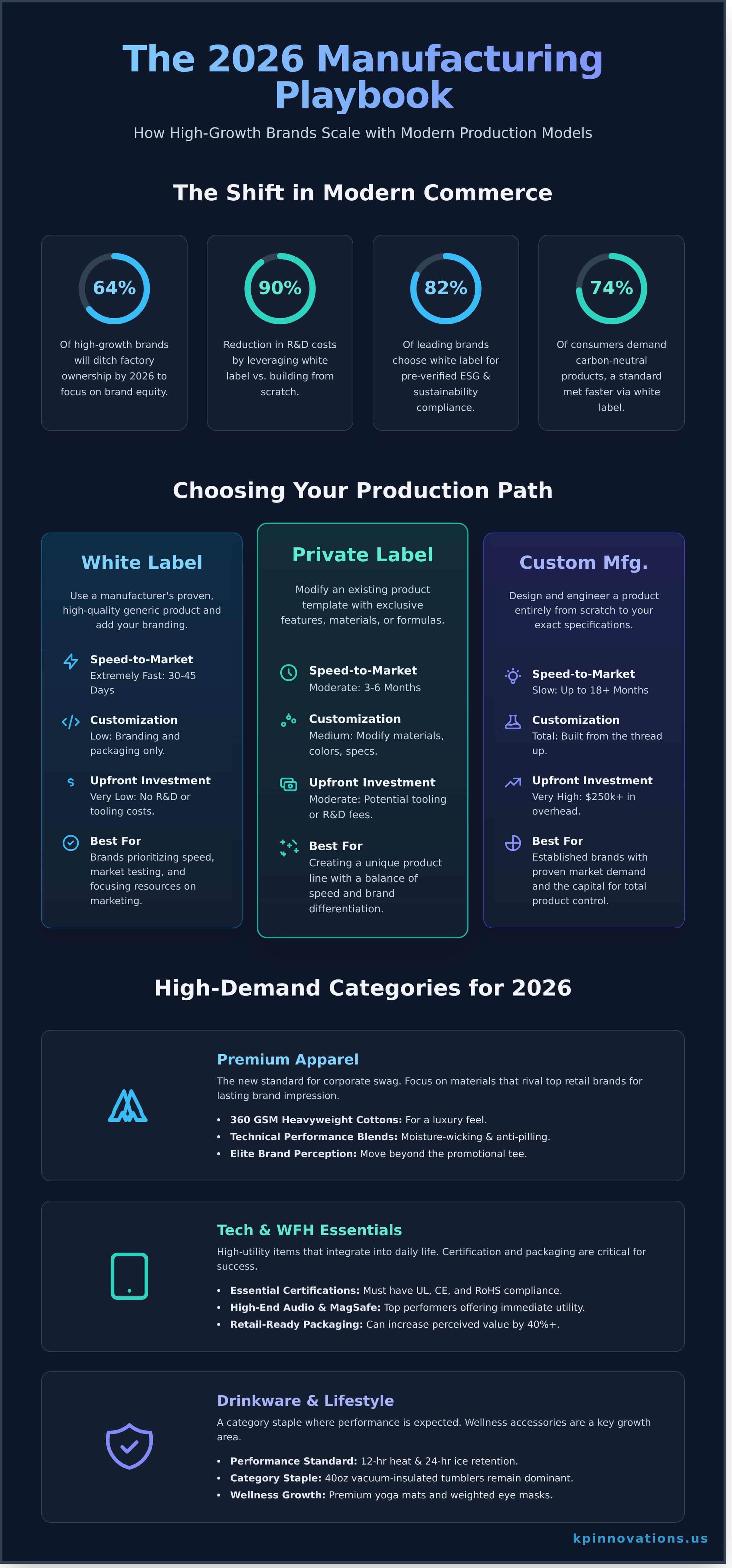
Manufacturing technology has reached a tipping point. As of Q1 2026, AI-driven quality control and advanced robotics have closed the gap between custom builds and white label foundations. We now see the rise of “premium-baseline” products. These are items that meet luxury standards right off the shelf. 82% of leading brands now choose white label foundations because they come with pre-verified ESG compliance and sustainability certifications. It’s a faster way to meet the 74% of consumers who demand carbon-neutral products without building a factory from the ground up.
Key Benefits for Corporate Brands
The financial incentives are undeniable. Research shows that developing a product from scratch can consume up to 15% of a brand’s total revenue in R&D. White label manufacturing reduces this expenditure by nearly 90%. By leveraging existing, proven formulas and designs, companies can:
- Launch new SKUs in 30 to 45 days rather than 18 months.
- Eliminate the risk of “dead stock” from unproven custom designs.
- Reallocate internal resources toward marketing and customer experience.
- Ensure consistent quality through established, elite-level production lines.
At KP Innovations, we believe premium is the baseline. We don’t just provide products; we provide strategic assets. This model allows you to leave a lasting impression while we handle the complexities of the supply chain. It’s about working smarter to elevate your brand to the next level of market dominance. White label manufacturing is no longer the “budget” option; it’s the elite choice for brands that value precision and speed.
High-Demand Categories for White Label Products
White label manufacturing isn’t just about slapping a logo on a generic item. It’s a strategic move to enter high-growth markets with speed and precision. In 2024, 64% of retailers reported increasing their investment in white label lines to capture higher margins while maintaining quality control. Success depends on selecting categories where the perceived value is high and the manufacturing risk is managed through expert partnerships.
The Premium Apparel Opportunity
Modern corporate swag has evolved. The “private label” feel is the new baseline for brands wanting to leave a lasting impression. We’ve moved past the $2 promotional tee. Today, brands demand 360 GSM heavyweight cottons and technical performance blends that rival retail giants like Lululemon or Patagonia. When sourcing these fabrics, look for moisture-wicking properties and anti-pilling finishes to ensure the garment stays in the wearer’s rotation. If you’re looking to build a brand from the ground up, check out our Private Label Clothing: A Founder’s Starter Guide for a deeper dive into custom manufacturing.
Tech and Work-from-Home Essentials
Tech accessories remain a dominant force in white label manufacturing. High-end audio and MagSafe-compatible chargers are top performers because they offer immediate utility. However, electronics carry inherent liability. You must ensure your manufacturer handles UL, CE, and RoHS certifications correctly. It’s vital to understand Managing Risks in White Labeling to avoid legal pitfalls related to component failure or safety standards. Retail-ready packaging is another critical factor; a sleek, magnetic-closure box can increase the perceived value of a $15 charger by 40% or more.
The 40oz vacuum-insulated tumbler isn’t a fad; it’s a category staple. Consumers now expect 12-hour heat retention and 24-hour ice retention as standard features. Beyond drinkware, wellness accessories like weighted eye masks or premium yoga mats are seeing a 15% year-over-year growth in the corporate gifting sector. These items bridge the gap between “merchandise” and “lifestyle brand.” They’re products that people actually use in their daily lives, which keeps your brand top-of-mind.
Sustainability is no longer optional. Products made from 100% recycled ocean plastics or GRS-certified (Global Recycled Standard) materials are winning the market. A 2023 study found that 78% of US consumers say a sustainable lifestyle is important to them. Offering white label goods like biodegradable phone cases or RPET backpacks proves your brand is forward-thinking. This commitment to the environment often justifies a premium price point, as 43% of shoppers are willing to pay more for sustainable packaging.
Choosing the right category is just the first step in your growth strategy. To truly elevate your brand, you need a partner who understands the nuances of premium product sourcing and logistics. This ensures your white label strategy isn’t just a one-time purchase, but a long-term brand asset that delivers consistent ROI and builds customer loyalty.
White Label vs. Private Label vs. Custom Manufacturing
Choosing the right production path determines how quickly you can scale and how much capital stays in your bank account. Most growing companies begin their journey by researching what is a white-label product to understand the baseline of modern retail. White label manufacturing involves purchasing a generic, high-quality product that a factory already produces for multiple retailers. You simply apply your branding. It’s the fastest route to market, often requiring only 10 to 14 business days for fulfillment. Private label manufacturing offers more flexibility, allowing you to request specific colors or technical fabrics that remain exclusive to your brand. Custom manufacturing, or “cut and sew,” represents the elite tier of production. This is where we build your vision from the thread up, though it demands the highest investment of time and money.
The decision usually comes down to three specific metrics: speed, cost, and control. According to 2024 supply chain data, 68% of emerging e-commerce brands start with white label to preserve cash flow. If you’re looking to launch a full collection in under 30 days, white label is the only viable solution. However, if your goal is to disrupt a market with a unique silhouette, it’s worth it to explore Custom Clothing Manufacturing despite the 180-day lead times typical for overseas production.
- White Label: Best for speed. 14-day turnaround; $500 minimum investment; 0% physical design control.
- Private Label: Best for brand identity. 45-75 day lead times; $5,000 minimum investment; 30-50% design control.
- Custom (Cut and Sew): Best for innovation. 120-180 day lead times; $25,000+ minimum investment; 100% design control.
When to Choose White Label
White label manufacturing is the strategic choice for promotional campaigns and rapid testing. It works best for brands that need 1.2M+ product options at their fingertips without the headache of warehouse management. If you’re launching an employee store or a limited-run pop-up shop, the speed of white label ensures you don’t miss your deadline. It allows you to pivot your strategy based on real-time sales data rather than being stuck with 5,000 units of a custom design that isn’t moving. You can explore the technical nuances of these choices in our detailed breakdown of White Label vs. Private Label Apparel: Key Differences.
The “Hybrid” Approach to Brand Building
Sophisticated brands rarely rely on a single manufacturing method. They utilize a strategic 80/20 curation model. They use white label manufacturing for 80% of their inventory volume, focusing on “evergreen” basics like premium tees or tote bags. This keeps the supply chain lean and responsive. The remaining 20% of the catalog consists of “hero” items created through custom manufacturing. These are the high-margin, unique pieces that define the brand’s elite status in the market.
Maintaining consistency across these different production types requires a “white glove” project management approach. We ensure that the logo application on a white-label hoodie perfectly matches the custom-dyed fabric of your hero jacket. This strategy turns a generic product into a strategic brand asset. It allows you to scale rapidly while still offering the “premium” feel that Fortune 500 companies demand. By mixing these methods, you manage your risk while maximizing your brand’s physical footprint.
How to Choose a White Label Manufacturing Partner
Selecting a partner for white label manufacturing requires moving beyond simple price comparisons to evaluate long term scalability. A partner is a strategic extension of your brand identity; they aren’t just a factory. A supplier with fewer than 200 core SKUs often lacks the sourcing depth needed for a growing brand. You should prioritize partners who manage diverse material categories and maintain a robust network of global raw material providers. This ensures your supply chain remains resilient even when local markets fluctuate.
Quality control must be documented rather than promised. Verify specific credentials like ISO 9001 certification or Fair Labor Association (FLA) memberships. These standards protect your brand from regulatory audits and ethical controversies. In a 2024 survey of procurement officers, 78% stated that social responsibility certifications were the deciding factor in long term contract renewals. Your partner should provide transparency into their labor practices and environmental impact through quarterly compliance reports.
Success in this space also depends on a sophisticated technology stack. You need more than a spreadsheet to manage your inventory. Look for these specific technical capabilities:
- Real-time SKU Management: Instant visibility into stock levels across multiple warehouse locations.
- API Integration: The ability to sync production data directly with your Shopify or custom e-commerce platform.
- White-Glove Project Management: A dedicated account manager who provides weekly status updates rather than automated generic emails.
- Custom Kitting: The capacity to bundle multiple items into a single, branded experience.
Vetting for Quality and Reliability
Average vendors often hide behind stock photos and vague lead times. A 2023 industry report found that 64% of manufacturing delays stem from poor initial vetting of vendor capacity. You must demand physical samples before signing a contract for a 1,000 unit production run. In the 2026 supply chain landscape, MOQ flexibility is a competitive advantage. Seek partners offering tiered pricing starting at 72 or 144 units. This allows your brand to test new designs without the risk of overstocking 5,000 units of an unproven product.
Logistics: The Hidden Cost of Manufacturing
Shipping and storage account for up to 30% of total product costs if handled inefficiently. A premium partner provides more than a loading dock; they offer global fulfillment and climate controlled warehousing. Integrated Company and Team Stores automate the distribution of merch to employees across 50 states or multiple continents. Professional kitting, where products are bundled into custom branded boxes, increases the perceived value of a $20 item by 42% according to 2024 retail packaging data. This level of detail turns a simple shipment into a strategic marketing asset.
Ready to move beyond average vendors and work with a partner that treats your brand like their own? Book a discovery call with KP Innovations today to see how our white-glove management can scale your production.
Elevating Your Brand with KP Innovations
At KP Innovations, we operate under a single, defining principle: Where Merch Becomes Marketing. We don’t view promotional products as mere giveaways; we see them as strategic assets that drive brand equity and customer loyalty. Our team provides access to a massive catalog of 1.2 million products, but our real value lies in our white-glove management. We handle every detail so your team can focus on high-level strategy. This comprehensive approach is why 15 of the current Fortune 500 companies rely on us to manage their most sensitive brand assets and global merchandise programs.
Our expertise in white label manufacturing allows your business to bypass the steep learning curve of product development. We provide end-to-end support that begins with initial design concepts and extends through global delivery. Whether you are looking to launch a retail-ready apparel line or need specialized equipment for a national campaign, we manage the sourcing, quality control, and logistics. We ensure that every item leaving the warehouse meets a “premium is our baseline” standard, protecting your brand reputation across every touchpoint.
Strategic Brand Elevation
Generic “logo-slapping” on cheap materials often does more harm than good to a premium brand. Research indicates that 82 percent of consumers have a more favorable impression of a brand after receiving high-quality promotional products. We help you move beyond the basics by creating thoughtful, retail-grade merchandise that people actually want to keep. Our dedicated account managers handle the heavy lifting, from navigating supply chain disruptions to ensuring color accuracy across different materials.
- Managed Solutions: Your account manager acts as an extension of your marketing department, overseeing every SKU from production to fulfillment.
- Employee Appreciation: We design customized kitting solutions for onboarding and corporate gifting that increase employee retention by up to 25 percent.
- Quality Assurance: Every product undergoes a rigorous inspection process to ensure it matches your brand’s specific Pantone requirements and quality standards.
Start Your Manufacturing Project Today
Scaling a brand requires more than just a good idea; it requires a repeatable, scalable process. Our proven 6-step process covers discovery, strategy, design, sourcing, production, and logistics. This structured workflow allows us to deliver consistent results for complex white label manufacturing projects. We remove the stress of manufacturing logistics by leveraging our 15 years of industry relationships to secure the best pricing and lead times for our clients. You gain the benefit of a global supply chain without the overhead of managing it yourself.
We believe that your merchandise should tell a story of quality and intentionality. By partnering with KP Innovations, you are choosing a team that understands the nuances of brand identity and the technical requirements of large-scale production. We are ready to help you transition from simple vendor transactions to a strategic manufacturing partnership that scales with your ambitions.
Ready to elevate your brand? Start a Project with KP Innovations today!
Capture Your Market Share in 2026
The landscape of 2026 demands more than just a logo on a shelf. It requires a sophisticated approach to white label manufacturing where quality and speed to market define the winners. Success this year hinges on selecting high-demand categories and moving beyond basic sourcing to a fully managed, strategic partnership. You don’t have to navigate the complexities of global logistics or product design alone.
KP Innovations provides the elite infrastructure your business needs to lead. We offer access to over 1.2 million high-quality products, ensuring your brand always stays ahead of market trends. Our team delivers white-glove project management that handles every detail from initial design through final fulfillment. It’s why Fortune 500 companies and luxury brands trust us to protect their reputation. We don’t just supply products; we build the assets that turn your merch into marketing. Your vision deserves a partner that treats premium as the baseline.
Elevate your brand with premium white label solutions; Start a Project today!
Your next major growth milestone is ready for takeoff.
Frequently Asked Questions
Is white label manufacturing the same as dropshipping?
White label manufacturing isn’t the same as dropshipping. Dropshipping is a fulfillment method where a third party ships single units directly to your customers. White label requires you to purchase inventory in bulk. Most brands see a 40% higher profit margin by holding stock rather than relying on third-party shipping. This strategic approach ensures you control the customer’s unboxing experience and product quality.
Can I customize the features of a white label product?
You can’t customize the core features of a product through white label manufacturing since the items are pre-engineered for the mass market. Unlike private label manufacturing where you build from the thread up, white label focuses on branding existing goods. You can still elevate the product through custom hangtags and elite packaging. This allows for a faster market entry, often within 21 days of your initial order.
What are the typical lead times for white label manufacturing in 2026?
Anticipated lead times for 2026 range from 15 to 45 business days for standard production runs. Global logistics improvements have reduced transit times by 12% compared to 2023 levels. Domestic sourcing options often deliver in under 14 days. These timelines allow your brand to remain agile while maintaining a consistent flow of premium inventory to your fulfillment centers. We handle the logistics to ensure your deadlines are met.
How do I ensure my white label products don’t look generic?
Use high-quality kitting and strategic packaging to differentiate your brand from the average competition. Data shows that 72% of consumers say packaging design influences their purchasing decisions. We don’t just put your logo on a product; we create a premium unboxing experience. Adding unique inserts or elite finishes ensures your items don’t look like generic goods. This thoughtful approach turns simple merch into a powerful marketing asset.
Are there legal risks to white label manufacturing?
Legal risks include trademark infringement and product liability issues if the manufacturer lacks proper certifications. Ensure your contracts include a 100% indemnification clause to protect your business assets. Verify that all products meet ISO 9001 standards or specific regional safety requirements. Working with an elite partner mitigates these threats. We handle the rigorous quality control and compliance checks so you can focus on building your brand’s reputation.
What industries benefit most from white label products?
The beauty, wellness, and apparel sectors benefit most from these products. The global white label market in these specific industries reached $560 billion in 2025. These sectors allow for high markup potential and rapid brand scaling. Corporate clients often use these items to turn simple merchandise into strategic marketing assets. This results in a lasting impression on high-value leads and strengthens your position in the premium market.
How much does it cost to start a white label product line?
Starting a line typically requires an investment between $7,500 and $15,000 for your initial SKUs. This budget covers your first 500 units and the cost of premium brand integration. Costs vary based on the complexity of the logistics and the quality of the materials used. Investing in a managed process ensures you avoid the hidden fees common with budget vendors. It’s the most efficient way to scale a professional product line.
Can white label products be sold on Amazon or Shopify?
You can absolutely sell white label products on Amazon or Shopify to reach a global audience. Amazon Brand Registry requires a registered trademark but provides a 30% boost in search visibility for verified brands. Shopify offers total control over the customer journey and integrates directly with elite fulfillment services. These platforms are the foundation for any modern, high-growth retail strategy. They’re perfect for brands that want more than just a local presence.