
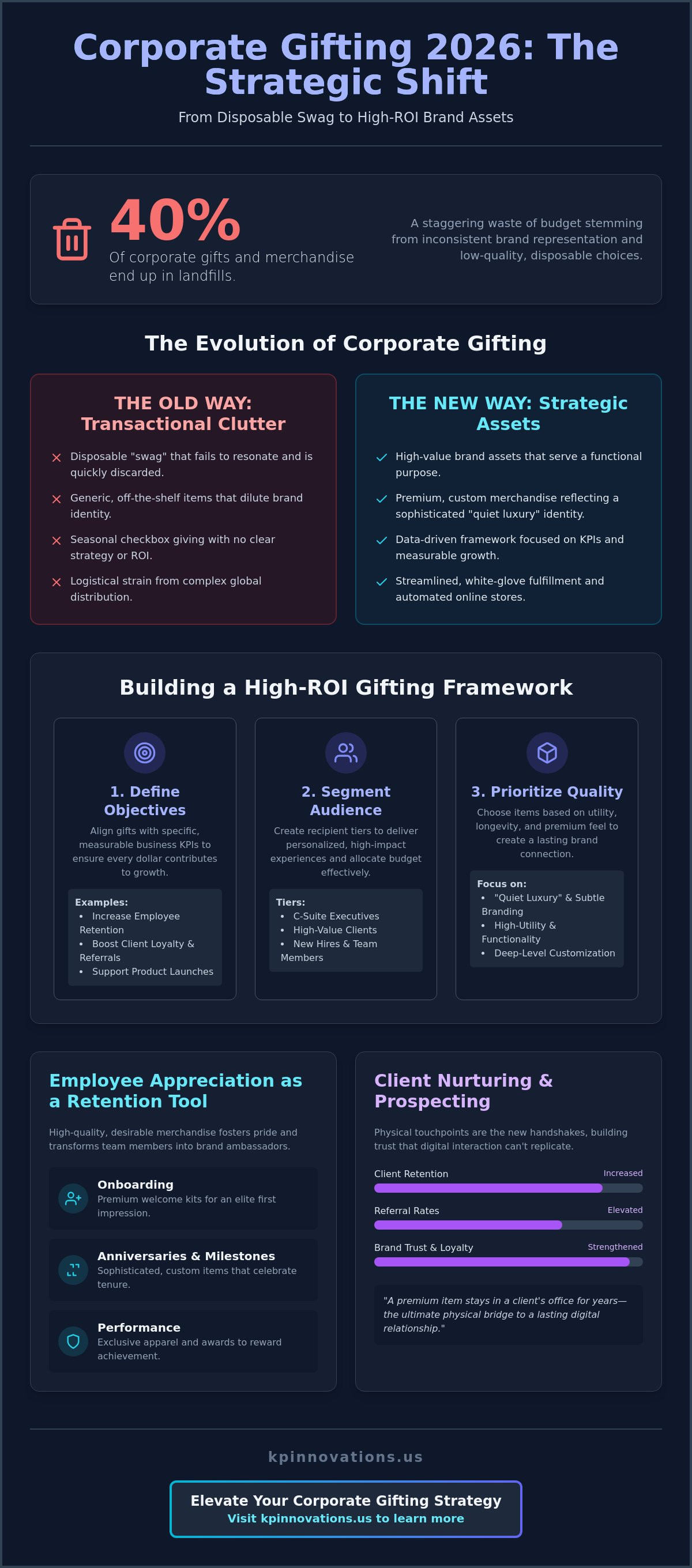
Did you know that an estimated 40% of corporate gifts and merchandise end up in landfills? It’s a staggering waste of budget that often stems from inconsistent brand representation and low-quality choices. To move beyond this cycle of transactional clutter, your corporate gifting strategy 2026 must pivot toward intentionality and precision. You shouldn’t settle for generic items that fail to resonate; instead, it’s time to treat every gift as a strategic asset for brand growth.
You’ve likely felt the logistical strain of global distribution or the disappointment of seeing a premium budget spent on items that don’t reflect your high standards. We understand that your goal is to foster genuine connection, not just check a seasonal box. This guide will show you how to master the shift from transactional giving to strategic brand elevation with a framework for ROI-driven results. You’ll learn how to streamline automated processes, increase client retention, and curate a portfolio of premium custom merchandise that recipients actually value. We’re breaking down the shift toward quiet luxury and sustainable practices that define the next era of professional partnership.
Key Takeaways
- Transition from disposable swag to high-value brand assets by aligning your gifts with specific business KPIs like employee retention and client loyalty.
- Develop a comprehensive corporate gifting strategy 2026 that segments your audience to ensure high-impact, personalized experiences for every recipient tier.
- Prioritize quality over quantity through custom apparel and premium merchandise that reflects a sophisticated, “quiet luxury” brand identity.
- Eliminate the burden of global distribution by utilizing white-glove fulfillment and logistics services that ensure your brand arrives perfectly every time.
- Empower your team and scale your reach with online company stores that automate gifting while maintaining complete control over your brand’s visual identity.
The Evolution of Corporate Gifting: Why Strategy Trumps Sentiment in 2026
Strategic corporate gifting is no longer a seasonal checkbox; it’s a data-driven approach to achieving specific business outcomes. In a market where digital noise is at an all-time high, your corporate gifting strategy 2026 must focus on physical items that serve as strategic brand assets. We’ve moved past the era of disposable “swag.” The modern executive understands that a gift’s value isn’t measured by the logo size, but by its functional purpose and longevity in the recipient’s life. It’s a shift from giving for the sake of giving to giving for the sake of growth.
The current corporate environment demands high-utility items because approximately 40% of corporate merchandise currently ends up in landfills. Your 2026 framework needs to prioritize quality over volume. This means selecting Gifts in kind that solve a daily problem or enhance a routine. Whether it’s custom apparel designed for longevity or premium tools for the modern office, the goal is to create a tangible connection that outlasts a single interaction. In a world of remote work and digital meetings, these physical touchpoints are the new handshakes.
Moving beyond the logo is essential for creating memorable brand experiences. Deep-level customization involves manufacturing items from the ground up to ensure they match your brand’s DNA perfectly. This level of precision shows a commitment to excellence that off-the-shelf products simply can’t replicate. It transforms a simple object into a sophisticated tool for client and employee elevation.
The ROI of Relational Gifting
Relational gifting acts as the essential bridge between digital marketing and a lasting physical brand presence. It’s the difference between an email that gets deleted and a premium item that stays in a client’s office for years. By focusing on high-value prospect nurturing through physical touchpoints, brands can see a direct impact on client retention and referral rates. When your corporate gifting strategy 2026 prioritizes the relationship over the transaction, it builds the trust necessary for long-term partnership and shared success.
Employee Appreciation as a Talent Retention Tool
High-quality apparel and custom awards are the anchors of a unified corporate culture. Generic, low-quality gifts can actually damage employee morale by signaling that the company doesn’t value their contribution. Instead, link premium merchandise to specific milestones to foster loyalty:
- Onboarding: High-end welcome kits that make new hires feel like part of an elite team from day one.
- Anniversaries: Custom recognition items that celebrate tenure with sophisticated design.
- Performance: Exclusive apparel or awards that incentivize and reward high-level achievements.
When employees receive items they actually want to keep, it builds a sense of pride and belonging that transcends the digital workspace. It turns every team member into a brand ambassador who carries your identity with them.
Building a High-ROI Gifting Framework: Objectives, Audience, and Tiers
A successful corporate gifting strategy 2026 requires more than just high-quality items; it demands a structured framework built on measurable KPIs. You shouldn’t invest in merchandise without defining what success looks like. Whether your goal is boosting employee morale, improving client retention, or supporting a high-profile product launch, each initiative must have a clear objective. According to the 2026 Industry Outlook, companies are increasingly shifting toward these data-driven models to justify spend and ensure every dollar contributes to brand growth.
Audience segmentation is the next pillar of a high-impact framework. A C-suite executive requires a different level of engagement than a summer intern or a mid-level manager. By categorizing your recipients, you can allocate your budget more effectively. This ensures that your most valuable relationships receive the “quiet luxury” they expect, while your broader engagement efforts remain functional and high-quality. Moving away from the traditional holiday rush toward a year-round gifting calendar also prevents your brand from getting lost in the seasonal noise. It allows for intentional touchpoints that feel personal rather than obligatory.
Tiered Gifting Models for 2026
Implementing a tiered system ensures that your resources are matched to the strategic value of the recipient. This structured approach maintains brand consistency across all departments:
- Tier 1 (Prestige): Reserved for VIP clients and executive milestones. This category focuses on fully custom private label apparel and high-end tech that isn’t available at retail.
- Tier 2 (Professional): Focused on high-quality promotional products like premium drinkware or sophisticated desktop tools for daily professional use.
- Tier 3 (Engagement): Designed for large-scale events or general team appreciation. These are functional office items and recognition awards that provide high visibility and utility.
If you’re ready to move beyond standard catalogs and begin manufacturing strategic assets, you can explore custom fulfillment solutions tailored to your specific brand goals.
Mapping Gifts to the Customer Lifecycle
Strategic gifting should mirror the journey your clients take with your brand. During post-sale onboarding, a high-touch welcome kit sets a professional tone and reaffirms their decision to partner with you. As the relationship matures, use milestone gifts to reinforce partnership value during renewal conversations. These shouldn’t feel like bribes; they should feel like celebrations of shared success. Finally, referral thank-yous create surprise and delight moments that naturally encourage word-of-mouth. By mapping your gifts to these critical stages, you turn a physical object into a powerful tool for lifecycle management and long-term loyalty.
Trends and Product Selection: Creating Brand Experiences Through Quality
The standard for a successful corporate gifting strategy 2026 is uncompromising quality. In previous years, volume was often the primary metric for success, but today’s executives prioritize high-utility items that recipients genuinely value. According to a recent corporate gifting trends guide, the shift toward “fewer, better” gifts is driven by a desire for lasting impact rather than temporary sentiment. You don’t want your brand associated with items that fail after a few uses. Instead, you should invest in technology and lifestyle products that integrate seamlessly into the recipient’s daily routine, such as MagSafe accessories or high-fidelity audio equipment that people actually use.
Wellness and lifestyle products have also become essential components of a sophisticated gifting portfolio. As remote and hybrid work cultures continue to evolve, items that improve the workstation experience are highly prized by employees and clients alike. Think of ergonomic desk accessories, high-quality lighting for video calls, or premium hydration products that promote a healthy office culture. These aren’t just gifts; they’re investments in the recipient’s well-being and daily comfort. When your brand provides a tool that makes someone’s workday easier, you’ve moved beyond a transaction and into a partnership.
The Power of Custom Private Label Apparel
Private label apparel represents the pinnacle of brand identity. Unlike standard promotional clothing that merely adds a logo to a pre-made garment, private label allows you to control every detail from the fabric weight to the custom stitch pattern. This level of customization distinguishes your brand from competitors who rely on generic off-the-shelf options. A critical part of this process is choosing the right apparel factory to ensure retail-grade quality that matches high-end fashion standards. Your 2026 apparel strategy should focus exclusively on items your employees would choose to buy with their own money.
Sustainable and Functional Merchandise
Eco-friendly materials are no longer a premium add-on; they’re a standard expectation for any high-ambition brand. Your selection process must prioritize sustainable sourcing and functional design to prevent waste and ensure longevity. Functional office swag should focus on items that solve specific problems, such as cable management tools or portable power solutions for mobile professionals. By selecting items with a high utility-to-brand ratio, you ensure your merchandise remains on the desk and out of the landfill. It’s about creating a brand experience that feels both responsible and indispensable to the modern professional.
The Logistics Playbook: Solving the Global Fulfillment Challenge
Managing thousands of individual gift boxes isn’t just a time sink; it’s a significant brand liability. Most executives cite a lack of physical space and administrative bandwidth as their primary barriers to scaling a high-impact program. Your corporate gifting strategy 2026 requires a partner that moves beyond simple delivery to offer comprehensive project management. This white-glove approach ensures that your leadership team stays focused on core business objectives while experts handle the granular details of international customs, regional regulations, and complex distribution schedules.
The 2026 supply chain landscape demands proactivity rather than reaction. You can’t rely on just-in-time ordering for high-stakes brand moments or executive recognition. Strategic warehousing allows you to secure premium inventory when market conditions are favorable, protecting your program from sudden shortages or global shipping delays. It provides a level of control that standard vendors simply can’t offer. If you’re ready to offload the complexity of international distribution, you should partner with a global fulfillment expert to manage your inventory from end to end.
Warehousing and Inventory Management
Centralized warehousing in the United States is the foundation of a cost-effective gifting program. By producing items in bulk and shipping them on demand, you significantly reduce your cost-per-unit while maintaining immediate availability. This model eliminates the need for your office to double as a storage facility. Real-time tracking provides total visibility into your inventory levels, ensuring that you never face program delays due to unexpected stockouts. It’s a structured, methodical approach that mirrors the high-level project management your brand deserves.
Kitting and Custom Packaging
The unboxing experience is the physical manifestation of your brand’s commitment to quality. In 2026, the box matters just as much as the gift inside. A thoughtfully designed custom kit transforms a simple delivery into a curated event. Creating this experience involves several precise steps:
- Selection: Curating items that complement each other and align with your brand’s aesthetic.
- Personalization: Adding custom insert cards or high-quality printed materials that speak directly to the recipient.
- Branded Packaging: Utilizing durable, custom-designed boxes that protect the contents while projecting a premium image.
Durability is non-negotiable during the shipping process. A crushed box or damaged item immediately erodes the trust you’ve worked so hard to build. By utilizing specialized kitting services, you ensure that every package arrives in pristine condition, regardless of how far it has traveled. This attention to detail turns a standard logistics hurdle into a sophisticated touchpoint for your brand.
Scaling Your Program with Online Company Stores and Automation
Decentralization is the final hurdle in achieving a truly scalable corporate gifting strategy 2026. In a high-growth environment, a centralized marketing or HR team shouldn’t be burdened with approving every individual t-shirt or recognition award. By utilizing online company stores, you empower department heads and regional managers to execute their own initiatives while you maintain absolute control over brand standards. This approach eliminates “rogue branding,” where inconsistent logos or sub-par merchandise might otherwise dilute your professional image. It creates a structured ecosystem where efficiency and quality coexist without constant oversight.
Automation is no longer a luxury; it’s the standard for 2026. With AI-based gifting solutions seeing nearly 50% adoption as early as 2024, the modern executive expects a seamless, digital-first ordering process. KP Innovations integrates custom manufacturing, online store technology, and global fulfillment into a single, managed ecosystem. This integration ensures that whether an employee is ordering a single custom kit or a department is outfitting a thousand-person event, the experience remains premium and the logistics remain invisible to the user.
The Strategic Advantage of Team Stores
Simplifying the outfitting of a global team starts with a centralized ordering hub. Instead of guessing sizes or preferences, you can implement “Choice Gifting.” This allows recipients to select their preferred item from a curated, pre-approved collection. It significantly reduces budget waste; since we know roughly 40% of corporate gifts end up in landfills, letting the recipient choose ensures your brand assets are actually kept and used. These stores also integrate directly with corporate budgets, providing transparent, real-time reporting that makes tracking your corporate gifting strategy 2026 ROI simpler than ever before.
Why KP Innovations is the Strategic Partner for 2026
KP Innovations moves beyond the role of a simple vendor to become a dedicated strategic partner. We provide the expertise and infrastructure required to turn physical items into powerful brand tools. Our value proposition is built on three core pillars:
- Unparalleled Selection: Access to a portfolio of 1.2 million products, each backed by our white-glove project management.
- Custom Manufacturing: The capability to move beyond off-the-shelf catalogs with deep-level, private label solutions that match your brand’s unique DNA.
- Managed Logistics: A service-first philosophy that handles the stress of global warehousing and international fulfillment, ensuring a smooth process from factory to doorstep.
We take pride in our ability to manage every detail of your gifting program, allowing your leadership team to focus on high-level growth. By combining sophisticated technology with high-touch service, we ensure your brand experience is consistently elite, regardless of the scale of your project. We don’t just ship boxes; we manufacture lasting impact for the world’s most ambitious brands.
Future-Proof Your Brand Identity Through Strategic Gifting
The transition from transactional giving to strategic brand elevation is a competitive necessity for high-ambition organizations. By prioritizing high-utility assets and retail-grade private label apparel, you ensure your brand remains a permanent fixture in the lives of your clients and employees. Your corporate gifting strategy 2026 should leverage the power of online company stores and automated fulfillment to eliminate logistical friction while maintaining absolute brand control. This structured approach transforms physical objects into measurable growth levers that drive long-term loyalty and retention.
KP Innovations provides the infrastructure and expertise to execute this vision at scale. As a premier U.S. supplier based in Horsham, PA, we offer access to 1.2 million customizable products backed by white-glove project management from initial design to final delivery. We take pride in managing the complexity of global logistics and warehousing so your team can focus on core business objectives. Elevate your brand with a managed 2026 gifting strategy from KP Innovations. We’re ready to partner with you to create the sophisticated, high-impact experiences your brand deserves.
Frequently Asked Questions
What is the average budget for a corporate gifting program in 2026?
Budgets for a corporate gifting strategy 2026 typically range from $25 to $75 per employee and $75 to $250 or more for top-tier clients. These allocations reflect a shift toward quality over volume. Investing in premium items ensures that your brand is perceived as a strategic partner rather than a simple vendor. It’s a calculated investment in relationship longevity that yields higher returns than generic, low-cost alternatives.
How do I measure the ROI of my corporate gifting strategy?
You can measure ROI by tracking specific business outcomes such as client retention rates, referral volume, and employee satisfaction scores. Strategic gifting acts as a physical touchpoint that influences long-term loyalty. By comparing the cost of the program against the lifetime value of retained clients, you can quantify the precise impact of your investment on brand growth. This data-driven approach allows you to justify spend and refine your framework.
Can I ship corporate gifts internationally without dealing with customs myself?
Yes, you can utilize managed fulfillment and logistics services to handle international shipping and customs documentation on your behalf. This white-glove approach eliminates the administrative burden of managing complex global distribution. Experts ensure that your brand experience remains consistent across international borders while navigating regional regulations and customs requirements with precision. It allows your leadership team to focus on high-level objectives while we manage the granular details.
What are the most popular corporate gift categories for 2026?
The most popular categories include eGift cards, high-quality food gifts, and functional office swag that enhances the workstation experience. Personalized clothing and experiential gifts also hold significant market share. Executives increasingly favor “quiet luxury” items with subtle branding that recipients will actually use in their daily routines. Focusing on these high-utility categories ensures your gifts are kept and appreciated, rather than discarded as clutter that fails to represent your brand.
How do online company stores work for branded merchandise?
Online company stores serve as a centralized hub where authorized users can order pre-approved branded merchandise on demand. This system empowers department heads while maintaining absolute control over your brand identity. It streamlines the ordering process for employees and partners, integrating directly with your corporate budget to provide transparent reporting and inventory management. This decentralized model reduces administrative friction and ensures that every item ordered meets your high standards for quality and design.
Is it better to send one high-end gift or several smaller items throughout the year?
Current trends favor frequent, intentional “micro-moments” over a single, large annual gift. Sending smaller, high-quality items throughout the year keeps your brand top-of-mind and feels less obligatory. This approach allows you to celebrate specific milestones like onboarding or project completions, creating more opportunities for genuine connection and relationship building. It turns your corporate gifting strategy 2026 into a consistent growth lever rather than a seasonal expense.
What is the lead time for custom private label apparel in a gifting program?
Lead times for custom private label apparel vary based on the complexity of the design and manufacturing requirements. Since these items are created from the ground up, we recommend beginning the planning process in the late summer or early fall for end-of-year delivery. This proactive approach ensures ample time for material selection, prototyping, and quality control. It guarantees that your final product meets retail-grade standards and reflects your brand’s commitment to excellence.
How can I ensure my corporate gifts align with sustainability goals?
You can ensure alignment with sustainability goals by selecting items made from eco-friendly, ethically sourced materials. Focus on high-utility products to prevent the 40% of corporate gifts that typically end up in landfills. Prioritizing quality over quantity ensures that your merchandise serves a functional purpose and remains in use for years to come. This commitment to responsible sourcing enhances your brand’s reputation and resonates with eco-conscious clients and employees alike.