
A single square inch of fabric often determines whether a customer perceives your garment as a boutique masterpiece or a generic commodity. You’ve likely felt the tension of wanting a premium look while fearing that an “itchy” tag might ruin the user experience or that a labeling oversight could lead to compliance issues. It’s a common challenge for growing labels to balance aesthetic ambition with the rigid demands of FTC and CPSIA regulations. Choosing the right custom neck tags for apparel brand elevation isn’t just about decoration; it’s a strategic decision that impacts your bottom line and brand loyalty.
We’ll help you transform standard garments into premium retail assets by mastering the nuances of tag selection and design. This guide provides a clear roadmap to navigate the choice between woven and heat transfer methods while ensuring your labels meet every legal requirement for 2026. You’ll discover how to increase the perceived value of your merchandise and ensure your line is fully prepared for seamless integration with modern fulfillment and logistics systems.
Key Takeaways
- Understand why a strategic neck tag serves as the ultimate brand signature for high-tier retail positioning and customer trust.
- Compare woven, printed, and heat transfer methods to determine the ideal balance of durability, detail, and tactile comfort for your specific garment types.
- Navigate 2026 labeling regulations, including FTC mandates and Country of Origin requirements, to ensure your merchandise remains fully compliant.
- Master the technical artwork specifications and sizing required to produce professional custom neck tags for apparel brand consistency across your entire line.
- Discover how to scale your operations through integrated private label solutions that manage every detail from initial design to global fulfillment.
Why Custom Neck Tags are the Ultimate Brand Differentiator in 2026
In the competitive retail market of 2026, the difference between a high-margin premium item and a clearance-rack basic often comes down to the details you can’t see from across the room. The neck tag is your brand signature. It’s the first thing a customer looks for during the unboxing moment. This tactile interaction sets the tone for the entire ownership experience. When you invest in a custom neck tags for apparel brand strategy, you’re signaling to the customer that every detail has been managed with precision. This small piece of fabric transforms a simple purchase into a curated brand experience.
Founders must view these tags as strategic assets rather than commodities. A blank t-shirt is a commodity with a hard price ceiling. A branded garment with professional finishing is a retail asset with significantly higher perceived value. By focusing on the interior of the garment, you’re building a foundation of trust that justifies premium pricing and encourages repeat purchases. Professional finishing results in several key business advantages:
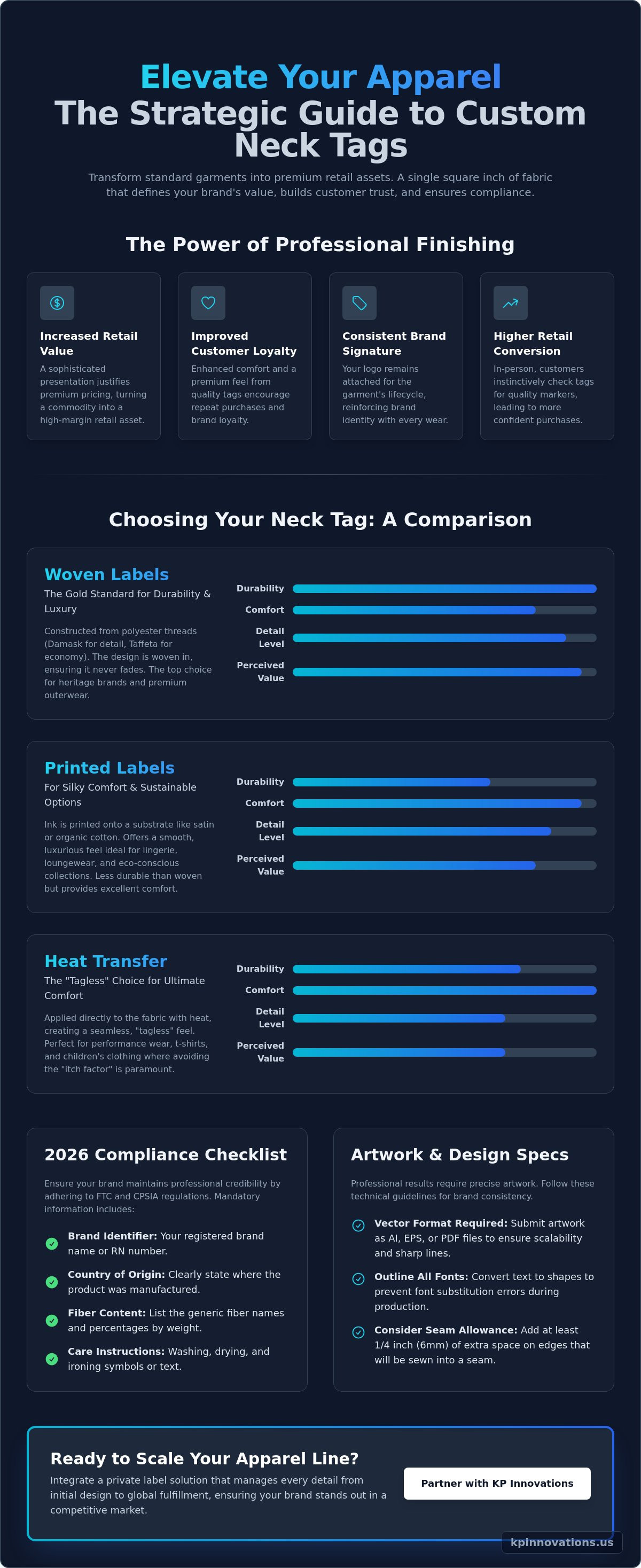
- Increased retail price points due to sophisticated, high-end presentation.
- Improved customer retention through enhanced wearability and comfort.
- Consistent brand recognition as your logo remains attached to the garment for its entire lifecycle.
- Higher conversion rates in physical retail environments where customers instinctively inspect the interior for quality markers.
The Shift from Blanks to Private Label
Using “tagless” blanks provides the ideal canvas for premium branding. It allows you to strip away the identity of the manufacturer and replace it with your own unique story. This transition is essential for building brand equity. Consistent internal labeling ensures that your logo is the only one the customer sees, which prevents brand dilution. This is particularly critical for corporate merchandise. You want your clients to feel they’ve received a bespoke product rather than a mass-produced promotional item. By owning the label, you own the relationship with the end user.
Tactile Branding: Comfort and Perception
The “itch factor” remains a primary concern for modern consumers. If a customer feels forced to cut out a sharp, uncomfortable tag, they’re effectively removing your brand from the garment. Premium material choices like soft satin or high-denier damask woven labels signal a luxury market position and a commitment to quality. Beyond comfort, your tags must meet federal standards to maintain professional credibility. Adhering to the Textile Fiber Products Identification Act demonstrates that your brand is sophisticated and compliant with consumer protection laws. A neck tag serves as a permanent business card inside a garment.
Comparing Custom Neck Tag Methods: Woven, Printed, and Heat Transfer
Selecting the ideal application method for your custom neck tags for apparel brand success is a technical decision with significant branding consequences. Your choice communicates your brand’s maturity and target market position before the customer even puts the garment on. Just as leaders leverage personal brand and fashion to project authority, your internal labeling must align with your external brand promise. Whether you prioritize the tactile richness of a woven label or the seamless comfort of a heat transfer, each method serves a specific strategic purpose. Making the right choice ensures your custom neck tags for apparel brand integration feels intentional rather than accidental.
Woven labels remain the industry benchmark for durability and a high-tier aesthetic. They’re constructed from polyester threads woven together to create your logo, ensuring the branding never fades or peels. For premium garments, high-denier damask is the preferred choice. It offers a soft feel and allows for intricate detail that cheaper taffeta weaves can’t match. If you’re building a heritage brand, woven labels provide the longevity required for items intended to last for years.
Printed labels offer a different set of advantages. Satin substrates provide a silky, luxurious feel that’s perfect for lingerie or high-end loungewear. Organic cotton printed labels are becoming the standard for sustainable collections, providing a natural look that resonates with eco-conscious consumers. These methods allow for more complex, multi-color graphics that might be technically impossible with weaving. If you need help determining which substrate fits your vision, exploring custom apparel finishing options can provide the clarity needed for a retail-ready launch.
The Woven Label Advantage
Precision in weaving is what separates professional labels from budget alternatives. High-density damask is essential for intricate logos, while taffeta is often reserved for hidden care labels. The way you fold these tags also impacts the final look. Center folds, or loop labels, are common in necklines, while end folds provide clean, finished edges that prevent fraying. For a truly high-end touch, mitre folds allow the tag to be sewn into the seam, creating a “hanger” look that’s common in luxury shirting.
Heat Transfer and Screen Printed Tags
Heat transfer, or tagless labeling, has revolutionized the activewear and athleisure sectors. By applying the branding directly to the fabric, you eliminate the risk of irritation during intense movement. This method is the go-to for performance-driven brands where comfort is the primary selling point. High-quality transfers must withstand rigorous durability testing, maintaining their integrity through 50 or more wash cycles without cracking or peeling. For high-volume corporate runs, this method offers remarkable cost-efficiency without sacrificing the professional look of your private label line.
Legal Compliance and Mandatory Labeling Requirements
Compliance is more than a legal hurdle; it’s a hallmark of a professional business. While aesthetic appeal drives the initial purchase, adherence to federal labeling laws ensures your garments are retail-ready and protected from costly regulatory action. Your custom neck tags for apparel brand strategy must prioritize the Textile Fiber Products Identification Act. This act mandates the disclosure of three critical pieces of information: fiber content, country of origin, and the identity of the manufacturer or brand. Failing to include these details doesn’t just look amateur; it can result in your merchandise being pulled from shelves or seized at customs.
Fiber content must be listed in descending order by weight. If you’re using blended fabrics, precision is essential. For example, a 60% cotton and 40% polyester blend must be clearly stated. The Country of Origin (COO) is equally vital. It must be placed on the front of the label where it’s easily visible to the consumer. As of 2026, the Federal Trade Commission (FTC) has increased its focus on the “Made in USA” claim. Following an executive order in March 2026, penalties for mislabeling domestic products can exceed $50,000 per violation. Accuracy isn’t just a best practice; it’s a financial necessity.
Care instructions are another mandatory requirement under 16 C.F.R. Part 423. You must provide clear, permanent instructions for washing and drying. While many brands use standardized symbols from the ASTM D5489-96c standard, it’s often safer to include written text to ensure there’s no ambiguity. This protects the consumer’s investment and reduces the likelihood of returns due to damaged garments.
FTC and CPSIA Standards for 2026
If your line includes children’s apparel, you must also comply with CPSIA tracking requirements. These labels must include specific information to facilitate recalls, such as the location and date of production. To identify your brand legally, you’ll need a Registered Identification Number (RN). This number allows you to use a code instead of your full business name on the tag, which helps maintain a clean design. Current 2026 updates also demand higher transparency for eco-labeling. Any claims of “sustainability” or “organic” must be backed by verifiable supply chain documentation to avoid greenwashing penalties.
Manufacturer Identification
You can properly credit your apparel factory by using their RN while keeping your brand logo as the primary visual element. Balancing this legal text with aesthetic design requires a strategic layout. Use a smaller font for mandatory disclosures and a bold, clear typeface for your brand identity. This ensures the tag remains readable without sacrificing the premium look of your private label line.
Designing Your Neck Tags: Sizes, Placements, and Artwork Specs
Execution is the final step in translating your brand vision into a physical product. Designing custom neck tags for apparel brand consistency requires a deep understanding of technical limitations and production standards. You must find the “Goldilocks” zone for sizing. A tag that is too large becomes a nuisance to the wearer, while one that is too small compromises the legibility of mandatory care instructions. Most retail-ready center-fold tags occupy a footprint of approximately 1.25 inches by 2 inches. This provides enough surface area for a bold logo on the front and compliant legal text on the reverse.
Your artwork must be provided in vector format. AI and EPS files are non-negotiable for woven applications because they allow our looms to translate your digital lines into precise thread patterns. Unlike raster images, vectors don’t lose quality when scaled, ensuring your logo remains sharp even on a tiny label. To maintain brand integrity across different product categories, utilize the Pantone Matching System (PMS). This ensures the specific hue of your logo on a woven neck tag perfectly matches your screen-printed graphics and digital assets. Ready to finalize your technical specs? Speak with our design team to ensure your files are production-ready.
Placement is equally strategic. While the internal center-back is the industry standard for primary branding, side-seam labeling is gaining popularity in luxury and streetwear sectors. Side-seam tags offer a unique tactile hit and can be used for “property of” labels or secondary branding without cluttering the neckline. Choosing the right location depends on your garment’s construction and how you want the customer to interact with the brand during daily wear.
Typography and Legibility
Woven threads and fabric inks have physical limits that digital screens don’t. For woven labels, keep your font size at 6pt or higher to prevent letters from “blobbing” together. Contrast is your best tool for readability; light text on a dark background or dark text on a light background ensures that care instructions are accessible to every customer. When working with printed satin, we use specific ink viscosities to avoid “bleeding,” which can occur when fine lines blur into the fabric weave. Clear, high-contrast typography signals a professional, detail-oriented brand.
Integration with Brand Stores
Strategic tagging does more than look good; it powers your backend operations. Custom labels that include clear sizing and SKU information simplify inventory management within online company stores. This level of organization allows for the creation of cohesive “kits” where neck tags, hang tags, and poly bags all share a unified design language. Consistent tag placement is vital for global fulfillment speed because it allows warehouse teams to identify sizes and styles at a glance during the picking and packing process.
Scaling Your Apparel Line with KP Innovations’ Private Label Solutions
Scaling a successful clothing line requires more than a clever logo or a high-quality fabric. It demands a partner who understands the entire movement of goods from the factory floor to the customer’s doorstep. While many competitors offer self-service portals with zero expert oversight, KP Innovations provides white-glove project management that covers the entire private label lifecycle. This includes the strategic selection and application of custom neck tags for apparel brand elevation. Our “manufacturing from the ground up” philosophy means we control every variable of production. We don’t just decorate off-the-shelf blanks; we build garments that reflect your brand’s unique DNA and exacting standards.
By sourcing your custom apparel and promotional products from a single strategic partner, you eliminate the friction of managing multiple vendors. This consolidated approach ensures that your brand’s visual identity remains consistent across every touchpoint. Whether it’s a premium heavyweight hoodie or a technical performance shirt, the quality of your branding stays uniform. This level of precision builds the trust necessary to move from a local startup to a global retail presence.
Strategic Fulfillment and Logistics
Our warehousing solutions are designed to scale alongside your ambitions. As your order volume increases, our global distribution network ensures your branded merchandise reaches your teams or customers anywhere in the world. For example, a tech client recently integrated our custom tag strategy with their existing corporate store. By moving from generic labeling to a fully managed private label system, they achieved a measurable improvement in their merchandise ROI. This success was driven by the increased perceived value of the garments and a significant reduction in logistical errors during high-volume global distribution events.
The KP Innovations Difference
We’re a strategic partner, not just another vendor. Most industry suppliers stop at the production line, leaving you to navigate the complexities of fulfillment and inventory alone. We provide a comprehensive ecosystem, offering access to 1.2 million products to complement your apparel line and round out your brand’s physical presence. This level of support allows you to focus on high-level growth while we manage the intricate details of the supply chain. Elevate your brand with custom private label apparel today.
Elevate Your Brand Signature for 2026
The transition from a standard garment to a premium retail asset requires a meticulous approach to every internal detail. By mastering the balance between tactile comfort and regulatory compliance, you position your brand for long-term equity and customer loyalty. Whether you choose the durability of woven damask or the seamless feel of heat transfers, your labeling strategy remains the most intimate touchpoint you share with your audience. It’s the definitive marker that separates a simple product from a lasting brand signature.
Successfully implementing custom neck tags for apparel brand elevation is just the beginning of a larger scaling strategy. Partnering with a specialist ensures that your vision is supported by white-glove project management from initial design through global fulfillment. As a premier U.S. promotional product supplier with access to over 1.2 million customizable items, we provide the infrastructure needed to turn physical merchandise into strategic brand assets. We manage the complexity so you can focus on high-level growth.
Start your private label apparel project with KP Innovations today and transform your high ambitions into a retail-ready reality. Your brand’s next level of impact starts with the details.
Frequently Asked Questions
What is the standard size for a custom neck tag?
Standard retail-ready center-fold tags are typically 1.25 inches by 2 inches. This specific size provides a balanced footprint that accommodates your logo on the front while leaving enough space for mandatory care instructions on the reverse. Finding this “Goldilocks” zone ensures the tag is professional and readable without becoming a nuisance to the wearer during daily use.
Can I use custom neck tags on pre-made “blank” t-shirts?
You can absolutely use custom neck tags for apparel brand elevation on pre-made “blank” garments. This process involves removing the original manufacturer’s tag and replacing it with your own private label. It’s a strategic way to build brand equity and transform a generic commodity into a premium retail asset with a higher perceived value.
What is the difference between a woven label and a heat transfer tag?
Woven labels are constructed from polyester threads to create a durable, high-end feel, while heat transfers are “tagless” prints applied directly to the fabric. Woven options are the industry standard for longevity and luxury shirting. Heat transfers are the preferred choice for performance-driven activewear where eliminating skin irritation is the primary design goal.
Are there legal requirements for what must be on a clothing label?
Federal law requires every clothing label to disclose the fiber content, country of origin, and the identity of the manufacturer or brand. These requirements are governed by the FTC Textile Act and must be clearly visible to the consumer. Adhering to these standards ensures your merchandise is compliant and ready for global retail distribution.
Do I need a different tag for different sizes (S, M, L, XL)?
Every garment must display its specific size to meet consumer expectations and legal standards. While your brand logo remains consistent, you’ll need separate tag versions or “size tabs” for Small, Medium, Large, and Extra Large. Managing these variations is a critical step in maintaining an organized inventory system within your online company store.
What is the minimum order quantity (MOQ) for custom neck tags?
Minimum order quantities depend on the production method you choose for your custom neck tags for apparel brand strategy. Woven labels typically require larger runs of 500 to 1,000 pieces due to loom setup requirements. Heat transfers often offer more flexibility for smaller collections, allowing you to scale your production as your demand grows.
How do I ensure my custom labels won’t itch or irritate the skin?
To prevent skin irritation, prioritize high-quality materials like soft satin or high-denier damask woven labels with finished edges. If your target audience is particularly sensitive, such as in children’s wear or athletic apparel, heat transfer labels provide a completely smooth finish. Choosing the right substrate ensures your customers don’t feel forced to cut out your branding.
Can KP Innovations help with the design and sewing of my tags?
We manage the entire private label lifecycle, including the professional design and physical application of your neck tags. Our white-glove project management service takes you from the initial artwork phase through the sewing process and final global fulfillment. We act as a strategic partner to ensure every detail of your custom apparel line meets premium retail standards.