
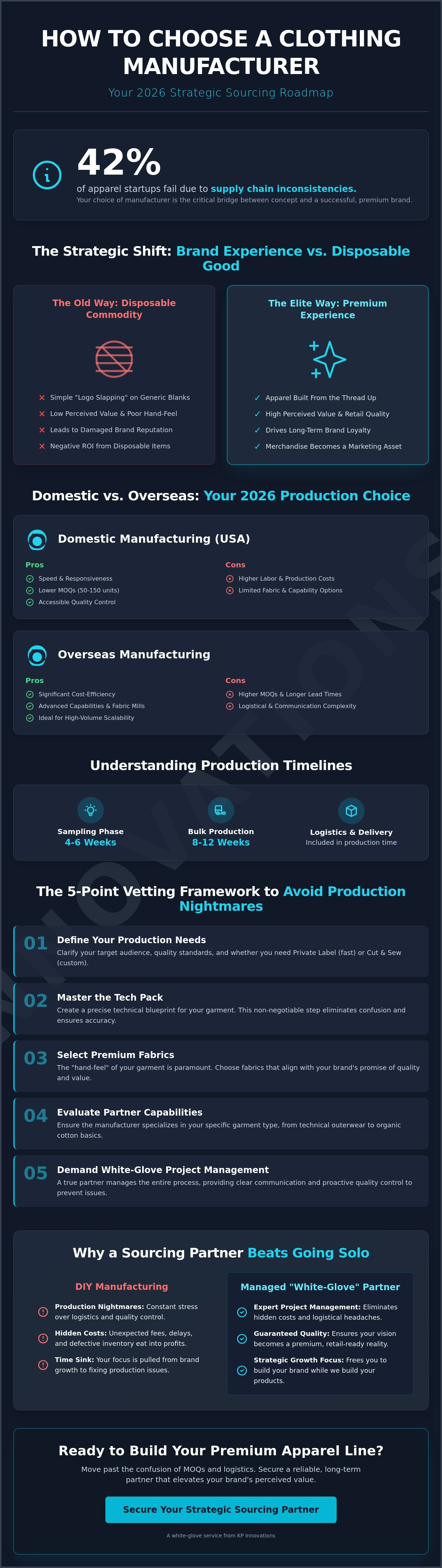
Your brand is either a premium experience or a disposable commodity, and that distinction is decided long before your customer opens their package. In an industry where 42% of apparel startups cite supply chain inconsistencies as their primary reason for failure according to 2023 industry data, the stakes for your 2026 sourcing strategy couldn’t be higher. You already know that receiving a shipment of low-quality merchandise isn’t just a financial loss; it’s a direct hit to your reputation. It’s exhausting to feel stuck between confusing Tech Packs and the stress of global logistics when you’re simply trying to build something elite. Understanding how to choose a clothing manufacturer is the bridge between a simple logo and a sophisticated private-label brand.
This guide provides a clear roadmap to help you vet and select a partner that acts as a strategic asset rather than just a vendor. We promise to move you past the confusion of MOQs and into a space where your apparel is built from the thread up with absolute precision. You’ll learn our proven vetting process to secure a reliable, long-term partner that elevates your brand’s perceived value. We’re diving into everything from technical specifications to white glove quality control to ensure your vision becomes a premium reality.
Key Takeaways
- Learn to move beyond standard “logo slapping” by building custom apparel from the thread up to drive brand perception and long-term loyalty.
- Evaluate the strategic trade-offs between domestic speed and overseas cost-efficiency to determine the best fit for your 2026 production goals.
- Master a five-point vetting framework to understand exactly how to choose a clothing manufacturer that aligns with your specific garment types and budget.
- Avoid production nightmares by mastering the Tech Pack process and selecting fabrics that deliver a premium, private-label hand-feel.
- Discover why white-glove project management eliminates the hidden costs of DIY manufacturing, allowing you to focus on strategic brand growth.
The Strategic Shift: Why Your Choice of Clothing Manufacturer Defines Your Brand
Your brand’s reputation lives in the seams of your garments. By 2026, the market has moved past simple logo slapping on generic blanks. Successful companies now prioritize apparel built from the thread up, ensuring every fiber aligns with their premium identity. Understanding how to choose a clothing manufacturer involves looking past the price per unit to find a strategic partner that understands your long-term vision. A comprehensive overview of the clothing industry reveals that supply chain transparency and material integrity are now non-negotiable for modern consumers.
The transition from transactional vendors to strategic partnerships is the hallmark of elite brands. In 2026, you aren’t just buying products; you’re securing a supply chain that reflects your values. Moving away from one-off orders allows for better quality control and more innovative design opportunities. This shift ensures that your merchandise isn’t just a giveaway but a legitimate retail-quality asset that competes with luxury labels.
Merchandise as a Marketing Asset
High-quality apparel serves as a long-term brand impression engine. According to data from the Advertising Specialty Institute, quality outerwear is kept for an average of 16 months, generating thousands of impressions during its lifecycle. The cost of cheap manufacturing is far higher than the initial invoice suggests. Poorly made items that shrink, fade, or tear after two washes result in a negative ROI and damaged brand perception. We help clients transition from disposable promotional items to premium brand experiences. When you invest in elite fabrics and thoughtful construction, your merchandise becomes a wearable endorsement that customers actually value.
Understanding Your Production Needs
Before you begin the process of how to choose a clothing manufacturer, you must define your specific production requirements. Identifying your target audience’s expectations for fit, fabric, and finish is the first step in our proven process. You need to determine if your project requires Private Label customization or full Cut and Sew services. Private Label allows for faster market entry by using pre-existing high-quality patterns with your custom branding. Cut and Sew offers total creative control over every measurement and detail.
- Target Audience: Define if they demand technical performance fabrics or sustainable organic cotton.
- Production Type: Choose between the speed of Private Label or the total customization of Cut and Sew.
- Realistic Timelines: Plan for 4 to 6 weeks for the sampling phase and 8 to 12 weeks for bulk production and logistics.
- Quality Standards: Establish clear benchmarks for stitching, dye lots, and hardware before production begins.
Setting these parameters early prevents delays and ensures your manufacturer can deliver on your brand promise. Our white glove service handles these complex details, allowing you to focus on growing your business while we manage the technical execution of your apparel line.
Domestic vs. Overseas: Evaluating the Pros and Cons for Your 2026 Strategy
Deciding where to produce your apparel is a foundational step in learning how to choose a clothing manufacturer that aligns with your brand’s DNA. This isn’t just a matter of finding the lowest price per unit. It’s a strategic calculation involving speed to market, supply chain resilience, and consumer perception. In 2026, the global logistics environment remains volatile, making your choice of production location a defining factor in your brand’s agility.
Domestic Manufacturing (USA)
Domestic production offers a distinct advantage for brands prioritizing speed and responsiveness. You’ll typically find much lower Minimum Order Quantities (MOQs), often starting at 50 to 150 units. This is ideal for testing new designs or launching limited seasonal drops without the risk of overstock. Quality control is also more accessible. You can easily schedule site visits to production hubs in Pennsylvania or other national centers to inspect samples in person. The marketing impact is equally significant. A 2023 study by the Reshoring Institute indicated that nearly 70% of American consumers prefer products made in the USA. This allows you to position your brand as a premium, ethical choice for a domestic audience.
Offshore Manufacturing (Global)
For high-volume corporate orders or complex technical apparel, overseas facilities provide unmatched scale and specialized machinery. You gain access to advanced construction techniques, such as laser-cut seams or specialized performance knits, that are often unavailable or cost-prohibitive domestically. Cost efficiency remains the primary driver. When you scale past 1,000 units, the cost per garment can drop by 30% to 50% compared to US production. However, you must manage longer lead times and geopolitical risks. Ocean freight currently averages 35 to 45 days from major Asian ports to the US West Coast. Successfully navigating this requires a partner who can elevate your brand by managing these complex international logistics on your behalf.
Navigating the 2026 global supply chain requires a balanced approach to budget and ethics. While offshore production offers savings, you must account for fluctuating tariffs and the environmental impact of long-distance shipping. Many elite brands now utilize a hybrid model. They produce core, high-volume SKUs overseas while keeping limited-edition or quick-turn items in domestic facilities. This strategy protects your margins while ensuring you never miss a trend. When you evaluate how to choose a clothing manufacturer, look for partners who offer transparency in their labor practices regardless of their zip code. Ethical production is no longer a luxury; it’s a baseline requirement for modern brand loyalty.
- Domestic: Best for 50 to 500 units, fast restocking, and “Made in USA” branding.
- Overseas: Best for 1,000+ units, technical fabrics, and maximum cost efficiency.
- Lead Times: Expect 2 to 4 weeks for domestic and 12 to 16 weeks for offshore projects.
The Vetting Framework: 5 Critical Criteria to Evaluate Potential Partners
Selecting a production partner is the most consequential decision you will make for your brand’s physical identity. Learning how to choose a clothing manufacturer requires moving past simple price quotes to analyze operational depth. You’re looking for a strategic partner that views your success as their own, not just another vendor filling a purchase order. This vetting process separates premium, retail-ready apparel from low-quality promotional items.
- Experience and Specialization: A factory that excels in denim production might fail at technical activewear. You must verify that they have deep expertise in your specific garment category. Ask to see physical examples of private label apparel they’ve produced for brands with similar quality standards.
- Minimum Order Quantities (MOQs): Finding the “sweet spot” is vital for cash flow. While high MOQs often reduce the price per unit, they can lead to excess inventory. In 2026, elite manufacturers often offer tiered MOQs that allow your brand to scale as demand grows.
- Sample Quality: Never skip the prototype phase. This is your insurance policy. A sample allows you to verify fabric hand-feel, stitch density, and fit accuracy against your tech pack. If a manufacturer cannot produce a perfect sample, they will never deliver a perfect production run.
- Communication and Transparency: Test their responsiveness before signing a contract. A 24-hour response window is the professional standard. If a factory is slow to communicate during the sales process, they will likely become unreachable when production challenges arise.
- Ethical Compliance: Your brand’s reputation is tied to your supply chain. Ensure the factory adheres to international labor laws. This protects your business from the legal and PR risks associated with poor working conditions.
Vetting for Technical Capability
You must look beyond the showroom to the factory floor. Ask for a detailed machinery list to ensure they have the specific tech needed for your finishes, such as laser cutting or ultrasonic welding. Verify their internal quality control (QC) processes by asking for their AQL (Acceptable Quality Limit) standards. A professional partner should maintain an AQL of 2.5 or better for major defects to ensure your “merch becomes marketing” that lasts.
Compliance and Traceability in 2026
Traceability is now a mandatory requirement for corporate brand managers and luxury labels alike. By 2026, approximately 70% of global textile markets will require detailed ESG (Environmental, Social, and Governance) documentation. You must verify that your partner holds certifications like WRAP or BSCI to ensure they meet US safety and labor standards. When you understand how to choose a clothing manufacturer with high traceability, you gain the ability to tell a transparent story to your customers, building trust from the thread up.
Mastering the Production Process: From Tech Pack to Final Delivery
Understanding how to choose a clothing manufacturer is only the first step in a long journey. The real work begins when you transition from a signed contract to active production. A premium brand requires a methodical approach to ensure the final product matches the vision you’ve promised your customers. This stage is where “white glove” project management separates elite brands from average ones.
The Tech Pack: Your Insurance Policy
A successful launch depends on the technical accuracy of your documentation. The tech pack serves as your primary insurance policy against costly mistakes. Industry data shows that a comprehensive tech pack can reduce factory errors by 80% during the initial production run. This document is much more than a simple sketch. It must include a detailed Bill of Materials (BOM), precise point-of-measure specs, and grading for every size in your range. When you realize choosing the right apparel factory requires total transparency, the tech pack provides the objective standard for that relationship.
The sourcing phase follows, where you select fabrics that meet your specific hand-feel goals. Don’t settle for “close enough.” Request swatches of various weights and compositions to ensure the drape and durability align with your brand’s quality tier. Once materials are set, the sampling and iteration phase begins. When providing feedback, use specific measurements and photos rather than vague descriptors. Factories understand “reduce sleeve length by 1.5cm” much better than “the sleeves feel a bit long.”
Monitoring the middle of the process is vital during bulk production. Quality assurance shouldn’t happen only at the end. Request inline inspections where random units are checked while they’re still on the sewing floor. This allows you to catch systemic issues before the entire 1,000-unit order is finished and packed.
Navigating Logistics and Fulfillment
Managing logistics requires a firm grasp of Incoterms to avoid unexpected costs. You’ll typically choose between three main options:
- EXW (Ex Works): You’re responsible for everything from the factory door.
- FOB (Free on Board): The factory delivers the goods to the port; you handle the sea or air freight.
- DDP (Delivered Duty Paid): The manufacturer handles everything, including taxes and duties, until the product reaches your warehouse.
For a seamless launch, consider the role of warehousing and kitting. Kitting involves pre-packaging items into specific sets or adding custom hangtags and polybags before they reach the final customer. This level of detail ensures your global distribution feels personal and premium rather than mass-produced. By 2026, brands that master these logistical nuances will stay ahead of competitors who struggle with shipping delays and customs hurdles.
The Managed Solution: Why a Sourcing Partner Beats Going Solo
Managing manufacturing in-house often reveals hidden costs that go far beyond the initial quote. Brands that attempt the DIY route frequently encounter a 15 percent error rate in initial sampling, leading to wasted capital and missed launch dates. When you evaluate how to choose a clothing manufacturer, the decision shouldn’t just be about the lowest unit price. It’s about the total cost of ownership, including the time spent chasing updates and correcting quality issues. DIY sourcing is often a recipe for burnout, as founders find themselves acting as amateur logistics managers instead of brand visionaries.
KP Innovations provides white-glove project management that transforms the production experience. This isn’t just about placing an order; it’s about elite oversight of the entire supply chain. We leverage an established network of 1.2 million products and pre-vetted factories to ensure your brand never settles for “good enough.” We bridge the gap between your initial design sketches and global fulfillment, handling the complex logistics so you don’t have to. Our team manages the stress of international shipping, customs, and quality control, delivering a finished product that’s ready for the retail floor.
Premium Is Our Baseline
Fortune 500 companies and luxury labels trust managed sourcing because they value consistency and scale. These organizations understand that a factory sales rep’s primary goal is to keep their specific machines running, regardless of whether that factory is the best fit for your specific garment. In contrast, a KP Innovations dedicated account manager acts as an extension of your team. We’ve moved past the traditional vendor mindset to become a strategic partner. We don’t just put your logo on a product, we build apparel from the thread up to ensure your merch becomes a powerful marketing asset that leaves a lasting impression.
Start Your Private Label Journey
Building a private label brand is a complex undertaking, but it doesn’t have to be a stressful one. Our proven 6-step process is designed for clarity and speed. It starts with a discovery call where we discuss your apparel vision and technical requirements. From there, we handle everything from sourcing the right fabrics to final kitting and distribution. You get the benefit of a professional team that understands how to choose a clothing manufacturer that aligns with your specific quality standards and ethical requirements. Elevate your brand with KP Innovations today and experience the difference of a truly managed, white-glove solution.
Secure Your Competitive Edge for 2026
Your brand’s trajectory in 2026 depends on moving beyond basic vendor relationships toward elite, strategic partnerships. Success requires a deep understanding of the production process and a commitment to quality that starts from the thread up. Learning how to choose a clothing manufacturer isn’t just about finding a factory; it’s about securing a partner that handles the complex logistics of sourcing, fulfillment, and kitting with precision. Industry data shows that the most successful brands prioritize a managed solution over the risks of going solo.
KP Innovations provides the elite support your business needs to scale effectively. We offer access to over 1.2 million premium products and provide white-glove project management that guides your vision from initial design to final delivery. There’s a reason Fortune 500 companies and luxury brands rely on our expertise to protect their reputations. We treat your apparel as a strategic marketing asset rather than just another SKU. You deserve a partner that cares about the details as much as you do.
Don’t leave your brand’s quality to chance. Let’s build something that makes a lasting impression on your audience. Book a Discovery Call to Start Your Custom Apparel Project and see how we turn merch into marketing.
Frequently Asked Questions
How do I find a clothing manufacturer for my small business?
You can find reliable partners by searching industry-specific directories like Maker’s Row or Kompass, which list over 10,000 verified production facilities. Attending trade shows like Magic Las Vegas allows you to vet dozens of potential partners in a single weekend. Learning how to choose a clothing manufacturer that specializes in small-batch production is vital for maintaining quality during your first 50 to 100 unit runs.
What is the difference between a clothing manufacturer and a supplier?
A clothing manufacturer builds finished garments from raw materials, whereas a supplier provides the individual components like textiles, zippers, or buttons. Manufacturers handle the technical cut, make, and trim process to deliver a retail-ready product. For a premium brand, you want a strategic partner that manages these suppliers for you. This ensures every SKU in your collection meets elite quality standards without you managing multiple vendors.
How much does it cost to start a clothing line with a manufacturer?
Costs vary based on garment complexity, but the 2024 State of Fashion report indicates that sample development typically consumes 15% to 25% of a startup’s initial budget. You’ll need to fund pattern making, size grading, and several rounds of prototypes. While we don’t dictate your specific costs, industry data shows that successful emerging brands often allocate 30% of their total capital to their first production run to ensure premium results.
What are MOQs and why do they matter for new brands?
Minimum Order Quantities, or MOQs, represent the lowest number of units a factory will produce per style or colorway. They matter because they directly impact your upfront inventory investment and storage requirements. High MOQs of 500 units or more can create significant cash flow challenges for a new business. Selecting a partner with flexible MOQs lets you test 3 or 4 different designs without the risk of holding thousands of unsold items.
Can I find a manufacturer that also handles shipping and fulfillment?
Yes, many high-end manufacturers now offer end-to-end brand support including kitting, logistics, and global fulfillment services. This white glove approach removes the logistical stress from your team. By centralizing your production and shipping under one roof, you can often reduce your total transit times by 10 to 14 days. It’s a strategic move for brands that want to focus on marketing while experts handle the warehouse operations.
What questions should I ask a clothing manufacturer before hiring them?
Ask about their specific experience with your product category, their current lead times, and their internal quality control protocols. You should confirm if they’ve served any of the 500 largest global corporations to verify their capacity and reliability. Understanding how to choose a clothing manufacturer involves vetting their ability to deliver private-label apparel from the thread up. Ask for a detailed breakdown of their 6-step production process before signing any contracts.
Is it better to manufacture clothing in the USA or overseas in 2026?
The best choice depends on your specific need for speed versus your target profit margins. Domestic manufacturing in the USA provides 20% faster shipping times and eliminates most language barriers. Overseas production in hubs like Portugal or Vietnam often offers lower unit costs for high-volume orders. In 2026, 45% of premium apparel brands use a hybrid sourcing model to balance rapid replenishment with cost-effective bulk production.
What is a tech pack and do I really need one?
A tech pack is a comprehensive blueprint for your garment that includes exact measurements, material specifications, and hardware details. You absolutely need one to ensure your manufacturer delivers an accurate product. Without this document, the risk of expensive manufacturing errors increases by 60%. It acts as a binding contract that holds the factory accountable to your premium quality standards throughout the entire sampling and production phase.