
The most expensive mistake a founder can make in 2026 isn’t a bad hire; it’s ordering a thousand units of “premium” apparel that ends up in a donation bin because the fabric feels like sandpaper. You know the frustration of receiving a shipment that looks nothing like the digital mockup. When sourcing custom clothing for startups, you’re often forced to manage three different vendors just to get a single hoodie from the design stage to your customer’s door. It’s a logistical nightmare that drains your most valuable resource: time.
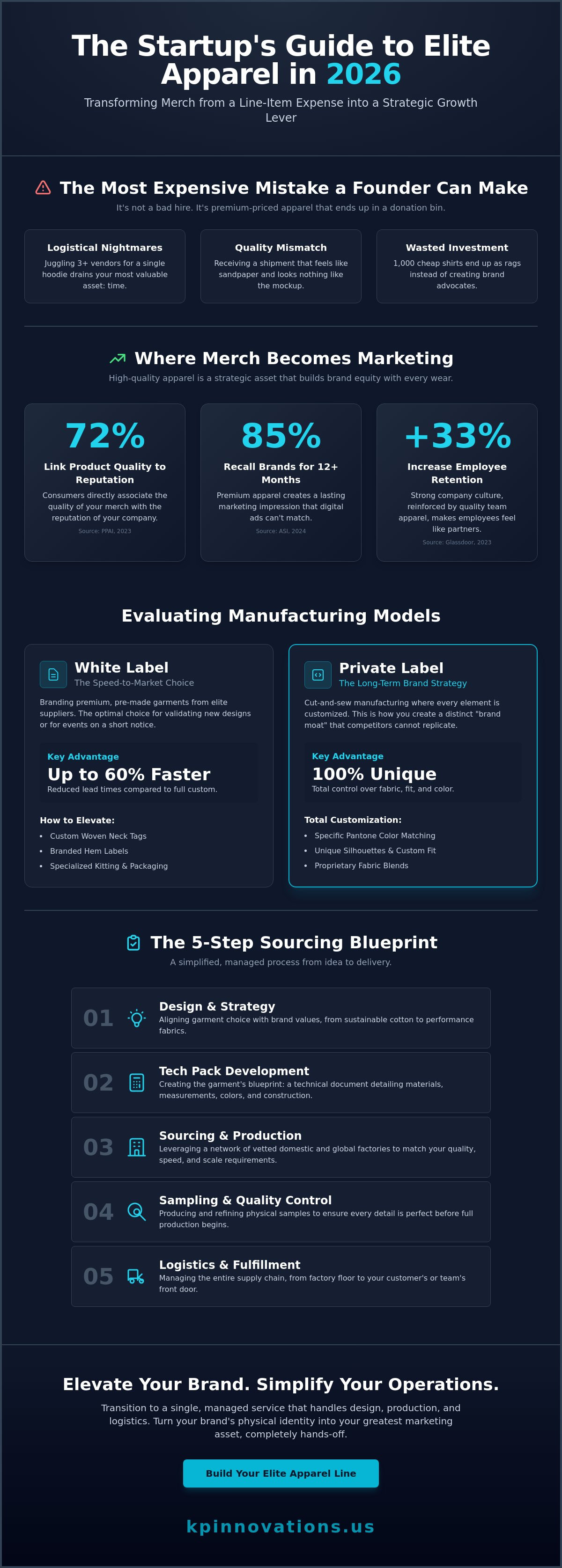
We agree that your team and your customers deserve better than “good enough” merch. A 2023 study by the Promotional Products Association International found that 72% of consumers link the quality of a promotional product directly to a company’s reputation. This guide will show you how to build an elite, private-label apparel line that people actually want to wear while keeping the process entirely hands-off. You’ll learn how to secure scalable manufacturing and seamless fulfillment without the hidden costs of overseas production, turning your brand’s physical identity into a strategic marketing asset.
Key Takeaways
- Learn why premium apparel is a strategic growth lever rather than just a logo on a shirt.
- Understand the critical differences between private label and off-the-shelf models when sourcing custom clothing for startups.
- Compare the speed of domestic production with the scalability of global manufacturing to determine your ideal sourcing strategy.
- Master the technical requirements of the sourcing process, including how to develop a tech pack that serves as your garment’s blueprint.
- Simplify your operations by transitioning to a managed service that handles design, production, and logistics under one roof.
Why Custom Clothing is a Strategic Growth Lever for Startups
Many founders view apparel as a line-item expense or a last-minute addition to a launch party. This perspective is a missed opportunity. In 2026, custom clothing for startups serves as a high-impact customer acquisition tool and a physical extension of your brand’s digital presence. When you invest in high-quality garments, you aren’t just buying fabric; you’re building a walking billboard that your community actually wants to wear. Research from the Advertising Specialty Institute in 2024 shows that 85% of consumers remember the brand on a high-quality piece of apparel for over 12 months. This longevity creates a recurring marketing impression that digital ads simply can’t match.
Where Merch Becomes Marketing
The era of disposable, ill-fitting “swag” is over. We believe that premium is the baseline for any early-stage brand looking to make a mark. It’s better to produce 100 elite hoodies that your team wears every weekend than 1,000 cheap shirts that end up as rags. This strategic shift transforms your merchandise into a marketing engine. High-end apparel creates “superfans” who advocate for your brand voluntarily. When your clothing feels like a retail-grade product, it validates your startup’s professionalism before you even say a word. We don’t just put your logo on a product; we help you design a strategic asset that drives brand recognition and builds trust with every wear.
Building Brand Equity from the Thread Up
Every detail of your apparel communicates your startup’s core values. A heavy-weight organic cotton tee suggests a commitment to sustainability and quality; a technical performance polo signals innovation and speed. These choices matter for internal culture just as much as external sales. A 2023 study by Glassdoor found that strong company culture increases employee retention by 33%. Providing your team with private label quality apparel makes them feel like partners in the mission rather than just employees. This pride often spills over into social media. A strategic apparel launch can trigger a wave of organic user-generated content. When your followers see your team and customers looking polished in custom-designed gear, your brand equity grows through authentic social proof.
Evaluating Manufacturing Models: Private Label vs. Off-the-Shelf
Choosing the right manufacturing model is a pivotal decision that dictates your startup’s speed and brand positioning. You have two primary paths: working with high-quality blanks, known as White Label, or building garments from the thread up, known as Private Label. Both models have their place in a growth strategy. The choice depends on your current stage, your budget, and how quickly you need to get your custom clothing for startups into the hands of your customers.
White Label: The Speed-to-Market Choice
White label manufacturing involves selecting pre-made garments from premium suppliers and adding your branding through screen printing, embroidery, or heat transfers. This is the optimal choice for validating a new design or producing merchandise for an upcoming event on short notice. According to 2024 industry reports from the Apparel Manufacturers Association, white label production can reduce lead times by as much as 60% compared to full custom manufacturing. It’s an efficient way to test the market without heavy upfront investment.
To ensure your brand doesn’t feel generic, focus on identifying elite blank manufacturers that prioritize fabric weight and modern fits. You can elevate these standard pieces into strategic brand assets by adding premium finishing touches. Custom woven neck tags, hem labels, and specialized kitting can make an off-the-shelf garment feel like a high-end retail product. If you’re looking to test the waters quickly, we can help you source elite blanks that align with your premium standards.
Private Label: The Long-Term Brand Strategy
When you’re ready to create a distinct brand moat, private label is the answer. This model involves cut-and-sew manufacturing where every element is customized. You control the specific Pantone colors, the unique silhouette of the fit, and the exact blend of the fabric. This level of detail is what separates a generic startup shirt from a piece of apparel that customers view as a wardrobe staple. It allows you to create something truly unique that competitors cannot easily replicate.
While private label offers the ultimate brand expression, it requires a deeper understanding of choosing the right apparel factory to manage higher Minimum Order Quantities (MOQs). Startups must balance these MOQs with their cash flow carefully. It’s often strategic to start with white label to prove demand before committing to the larger inventory requirements of private label. This thoughtful approach ensures you don’t tie up essential capital in stock that hasn’t been market-tested, allowing for scalable production that grows alongside your business.
Navigating the Sourcing Maze: Domestic vs. Global Production
Deciding where to manufacture your custom clothing for startups is a high-stakes choice that influences your brand’s agility and its bottom line. Sourcing isn’t just about finding the lowest price per unit; it’s about calculating the total landed cost and evaluating your risk tolerance. In 2026, founders must weigh the immediate benefits of local production against the long-term scalability of global supply chains. A strategic partner helps you determine which path aligns with your current growth phase while ensuring that your quality standards never waver.
The Reality of Domestic Sourcing
Domestic manufacturing offers a clear advantage in speed and marketing appeal. Producing in the USA allows for significantly faster restocks. This agility is vital when a specific SKU suddenly gains traction on social media. A 2024 study by the Reshoring Institute found that 70% of companies are actively looking to bring production closer to home to avoid the shipping volatility seen in previous years. While the unit price may be higher, the lower shipping costs and reduced lead times often result in better cash flow management. Clear communication is another major win. You can speak directly with factory managers during your own business hours, ensuring that “white glove” project management remains the standard for every stitch.
Managing Global Supply Chains
Overseas production remains the gold standard for startups that have validated their designs and are ready to scale. The cost savings can be substantial, but these benefits come with a “logistics nightmare” of customs, duties, and long-distance quality control. You can’t just hope for the best when your inventory is 5,000 miles away. Third-party inspections are non-negotiable to maintain consistency across large production runs. We believe that global sourcing requires a proactive approach. You need a partner who handles the complexities of international trade so you can focus on building your brand.
Ethical sourcing is also a major priority for the modern consumer. Data from a 2025 consumer sentiment report shows that 81% of Gen Z buyers demand full transparency in the manufacturing process. Choosing factories that prioritize fair wages and sustainable practices isn’t just a moral choice; it’s a strategic move to build brand equity. Whether you produce locally or globally, your sourcing strategy must reflect the values of your startup culture. If you’re ready to elevate your brand with a managed sourcing process, we’re here to handle the details from thread to delivery.
The 5-Step Sourcing Checklist: From Tech Packs to Final Samples
Executing a successful launch of custom clothing for startups requires a disciplined, step-by-step approach. You can’t leave quality to chance. The process begins with conceptualizing the target “vibe” and moves through a rigorous technical phase to ensure the final product matches your vision. A 2024 report by the Fashion Institute of Technology highlighted that 45% of production delays are caused by incomplete technical specifications. Following a structured checklist is the only way to avoid these pitfalls and deliver a premium product to your community.
- Step 1: Conceptualization. Define the silhouette, color palette, and target use case.
- Step 2: Tech Pack Development. Create the comprehensive blueprint for your garment.
- Step 3: Material Selection. Source specific fabrics and high-end hardware like custom-milled zippers.
- Step 4: Sampling. Request a pre-production sample to verify fit and finish.
- Step 5: Golden Sample Approval. Finalize the master sample that sets the standard for the entire run.
Demystifying the Tech Pack
A tech pack is more than just a drawing; it’s a legal document that protects your brand. It includes precise measurements, material compositions, stitch types, and label placements. Without one, manufacturers are forced to guess, leading to the logistical headaches that plague many early-stage brands. Many founders find this stage intimidating because they lack a design background. We handle the “design to spec” process for you, translating your ideas into professional technical documents that factories can execute flawlessly. This insurance against production errors is a core part of our white-glove service. If you’re still exploring how these items fit into your overall strategy, you can read our guide on what are promotional products to see how apparel compares to other branded assets.
The Sampling Strategy
Never approve a full production run of custom clothing for startups without holding a physical sample in your hands. A fit sample focuses on the drape and sizing, while a production-ready sample uses the actual fabrics and colors chosen for the final product. When you receive a sample, you must provide constructive, data-driven feedback. Don’t just say a shirt “feels off.” Instead, specify that the sleeve length needs a 0.5-inch reduction or the neck ribbing requires more tension. This level of detail ensures the “Golden Sample” is perfect. Once approved, this sample becomes the benchmark for quality control during the final production. If you’re ready to move from concept to a physical sample without the stress, start your apparel project with us today.
Elevating Your Brand with KP Innovations: Beyond the Average Vendor
KP Innovations isn’t your average promotional vendor. We’ve spent years refining a white-glove project management process that scales alongside your growth. Whether you’re a lean team of five or a scaling enterprise, our expertise in custom clothing for startups ensures your brand identity remains premium across every SKU. We provide access to over 1.2 million products, giving you the freedom to find the exact fabric, fit, and finish that aligns with your elite standards. If Fortune 500 companies and luxury brands rely on our strategic oversight, you can trust that your project is in capable hands. We don’t just put your logo on a product; we build assets that drive your marketing.
Company & Team Stores for Scaling Startups
Managing sizes, shipping addresses, and individual preferences often turns into a spreadsheet nightmare for founders. We eliminate this friction through automated company stores. These digital platforms streamline employee onboarding and customer rewards by allowing users to select their own gear directly. Our system handles on-demand fulfillment and kitting, which is a massive benefit for lean teams that want to stay focused on their product. You won’t have to worry about storing inventory in your office or managing individual shipments. We handle the logistics of delivering your apparel globally, ensuring a consistent brand experience for every team member, regardless of their location. This managed approach turns a logistical headache into a seamless, hands-off operation.
Your Strategic Partner in Brand Elevation
A successful apparel line requires more than just a manufacturer; it requires a partner who understands the nuances of sourcing and quality control (QC). Our customer-first culture means your project never falls through the cracks. We manage the entire lifecycle from the initial tech pack design discussed earlier to the final logistics and delivery. This end-to-end support allows you to focus on your core business while we handle the complexities of international customs and shipping volatility. We’re ambitious for your success and position ourselves as a tool for your brand elevation. Where merch becomes marketing, we’re the engine that drives your physical brand presence. Start your startup’s custom apparel project with KP Innovations today and experience the difference of apparel built from the thread up.
Build Your Brand Legacy Through Elite Apparel
Building a premium brand identity in 2026 requires moving beyond the “logo on a shirt” mentality. You now understand that high-quality apparel acts as a strategic growth lever, provided you navigate the technical complexities of tech packs and sampling with precision. By choosing the right manufacturing model and sourcing strategy, you protect your cash flow while ensuring your team wears your brand with pride. Your physical identity is the first thing a customer touches; it shouldn’t be an afterthought.
Managing custom clothing for startups doesn’t have to be a logistical nightmare that distracts from your core mission. We’ve managed over 1.2 million products and provided white-glove project management for Fortune 500 companies and high-growth startups alike. Our team handles everything from the initial design to global fulfillment, so you can focus on scaling your business. It’s time to transition from being a simple vendor client to having a strategic brand partner that understands your ambition.
Elevate your brand with a custom apparel discovery call. Your startup’s physical identity is too important to leave to chance. Let’s build something your customers actually want to wear.
Frequently Asked Questions
What is the typical minimum order quantity (MOQ) for startup custom clothing?
Minimum order quantities typically start as low as 24 to 48 units for white-label projects using premium blanks. If you’re pursuing full private-label manufacturing, MOQs generally range from 200 to 500 units per SKU. This flexibility allows you to validate designs without overextending your cash flow. We help you balance these requirements to ensure your custom clothing for startups remains scalable as your community grows.
How long does the custom apparel manufacturing process take from start to finish?
Standard lead times range from 3 weeks for domestic white-label orders to 12 weeks for complex international private-label projects. Domestic sourcing provides the fastest turnaround for event-driven needs or quick restocks. Overseas production requires a longer horizon to account for ocean freight and customs clearance. A 2024 industry survey noted that 45% of production delays occur during the sampling phase, so proactive project management is essential for meeting launch dates.
Do I need to provide my own designs or tech packs to start a project?
You don’t need a professional design background or a finished tech pack to begin working with us. We translate your conceptual “vibe” and basic sketches into production-ready blueprints through our “design to spec” service. This white-glove approach ensures that measurements, fabric weights, and stitch types are documented correctly. Our team handles the technical heavy lifting so your brand’s physical identity matches your digital vision perfectly.
What is the difference between screen printing and embroidery for startup gear?
Screen printing is the most cost-effective method for large, vibrant graphics on t-shirts and lightweight hoodies. It uses ink pressed through mesh screens to create a smooth finish. Embroidery uses high-speed needles to sew your logo directly into the fabric, providing a premium, textured look ideal for hats and heavy-weight outerwear. While screen printing handles fine details better, embroidery offers superior durability for items intended for daily long-term wear.
Can you handle international shipping and fulfillment for our remote team?
We provide end-to-end fulfillment and logistics services that include shipping to individual addresses across the globe. Our automated company stores eliminate the manual work of collecting sizes and tracking residential deliveries. We manage the kitting process and ensure that every package reflects your brand’s premium standards. This hands-off system allows you to reward remote employees and international superfans without managing a single post office run yourself.
How do I ensure the clothing is ethically sourced and manufactured?
We vet every factory in our network against global compliance standards to ensure fair wages and safe working conditions. Ethical sourcing is a non-negotiable requirement in 2026, as 81% of Gen Z consumers now demand full transparency in the supply chain. We prioritize partners with recognized certifications like WRAP or the Fair Labor Association. This commitment protects your brand reputation and ensures your custom clothing for startups aligns with modern corporate social responsibility values.
Is it better to source clothing domestically or overseas for a new brand?
Domestic sourcing is usually the superior choice for new brands that prioritize speed and low inventory risk. It allows for faster communication and restocks, which is vital when 70% of companies are currently looking to shorten their supply chains. Overseas production becomes the strategic choice once you have validated your designs and need to maximize margins on high-volume runs. We help you evaluate the total landed cost to determine the best path for your current stage.
What should I look for in a pre-production sample?
You must evaluate the “hand feel” of the fabric, the accuracy of Pantone color matching, and the structural integrity of the stitching. Check the sample against your tech pack to ensure the measurements are within the allowed 0.5-inch tolerance. This is your final opportunity to provide feedback before the full production run begins. Once you approve this “Golden Sample,” it serves as the master benchmark for our quality control audits during the manufacturing process.