
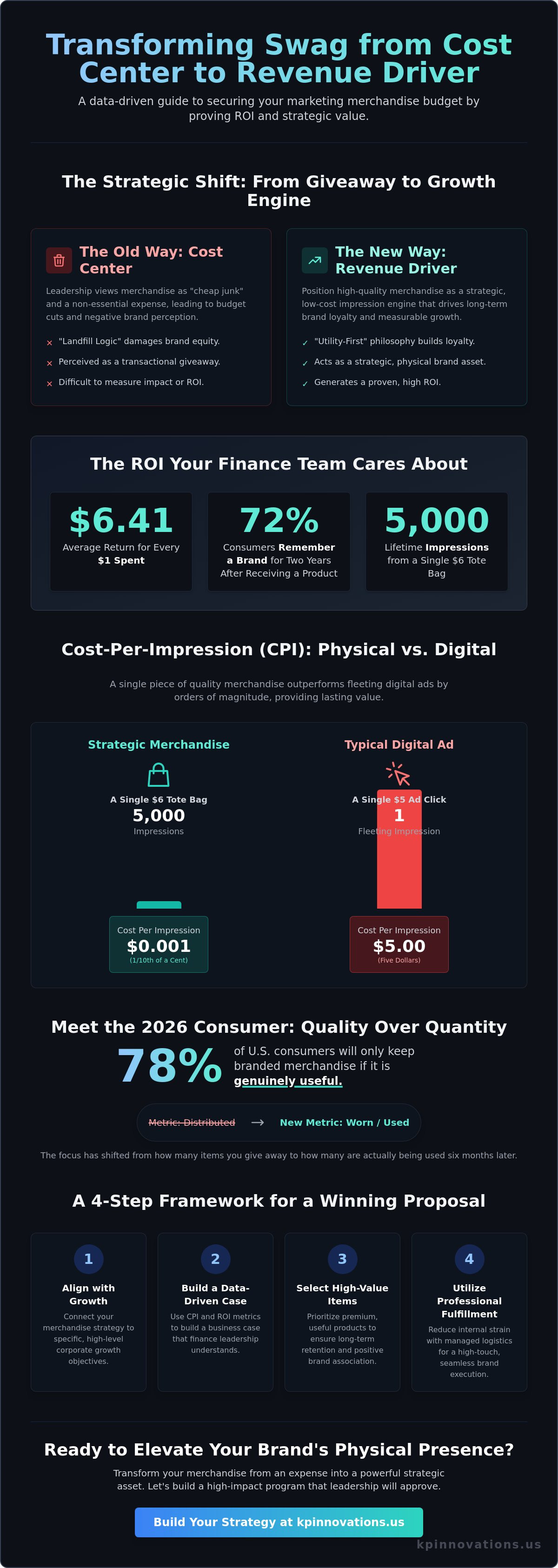
Did you know that 72% of consumers remember a brand that gave them a promotional product even two years after receiving it? While digital channels become increasingly saturated, physical brand assets offer a lasting impact that a $6 tote bag can turn into 5,000 lifetime impressions at a cost of just 1/10 of a cent each. You likely recognize the power of these tangible connections; however, getting buy-in for marketing swag budget often feels like an uphill battle against perceptions of “cheap junk” and non-essential spending. It’s difficult to defend a budget when leadership views merchandise as a cost center rather than a strategic revenue driver.
This guide will empower you to master the art of persuading leadership to invest in high-impact brand merchandise by speaking the language of ROI and strategic growth. We’ll show you how to align marketing, sales, and finance around a sophisticated strategy that prioritizes quality over quantity. You’ll learn to navigate 2026 regulatory shifts like IEC 62368-1 safety standards and the July USPS price changes while proving a potential return of $6.41 for every dollar spent. It’s time to transform your physical touchpoints into strategic assets! This article provides a clear roadmap to secure an approved budget for premium custom apparel, awards, and fulfillment services that elevate your brand’s market position.
Key Takeaways
- Transition from transactional giveaways to the 2026 “Merchandise Maturity Model” to elevate your brand’s physical presence and strategic impact.
- Master the Cost-Per-Impression (CPI) model to build a data-driven business case for getting buy-in for marketing swag budget from your finance leadership.
- Leverage the “Psychology of Ownership” to select high-value, premium items that ensure long-term retention and eliminate the perception of waste.
- Apply a structured 4-step framework to align your custom apparel and promotional products with specific, high-level corporate growth objectives.
- Reduce internal administrative strain by utilizing professional fulfillment and logistics services designed for high-touch, managed brand execution.
The Shift from “Giveaways” to Strategic Brand Assets
The era of “trinkets and trash” has officially ended. In 2026, the most successful brands have moved past the transactional nature of buying logos on cheap plastic. They’ve embraced a sophisticated approach where every physical item serves as a deliberate touchpoint in a multi-channel brand strategy. This transition is best defined by the Merchandise Maturity Model. This framework helps marketing leaders move from being a simple “buyer” of products to a “strategic partner” who manages brand assets. When you’re getting buy-in for marketing swag budget, you aren’t just asking for money to buy pens; you’re proposing an investment in a physical impression engine that drives long-term loyalty.
The traditional concept of promotional merchandise has evolved into a category of strategic private label apparel and precision-engineered goods. High-quality merchandise functions as a silent brand ambassador. It lives in your client’s home or office for years, generating thousands of impressions at a fraction of the cost of digital search ads. By shifting your focus from “disposable promo” to premium, durable assets, you ensure that your brand remains visible and respected in an increasingly cluttered digital world.
Why the “Landfill Logic” is Killing Your Brand
Distributing low-quality items is a high-risk gamble with your brand equity. If a branded charger fails or a shirt loses its shape after one wash, that failure is immediately associated with your company’s service standards. This “landfill logic” creates a negative feedback loop where “cheap” items signal a “cheap” brand. To counter this, forward-thinking organizations adopt a “Utility-First” philosophy. They prioritize products that solve a problem or enhance a lifestyle. This ensures your investment stays on a desk or in a wardrobe rather than in a trash bin. It’s a strategic move that protects both the environment and your reputation.
The 2026 Consumer: Why Quality Matters More Than Ever
The modern workforce, dominated by Gen Z and Millennials, has high expectations for corporate gifts. They value transparency, sustainability, and genuine utility. Research shows that 78% of U.S. consumers only keep branded merchandise when it’s genuinely useful. This shift has replaced the “Distributed” metric with the “Worn/Used” metric. It’s no longer about how many items you gave away; it’s about how many items are actually being used six months later. Strategic swag is the physical manifestation of your brand’s core values, designed to occupy a permanent space in your customer’s daily life. This focus on longevity is essential for getting buy-in for marketing swag budget from a leadership team that demands measurable impact and waste reduction.
Building the Business Case: ROI Metrics That Finance Actually Cares About
Securing approval for your marketing spend requires a shift from emotional appeals to hard data. Finance directors rarely find value in the “cool factor” of a product. They prioritize the ROI of promotional products based on measurable business outcomes. When getting buy-in for marketing swag budget, you must present high-quality merchandise as a low-cost impression engine that aligns with the company’s fiscal goals. Research indicates that promotional products can generate an average ROI of $6.41 for every dollar spent, a figure that demands attention in any budget meeting.
Digital advertising costs continue to climb while consumer attention spans shrink. A $5 digital ad click provides a fleeting moment of engagement that often fails to convert. In contrast, a $30 high-quality hoodie acts as a mobile billboard for years. This longevity creates a cumulative brand presence that digital banners cannot match. Physical assets occupy permanent real estate in a customer’s daily routine, building “Liking” and “Reciprocity.” These psychological triggers are proven to accelerate the sales cycle by establishing trust before a sales representative even makes the first call.
Calculating Cost-Per-Impression (CPI) for Physical Goods
The formula for physical goods is straightforward: (Total Cost / Estimated Uses) / Impressions Per Use. Consider a premium tumbler as a case study. Over a three-year lifespan, a high-utility drinkware item can generate over 1,000 impressions. While a social media post disappears from a feed in hours, a durable tumbler remains on a desk or in a car, providing consistent visibility. This makes the cost-per-impression significantly lower than almost any digital alternative. You aren’t just buying a cup; you’re buying years of targeted brand exposure.
Merchandise as a Tool for Employee Lifetime Value (ELTV)
The business case for promotional products extends deep into internal operations. High-quality merchandise is an essential tool for increasing Employee Lifetime Value (ELTV). The cost of employee turnover is a major pain point for finance teams. Investing in premium onboarding kits or “Private Label Apparel” fosters a sense of belonging and professional pride from day one. This internal alignment reduces turnover and strengthens recruitment efforts. When employees feel valued through high-tier awards and recognition items, they become active brand advocates. If you’re ready to build a data-backed proposal, strategic merchandise planning can help you quantify these results for your leadership team.
Overcoming the “Swag is Waste” Objection
Leadership often views branded merchandise as a direct line to the landfill. This skepticism is understandable when budgets are spent on disposable plastic that fails within weeks. However, the “waste” isn’t the category; it’s the execution. To succeed in getting buy-in for marketing swag budget, you must demonstrate a commitment to functional, sustainable sourcing. Statistics show that 81% of consumers will keep a promotional product they find useful. This proves that utility is your primary defense against waste. When you prioritize high-tier items, you aren’t just buying products; you’re investing in long-term brand equity.
High-quality items trigger the “Psychology of Ownership.” When someone receives a premium, durable product, they assign it a higher perceived value and are less likely to part with it. This leads to retention rates that span years rather than days. By pivoting toward items that people actually want to use, you eliminate the landfill objection and replace it with a long-term brand asset. Understanding how to get your marketing budget approved involves showing that every dollar spent has a specific, waste-free purpose. White-glove project management ensures that every item in your proposal is vetted for quality and brand alignment before it ever reaches a recipient.
Quality vs. Quantity: The New Budget Paradigm
Spending your budget on 100 premium items creates more impact than 1,000 cheap ones. Scarcity and quality drive higher brand engagement because the item feels like a reward rather than a generic giveaway. This strategy requires choosing the right apparel factory to ensure that your custom apparel meets retail-grade standards. Premium goods are simply less likely to be discarded, ensuring your brand message persists in the user’s daily life.
The Logistics of Waste Reduction
Inventory waste is a silent budget killer that frustrates finance teams. Online Company Stores solve this by allowing for on-demand ordering or controlled distribution, which prevents the “closet full of boxes” syndrome. Our Fulfillment & Logistics services provide targeted distribution, ensuring products reach the right hands at the right time. Additionally, on-demand production methods allow for deeper customization without the need for massive, wasteful stock piles. This level of precision is vital when getting buy-in for marketing swag budget because it proves you’re managing resources with a sophisticated, data-driven approach.
The 4-Step Framework for a Winning Swag Proposal
Securing executive approval requires more than a list of products; it demands a structured business case. Most marketing managers struggle because they present merchandise as an isolated cost rather than a core component of the revenue engine. To succeed in getting buy-in for marketing swag budget, you must demonstrate how physical assets directly support your 2026 business objectives. This 4-step framework transforms your request into a strategic roadmap that leadership will respect and approve.
- Step 1: Audit and Align. Map your merchandise needs to specific Q1-Q4 business goals. Whether you are targeting lead generation at trade shows or customer retention milestones, every item must serve a documented purpose.
- Step 2: The “Tiers of Impact” Model. Segment your recipients into tiers to maximize ROI. High-value prospects deserve premium items, while general event attendees receive cost-effective, high-utility products that drive brand reach.
- Step 3: The Proof of Concept. Use data from small-scale Online Company Stores to demonstrate demand and track engagement metrics. Showing real-world usage data makes the case for scaling much stronger.
- Step 4: The Fulfillment Roadmap. Provide a detailed plan for managed, low-stress execution. Proving you have considered every logistical hurdle ensures leadership that the budget will be used efficiently.
Step 1 & 2: Mapping Merchandise to the Funnel
Your proposal should clearly distinguish between top-of-funnel (TOFU) and bottom-of-funnel (BOFU) strategies. For large-scale events, focus on low-cost, high-impression items that maximize brand visibility. For high-value account-based marketing (ABM) campaigns, invest in premium “Private Label Apparel” that reflects the status of your target clients. Strategic branded merchandise serves as a sophisticated bottom-of-funnel conversion tool that bridges the gap between digital interest and a signed contract.
Step 3 & 4: Demonstrating Operational Excellence
Executive anxiety often stems from the fear of unmanaged logistics and hidden costs. Presenting a “white-glove” project management plan immediately reduces this tension by showing that every detail, from manufacturing to delivery, is handled by experts. In a globalized economy, highlighting global fulfillment and logistics capabilities is essential for supporting a remote or international workforce. Pitch an Online Company Store as a self-sustaining ecosystem that automates ordering, prevents inventory waste, and provides real-time data to justify your spend. If you are ready to build your business case, start your strategic swag proposal here to ensure a managed, high-impact execution.
Partnering for Success: How KP Innovations Maximizes Your Impact
Securing the final signature on your proposal requires a partner that mirrors your company’s high ambitions. Average vendors focus on SKU numbers; we focus on your strategic growth. KP Innovations provides access to 1.2 million products, which allows for unparalleled precision in brand alignment. Our white-glove project management manages every granular detail to reduce your team’s workload. Based in Horsham, PA, we combine local expertise with a sophisticated global reach to ensure your brand’s impact isn’t limited by geography. We’re the partner that elevates merchandise from a simple giveaway to a strategic corporate asset.
Choosing a partner who understands the nuances of supply chain and inventory management is the final step in getting buy-in for marketing swag budget. When you present a plan backed by professional-grade logistics, you eliminate the operational anxieties that often stall budget approvals. We don’t just sell items; we provide a managed service that ensures your investment drives measurable results across every department.
Beyond the Logo: Custom Manufacturing and Design
Generic products often dilute brand identity. We distinguish ourselves through deep-level customization and manufacturing from the ground up. Instead of simply slapping a logo on a pre-made item, our design team collaborates with you to create unique, retail-quality goods. This is where your strategy for getting buy-in for marketing swag budget gains its strongest momentum. By offering custom apparel that feels like a private label brand, you provide a high-status experience for employees and clients alike. This level of quality ensures your physical touchpoints are respected and retained for years.
Seamless Fulfillment and Global Logistics
Logistical friction is a major reason why leadership denies budget requests. Our comprehensive fulfillment and logistics services eliminate these concerns. We manage the entire lifecycle of your promotional products, from warehousing to the recipient’s doorstep. This is especially critical for awards and recognition items where timing and presentation are paramount. Our technology platforms integrate directly with your internal systems, making budget tracking and inventory management transparent for your finance department. This transparency proves your spend is managed with professional rigor. Our Online Company Stores offer a streamlined, self-sustaining ecosystem that automates distribution while maintaining strict brand control. Ready to build your business case? Contact KP Innovations for a strategic consultation.
Securing Your Brand’s Physical Future
You now have the tools to move beyond transactional purchases and toward a high-impact brand strategy. By focusing on cost-per-impression and genuine utility, you transform merchandise into a measurable revenue driver that finance teams respect. Mastering the art of getting buy-in for marketing swag budget depends on your ability to prove long-term brand equity over short-term savings. You’ve learned that quality is the only true defense against waste.
Success in 2026 requires a partner that can execute this vision with professional precision. KP Innovations offers access to 1.2 million products and provides white-glove project management to ensure every detail is managed flawlessly. Our global fulfillment and logistics expertise ensures that your strategic assets reach their destination, regardless of your corporate structure’s complexity. We’re here to help you navigate the transition from vendor to strategic partner.
Elevate your brand with a strategic merchandise partner: Get a Quote today
You’re ready to present a proposal that wins. Let’s work together to turn your physical touchpoints into your brand’s most powerful growth engine. Your path to a streamlined, high-impact merchandise strategy starts now.
Frequently Asked Questions
How do I calculate the ROI of promotional products?
You calculate the ROI of promotional products by using the Cost-Per-Impression (CPI) model. Divide the total cost of the item by the estimated number of uses and the impressions generated per use. Research indicates that promotional products can deliver an average return of $6.41 for every dollar spent. This data-driven approach is essential for getting buy-in for marketing swag budget because it translates physical items into financial metrics that leadership understands.
What is the average marketing budget percentage for swag?
Average marketing budget allocations for branded merchandise vary by industry and growth stage. However, the U.S. promotional products industry generates over $24 billion in annual revenue, which demonstrates its significant role in modern brand strategies. Most successful organizations integrate these costs into their wider advertising or account-based marketing (ABM) budgets. You should align your spend with specific quarterly goals rather than viewing it as a standalone expense.
How can I convince my CFO that premium swag is better than cheap giveaways?
Convincing a CFO requires shifting the conversation from unit price to brand equity and longevity. Statistics show that 81% of consumers keep promotional products they find useful, whereas cheap giveaways often end up in landfills, creating a negative brand impression. High-quality items generate thousands of impressions over several years. Presenting a “Quality over Quantity” strategy is a sophisticated way of getting buy-in for marketing swag budget while reducing long-term waste.
What are the most effective promotional items for 2026?
The most effective items for 2026 include high-utility drinkware, sustainable tote bags, and premium custom apparel. Tech-integrated swag like wireless chargers and Bluetooth speakers remains popular, provided they meet current IEC 62368-1 safety standards. Consumers now prioritize sustainability and wellness-related products. Choosing items made from recycled materials or those that promote comfort ensures your brand remains relevant and appreciated in a competitive market.
How does an online company store help manage a marketing budget?
An online company store manages your budget by eliminating over-ordering and preventing dead stock. These platforms allow for on-demand production and controlled distribution, ensuring that products only ship when they are actually needed. This technology provides your finance department with transparent, real-time tracking of all expenditures. It transforms a complex logistics process into a streamlined, self-sustaining ecosystem that reduces internal administrative strain and inventory waste.
Can high-quality corporate gifts really improve employee retention?
High-quality corporate gifts and awards and recognition items significantly improve employee retention by fostering a sense of belonging. Premium onboarding kits signal that a company values its talent from day one, which increases Employee Lifetime Value (ELTV). When employees receive retail-quality apparel they actually want to wear, they become active brand advocates. This internal alignment reduces turnover costs and strengthens your company’s overall culture and recruitment efforts.
What is the difference between promotional products and private label apparel?
The primary difference lies in the level of customization and manufacturing. Standard promotional products are often off-the-shelf items with a logo applied to the surface. Private label apparel involves manufacturing from the ground up with deep-level customization, resulting in a retail-quality garment. This “Private Label” experience provides a higher status for your brand and ensures the product is used more frequently and kept longer by the recipient.