
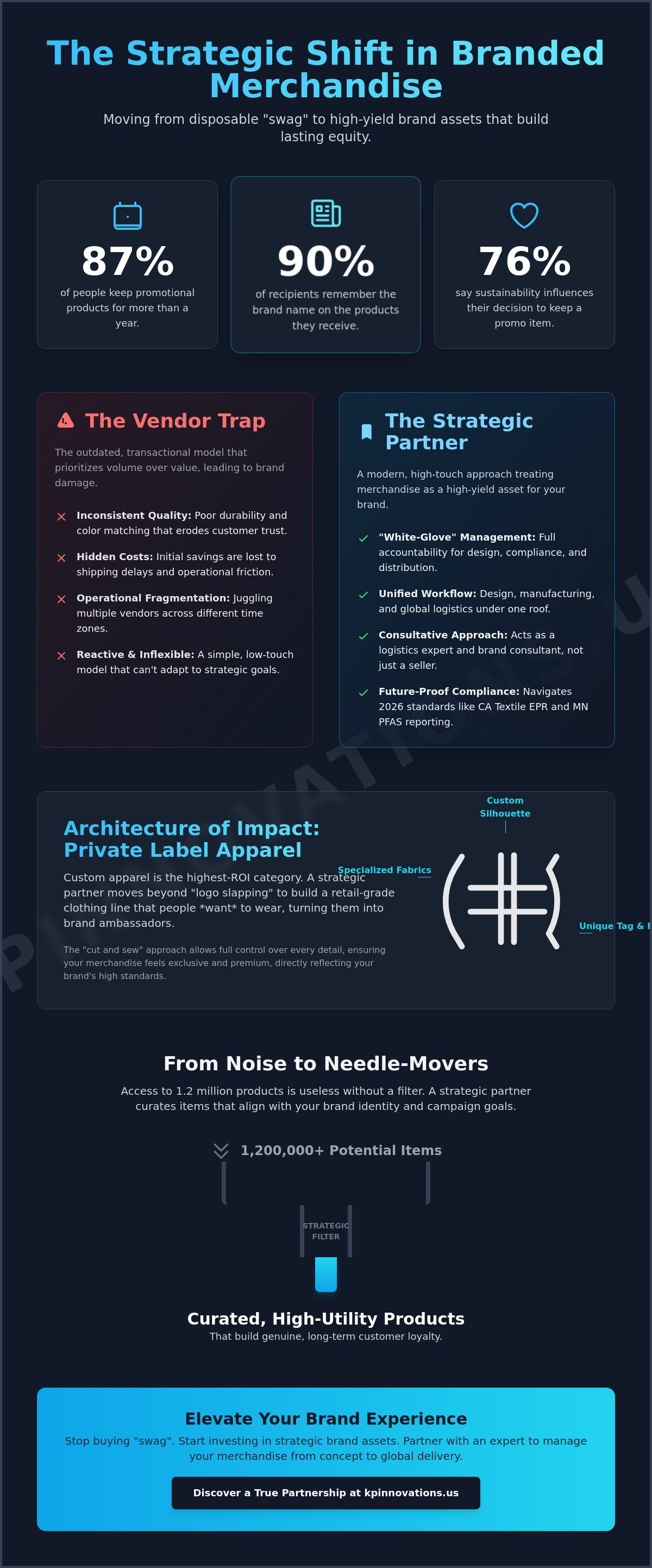
Did you know that 87% of people keep promotional products for more than a year, yet 76% say sustainability directly influences whether they keep an item or toss it? In a market where 90% of recipients remember your brand name, settling for subpar quality isn’t just a missed opportunity; it’s a risk to your reputation. You’ve likely felt the frustration of inconsistent product quality or the logistical headache of managing multiple vendors across different time zones. Finding a strategic merchandise partner for brands has become the critical difference between a cluttered warehouse and a powerful marketing engine.
You deserve a seamless experience that delivers high-quality custom apparel people actually want to wear. This guide will show you how to transition from transactional vending to a strategic partnership that treats branded merchandise as a high-yield asset for your brand equity. We’ll explore how to navigate new 2026 compliance standards, such as the California Textile EPR Program and the Minnesota PFAS reporting deadlines. You’ll learn how to achieve global distribution through white-glove fulfillment and logistics services that eliminate shipping nightmares for good.
Key Takeaways
- Shift from transactional vending to a high-touch model where your strategic merchandise partner for brands acts as a consultant and logistics expert.
- Prioritize high-ROI categories like custom apparel to transform physical items into high-yield assets that build long-term brand equity.
- Eliminate operational fragmentation by consolidating design, manufacturing, and global fulfillment and logistics services into one unified workflow.
- Apply a rigorous evaluation framework to audit production capabilities and identify vendor red flags before they impact your brand reputation.
- Discover how a “white-glove” management philosophy ensures precision at every stage, from initial product design to final global distribution.
Beyond the Logo: Defining the Strategic Merchandise Partner
Transactional vendors thrive on volume. Brands thrive on precision. For years, the industry has operated on a simple, reactive model: a brand needs a shirt, a vendor prints a logo, and a box arrives. In 2026, this model is obsolete. Choosing a strategic merchandise partner for brands is no longer just about buying stuff; it’s a move toward long-term asset management. A strategic partner operates as a consultant, a manufacturer, and a logistics expert all under one roof. They ensure that every physical item reinforces your brand’s market position rather than diluting it.
Physical touchpoints remain the most durable form of marketing because they exist in the real world. While digital ads vanish with a scroll, high-quality merchandise lingers on desks and in closets. A true strategic merchandise partner for brands doesn’t just fulfill orders; they engineer outcomes. They manage the “White-Glove” standard, which means taking full accountability for the design, compliance, and global distribution of your assets. This high-touch approach reduces client stress by managing the granular details that usually cause operational friction.
The Vendor Trap: Why Low-Cost Printing Fails Growing Brands
Low-cost vendors prioritize their own production efficiency over your brand alignment. They rely on rigid structures that demand high volume and offer zero flexibility. This often leads to the “Vendor Trap,” where the initial savings on a per-unit basis are quickly erased by hidden costs. You’ll likely face inconsistent colors, poor fabric durability, and shipping delays that miss critical campaign dates. “Cheap” merchandise is often the most expensive marketing mistake you can make. It erodes trust with your audience. If a shirt falls apart after one wash, that’s the message your customer receives about your brand’s quality. High-growth entities need partners who manufacture from the ground up, ensuring every stitch meets a premium standard.
The Strategic Shift: Merchandise as a Tactical Asset
The industry is moving away from generic “swag” toward curated brand experiences. Success in 2026 requires filtering through over 1.2 million potential items to find the handful that actually move the needle for your business. Promotional merchandise serves as a primary driver of brand recall, but only when the product is useful and well-designed. A strategic partner aligns product selection with your specific business goals, whether that’s increasing employee retention or driving customer referrals. By focusing on promotional products that offer high utility, you create a lasting bond with your audience. This shift transforms physical items from a line-item expense into a tactical asset that builds genuine, long-term customer loyalty.
The Architecture of Impact: Product Strategy and Private Label Apparel
Access to a database of 1.2 million products sounds impressive. However, without a rigorous filter, it’s just noise. A strategic merchandise partner for brands acts as that filter, identifying items that align with your specific identity and campaign goals. In 2026, the goal isn’t just to fill a box with items. It’s to select high-utility products that command attention and stay in the hands of your audience. High-growth brands understand that every item distributed is a physical representation of their standards.
Custom apparel remains the highest-ROI category for modern brand ambassadors. There’s a massive gulf between “putting a logo on a shirt” and building a legitimate clothing line. When your employees and customers feel like they’re wearing a retail-grade garment, they become walking billboards for your message. Working with a strategic merchandise partner for brands ensures that these garments are built to last and designed to be worn. This shift is backed by research into how supply chain partnerships and brand value create lasting market impressions through physical touchpoints.
Private Label Apparel: Designing from the Ground Up
Premium brand positioning requires more than off-the-shelf blanks. Private label manufacturing allows you to dictate every detail, from custom silhouettes and specialized fabrics to unique tag placement and hem details. This “cut and sew” approach ensures your merchandise feels exclusive rather than generic. Choosing the right apparel factory is the most critical step in this lifecycle. A partner manages this entire process, moving from initial design concepts to final production without sacrificing quality or ethical standards. If you’re ready to elevate your strategy, consider exploring how custom apparel can redefine your brand’s physical presence.
Curating the Catalog: Quality over Quantity
Effective curation means selecting products that people actually keep and use daily. Data from 2026 shows that 73% of consumers are more likely to do business with a brand that provides useful promotional items. Whether you’re selecting tech tools, premium drinkware, or awards and recognition items, consistency is key. Your partner ensures that the quality of a power bank matches the quality of your custom hoodies. This creates a unified brand experience across every category. By leveraging a massive product database with a strategic lens, you can find unique, trend-aligned items that stand out in a crowded market.
Solving the Fragmentation Crisis: Unified Fulfillment and Logistics
Managing five different vendors for a single campaign is an operational nightmare that actively erodes your return on investment. When one vendor handles custom apparel, another manages tech gadgets, and a third oversees warehousing, the risk of brand dilution skyrockets. This fragmentation creates a “hidden tax” on your time and budget. Communication breaks down. Shipping dates slip. Quality varies wildly between shipments. A strategic merchandise partner for brands eliminates this friction by unifying the entire lifecycle under one roof. In an era where 54.3% of industry distributors report rising freight expenses as a major challenge, consolidation isn’t just a convenience. It’s a financial necessity.
Unified logistics is the “secret sauce” that separates successful brand programs from logistical disasters. By integrating production with fulfillment and logistics services, you gain real-time visibility into your inventory. This data prevents the brand friction that occurs when items are out of stock or delayed during critical launch windows. You no longer have to play the middleman between a factory and a 3PL provider. Instead, you have a single source of truth that ensures your brand assets are ready for deployment the moment they’re needed.
The Unified Solution: One Partner, End-to-End Control
Simplifying the supply chain from manufacturing to the final mile requires a partner with deep infrastructure. A single point of contact reduces errors by ensuring that design specifications are communicated perfectly to the production floor and the warehouse team. This integrated approach offers several distinct advantages:
- Reduced Turnaround Times: Integrated warehousing allows for immediate picking and packing once production is complete.
- Superior Quality Control: On-site inspections happen before items are shelved, not after they reach the customer.
- Operational Efficiency: On-demand distribution through online company stores allows employees to order what they need without bloating your inventory.
Global Scalability for Nationwide Brands
Scaling a brand program from a local event to a nationwide initiative involves navigating complex shipping lanes and customs regulations. A strategic merchandise partner for brands protects your consistency across borders. Whether a package is landing at a headquarters in Horsham, PA, or being delivered to a remote team member across the globe, the experience must be identical. High-tier partners manage the intricacies of international logistics so you don’t have to. They ensure that your awards and recognition items arrive on time and in pristine condition, regardless of the destination. This level of global scalability allows your brand to grow without the fear of a logistical nightmare stalling your momentum.
Evaluating Your Options: A Framework for Selecting the Right Partner
Selecting a strategic merchandise partner for brands requires a shift in perspective. You aren’t just vetting a supplier; you’re auditing a critical extension of your marketing and operations team. Simple screen printing is no longer the benchmark for excellence. In 2026, you must evaluate a partner’s ability to execute fully custom manufacturing and manage complex global distribution. Red flags often hide in the margins, such as a lack of dedicated project management or opaque quality control processes. If a partner can’t provide a single point of contact who understands your brand’s specific aesthetic and strategic goals, they’re likely a transactional vendor in disguise.
Modern brand equity depends on precision. A partner should offer sophisticated technical infrastructure, including seamless eCommerce portals and API integrations that connect with your existing workflows. This ensures that your brand assets aren’t just sitting in a warehouse but are actively working for you. Prioritizing partners with dedicated support roles ensures that your high-level strategy isn’t lost in the shuffle of daily production. You need an advocate who understands the difference between a simple giveaway and a strategic brand asset.
The 5 Critical Questions for Every Potential Partner
Before signing a contract, you must look beneath the surface of a polished pitch. Use these questions to determine if a vendor can truly operate as a strategic merchandise partner for brands:
- Can you handle fully custom manufacturing? Distinguish between those who only decorate catalog items and those who can build products from the ground up.
- What does your fulfillment and warehousing infrastructure look like? Verify that they own the process rather than outsourcing it to a third party.
- How do you handle quality control for large-scale global orders? Ask for specific procedural steps taken before an item is shipped.
- Do you provide a dedicated project manager? Ensure you have a high-touch advocate who manages every detail of your account.
- How do your systems integrate with our current technology? Confirm they offer more than just manual order forms.
Technological Synergy: Portals and Ordering Systems
Manual order forms and fragmented email chains are relics of the past. Modern brands require streamlined, custom-built online company stores to manage their assets effectively. These portals allow your team to order promotional products and custom apparel on demand, reducing the burden on your internal staff. This automated approach ensures that your brand guidelines are followed every time, regardless of who is placing the order.
High-tier partners provide robust data reporting that helps you track ROI and inventory turnover in real time. This visibility allows you to make informed decisions about which products are resonating with your audience and which need to be phased out. By integrating these systems, you gain a clear picture of your merchandise spend and its impact on your overall brand growth. If you’re looking for a partner that combines manufacturing expertise with cutting-edge technology, contact KP Innovations to discuss your brand’s unique needs.
Elevating Your Brand Experience with KP Innovations
KP Innovations isn’t just a supplier. We’re the premier partner for brands that demand more than a simple catalog. Based in Horsham, PA, our team brings a level of precision and domestic oversight that transforms basic merchandise into a tangible brand experience. Top companies nationwide trust our Horsham-based expertise because they know we maintain centralized control over every project. This ensures that your brand’s vision isn’t lost in a fragmented supply chain. We manage every detail, from the initial sketch of a custom garment to the final mile of global distribution.
Our “White-Glove” promise means we take full ownership of the entire lifecycle. You won’t have to spend your day chasing down production updates or worrying about quality inconsistencies. We handle the design, manufacturing, and fulfillment and logistics services so your team can focus on high-level growth. This comprehensive approach ensures that every award, recognition item, and print material meets your exact standards every time. We believe that physical touchpoints should be high-yield assets, not operational burdens.
Custom Company & Team Stores: Streamlined Distribution
Managing gear for a growing workforce shouldn’t be a logistical nightmare. We build frictionless online company stores that allow your employees to order pre-approved branded merchandise on demand. This system eliminates the inventory headache by automating the ordering process and ensuring brand consistency across every department. Whether you’re outfitting a local team of 10 or a global workforce of 10,000, our portals scale with your ambitions. It’s the simplest way to manage team outfitting without bloating your internal workload. You gain complete control over your brand assets while providing a retail-grade shopping experience for your staff.
The KP Innovations Advantage: Strategy First
We combine the massive reach of a 1.2 million product database with the high-touch precision of a boutique agency. As a strategic merchandise partner for brands, we don’t just sell items; we engineer physical assets that drive loyalty. Our commitment to manufacturing “from the ground up” ensures that your private label apparel feels exclusive and retail-grade. We treat your brand with the respect it deserves, ensuring that every promotional product reflects your premium market position. Ready to start? Partner with KP Innovations for your next strategic project.
Future-Proofing Your Brand’s Physical Assets
The shift toward strategic merchandise management is no longer optional for brands aiming for market leadership in 2026. You’ve seen how fragmented vendor relationships create hidden costs and how private label apparel transforms simple clothing into a powerful brand ambassador. By consolidating your efforts, you eliminate the operational friction that stalls growth. Selecting a strategic merchandise partner for brands allows you to reclaim your time and focus on high-level strategy while experts manage the granular details of production and global logistics.
KP Innovations provides the infrastructure necessary to turn your vision into a tangible reality. With access to over 1.2 million customizable products and a specialized focus on private label apparel and automated company stores, we offer the precision of a boutique agency with global fulfillment capabilities. We’re ready to help you move beyond transactional vending to a high-touch partnership that treats every physical item as a strategic asset. Elevate your brand with a strategic merchandise partner; connect with KP Innovations today. Your brand’s physical legacy starts with a single, well-executed project. We look forward to building it with you.
Frequently Asked Questions
What is the difference between a merchandise vendor and a strategic partner?
A merchandise vendor focuses on single, transactional orders while a strategic merchandise partner for brands manages the entire lifecycle of your physical assets. Vendors are typically reactive and volume-driven. In contrast, a partner acts as a consultant that aligns product selection with your specific business objectives to ensure every item serves a tactical purpose.
How does a strategic merchandise partner help with brand consistency?
Consistency is maintained through centralized management of all design specifications and production standards across every product category. By using a single partner, you eliminate the color and quality variations that occur when using multiple suppliers. This high-touch oversight ensures that your custom apparel and promotional products look identical whether they land in a local office or at an international satellite branch.
Why is global fulfillment important for a national brand?
Global fulfillment ensures that every team member receives the same premium experience regardless of their location. National brands often struggle with shipping delays and customs issues that erode trust with employees and clients. A partner with robust fulfillment and logistics services manages these complexities, protecting your brand’s reputation by ensuring on-time, professional delivery across all borders.
Can a strategic partner help with custom private label apparel design?
A strategic partner manages the entire design-to-production lifecycle for private label clothing. This includes selecting custom fabrics, developing unique silhouettes, and overseeing specialized branding details like custom tags or hem labels. It’s the difference between printing on a generic blank and manufacturing a retail-grade garment from the ground up to match your brand’s aesthetic.
What are the benefits of setting up an online company store?
Online company stores create a frictionless ordering environment for your employees and stakeholders. These portals simplify team outfitting for any size and manage pre-approved merchandise with zero inventory headaches for your internal staff. You gain real-time visibility into spend and usage without having to manage a physical warehouse or handle individual shipping requests yourself.
How do I calculate the ROI of a strategic merchandise program?
ROI is calculated by measuring brand recall, employee engagement, and inventory efficiency. Industry data shows that 90% of recipients remember the brand on a quality promotional product. By tracking how these items drive customer loyalty and reduce employee turnover, you can quantify the long-term value of your merchandise investment compared to traditional digital advertising spend.
What should I look for in a merchandise partner’s project management style?
You should look for a high-touch, proactive style that prioritizes a dedicated support role for your account. A partner should provide a single point of contact who understands your brand’s unique needs and manages every detail from concept to final delivery. This reduces your operational stress and ensures that your strategic goals are met without the need for constant client-side follow-up.