
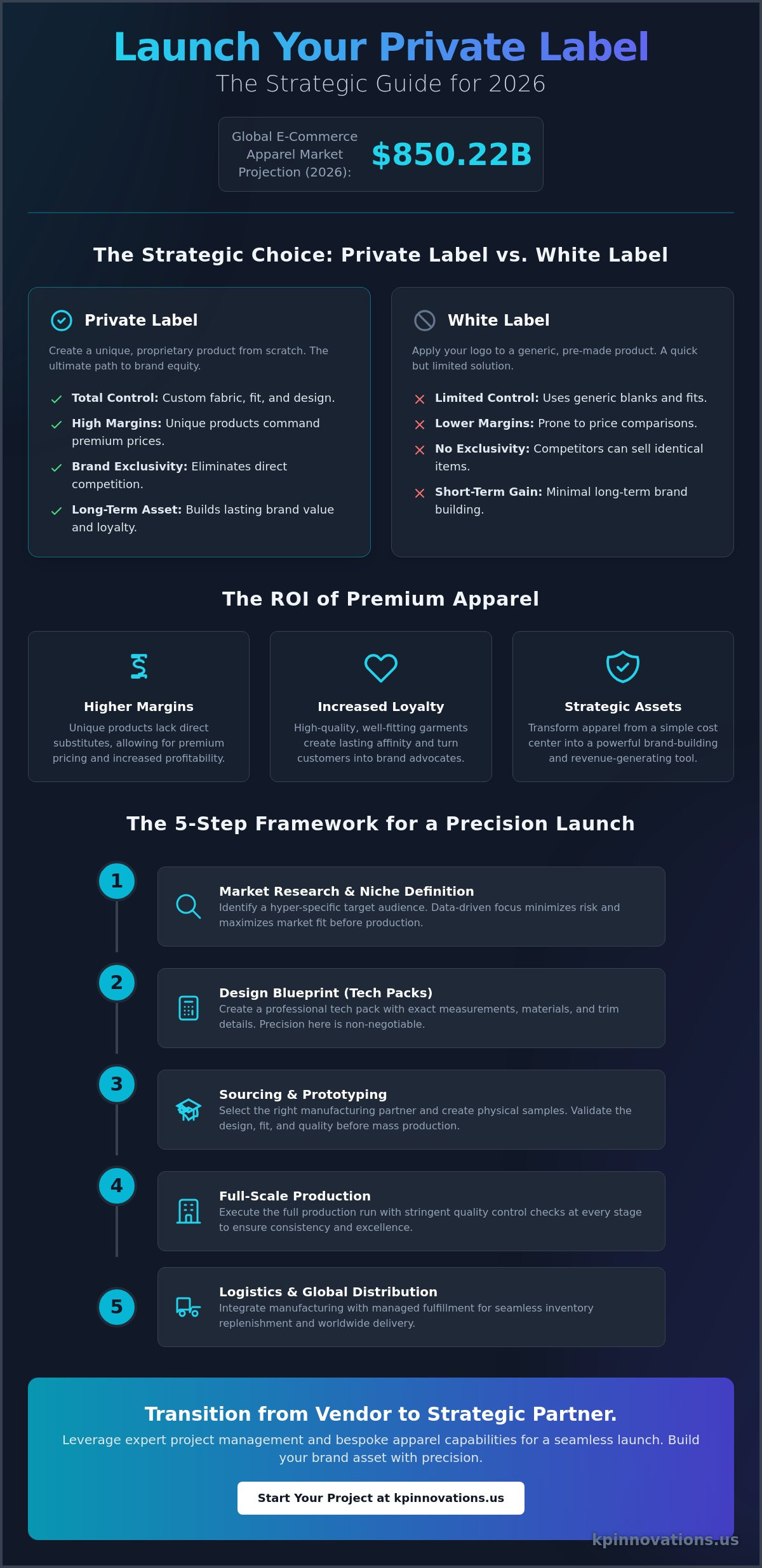
With the global e-commerce apparel market projected to reach $850.22 billion in 2026, the real question isn’t whether you should sell clothing, but whether your brand is distinct enough to survive the competition. You’ve likely realized that slapping a logo on a generic blank isn’t enough to build a lasting legacy. You’re ready to move beyond basic printing and take full control of your designs, quality, and supply chain. Learning how to start a private label clothing line is the strategic shift that turns a simple product into a high-status asset.
It’s natural to feel overwhelmed by the complexity of manufacturing logistics or the fear that poor production quality might damage your reputation. We understand these pressures and believe that your ambition deserves a sophisticated, managed approach. This 2026 strategic guide promises to master your transition from off-the-shelf apparel to a fully custom brand. We’ll preview the essential roadmap for the year ahead, including navigating the latest 10% Section 122 tariffs, developing professional tech packs, and establishing scalable logistics for global distribution. By the end of this article, you’ll have the clarity to build a unique line that elevates your brand status and operates with precision.
Key Takeaways
- Elevate your brand by shifting from generic promotional items to retail-quality merchandise that commands attention and loyalty.
- Discover how to start a private label clothing line using a strategic 5-step framework that prioritizes precise tech pack development and market research.
- Master various levels of customization; choose between high-precision embroidery or advanced branding elements like custom woven labels and unique hem tags.
- Streamline your operations by integrating manufacturing with managed fulfillment and global logistics to ensure seamless inventory replenishment.
- Transition from a simple vendor relationship to a strategic partnership that leverages expert project management and bespoke apparel capabilities.
What is Private Label Clothing and Why Your Brand Needs It in 2026?
In a market saturated with generic commodities, true brand ownership begins with deep customization. To understand What is Private Label Clothing, one must look beyond simple logos. It is the process of custom manufacturing apparel tailored to your specific brand identity; it involves controlling everything from the weight of the fabric to the specific silhouette of the garment. In 2026, the global e-commerce apparel market is projected to reach $850.22 billion. Learning how to start a private label clothing line is no longer just for fashion startups; it’s a necessity for corporate entities wanting to turn their apparel into high-value assets that capture a share of this growth.
Exclusivity is your greatest competitive advantage. When you offer a product that cannot be found anywhere else, you eliminate direct price comparisons and elevate your brand’s perceived value. Understanding how to start a private label clothing line allows you to build a moat around your business. You aren’t just selling a shirt; you’re selling a proprietary fit and a curated experience that aligns with your professional standards. This shift from ‘disposable swag’ to ‘retail-quality merchandise’ ensures that your brand remains relevant in a marketplace that increasingly values quality over quantity.
Private Label vs. White Label: Making the Strategic Choice
The choice between these two models defines your brand’s trajectory. White label products are pre-made items where you simply add your logo. While this is fast, it’s often generic and easily replicated by competitors. Private label involves custom designs, unique fabrics, and specialized fits. If your goal is long-term brand equity, the private label model provides the uniqueness required to stand out. It’s the difference between being a simple vendor and being a strategic partner that sets industry standards.
The ROI of Premium Private Label Apparel
Investing in higher-quality private label apparel yields significant returns through brand differentiation and perceived excellence. Strategic apparel choices lead to specific business outcomes:
- Higher Margins: Unique products command premium pricing because they lack direct, off-the-shelf substitutes.
- Increased Loyalty: High-quality garments stay in a customer’s or employee’s wardrobe longer, creating lasting affinity.
- Strategic Assets: You turn a traditional cost center into a profit-generating or brand-building powerhouse.
By focusing on retail-grade quality, you ensure your investment doesn’t end up in a landfill. Instead, it becomes a visible, high-status representation of your company’s commitment to precision and growth.
The 5-Step Framework for Launching Your Private Label Line
Building a premium brand requires more than vision; it demands a structured methodology. Understanding how to start a private label clothing line involves a transition from creative ideation to rigorous project management. This five-phase framework ensures your brand moves from concept to global distribution with precision and scale. It begins with market research and niche definition. In 2026, successful brands are increasingly targeting hyper-specific segments, such as sustainable activewear for postpartum runners, rather than broad categories. This data-driven focus allows for more targeted product development before you ever invest in inventory.
Once your niche is defined, you move through design, sourcing, and prototyping before hitting full-scale production. Each step is designed to mitigate risk and ensure the final product reflects the high-tier status of your brand identity. Treating your apparel line as a strategic asset rather than a simple commodity is what separates market leaders from average vendors.
Building Your Design Blueprint (Tech Packs)
A tech pack is the essential blueprint of your garment. A professional tech pack must include exact measurements, material specifications, and detailed trim instructions. Precision at this stage is non-negotiable. Even a minor discrepancy in a seam allowance can lead to significant financial loss in wasted inventory. When you are choosing the right apparel factory, providing a comprehensive tech pack establishes your brand as a sophisticated partner. It ensures that the manufacturer understands your exact requirements, reducing the need for multiple costly revisions.
The Sourcing and Prototyping Phase
Phases 3 and 4 involve sourcing the right manufacturing partner and perfecting your prototypes. You must weigh the benefits of domestic production against overseas manufacturing. Domestic options often provide faster lead times and the premium ‘Made in USA’ status, which can justify higher retail margins. However, Navigating Logistics in the 2026 environment requires accounting for the 10% Section 122 reciprocal tariff and potential Section 301 duties on specific regions. Balancing these costs with production quality is a critical strategic decision.
Never skip the ‘Golden Sample.’ This is the final physical prototype that serves as the quality benchmark for your entire production run. It’s your last chance to verify fit, fabric feel, and branding placement. Once this sample is approved, you enter Phase 5: Full-Scale Production and Launch. This stage requires a robust fulfillment and logistics strategy to handle the projected growth of the $163.82 billion U.S. e-commerce apparel market. By following this structured approach, you turn a complex manufacturing process into a streamlined, scalable business asset.
Levels of Customization: From Screen Printing to Cut and Sew
Choosing the right level of customization is a strategic decision that dictates your brand’s market position. Precision matters. While many vendors offer basic logo placement, understanding how to start a private label clothing line requires a deeper knowledge of manufacturing tiers. You can begin with standard decoration, such as high-quality screen printing or precision embroidery on premium blanks. However, to truly separate your brand from generic competitors, you must incorporate advanced branding elements. Custom woven labels, printed neck tags, and unique hem tags signal to your audience that every detail has been meticulously managed. These small touches turn a simple garment into a professional, retail-ready product.
For brands aiming for a luxury or high-performance status, premium customization is essential. This includes custom fabric dyeing to match your specific brand palette, bespoke zippers, and branded hardware. These details transform a simple garment into a proprietary asset. The ultimate level of brand ownership is full cut and sew manufacturing, which provides absolute control over the garment’s silhouette and construction. By moving beyond off-the-shelf limitations, you ensure your apparel is as unique as your brand identity.
When to Choose Cut and Sew Manufacturing
True innovation often requires building from the ground up. We define cut and sew as the process of manufacturing a garment from raw fabric rather than modifying a pre-made blank. This model is ideal for brands that require unique fits or specialized paneling that off-the-shelf options cannot provide. While this path involves higher minimum order quantities (MOQs) and longer lead times, the result is a completely unique product. It allows you to dictate every measurement and seam, ensuring your apparel meets the exact performance or aesthetic needs of your niche.
Elevating Basics with Premium Finishing
You don’t always need to reinvent the silhouette to create a premium experience. Strategic finishing can elevate high-quality blanks into boutique-level merchandise. In 2026, trends favor specialized embroidery techniques like 3D puff and chenille to add tactile depth to designs. Custom packaging and bespoke hangtags further enhance the unboxing experience, reinforcing the high-status nature of your brand. Using custom trims and unique finishes allows you to signal premium quality without the complexity of full-scale manufacturing, providing a scalable way to grow your private label line.
Navigating Logistics: Fulfillment and Global Distribution
Designing a high-status garment is a significant achievement, but it’s only half the battle. The most substantial challenge in learning how to start a private label clothing line is managing the physical inventory once it leaves the factory. Many founders focus exclusively on the creative phase, only to be overwhelmed by the complexity of storage and distribution. High-tier brands treat logistics as a strategic asset. By integrating manufacturing with professional warehousing, you create a seamless replenishment cycle that prevents stockouts and ensures your brand is always available to your audience. This level of coordination is what separates a professional apparel line from a hobbyist project.
Global fulfillment requires a level of precision that manual spreadsheets cannot provide. In 2026, your brand must be capable of shipping to international offices or global customers without friction. This demands specialized software that tracks every SKU from the moment it’s cut and sewn to the moment it reaches the end-user. When your production and logistics are synchronized, you gain the agility to respond to market shifts in real-time. This visibility turns your supply chain into a competitive advantage, allowing you to focus on growth rather than troubleshooting delayed shipments.
Warehousing and Inventory Management
The “just-in-time” manufacturing model is shifting toward “strategic stockpiling.” In an era of unpredictable supply chain variables, maintaining a controlled inventory buffer is the hallmark of a reliable brand. Managing multiple SKUs across various sizes, colors, and styles is a logistical puzzle that requires expert oversight. Partnering with a provider that handles both your production and storage eliminates the communication gaps that often lead to inventory errors. This unified approach is a critical component of how to start a private label clothing line that scales globally. It ensures that your high-quality apparel is stored in a secure, climate-controlled environment, ready for immediate dispatch.
Implementing Company and Team Stores
For corporate entities and growing franchises, the ordering process must be centralized. Online company stores provide a streamlined platform for employees and partners to access pre-approved branded merchandise. These digital storefronts remove the administrative burden from your internal team by automating the fulfillment process. Every order is picked, packed, and shipped with the same level of care that went into the garment’s design. By automating these touchpoints, you can focus on high-level brand strategy rather than the minutiae of shipping labels. If you’re ready to scale your distribution with professional precision, explore our fulfillment and logistics services to secure your brand’s future.
Partnering for Success: The KP Innovations Approach to Private Label
When researching how to start a private label clothing line, many corporate leaders find that standard suppliers lack the necessary sophistication for high-tier brand building. Most guides focus on small scale entrepreneurs, leaving a gap for organizations that require professional grade strategy and execution. At KP Innovations, we move beyond the role of a simple vendor to become your strategic manufacturing partner. We understand that your apparel is a physical extension of your brand’s reputation. Our approach ensures that every garment produced is a high-status asset that reflects your commitment to excellence and precision.
Our capabilities extend far beyond basic sourcing. We provide access to over 1.2 million products alongside bespoke apparel capabilities that allow for deep level customization. This isn’t about generic promotional products that end up forgotten. We focus on creating retail-quality merchandise that your audience actually wants to wear. From the initial sketch to the final global delivery, our white-glove project management ensures that your vision is realized without the logistical friction typically associated with custom manufacturing.
Our Managed Process for Premium Brands
Success in the private label sector requires meticulous attention to detail. Our managed process includes dedicated support roles that oversee every phase of your production. We specialize in ground-up manufacturing, which provides a level of quality and control that standard off-the-shelf suppliers simply cannot match. By maintaining comprehensive supply chain control, we significantly reduce client stress. You can trust that your brand standards are being upheld at every stitch, allowing you to focus on high-level growth while we handle the complexities of the factory floor.
Launch Your Private Label Line Today
The transition from a simple vendor relationship to a strategic partnership is the most critical step in learning how to start a private label clothing line. You need a partner who understands your brand’s ambitions and has the infrastructure to support global scaling. Whether you’re looking to create a boutique employee collection or a high-performance team store, the right foundation is essential. We invite you to move beyond the limitations of average merchandise and embrace a strategy-first approach to apparel. Ready to elevate your brand? Get a custom quote for your private label line and let’s begin building your legacy.
Transform Your Brand Identity Into a Strategic Asset
Building a legacy in the 2026 apparel market requires more than a logo; it demands a commitment to retail-grade quality and logistical precision. By mastering the levels of customization, from advanced branding to full cut and sew manufacturing, you elevate your products from simple merchandise to high-status brand assets. You’ve now seen the essential framework for how to start a private label clothing line, from the importance of precise tech packs to the necessity of integrated global fulfillment.
Success depends on choosing a partner that operates with the same level of ambition as your brand. KP Innovations provides white-glove project management from our headquarters in Horsham, PA, ensuring every detail of your production is handled with professional care. With access to over 1.2 million premium products and the support of our global fulfillment and logistics experts, we manage the complexities so you can focus on brand strategy. We’re ready to help you move beyond the ordinary and build something truly unique.
Elevate your brand with a custom private label clothing line from KP Innovations
Frequently Asked Questions
What is the minimum order quantity (MOQ) for a private label clothing line?
Minimum order quantities depend on your chosen production method and level of customization. Standard decoration on premium blanks often allows for lower MOQs, while full cut and sew manufacturing typically requires higher minimums to justify custom fabric runs. We recommend starting with a strategic partner who can scale these quantities as your brand grows. This flexibility allows you to test market segments without overcommitting to inventory.
How much does it cost to start a private label apparel brand in 2026?
The initial investment for learning how to start a private label clothing line varies significantly based on your scale and customization depth. General industry estimates for 2026 suggest entry costs between $2,000 and $50,000. These figures account for design, sampling, and the 10% Section 122 reciprocal tariff on imported apparel. Your total cost will reflect the premium position of your brand and the complexity of your designs.
How do I find a reliable clothing manufacturer in the USA?
Finding a reliable USA manufacturer requires vetting partners for their project management capabilities and domestic infrastructure. “Made in USA” products often justify a price markup of up to 50% because consumers perceive them as having higher quality and ethical standards. Look for firms with established facilities that offer white-glove service to ensure your brand standards are met with precision. A domestic partner reduces lead times and simplifies communication.
What is the difference between private label and custom manufacturing?
Private label refers to the business model of selling products made by a third party under your own brand identity. Custom manufacturing, specifically cut and sew, is the highest level of this model where you control the garment from raw fabric. Both allow for brand ownership, but custom manufacturing offers the most silhouette control. Private label can also include modifying high-quality existing blanks with custom labels and trims.
How long does the production process take for a private label line?
Production timelines in the 2026 supply chain usually range from 4 to 12 weeks after sample approval. A common industry rule is to add at least 30% to any manufacturer’s initial estimate to account for unforeseen logistics variables. This buffer ensures you can manage your launch strategy without the stress of unexpected delays. Timely production relies on having finalized designs and approved samples before bulk manufacturing begins.
Can I use private label for corporate employee uniforms?
Private label apparel is an excellent solution for corporate employee uniforms because it elevates standard workwear to retail-quality merchandise. This strategic shift increases employee loyalty and ensures your team represents your brand with high-status apparel. It turns a necessary expense into a brand-building asset. Customizing uniforms with private labels and unique trims provides a level of professional consistency that off-the-shelf options cannot match.
What documents do I need to provide to a manufacturer (Tech Packs)?
You must provide a detailed tech pack, which serves as the technical blueprint for your garment. This document includes sketches, material specifications, exact measurements, and construction details. Precision at this stage is critical for avoiding expensive errors during the full production run. It establishes a clear quality benchmark for your manufacturing partner and ensures the final product aligns perfectly with your brand’s vision and fit requirements.
How do I ensure quality control when manufacturing overseas?
Quality control for overseas manufacturing requires a non-negotiable sampling phase and managed oversight. You should always approve a “Golden Sample” before bulk production begins to verify fit and finish. Partnering with experts who understand the 2026 regulatory environment, including Section 301 tariff updates, ensures your quality remains consistent while navigating complex global logistics. This proactive management reduces the risk of receiving sub-standard inventory that reflects poorly on your brand.