
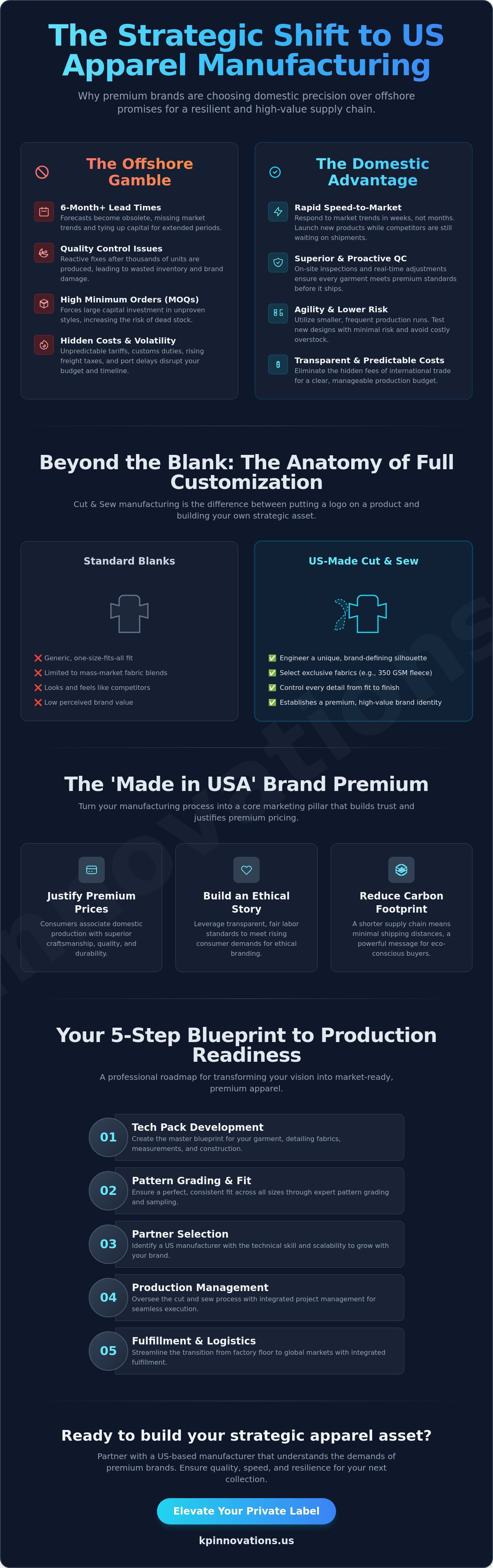
Why are the world’s most ambitious premium brands abandoning offshore “cost savings” for the precision of domestic manufacturing? When you invest in US-made private label apparel, you’re not just buying a garment; you’re securing a strategic asset. You’ve likely felt the sting of traditional offshore production. Quality control issues, six-month lead times, and the frustration of technical communication barriers can stall even the most promising collection. High minimum order quantities frequently tie up your capital in inventory that might not move, while rising freight carbon taxes add hidden costs to every shipment.
We understand that your brand demands more than just a vendor; you need a strategic partner. This guide shows you how to leverage domestic cut and sew manufacturing to ensure superior quality, faster turnaround times, and a resilient supply chain for your custom line. You’ll discover a roadmap for domestic production that increases your perceived brand value and gets you to market faster than your competitors. We’ll preview the 2026 regulatory landscape, including new PFAS restrictions in states like California and Minnesota, along with the impact of the latest Section 301 tariffs, to ensure your production remains compliant and competitive.
Key Takeaways
- Learn how domestic cut and sew production acts as a strategic logistical weapon to bypass global shipping volatility and enhance supply chain resilience.
- Discover the process of moving beyond standard blanks to create high-value US-made private label apparel with custom silhouettes and exclusive fabric weaves.
- Identify the specific technical criteria and scalability factors required to select a manufacturing partner capable of growing alongside your premium brand.
- Master the professional roadmap to production readiness, from developing precise tech packs to ensuring a perfect fit through expert pattern grading.
- Understand how integrated project management and fulfillment logistics can streamline your transition from the factory floor to international markets.
Why US-Based Cut and Sew Production is a Strategic Asset in 2026
In the global apparel industry, the choice between simple decoration and true manufacturing defines your brand’s ceiling. Cut and sew production involves creating garments from raw fabric rolls based on your specific patterns and specifications. It’s the opposite of printing on pre-made, off-the-shelf blanks. When you choose this path for your US-made private label apparel, you’re building a product from the ground up. This level of control is no longer a luxury; it’s a requirement for premium brands that refuse to compromise on fit, feel, and finish.
Domestic manufacturing provides a safety net against global shipping volatility and port delays that often plague offshore sourcing. Because your production floor is local, quality control becomes a proactive process rather than a reactive one. You can perform rigorous inspections on stitching, seam strength, and dye consistency at every stage. You make real-time production adjustments before a single unit leaves the facility. This proximity translates directly into speed-to-market. You’re able to implement just-in-time inventory strategies, allowing your brand to respond to shifting fashion trends in weeks rather than months.
The ‘Made in USA’ Brand Premium
By 2026, consumer psychology has shifted. Buyers increasingly associate domestic production with superior craftsmanship and lasting durability. They aren’t just looking for a label; they’re looking for a story of ethical labor and transparent practices. Using a local supply chain allows you to turn your manufacturing process into a core marketing pillar. High-tier brands use this visibility to justify premium price points and build deep trust with an audience that values local impact. Key marketing advantages include:
- Direct access to factory floor content for social proof and brand storytelling.
- Verification of fair labor standards to meet rising ethical branding demands.
- A significantly reduced carbon footprint due to minimal shipping distances.
Mitigating Risk with Domestic Agility
Agility is your best defense against market uncertainty. Domestic production allows for smaller, more frequent runs that significantly reduce your risk of carrying dead stock. You also eliminate the hidden costs often buried in offshore contracts, such as unpredictable tariffs, customs duties, and expensive long-distance freight. US-based cut and sew manufacturing serves as a decisive hedge against global logistical uncertainty and the rising costs of international trade. By keeping your US-made private label apparel production close to home, you maintain the flexibility to scale up or pivot based on real-time sales data rather than six-month-old forecasts.
The Anatomy of Full Custom Apparel: Beyond the Standard Blank
Building a premium brand requires moving away from the limitations of pre-made garments. When you develop US-made private label apparel through a true cut and sew process, you aren’t just adding a logo to a shirt. You’re engineering a unique silhouette that defines your brand’s specific fit and feel. This architectural approach allows you to dictate every measurement, from the drop of a shoulder to the precise taper of a waistline. It’s the difference between a product that looks like everyone else’s and one that feels like a strategic asset.
Fabric selection is where the tactile identity of your product is born. Off-the-shelf garments often use generic blends designed for mass appeal. In contrast, custom production lets you select weights and weaves that competitors can’t match. Whether it’s a 350 GSM heavy-weight fleece or a technical moisture-wicking jersey, the raw material is the foundation of your brand’s perceived value. Choosing the right fabric ensures your line stands up to the rigors of daily wear while maintaining its premium aesthetic.
Fabric Sourcing and Material Selection
Understanding the difference between knit and woven fabrics is fundamental to your design process. Knits offer the stretch and comfort required for activewear, while wovens provide the structure needed for high-end shirting or outerwear. While many brands utilize domestic textile mills to keep their entire footprint within the states, others choose to import specialized raw materials for US assembly to meet specific performance needs. According to recent U.S. apparel manufacturing statistics, the domestic sector continues to evolve, with a growing emphasis on high-tech and sustainable fiber integration. By 2026, premium lines are leaning heavily into organic cotton, recycled polyesters, and Tencel to meet both regulatory standards and consumer demand for longevity.
Advanced Construction Techniques
The precision of the initial cut determines the ultimate quality of the sew. Even the best seamstress can’t fix a poorly cut panel. Premium construction relies on specialized stitching like flatlock seams for skin-close comfort, overlock for clean internal edges, and coverstitch for professional hems. These aren’t just aesthetic choices; they’re durability requirements. Reinforced seams at high-stress points ensure your garments survive years of wear, not just a few wash cycles. If you’re ready to move beyond the basics, choosing the right apparel factory is the next critical step in your sourcing journey.
Finally, hardware and finishes provide the cohesive identity that signals luxury. Custom zippers, engraved buttons, and woven neck labels transform a piece of clothing into a branded experience. Every detail, down to the thread color, should be intentional. To begin developing your own signature line, you can explore specialized custom apparel services that manage these complex details for you.
Navigating the US Manufacturing Landscape: Evaluation Criteria
Finding the right partner for your US-made private label apparel requires a methodical evaluation that goes beyond simple price per unit. A factory is more than a vendor; it’s the physical engine of your brand’s reputation. You must assess capacity and scalability from the outset. A studio that excels at a 50-piece boutique run may lack the infrastructure to handle a 5,000-piece seasonal rollout. Your strategic goal is to identify a partner that offers the agility of small-batch production while maintaining the technical headroom to scale as your market share grows.
Technical expertise is equally non-negotiable. You shouldn’t send high-performance activewear to a facility specialized in heavy denim. Every factory has a unique machine list. You need to verify they possess the specific equipment, such as flatlock or seam-sealing machines, required for your garment’s blueprint. This technical alignment ensures that your US-made private label apparel meets the durability standards of the premium market. According to insights from the U.S. textile and apparel industry, domestic manufacturers are increasingly investing in specialized automation to maintain this competitive edge in precision and quality.
Communication serves as the bridge between your design and the final product. Project success often hinges on having a dedicated production manager who understands your brand’s specific aesthetic language. This role eliminates the technical communication barriers that frequently lead to costly errors in offshore production. Finally, prioritize transparency and compliance. Verifying fair labor standards and factory certifications isn’t just an ethical choice; it’s a risk management strategy that protects your brand from future regulatory or reputational crises.
Studio Level vs. Factory Level Production
Choosing between a small-batch studio and a large-scale factory depends on your current volume and speed requirements. Studios are ideal for high-detail, low-volume exclusive drops where craftsmanship is the primary selling point. However, as you move toward cost-efficiency and higher volume, transitioning to factory-level production becomes necessary. In 2026, the reality of “no-minimum” production has largely faded. Most professional US facilities now operate with low-minimum order quantities (MOQs) starting between 50 and 300 units per style to ensure production viability.
Geographic Hubs of US Production
The US manufacturing landscape is concentrated in several strategic hubs. Los Angeles remains the heart of high-fashion and denim manufacturing, offering a deep ecosystem of laundries and finishing houses. New York City continues to lead in specialized high-end sampling and luxury production for the runway. We’re also seeing the rise of regional hubs in the Mid-Atlantic and South, where facilities often provide more scalable manufacturing solutions for growing brands. Need a partner to manage the US production lifecycle? Explore our private label apparel services.
Building Your Blueprint: The 5-Step Roadmap to Production Readiness
Launching a successful collection of US-made private label apparel requires more than just a creative vision. It demands a rigorous technical roadmap. To move from a sketch to a finished garment, your brand must navigate a series of strategic milestones that ensure quality and scalability. Skipping even a single step in this process can lead to expensive production errors or delayed launches that erode your market position. We view this roadmap as the foundation of your brand’s physical identity.
- Phase 1: Design and Tech Pack Development – This is where you create the technical blueprint for your garment, detailing every measurement and material.
- Phase 2: Pattern Making and Grading – Professional patterns translate your 2D designs into 3D shapes; grading ensures a consistent fit across your entire size range.
- Phase 3: Prototyping and Sampling – You’ll produce fit samples to test the silhouette and salesman samples to finalize the aesthetic details.
- Phase 4: Sourcing and Trim Procurement – This phase involves coordinating the delivery of raw fabrics, zippers, buttons, and labels to the production floor.
- Phase 5: Production and Quality Inspection – The final cut, sew, and trim phase where your US-made private label apparel is manufactured and rigorously inspected.
The Tech Pack: Your Production Blueprint
Your tech pack is the most critical document in your manufacturing journey. It must include a detailed Bill of Materials (BOM), precise spec sheets, and clear construction notes. Think of it as a comprehensive manual that leaves zero room for factory interpretation. A professional tech pack is your best defense against production errors; it ensures that the factory understands your exact requirements for stitch density and seam allowances. While this level of detail is essential for custom clothing, it also provides a framework if you choose to expand your brand into other categories, such as branded promotional products and accessories.
The Sampling Process: Fit, Feel, and Function
Sampling is where your brand’s strategy meets the physical world. You’ll start with fit samples, often made from “muslin” or scrap fabric, to perfect the silhouette. Once the fit is locked, you move to pre-production samples using your actual fabrics and trims. This is your opportunity to provide constructive feedback to the factory on everything from pocket placement to the hand-feel of the material. Ultimately, the approved pre-production sample serves as the final, binding contract between your brand and the factory. If you’re ready to start this journey with an expert partner, you can leverage our specialized production management services to handle every technical detail.
Elevating Your Private Label: The KP Innovations Advantage
Sourcing US-made private label apparel is a complex undertaking that requires more than just a talented seamstress; it requires a sophisticated management infrastructure. We position ourselves as your strategic partner, moving beyond the role of a simple vendor to become an extension of your brand’s operations. Our white-glove project management handles every facet of factory communication and production oversight. This allows your team to stop managing stitch counts and start focusing on high-level brand growth and market expansion. We provide the expertise needed to turn physical items into strategic assets for your business.
Strategic sourcing in 2026 demands a deep understanding of material innovation and regulatory compliance. We provide access to premium materials that align with modern consumer expectations, from high-GSM luxury knits to sustainable bio-cellulosics. Throughout the process, we maintain end-to-end visibility. You receive real-time updates from the initial design phase through to final delivery, ensuring that your project remains on schedule and within your specified quality parameters. This transparency eliminates the “black box” of manufacturing, giving you total control over your supply chain without the stress of daily micro-management.
From Sewing Floor to Global Fulfillment
The most significant challenge for premium brands is bridging the gap between the manufacturing floor and the customer’s doorstep. We solve this by integrating US manufacturing with robust international distribution networks. You don’t have to worry about the logistics of moving finished goods from a domestic facility to global markets. By utilizing our warehousing and logistics expertise, you streamline your entire supply chain into a single, efficient flow. There’s a massive operational benefit to having one partner handle your production, fulfillment, and even your online company stores. This integration reduces touchpoints, lowers the risk of shipping errors, and ensures your inventory is always where it needs to be.
Customization Beyond the Garment
A premium brand experience doesn’t end with the garment’s construction. To truly elevate your US-made private label apparel, every detail must be retail-ready. We offer comprehensive customization solutions that go beyond the sewing machine, including private labeling, custom hangtags, and specialized packaging. This ensures a consistent, high-touch brand experience from the first stitch to the final unboxing. Whether you’re stocking a boutique or shipping to international corporate clients, your products arrive ready for the shelf. Ready to launch your premium US-made line? Get a custom quote today.
Secure Your Brand’s Future with Domestic Precision
The 2026 retail market leaves no room for supply chain fragility or compromised quality. By prioritizing domestic cut and sew production, you transform your inventory from a liability into a strategic asset. You’ve seen how a rigorous technical roadmap and a focus on custom silhouettes separate premium brands from the competition. Investing in US-made private label apparel isn’t just about a label; it’s about securing the agility and precision required to lead your sector. This shift ensures your brand remains resilient against global volatility while delivering the superior craftsmanship your customers demand.
You don’t have to manage these technical complexities alone. We serve as a strategic partner for top nationwide brands, providing the white-glove project management necessary to move from initial design to global fulfillment. With access to 1.2 million products and elite custom manufacturing capabilities, we ensure your vision is executed with absolute fidelity. Elevate your brand with premium US-based production. Contact KP Innovations. Your brand deserves a manufacturing partner that values precision as much as you do. We’re ready to help you build a resilient, high-value supply chain that fuels lasting growth and consumer trust.
Frequently Asked Questions
What is the difference between screen printing and cut and sew production?
Screen printing is a decorative process applied to pre-made garments, often called blanks, while cut and sew is the comprehensive manufacturing of a garment from raw fabric rolls. Cut and sew production gives you total control over the silhouette, fabric weight, and specialized stitching of your US-made private label apparel. While printing is faster for simple merch, cut and sew is the standard for premium brands that require a signature fit and unique design details.
How much does US-made private label apparel typically cost to manufacture?
Manufacturing costs depend on garment complexity, fabric choice, and total order volume. While domestic production often has a higher per-unit sewing cost than offshore mass production, it significantly reduces total landed costs by eliminating international freight and customs duties. Brands typically offset the production investment through higher retail price points and the reduced risk of carrying excess inventory. The agility of domestic sourcing allows for a more efficient use of capital compared to high-volume offshore runs.
What is a Tech Pack and why do I need one for US production?
A Tech Pack is a technical blueprint that includes your Bill of Materials (BOM), graded spec sheets, and detailed construction notes. It serves as the definitive manual for the factory, ensuring your vision is executed with absolute precision. Without a professional tech pack, you risk costly production errors and miscommunications. This document acts as a technical contract that protects your brand’s quality standards during the final inspection phase.
Can I do small-batch production with a US manufacturer?
Yes, small-batch agility is one of the primary advantages of domestic manufacturing. Many US facilities offer low minimum order quantities (MOQs) starting between 50 and 300 units per style. This allows premium brands to launch exclusive drops or test new silhouettes without the financial burden of massive inventory commitments. It’s a strategic way to maintain brand scarcity while managing your cash flow effectively.
How long does the typical US cut and sew production cycle take?
A typical domestic production cycle ranges from 4 to 12 weeks, depending on the design’s complexity and raw material availability. This is a massive improvement over the six-month lead times often seen with offshore partners. Shorter cycles allow your brand to respond to real-time sales data and fashion trends. Proximity to the factory floor also means fit samples can be reviewed and approved in days rather than weeks.
What are the most common mistakes brands make when starting domestic production?
The most frequent errors include submitting incomplete tech packs and failing to verify a factory’s specific machine list. Brands often underestimate the time required for fabric sourcing or try to rush the sampling phase. Another mistake is choosing a partner based solely on location rather than technical expertise in a specific category like activewear or denim. Clear communication and a structured roadmap are the best ways to avoid these setbacks.
Do US manufacturers provide fabric or do I need to source it myself?
This varies by factory. Some offer “Full Package” services where they handle sourcing for you, while others operate on a “CMT” (Cut, Make, Trim) basis where you must provide all raw materials. Partnering with a strategic manager can help you navigate these options and secure premium textiles that meet 2026 market demands. Having an expert handle the procurement process ensures that your US-made private label apparel uses materials that are both compliant and high-quality.
Is US-based production more sustainable than overseas manufacturing?
Domestic production is inherently more sustainable due to the drastically reduced carbon footprint of shorter shipping distances. US manufacturers also operate under some of the world’s strictest environmental and labor regulations, including new 2026 PFAS restrictions in states like California and Minnesota. Smaller production runs further enhance sustainability by preventing the waste associated with unsold, mass-produced inventory. Choosing local manufacturing is a powerful way to align your brand with modern ethical standards.