
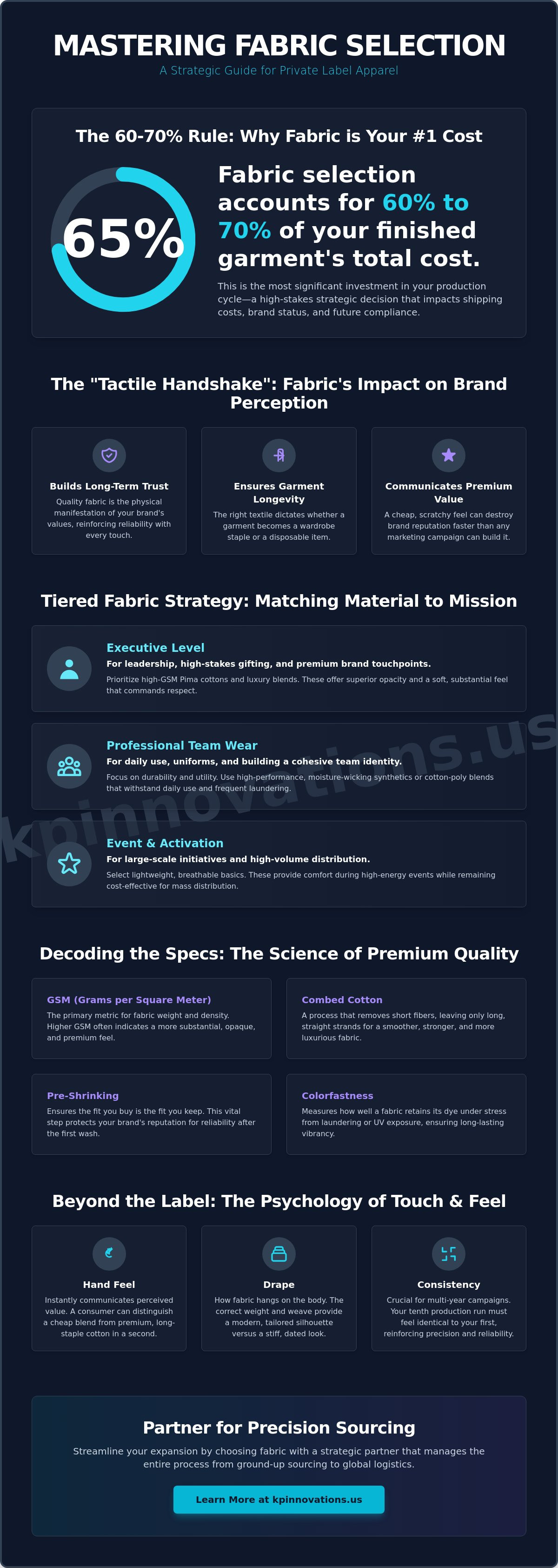
Did you know that fabric selection accounts for 60% to 70% of your finished garment’s total cost? It’s the most significant investment in your production cycle, yet many brand owners still struggle with the technical complexity of GSM, thread counts, and fiber origins. Choosing fabric for private label clothing is no longer just about hand-feel; it’s a high-stakes strategic decision that impacts your shipping costs, your brand’s premium status, and your compliance with the 2026 EU Digital Product Passport requirements.
You likely understand that a scratchy, low-quality garment can destroy your reputation faster than any marketing campaign can build it. This guide provides a clear framework for selecting textiles that align with your brand tier and scale with your ambitions. You’ll learn how to master technical specifications to ensure your apparel reflects premium quality every time. We’ll explore the ROI of high-performance blends, the impact of current cotton prices on your bottom line, and how to communicate your requirements to manufacturers with total confidence.
Key Takeaways
- Define your brand’s “tactile handshake” by selecting fabrics that reinforce quality and build long-term consumer trust.
- Master technical specifications like GSM and weave structures to ensure every garment meets your exact standards for weight and durability.
- Evaluate the ROI of natural fibers versus synthetic blends to optimize production costs without compromising on a premium feel.
- Protect your bottom line by selecting fabrics that reduce international shipping expenses and maintain their integrity during long-term storage.
- Streamline your expansion by choosing fabric for private label clothing with a strategic partner that manages the entire process from ground-up sourcing to global logistics.
The Strategic Impact of Fabric Choice on Brand Perception
The fabric you select is the “tactile handshake” of your brand. It’s the physical manifestation of your company’s values and the first point of sensory contact your audience has with your brand identity. While many businesses view apparel as a simple commodity, high-growth brands recognize that choosing fabric for private label clothing is a strategic maneuver. It’s the primary factor in garment longevity; it dictates whether a shirt becomes a wardrobe staple or a disposable item that ends up in a landfill.
In the competitive landscape of 2026, the difference between “disposable” promotional wear and “strategic” private label apparel is measured in brand trust. Research indicates that fabric typically accounts for 60% to 70% of the finished garment cost for cut-and-sew apparel. This investment is your most powerful tool for ensuring user retention. By understanding textile basics, you can move beyond generic off-the-shelf blanks and build custom apparel that serves as a high-value asset. When you prioritize quality materials, you’re not just selling a product; you’re promising a standard of excellence that scales with your reputation.
Mapping Fabric to Your Brand Tier
Successful brand managers don’t use a one-size-fits-all approach. They utilize a tiered framework for fabric selection based on specific corporate needs and end-user expectations:
- Executive Level: For leadership and high-stakes gifting, prioritize high-GSM pima cottons and luxury blends. These materials offer superior opacity and a soft, substantial feel that commands respect.
- Professional Team Wear: Focus on durability and utility. Use high-performance, moisture-wicking synthetics or sophisticated cotton-poly blends that withstand daily use and frequent laundering without losing their shape.
- Event & Activation: For large-scale initiatives, select lightweight, breathable basics. These provide comfort during high-energy events while remaining cost-effective for high-volume distribution.
The Psychology of Touch in Private Label Apparel
The “hand feel” of a garment immediately communicates its perceived value to the wearer. A consumer can instantly distinguish between a cheap polyester blend and a premium, long-staple cotton. This sensory input directly influences their perception of your brand’s price point and prestige. If the fabric feels scratchy or thin, the brand’s perceived value drops instantly.
Drape is equally critical. The way a fabric hangs on the body determines the wearer’s professional appearance. Stiff, unyielding fabrics look dated and uncomfortable; however, fabrics with the correct weight and weave provide a modern, tailored silhouette. Finally, maintaining consistency in fabric sourcing is vital for multi-year brand campaigns. Your clients expect the same premium experience every time they interact with your brand. Successful choosing fabric for private label clothing ensures that your tenth production run feels exactly like your first, reinforcing a message of reliability and precision.
Decoding Technical Specs: GSM, Weaves, and Performance
Technical specifications transform a creative concept into a durable asset. When you’re choosing fabric for private label clothing, you must move beyond aesthetics to understand the engineering of the textile itself. Precision at this stage prevents the “scratchy” or “cheap” feel that often plagues entry-level brands. Quality control begins with two essential processes: combing and pre-shrinking. Combed cotton involves removing short, erratic fibers and impurities, leaving only the long, straight strands that create a smooth, premium hand-feel. Pre-shrinking ensures that the fit your customer buys is the fit they keep after the first wash, protecting your brand’s reputation for reliability.
Colorfastness is another critical technical metric. It measures how well a fabric retains its dye under stress, such as laundering or UV exposure. Different fibers hold dyes with varying levels of tenacity; for instance, synthetic blends often maintain vibrant hues longer than certain natural fibers. When evaluating sustainable fiber choices, technical performance remains the primary metric for quality control. Refining these technical details is easier with expert support; KP Innovations provides the precise project management needed to execute these complex specifications from the ground up.
Understanding GSM for Different Garments
GSM, or Grams per Square Meter, is the standard measure of fabric weight and density. It directly impacts the garment’s opacity, drape, and perceived value. For standard t-shirts, a range of 140 to 180 GSM provides a balanced, breathable feel. However, the 2026 streetwear market favors a “heavyweight” aesthetic, often requiring 200+ GSM for a structured, premium drop. Hoodies and sweatshirts demand a more substantial 280 to 400 GSM to provide the warmth and “heft” customers associate with high-end loungewear. Outerwear requires even higher density to ensure weather resistance and proper insulation.
Performance Weaves and Finishes
The weave of a fabric dictates its texture and utility. Jersey is the smooth, stretchy staple of the t-shirt world, while Pique offers the classic, breathable “honeycomb” texture required for professional polos. For internal textures, the choice between French Terry and Fleece is a strategic one. French Terry features soft loops on the inside, making it ideal for lighter, moisture-wicking luxury layers. Fleece is brushed to create a fuzzy, insulating nap that’s perfect for cold-weather comfort. Modern private label lines also benefit from technical finishes, such as antimicrobial treatments or moisture-wicking capabilities, which add functional value to everyday apparel.
Natural vs. Synthetic vs. Blends: An ROI Comparison
Every fiber choice you make carries a distinct financial and reputational return on investment. When choosing fabric for private label clothing, you must weigh the immediate cost against the long-term value of garment performance and brand loyalty. As of June 12, 2026, the price of cotton sits at 76.42 USd/Lbs, making it a stable yet premium foundation for many collections. However, the true ROI of a material isn’t found in the raw cost alone; it’s found in how that material serves your specific brand tier and sustainability goals. Understanding the U.S. Textile Industry Facts regarding material innovation can help you select fibers that offer the best strategic advantage for your market position.
While 100% natural fibers offer unparalleled prestige, high-performance blends often provide the best balance for corporate and promotional applications. Tri-blends, typically a mix of polyester, cotton, and rayon, have emerged as the “sweet spot” for private label comfort. They mimic the soft, lived-in feel of a vintage tee while retaining the structural integrity of a technical garment. For brands focused on 2026 sustainability mandates, recycled polyester (rPET) has become a core component of corporate social responsibility initiatives, allowing brands to meet environmental targets without sacrificing the durability synthetics provide.
The Case for Natural Fibers
Cotton remains the gold standard for breathability and hypoallergenic properties. It’s the essential choice for brands that prioritize a classic, organic aesthetic. To elevate your brand story, GOTS-certified organic cotton offers significant marketing value, signaling a commitment to ethical sourcing that resonates with modern consumers. For niche luxury applications or high-end corporate gifting, linen and silk provide a level of sophistication that synthetic alternatives cannot replicate. These fibers drape beautifully and offer a cooling effect that’s synonymous with premium summer collections.
The Power of Synthetics and Blends
Polyester is the workhorse of the apparel industry because it resists shrinking, wrinkling, and fading. It’s the logical choice for uniforms and team wear that must endure heavy use. In modern professional cuts, a small percentage of Spandex or Elastane is often a necessity; it provides the stretch required for a tailored, contemporary fit. CVC (Chief Value Cotton) blends are another strategic option. By ensuring the fabric is at least 50% cotton, you maintain the breathability and “hand feel” of a natural fiber while gaining the colorfastness and strength of polyester. This combination ensures your garments look as sharp after fifty washes as they did on day one.
Production and Fulfillment: Why Fabric Choice Affects Your Bottom Line
Hidden costs often reside in the weight and volume of your inventory. While design teams focus on aesthetics, strategic brand owners recognize that choosing fabric for private label clothing dictates long-term fulfillment overhead. Weight translates to dollars. When you scale a private label line to thousands of units, a difference of 50 GSM can increase your international air freight costs by a significant margin. Selecting a heavyweight 400 GSM fleece for a global campaign requires a much larger logistics budget than a 280 GSM alternative, simply because of the physical mass being moved across borders.
Shelf stability is another critical factor that impacts your profitability. Certain natural fibers, like 100% linen or lightweight rayon, are prone to severe wrinkling when compressed in polybags for extended periods. If your garments arrive at their destination looking unkempt, your return rates will climb. Synthetic blends and high-quality “pre-shrunk” cottons maintain their integrity during long-term storage. This is particularly vital for the success of online company and team stores, where inventory must remain “retail-ready” for months at a time. Choosing durable, wrinkle-resistant fabrics ensures that every piece emerges from its packaging in pristine condition, protecting your brand’s premium reputation.
Logistics and Warehousing Considerations
Fabric volume directly influences your warehouse footprint. Thicker, bulkier materials require more pallet space, which leads to higher monthly storage fees. You must also consider how textiles survive the rigors of global fulfillment transit. Fabrics that are prone to “pilling” or snagging can be damaged before they even reach the customer. To ensure your production and logistics are perfectly aligned, it is essential to partner with a manufacturer that understands these nuances. You can learn more about choosing the right apparel factory to manage these complex supply chain variables effectively.
Decorating Your Private Label Fabric
The chemistry between your fabric and your decoration method determines the final quality of the garment. 100% cotton remains the undisputed king for high-detail screen printing because the fibers absorb ink deeply and consistently. In contrast, polyester requires specialized “low-bleed” inks to prevent dye migration, a common issue where the fabric color seeps into the printed design during the heat-curing process. If you prefer embroidery, the fabric weight must be substantial enough to support the stitch count. Thin, low-GSM fabrics will pucker and pull under a heavy embroidered crest, resulting in a distorted logo and a cheapened brand image. To avoid these technical pitfalls, consult with KP Innovations to match your fabric selection with the ideal decoration technique for your brand.
Partnering for Precision: Custom Sourcing with KP Innovations
Execution is the bridge between a visionary brand strategy and a high-performing product line. While the technical nuances of GSM and fiber ROI are vital, the success of your brand depends on a partner who can translate those specs into reality. KP Innovations moves beyond the role of a simple vendor; we function as a strategic extension of your team. By choosing fabric for private label clothing through our white-glove project management service, you gain access to a level of precision that standard off-the-shelf suppliers cannot match. We specialize in managing complex private label clothing lines for top-tier brands that refuse to compromise on quality or consistency.
Our approach is designed to turn physical items into strategic brand assets. Many businesses settle for “swag” that is quickly forgotten. We help you build apparel that people actually want to wear. This transition from commodity to asset requires deep-level customization and a manufacturing process that starts at the fiber level. Whether you’re developing high-performance team wear or executive-tier gifting, our team ensures every detail is managed to reduce your stress and elevate your market position.
From Design to Global Fulfillment
Based in Horsham, PA, our facility serves as a strategic hub for U.S. brands looking to scale with efficiency. Our “Manufacturing from the Ground Up” philosophy means we don’t rely on pre-made blanks. We source the exact textiles required for your specific brand tier. This eliminates the compromises often found in the promotional industry. Once your custom line is produced, we can integrate it directly into a streamlined company store platform. This end-to-end support covers everything from initial fabric sourcing to final global distribution, ensuring your inventory is managed with the same care used to create it.
Get Started with a Strategic Consultation
Digital specs only tell half the story. In the world of premium apparel, physical fabric swatches are essential for making informed decisions about hand-feel and drape. Our consultants guide you through this sensory selection process while helping you navigate the complexities of mill MOQs and production timelines. We provide a clear roadmap from the first sample to bulk manufacturing, ensuring your project stays on track and meets your quality benchmarks. Elevate your brand with KP Innovations today and experience a managed process that prioritizes your brand’s growth and lasting impact.
Building Your Brand Legacy Through Strategic Fabric Selection
Every technical specification you’ve explored, from GSM density to fiber ROI, dictates your brand’s long-term trajectory. It’s about more than just hand-feel. Choosing fabric for private label clothing is the most critical decision in your production cycle. This choice influences the tactile experience of your customers and the direct efficiency of your global fulfillment. By prioritizing strategic value over off-the-shelf compromises, you transform simple apparel into a powerful brand asset that scales with your ambition.
Success in the 2026 market requires a partner who manages this complexity with precision. KP Innovations provides white-glove project management and access to over 1.2 million products to ensure your vision is executed perfectly. Based in Horsham, PA, we act as your US-based strategic partner to navigate every nuance of manufacturing from the ground up. Your brand deserves a standard of quality that lasts. Partner with KP Innovations for your custom apparel line and start building a collection that reflects your highest standards today.
Frequently Asked Questions
What is the best fabric for a premium private label t-shirt?
Long-staple pima cotton or a high-quality tri-blend is the gold standard for premium t-shirts. Pima cotton offers superior softness and durability that creates a “tactile handshake” with your customers. While 100% cotton is a classic choice, tri-blends provide a modern, lived-in feel and better drape. These materials ensure your garments feel like a luxury asset rather than a disposable commodity.
How does GSM affect the quality of a garment?
GSM measures the weight and density of the fabric, but it isn’t a direct indicator of quality. Instead, you should match the GSM to the garment’s specific purpose and brand tier. For example, a 300+ GSM is ideal for structured, heavyweight hoodies, while a 160 GSM is perfect for a breathable, professional tee. Understanding this metric helps you control opacity and shipping mass effectively.
What is the difference between combed and carded cotton?
Combed cotton is significantly softer and more durable than carded cotton because it undergoes an additional refinement process. This step removes short, erratic fibers and impurities, leaving only the long, straight strands. This choice is essential when choosing fabric for private label clothing if you want to avoid the “scratchy” feel and pilling associated with lower-tier promotional products.
Are synthetic fabrics good for high-end corporate apparel?
High-performance synthetic blends are excellent for modern corporate apparel because they offer wrinkle resistance and moisture-wicking properties. While 100% polyester can feel cheap, sophisticated CVC blends or recycled polyester provide a professional appearance that survives long-term storage. These fabrics ensure your team looks sharp during high-stakes activations and daily operations without the maintenance required by pure natural fibers.
How do I test fabric quality before starting mass production?
You should always request a mandatory pre-production sample to verify hand-feel, drape, and color accuracy. Conduct rigorous wash tests to check for shrinkage and pilling before committing to bulk manufacturing. At KP Innovations, we manage this verification process to ensure the technical specs align with your brand’s quality standards before the first yard of fabric is cut.
What are the minimum order quantities (MOQs) for custom fabric sourcing?
Most fabric mills require minimum order quantities ranging from 500 to 3,000 yards per color. Total order minimums often fall between 1,000 and 5,000 yards. Navigating these requirements is a critical part of choosing fabric for private label clothing. If your project doesn’t meet these thresholds, we help you source premium stock fabrics that still allow for deep-level customization and brand alignment.
Which fabrics are best for sustainable private label lines?
Organic cotton, hemp, Tencel, and recycled polyester blends are the leading choices for sustainable collections in 2026. These materials help brands comply with the EU Ecodesign for Sustainable Products Regulation. Choosing GOTS-certified fibers or recycled blends adds significant marketing value and ensures your brand meets the “excellent environmental performance” standards required by modern consumers and regulatory bodies.
How does fabric choice impact screen printing vs. embroidery?
100% cotton is the ideal substrate for high-detail screen printing because its fibers absorb ink consistently. Conversely, embroidery requires a fabric with enough weight and stability to support the stitch count. If you select a low-GSM fabric for a heavy embroidered crest, the material will pucker and distort. Matching your decoration method to your textile’s technical properties is vital for a professional finish.