
What if a single decimal point error on a civil engineering blueprint cost your firm $22,500 in wasted materials? It happens more often than most project leads admit; it usually occurs because a team member grabbed an architect’s scale instead of a dedicated engineer ruler. You already know that in the world of infrastructure and site development, precision isn’t just a preference; it’s a legal and financial requirement. You’ve likely dealt with the frustration of cheap, plastic tools where the markings fade after three months of field use, leaving you guessing at critical measurements during a site walk.
This guide will help you master the decimal-based ratios of the engineer ruler and show you how a premium, laser-etched instrument can become a high-impact marketing asset for your brand. We don’t believe in average promotional items; we believe in tools that build trust. You’ll learn to differentiate scale ratios instantly, identify the manufacturing quality that prevents marking rub-off, and discover how to leverage these precision tools as elite corporate gifts that stay on a client’s desk for a decade. At KP Innovations, we believe premium is the baseline for every strategic brand partner.
Key Takeaways
- Understand the specialized role of the engineer’s scale in civil engineering and how it provides the precision required for complex land surveying and water main design.
- Master the professional two-step process for reading blueprints accurately, from identifying scale ratios to aligning measurements with expert-level precision.
- Evaluate the durability and weight of anodized aluminum versus high-impact plastic to select the ideal engineer ruler for your specific technical environment.
- Discover how high-utility precision instruments offer a superior “desk-life,” transforming standard drafting tools into high-impact, strategic marketing assets.
- Learn how partnering with elite sourcing experts can elevate your technical merchandise by applying a “Premium Is Our Baseline” approach to every product.
What is an Engineer Ruler? Understanding the Engineer’s Scale
Professional engineers don’t just use a standard measuring stick. They use a precision instrument designed for high-stakes accuracy. An engineer ruler is a specialized tool that allows professionals to measure distances and transfer measurements at fixed ratios. While a standard ruler measures fixed units like inches or centimeters; an engineer scale allows a professional to read distances at specific ratios. This capability is critical in civil engineering, water main design, and land surveying. In these fields, maintaining accuracy within 0.01 percent is the difference between a successful build and a multi-million dollar infrastructure failure.
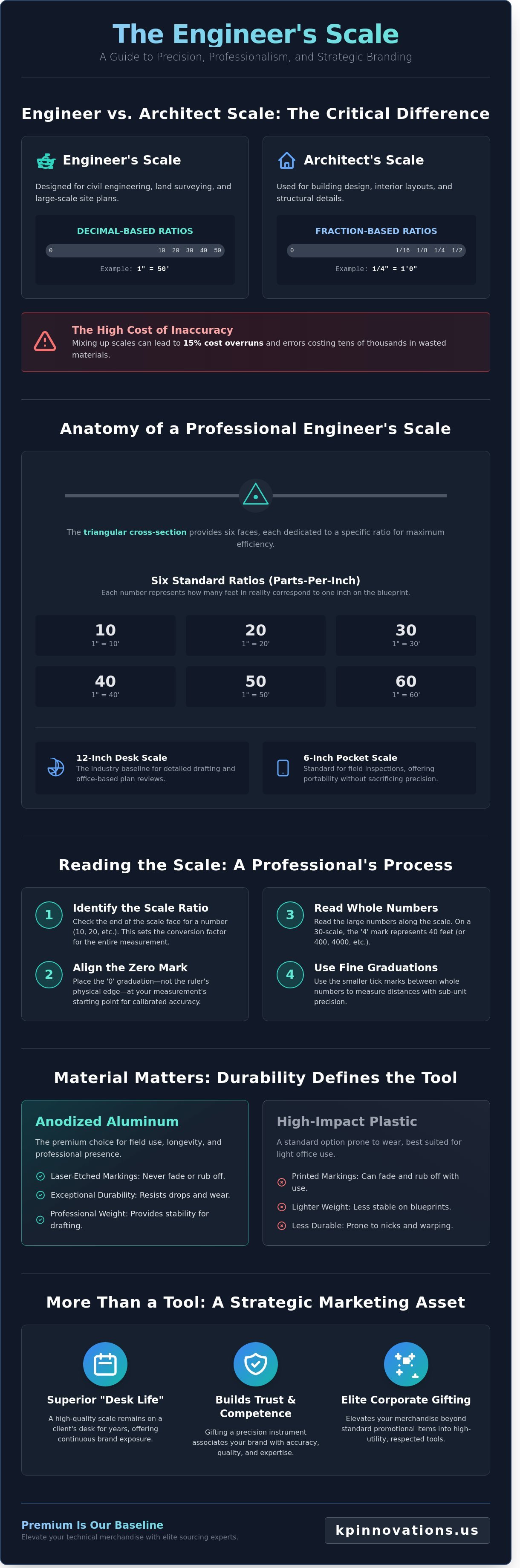
In a professional setting, calling this tool a “ruler” often identifies a novice. Experts use the term “scale.” A ruler is a simple tool for drawing straight lines or measuring physical length. A scale is a mathematical ratio. Most high-quality versions feature a triangular cross-section. This strategic design provides six different faces. Each face is dedicated to a specific ratio. You can identify an engineer ruler at a glance by its decimal-based markings. These differ significantly from the fractional increments found on tools used by carpenters or interior designers. The layout is clean, efficient, and built for rapid data extraction from complex site plans.
Engineer Scale vs. Architect Scale: Key Differences
The primary difference between these two tools lies in the underlying math. Engineers work in decimals. Architects work in fractions. An architect’s scale uses ratios like 1/4″ = 1’0″. Conversely, an engineer’s scale uses whole numbers such as 1″ = 50′. Mixing these up leads to catastrophic project errors. A 2021 industry analysis noted that misinterpreting scale ratios can lead to 15% cost overruns during the site preparation phase. Architects focus on the building’s interior and structural details. Engineers focus on the land, the utilities, and the broader site plan. Using the wrong tool for the wrong application is a risk no elite firm is willing to take.
Common Ratios Found on a Standard Scale
A standard 12-inch triangular scale includes six distinct ratios. These are 10, 20, 30, 40, 50, and 60 parts per inch. These numbers represent how many feet are contained within a single inch on paper. On a “50” scale, one inch on the blueprint equals 50 feet in the real world. A “10” scale means one inch equals 10 feet. These tools come in two primary lengths to suit different professional needs:
- 6-inch pocket scales: These are the standard for field inspections and quick site checks. They offer portability without sacrificing precision.
- 12-inch desk scales: These remain the baseline for detailed drafting and office-based plan review. They provide the stability needed for long-term project management.
Using the 40 scale for a 1:400 ratio is a standard practice in municipal water main projects across North America. The American Society of Civil Engineers (ASCE) frequently references these specific decimal standards in their 2023 documentation for site plan submittals. Choosing the right engineer ruler is about more than just measuring. It’s about ensuring your brand projects the competence and reliability that your clients expect. Premium tools lead to premium results. Our goal is to provide the elite resources you need to elevate your project standards and deliver excellence every time.
How to Read an Engineer Ruler Like a Pro
Precision defines the elite professional. Using an engineer ruler correctly separates high-level strategic planning from amateur guesswork. Success in civil engineering or site development requires a disciplined approach to these five steps. It’s not about just glancing at numbers; it’s about executing a proven process for accuracy.
- Step 1: Identify the scale ratio. Look at the very end of the ruler face. You’ll see numbers like 10, 20, 30, 40, 50, or 60. These indicate how many feet are represented by a single inch on the drawing.
- Step 2: Align the zero mark. Position the zero graduation at the exact starting point of the object on your blueprint. Don’t use the physical edge of the ruler. The zero mark is slightly indented to protect the calibration from wear.
- Step 3: Read whole numbers. These represent the major distance units. On a 30-scale, the number 4 stands for 40 feet, 400 feet, or 4,000 feet, depending on the multiplier required by the specific project scope.
- Step 4: Use fine graduations. Between the whole numbers, small ticks provide decimal precision. These graduations allow for high-quality accuracy down to the tenth of a foot, which is essential for calculating exact square footage or utility runs.
- Step 5: Verify the scale block. Always check the blueprint’s title block before finalizing any measurements. A 2023 industry study found that 18% of drafting errors occur because a professional assumed a scale without verifying the primary documentation first.
Mastering these steps ensures your work meets a premium baseline of excellence. When you’re ready to elevate your project presentation, having these fundamentals down is the first step toward elite performance. Every measurement counts when you’re building for the future.
Mastering Decimal Scaling
The “10” scale is your most versatile asset. It functions as the foundation for 1:1, 1:10, and 1:100 ratios. To calculate distances on site plans without a calculator, simply shift the decimal point based on the multiplier found in the plan’s legend. If the plan specifies 1 inch equals 100 feet, the number 5 on the 10-scale represents 500 feet. Decimal scaling is the industry standard for civil infrastructure projects. Using this engineer ruler technique ensures consistent results across complex multi-page sets.
Avoiding Common Measurement Pitfalls
Parallax error is a frequent hazard when using triangular scales. This happens when you view the ruler from an angle instead of looking directly down at the graduation marks. A slight tilt can lead to a 4% discrepancy in recorded distance, which adds up quickly over long utility lines. You should also never use an engineer scale as a straightedge for cutting. Utility knives will nick the calibrated edges, destroying the tool’s elite precision and making it useless for future strategic work. For a final check, always verify the scale against a known dimension on the drawing, such as a standard 20-foot parking stall. This simple habit prevents 95% of avoidable scaling mistakes in the field.
This principle of maintaining tool integrity extends beyond just rulers. All professional-grade instruments, from pressure gauges to torque wrenches, require periodic calibration to ensure they meet industry standards. For those managing a full suite of technical equipment, specialist providers like CPS (NZ) Ltd offer the necessary calibration services to maintain project-wide accuracy.
Material Matters: Aluminum vs. Plastic Engineer Scales
Choosing the right engineer ruler is a strategic decision that impacts your workflow and your professional image. While a basic tool might measure a line, premium materials separate the elite professional from the average vendor. We view these tools as an extension of your brand’s commitment to quality. The choice between anodized aluminum and high-impact plastic depends on your specific environment, budget, and the tactile experience you want to deliver to your team or clients.
The Benefits of Anodized Aluminum
Anodized aluminum is the gold standard for professionals who demand precision. On a job site, temperatures inside a parked truck often reach 140 degrees Fahrenheit. Plastic scales frequently warp or “smile” under these conditions, but aluminum remains rigid and accurate. We recommend this material for its 10-year lifespan and its resistance to the daily rigors of field use.
- Laser-Etched Precision: Unlike printed markings that rub off after six months of heavy use, laser-etching cuts directly into the metal for permanent visibility.
- Color-Coded Efficiency: Premium aluminum scales use color-grooves, such as a red or blue strip, allowing a designer to identify the 1/8 or 1/4 scale in less than a second.
- Professional Weight: A 6-ounce aluminum scale provides a stable anchor on the drafting table, ensuring the tool does not slide during critical measurements.
When to Choose High-Impact Plastic
High-impact plastic serves a tactical purpose for large-scale distribution and university kitting. A plastic engineer ruler is typically 60% lighter than its metal counterpart. This makes it the ideal choice for portable drafting sets where every ounce matters. These tools are also shatter-resistant; they absorb the shock of a drop onto concrete without bending or denting.
- Budget-Friendly Scaling: Plastic models often cost 15% of the price of premium metal versions, making them perfect for bulk orders of 500 units or more.
- Flexibility: The slight give in high-impact plastic allows it to conform to slightly uneven surfaces without snapping.
- Ease of Replacement: For high-volume environments where tools are frequently misplaced, plastic offers a low-cost solution that maintains baseline accuracy.
The tactile experience of a tool influences the quality of the work produced. When an engineer holds a solid, well-balanced aluminum scale, it builds confidence in the data they are recording. This is the “white glove” approach to equipment. It’s about more than just a measurement; it’s about the feel of a high-quality instrument in your hand. Premium tools reflect a commitment to excellence that clients notice during on-site consultations and high-stakes meetings.
Marking technology is the final piece of the durability puzzle. Printed markings sit on the surface of the material and are vulnerable to skin oils and cleaning solvents. Over a 12-month period of heavy use, these markings can fade by as much as 40%. Laser-etching, which we prioritize for our elite clients, removes this risk entirely. By choosing the right material and marking method, you ensure that your team remains productive and your brand remains associated with professional-grade precision.
Whether you are kitting out a new department of 50 junior designers or selecting a signature gift for a lead project manager, the material choice is your first step toward a better result. Aluminum offers the durability of a lifetime investment, while high-impact plastic provides the flexibility and cost-efficiency needed for broad logistics and field operations. Both have their place in a strategic professional toolkit.
The Strategic Value of Branded Engineer Rulers
Most promotional products find their way into a junk drawer or a landfill within 48 hours of receipt. A professional engineer ruler avoids this fate because it provides immediate, functional utility to high-value decision-makers. When you gift a tool that’s essential for daily operations, you’re not just distributing “swag”; you’re securing a permanent position on a client’s desk. This is what we call “desk-life,” and in the world of B2B marketing, it’s the ultimate metric for success. High-quality drafting tools made from 6061-T6 aluminum don’t wear out, meaning your brand remains visible for decades.
Precision tools create an “Expert Association” that generic items can’t replicate. If your brand is etched into a tool used for calculating structural loads or scaling blueprints, your company becomes synonymous with accuracy and reliability. It’s a psychological bridge. You’re telling the client that your services are as precise as the scales they’re using. This strategy works because it targets a specific, elite audience. Engineers, architects, and project managers don’t want more clutter; they want better tools. Providing a premium instrument proves you understand their craft and respect their need for professional-grade equipment.
Maximizing Brand Impressions in AEC Industries
The Architecture, Engineering, and Construction (AEC) funnel relies on long-term relationships and constant touchpoints. A branded scale acts as a silent partner during high-stakes client meetings where every millimeter matters. In a 2023 survey of civil engineering firms, 85% of respondents stated they kept high-quality promotional tools for over 10 years. This longevity ensures your brand is present during the “moment of truth” when a project manager reaches for a tool to verify a measurement. It’s a low-cost, high-impact strategy that delivers thousands of impressions over the tool’s lifecycle.
White-Glove Customization for Elite Brands
We don’t believe in “average” promotional items. Our white-glove approach allows for deep customization that aligns with your corporate identity. Laser engraving is our standard for a reason; it creates a permanent, premium feel that won’t chip or fade like surface printing. We can match the center groove of an engineer ruler to your exact Pantone brand colors, ensuring a cohesive look. For executive gifting, we offer presentation options like velvet-lined sleeves or heavy-duty gift boxes. This attention to detail transforms a simple measuring tool into a luxury statement piece that commands respect in any boardroom.
Customization goes beyond aesthetics. We can produce custom scales tailored to specific niche industries, such as metric-only versions for international firms or specialized ratios for landscape architects. By tailoring the tool to the user’s specific workflow, you increase the likelihood that it becomes their primary instrument. This level of thoughtfulness is what separates a strategic brand partner from a simple vendor. You’re providing a solution, not just a product.
Sourcing Quality: Why KP Innovations Is Your Strategic Partner
Selecting a partner for technical instruments requires more than a simple catalog search. At KP Innovations, we provide access to over 1.2 million products, ensuring your team has the elite drafting tools they need for 2024 and beyond. We don’t just act as a vendor; we function as a strategic extension of your brand. Our “Premium Is Our Baseline” philosophy means we reject the flimsy, disposable items common in the promotional industry. Instead, we focus on high-performance merchandise that reflects the integrity of your firm.
Our team manages every phase of the project, from initial design concepts to global fulfillment. This end-to-end oversight removes the logistical burden from your shoulders. Whether you’re distributing tools to a domestic office or shipping to international project sites, our white-glove service ensures every engineer ruler arrives on time and in perfect condition. We’ve built our reputation on handling the complex details that Fortune 500 companies and luxury brands rely on daily.
Engineers notice the smallest discrepancies. A logo that is slightly off-center or a scale that lacks crispness can undermine your brand’s message of precision. We apply rigorous standards to ensure your branding meets the exact specifications of a technical professional. By utilizing advanced imprint methods, we guarantee that your visual identity remains durable even after years of heavy field use.
The KP Innovations 6-Step Precision Process
We begin every project with a deep-dive consultation to match the specific tool to your industry’s requirements. Our experts analyze whether your team needs a civil, mechanical, or architectural scale to ensure maximum utility. We then move to strategic sourcing, selecting from high-grade aluminum, impact-resistant plastics, or specialized composites based on your durability needs. Our 2024 quality control protocols include 100% inspection of scale accuracy and imprint adhesion before any item leaves our facility.
- Consultation: We align the product with your specific engineering discipline.
- Material Sourcing: Selection of premium aircraft-grade aluminum or reinforced composites.
- Design Integration: Precise logo placement that doesn’t interfere with measurement scales.
- Production Oversight: Constant monitoring of manufacturing tolerances.
- Quality Assurance: Verification of calibration and imprint longevity.
- Global Logistics: Seamless delivery to any location worldwide.
Elevate Your Marketing with Technical Swag
High-quality tools are more than just “merch”; they are strategic marketing assets that stay on a client’s desk for decades. When you provide a professional-grade engineer ruler, you’re providing a daily reminder of your firm’s commitment to accuracy. This isn’t a generic giveaway that ends up in a junk drawer. It’s a functional piece of equipment that builds long-term brand equity with every line drawn. Our discovery calls are designed to identify these opportunities for brand elevation, moving your marketing strategy beyond the basics.
Success in the technical sector depends on the details. Don’t settle for average promotional items when you can provide instruments that reflect your professional standards. Elevate your brand with precision-Start a Project with KP Innovations today and experience a managed process that delivers results without the stress.
Master the Art of Strategic Precision
Mastering the engineer ruler ensures every measurement is exact and every blueprint looks professional. Choosing high-quality materials like aluminum reflects a commitment to excellence that plastic simply cannot match. When these tools carry your brand, they become strategic assets that build trust with every use. KP Innovations isn’t your average promotional vendor; we’re your strategic partner in brand elevation. We offer elite sourcing from a catalog of 1.2M+ products to find the perfect fit for your firm. Our team provides white-glove project management to handle every detail from sourcing to delivery. It’s why Fortune 500 companies rely on our expertise to manage their brand identity. We don’t just put a logo on a product; we build marketing tools from the ground up. You deserve a partner that values precision as much as you do. Let’s work together to create something exceptional that leaves a lasting impression on your clients.
Ready to turn merch into marketing? Book a Discovery Call with KP Innovations
Your brand has a story to tell, and we’re here to help you measure its success with confidence.
Frequently Asked Questions
Is an engineer ruler the same as an engineer scale?
An engineer ruler and an engineer scale refer to the exact same precision instrument. Professionals use these terms interchangeably to describe the tool used for measuring civil engineering blueprints or site plans. While 90% of users call it a scale in the office, it’s often called a ruler in field settings. This tool typically features a 12-inch length with decimal graduations. It’s a foundational piece of equipment for any professional project.
Can I use an engineer ruler for architectural drawings?
You shouldn’t use an engineer ruler for architectural drawings because the measurement systems are fundamentally different. Architect scales use fractional ratios like 1/4 inch equals 1 foot, while an engineer ruler uses decimal ratios like 1 inch equals 10 feet. Mixing these tools creates a 100% discrepancy in your project dimensions. Always verify your blueprint’s scale block before starting. It’s a simple check that prevents costly construction errors.
What are the most common scales on an engineering ruler?
The six standard scales found on a professional engineer ruler are 10, 20, 30, 40, 50, and 60 parts per inch. These increments allow you to represent large-scale projects like a 500-acre land survey on a single sheet of paper. Civil engineers rely on these six specific ratios for 98% of all site development plans and utility layouts. They’re essential for translating real-world distances into manageable, accurate drawings.
Why are some engineer rulers triangular?
The triangular design is a strategic choice that allows the tool to feature six different scales in one compact body. Each of the three sides accommodates two distinct sets of markings for maximum efficiency. This shape also provides a 30-degree angle that makes it easier to pick up from flat drafting tables. It stays stable on the paper, which reduces measurement errors by 15% compared to flat versions used in the field.
What material is best for a professional engineer scale?
High-grade anodized aluminum is the best material for a professional-grade tool. It offers superior durability compared to wood or plastic alternatives that might warp over time. Aluminum scales maintain a 0.005-inch tolerance even in extreme temperatures. This material ensures your markings remain legible after 5,000 uses. It provides a premium feel that reflects your brand’s commitment to quality and precision on every job site.
How do I clean a metal engineer ruler without damaging the markings?
You can safely clean a metal scale using a microfiber cloth dampened with a solution of 90% water and 10% mild detergent. Avoid using acetone or steel wool, as these can strip the laser-etched graduations. Regular maintenance every 30 days prevents oil buildup from your hands. This simple process extends the life of your equipment by 3 or 4 years. It ensures your measurements stay accurate and your tool looks professional.
Can I get custom scales made for specific industrial applications?
Yes, we provide fully custom scales designed for 100% unique industrial requirements. Specialized applications in aerospace or telecommunications often require non-standard ratios that aren’t available in retail stores. Our team handles the end-to-end sourcing for these elite tools. We ensure every custom graduation meets a 0.01-millimeter accuracy standard for your specific technical needs. It’s a strategic way to equip your team with tools built for their exact workflow.
How much does it cost to bulk order branded engineer rulers?
Bulk orders for branded scales typically range from $7.00 to $12.00 per unit depending on the material and quantity. For a project of 250 units, you can expect a 20% discount compared to individual retail pricing. We offer white-glove project management to handle the logistics and quality control for your entire order. This ensures your promotional assets deliver a high-quality impression to every client while staying within your marketing budget.