
What if the clothes your team wears are actually diluting your brand value? Most marketing leaders realize too late that choosing the wrong corporate apparel suppliers turns a culture-building initiative into a logistical nightmare of scratchy fabrics and inconsistent logos. It’s a frustrating reality; you invest in merchandise only to see it end up in a donation bin because it doesn’t meet the standards of the people wearing it.
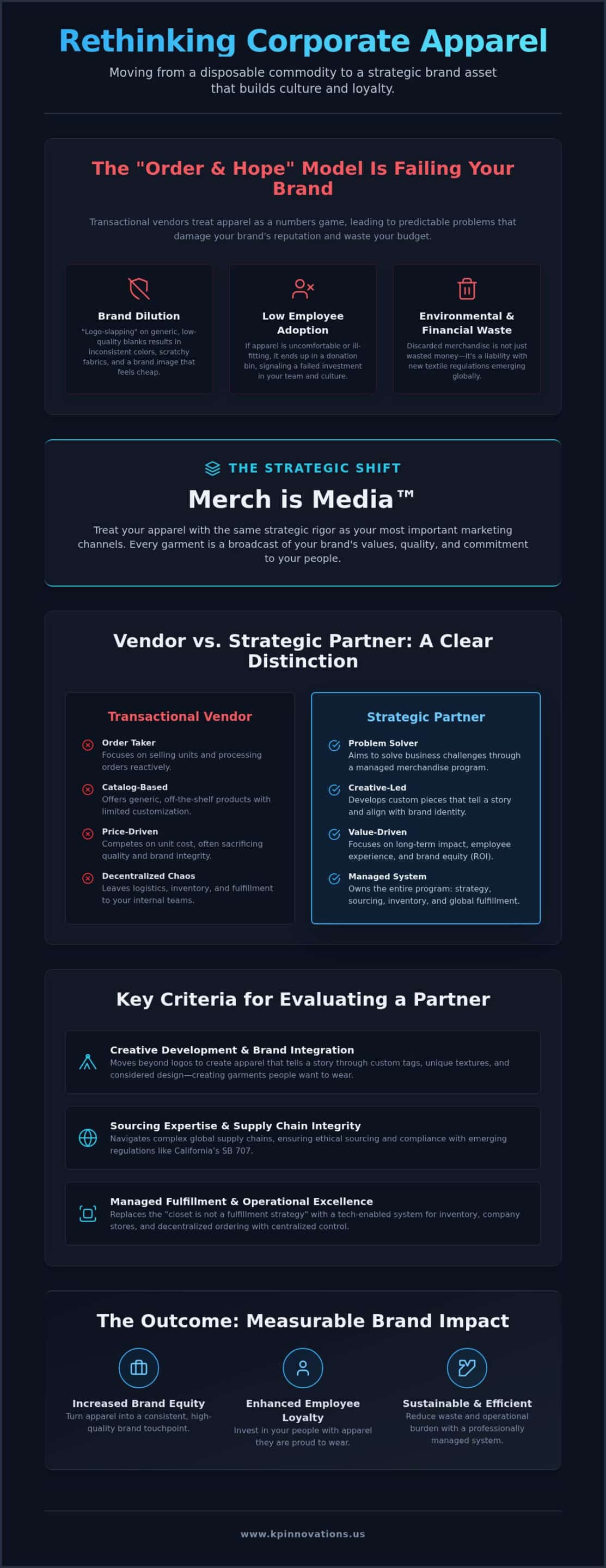
We believe that Merch is Media™. This means your apparel should be treated with the same strategic rigor as any other high-impact marketing channel. This article will teach you how to evaluate partners through the lens of brand experience and operational efficiency rather than just unit price. We’ll explore the shift toward quiet luxury, the impact of 2026 textile regulations like California’s SB 707, and how a managed fulfillment system can finally take the logistical burden off your internal team.
Key Takeaways
- Move beyond the “order and hope” model to understand why transactional vendors often fail to protect your brand’s visual identity and employee experience.
- Evaluate corporate apparel suppliers based on their ability to own the entire program lifecycle, including creative strategy, ethical sourcing, and global logistics.
- Navigate the manufacturing spectrum by learning when to leverage high-end retail brands versus investing in custom-manufactured private label pieces.
- Replace the hidden costs and headaches of decentralized ordering with a managed fulfillment system that ensures consistency across every global office.
- Adopt the Merch is Media™ philosophy to measure your apparel program’s impact with the same rigor you apply to your digital marketing investments.
Moving Beyond the Transactional Vendor Model
For decades, the process of procuring branded clothing has been purely transactional. You browse a catalog, pick a polo, upload a logo, and hope for the best. This “order and hope” method might have worked in a less competitive era, but modern brands can’t afford the risk. When you treat your apparel as a commodity, your audience treats your brand the same way. Most corporate apparel suppliers act as order takers, but they don’t protect your visual identity or your bottom line. The true cost of low-quality apparel isn’t just the invoice; it’s the damage to your reputation when garments are discarded or ignored.
High-quality corporate apparel is not a giveaway; it is a strategic media channel. We call this Merch is Media™. Every time an employee wears a company jacket or a client dons a branded cap, they are broadcasting your brand values. If that garment is ill-fitting or uncomfortable, the message is clear: your brand doesn’t value quality. Shifting your mindset from buying items to investing in media ensures that every stitch protects your brand equity. It transforms a simple shirt into a tool for building culture and loyalty.
The Hidden Risks of “Logo-Slapping”
Generic blanks often lead to brand dilution. Historically, Promotional merchandise has often been treated as disposable, which creates a negative cultural and environmental impact. In 2026, the stakes are higher than ever. With new regulations like the EU ban on destroying unsold textiles and California’s SB 707, brands must be accountable for what they produce. If your team refuses to wear the apparel because it feels cheap, it isn’t just wasted money. It’s a failed brand experience that signals a lack of investment in your people. Quality garments reduce waste and increase the frequency of impressions your brand receives in the real world.
Why Your Brand Deserves an Agency, Not a Catalog
The primary difference between a traditional distributor and a brand experience agency lies in the strategy. A distributor wants to sell you more units. An agency wants to solve a business problem. While average corporate apparel suppliers focus on the transaction, a strategic partner identifies the right garment for the specific audience. This is where the Chief Swag Officer model becomes essential. It’s about having an expert who owns the entire program. They manage everything from creative development to global fulfillment, ensuring that your apparel supports your culture rather than cluttering a closet. This approach turns physical items into strategic assets that build long-term loyalty and measurable impact.
The Criteria for a Strategic Apparel Partner
Finding the right corporate apparel suppliers requires looking far beyond the checkout button. A strategic partner doesn’t just fulfill orders; they manage the entire lifecycle of your brand experience. This means moving from a reactive mindset to a proactive strategy that anticipates your annual recognition and event needs months in advance. You need a partner that integrates with your team, utilizing an advanced technology stack to manage online company stores and decentralized ordering without losing brand control.
Success in 2026 is defined by operational precision. Your partner should provide a managed system that handles the heavy lifting of inventory and logistics, allowing your marketing and HR teams to focus on their core objectives. If a supplier can’t talk to you about long-term program management or how they protect your visual identity across different fabric types, they are a vendor, not a partner.
Creative Development and Brand Integration
True brand integration goes deeper than a logo on a chest. Expert creative development ensures that every apparel piece aligns perfectly with your visual identity, using textures, custom tags, and unique placements to tell a story. When you move beyond standard embroidery, you create garments that employees actually want to wear. When employees feel that a garment was designed specifically for their professional lifestyle rather than pulled from a generic shelf, adoption rates soar and the piece becomes a permanent part of their daily wardrobe.
Sourcing Expertise and Supply Chain Integrity
The supply chain environment has changed. As of July 8, 2026, the U.S. Consumer Product Safety Commission requires mandatory electronic filing for product safety information. Additionally, the California Responsible Textile Recovery Act (SB 707) now mandates that producers join an approved organization to manage textile recycling. These aren’t just administrative hurdles; they are critical compliance points that your partner must navigate on your behalf.
Reliable strategic sourcing ensures that your quality remains consistent regardless of global shifts. You need a partner with deep-level manufacturing expertise who can verify ethical standards and environmental compliance at the factory level. This level of oversight protects your corporate social responsibility goals and ensures your brand isn’t associated with substandard labor practices. To ensure your program stays compliant and consistent, it is vital to work with a partner that prioritizes transparent sourcing and supply chain integrity.
White Label vs. Private Label: Navigating Manufacturing Levels
Most corporate apparel suppliers offer a limited binary choice: you can either select a generic white-label blank or pay a premium for a recognized retail brand. While both have their place, modern brand leaders are increasingly looking toward a third option: private label manufacturing. Understanding the spectrum of customization available in 2026 is the key to moving from a standard uniform program to a sophisticated brand collection. It’s about deciding whether you want to simply decorate a garment or own the design of the garment itself.
The ROI of private label is found in the longevity and perceived value of the piece. When you build a custom clothing line rather than just ordering a uniform, you create a brand asset that people actually want to keep. This approach requires a deeper understanding of the process, which is why we developed Private Label Clothing: A Founder’s Starter Guide to help leaders navigate these early strategic decisions. Investing in your own line eliminates the risk of your team looking like every other company at the trade show.
The Power of Private Label Apparel
Private label allows for deep-level customization that isn’t possible with off-the-shelf blanks. You gain control over unique fits, specific fabric blends, and custom finishes like branded buttons or internal neck tapes. This level of detail is the ultimate expression of our Merch is Media™ philosophy. It signals to your employees and clients that your brand is intentional about every touchpoint. High-tier programs, such as executive gifting or exclusive employee anniversary collections, benefit significantly from this “designed-from-scratch” feel, as it elevates the garment from a commodity to a luxury item.
Choosing the Right Manufacturing Process
Evaluating the right manufacturing path depends on your volume and your goals. Standard embellishment on pre-made garments is efficient for quick turns, but cut-and-sew manufacturing offers unparalleled control over the final product. When you evaluate an apparel factory, you must look for their ability to handle modern performance fabrics. In 2026, corporate environments demand technical features like four-way stretch, moisture-wicking, and stain resistance blended into professional silhouettes.
Budgeting for these programs has also become more precise. Current 2026 data shows that a 200 GSM cotton t-shirt typically costs between $3.80 and $5.50 per unit at the manufacturing level, while sample costs for complex items like jackets range from $150 to $300. Knowing these benchmarks helps you stay competitive while ensuring you don’t sacrifice quality for a lower unit price. A strategic partner will guide you through these costs to ensure your investment yields the highest possible brand impact.
Operational Excellence: The Closet Is Not a Fulfillment Strategy
Many companies treat apparel like an office supply, stashing boxes in a back room and hoping someone remembers to ship them. This “closet strategy” is where brand experience goes to die. Traditional corporate apparel suppliers often stop at the delivery dock, leaving you to manage the logistical nightmare of sizing, inventory, and individual shipping. A strategic partner views fulfillment as a core component of the brand experience. They ensure every garment arrives in pristine condition, regardless of where your team is located.
Decentralized ordering is another common bottleneck. When regional managers order their own gear, you lose control over brand consistency. You end up with five different shades of “brand blue” and massive amounts of wasted spend. Centralizing this through a managed system protects your visual identity and your budget. It allows you to streamline global delivery for remote teams, ensuring that a new hire in Berlin feels just as valued as one in Boston.
Company Stores and Team Platforms
Managing sizes and colors manually is a drain on HR and marketing resources. Implementing online company stores solves this by putting the choice in the hands of the employee. You can implement credit-based systems for recognition, allowing team members to select the gear they actually want. This platform also provides valuable data. By tracking which items are most popular, you can optimize future spend and eliminate inventory that sits on a shelf for years. It turns your apparel program into a self-sustaining ecosystem.
Program Management for Long-Term Success
Complex industries like aviation, hospitality, or manufacturing require more than just a vendor. They need a dedicated program management team to ensure continuity. If you have thousands of employees across the globe, your brand experience must be identical in every location. A managed program ensures that a uniform ordered three years from now matches the one ordered today. It’s about building a system that scales with your growth without adding internal headcount. To move away from the “closet strategy” and secure your supply chain, you should partner with experts who manage the entire sourcing and logistics lifecycle.
Merch is Media™: Measuring the Impact of Corporate Apparel
The most successful brands in 2026 treat their apparel programs with the same analytical rigor as a high-performing digital ad campaign. While traditional corporate apparel suppliers focus on shipping boxes, a strategic partner focuses on the return on your investment. With the global corporate apparel market projected to reach 321.50 billion USD in 2026, the scale of this industry proves that clothing is no longer a peripheral marketing expense. It is a primary channel for brand visibility. Unlike a digital banner that is clicked and forgotten, a premium garment provides years of repeated impressions at a fraction of the long-term cost.
High-quality apparel does more than just display a logo; it influences internal culture and external brand perception simultaneously. When employees feel proud of what they are wearing, they become mobile brand ambassadors. They wear the gear on weekends, at the gym, and in their communities. This organic reach is impossible to buy through traditional advertising. It builds a sense of belonging that directly impacts employee retention and loyalty, turning a physical item into a powerful tool for relationship management.
The future of this industry is defined by three pillars: sustainability, tech-integration, and lifestyle-first design. We are moving away from “corporate uniforms” and toward retail-quality collections that people genuinely want to own. This includes a focus on circularity and traceability, ensuring that every piece aligns with modern environmental expectations. As we look toward the end of the decade, the brands that win will be those that view their apparel as a sophisticated media asset rather than a simple commodity.
Turning Apparel into a Strategic Asset
Strategic recognition programs leverage high-end apparel to drive specific performance outcomes. By reserving exclusive, private-label pieces for top performers or long-tenured employees, you create a tangible symbol of achievement. Adopting a Merch is Media™ philosophy changes the procurement conversation by moving the focus from the unit price of a garment to the lifetime value of the brand impressions it generates. This approach has been proven to drive customer loyalty and referral rates, as your brand becomes a visible part of your clients’ and employees’ daily lives.
Partnering with KP Innovations
KP Innovations operates as your outsourced merchandise department, removing the operational burden from your internal teams. We don’t just sell products; we manage a comprehensive system that protects your brand equity across every touchpoint. Our model ensures that your program is handled with white-glove precision, from the initial strategy and creative development to complex global delivery and fulfillment.
Your brand deserves more than a standard vendor relationship. You need a partner that understands the intersection of logistics, manufacturing, and brand experience. We invite you to challenge your current assumptions about merchandise and discover how a managed program can elevate your culture and your market presence. Elevate your brand experience with KP Innovations and turn your corporate apparel into a strategic growth engine.
Turning Your Apparel Program into a Strategic Asset
The transition from a transactional vendor to a strategic partner is the difference between a cluttered supply closet and a high-performing media channel. By adopting the Merch is Media™ philosophy, you ensure that every garment worn by your team reinforces your brand’s premium position. Evaluating corporate apparel suppliers through this lens allows you to solve operational headaches and drive measurable employee loyalty simultaneously.
As a premier U.S. partner with access to over 1.2 million product options, KP Innovations provides the white-glove project management necessary to handle everything from custom design to global distribution. We remove the logistical burden from your team, allowing you to focus on growth while we manage the system. It’s time to stop slapping logos on generic blanks and start building an intentional brand collection that people actually want to wear.
Ready to move beyond the catalog? Partner with a Chief Swag Officer to elevate your brand. We’re here to help you turn your merchandise into your most effective marketing asset.
Frequently Asked Questions
What should I look for in a corporate apparel supplier in 2026?
Look for a partner that prioritizes strategic program management and regulatory compliance. In 2026, corporate apparel suppliers must navigate complex requirements like the U.S. CPSC mandatory eFiling for safety information and California’s SB 707 textile recycling laws. A true strategic partner offers white-glove project management from initial design to global fulfillment, ensuring your brand remains protected and compliant across every market you inhabit.
How does private label apparel differ from standard branded clothing?
Private label apparel is custom-manufactured from the ground up, while standard branded clothing involves adding a logo to pre-made retail or white-label items. Private label grants you total control over fit, fabric choice, and unique finishes like custom neck tapes or branded buttons. This approach allows you to build a unique brand collection rather than a generic uniform, ensuring your team stands out with exclusive garments.
Can an apparel supplier handle global fulfillment for remote teams?
Yes, a sophisticated partner manages global fulfillment and logistics to ensure consistent brand experiences for distributed teams. This includes handling international customs, duties, and local regulations to deliver gear directly to remote employees. Centralized management eliminates the logistical headaches of regional offices trying to source their own inconsistent apparel locally, ensuring every employee receives the same high-quality experience regardless of their location.
Why is a company store better than ordering in bulk and storing it in-house?
Online company stores eliminate the “closet strategy” of storing inventory in-house, which often leads to wasted spend and sizing nightmares. A managed store allows employees to select their own sizes and styles using a credit-based system. This on-demand model reduces overhead, ensures every piece is actually wanted by the wearer, and provides real-time data to help you optimize future apparel investments effectively.
What is the “Merch is Media™” philosophy?
Merch is Media™ is the core belief that every physical item your company produces is a strategic media channel. It shifts the conversation from the unit cost of a shirt to the lifetime value of the brand impressions it generates. When you treat apparel as high-impact media, you prioritize quality and design to ensure your employees and clients become active brand ambassadors in their daily lives.
How do I ensure the apparel I order is ethically sourced?
Ethical sourcing is ensured through deep-level factory audits and transparent supply chain management. Your partner should verify labor practices, environmental compliance, and material certifications at the manufacturing level. In 2026, this includes adhering to circular economy standards, such as the EU’s ban on destroying unsold textiles, to protect your brand from both reputational risks and emerging legal liabilities.
How can I measure the ROI of my corporate apparel program?
ROI is measured by tracking employee adoption rates, brand impressions, and the longevity of the garments. High-quality apparel from strategic corporate apparel suppliers serves as a long-term marketing asset rather than a one-time expense. You can also measure impact through employee sentiment surveys and the reduction in recruitment costs as your brand culture becomes more visible and attractive to top-tier talent.
What industries benefit most from a managed uniform program?
Industries with high employee visibility and complex logistics, such as aviation, hospitality, healthcare, and retail, benefit most from managed programs. These sectors require absolute brand consistency across thousands of staff members in multiple locations. A managed system ensures that every uniform matches your brand standards perfectly while removing the administrative burden from your internal marketing and operations teams.