
The safest gift may be the one directors forget by the time they leave the room. Board of directors meeting gifts aren’t just a courtesy to check off a planning list. They’re a brand touchpoint, and the right choice can make the organization’s values and appreciation feel tangible.
Choosing well takes more than adding a logo to a popular item. Directors may have different preferences, and a gift that feels generic or excessive can miss the mark. You also need to coordinate personalization, quantities, timing, and delivery without turning meeting preparation into a second job.
This guide will help you choose a gift that fits the organization and the experience you want directors to remember. You’ll find a practical way to compare options, avoid guessing at individual tastes, and plan sourcing and fulfillment with fewer last-minute surprises.
At KP Innovations, we see merchandise as media: a physical expression of your brand that can strengthen relationships when chosen with purpose. A Chief Swag Officer brings that strategic perspective to the details, helping organizations treat meeting gifts as part of a considered brand experience, not just another giveaway.
Key Takeaways
- Compare options by purpose, recipient fit, personalization, practicality, and fulfillment.
- For board of directors meeting gifts, let the intended experience guide the choice instead of selecting an item simply because it’s popular.
- Keep branding in proportion to the gift’s usefulness and intent so the gesture feels considered, not transactional.
- Map approvals, sourcing, personalization, and delivery responsibilities early. Verify timing and availability with suppliers before making commitments.
- Evaluate the gift as one touchpoint in the wider relationship, aligned with your organization’s values and the experience you want directors to remember.
Board of directors meeting gifts: start with the experience, not the item
A board gift has to do several things at once. It should feel appropriate to the relationship, reflect the organization, and be straightforward to coordinate around a meeting. Starting with a product search can make those goals harder to balance. First decide what you want directors to experience.
Board of directors meeting gifts work best when they express appreciation or a shared purpose, rather than simply adding something to a gift bag. A visible logo or unexpected item isn’t automatically meaningful. Ask whether the gesture connects to the organization and recognizes the time directors have invested.
What should a board meeting gift communicate?
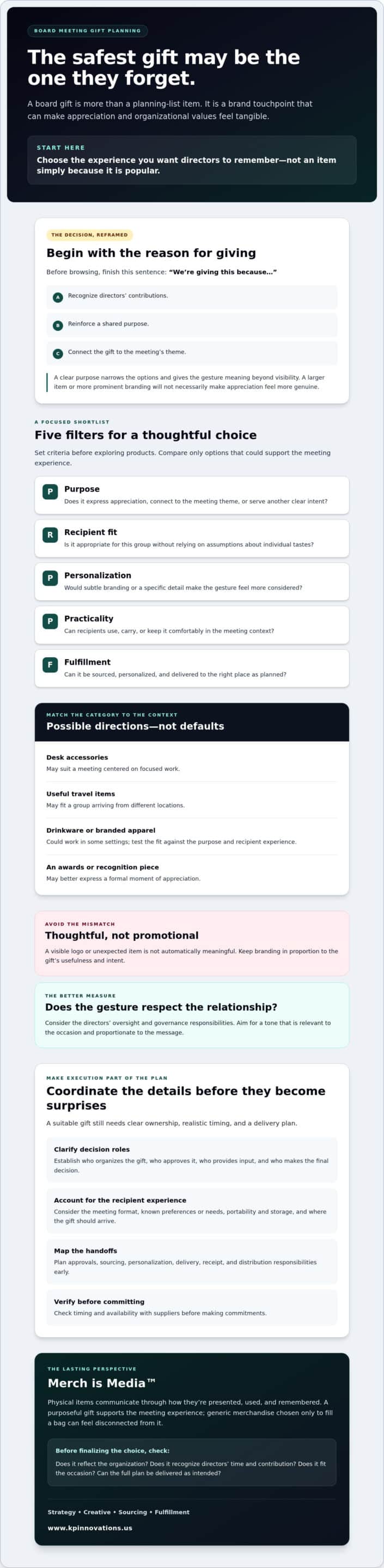
Start by completing this sentence: “We’re giving this because…” The answer might be to recognize directors’ contributions, reinforce a shared purpose, or connect the gift to the meeting’s theme. A clear reason narrows the options and gives the gift a purpose beyond visibility.
That context matters because directors are not just another event audience. A Board of directors has responsibilities tied to an organization’s oversight and governance. A meeting gift should respect that relationship: thoughtful in tone, relevant to the occasion, and proportionate to the message. A larger item or more prominent branding won’t necessarily make appreciation feel more genuine.
KP Innovations describes this principle as Merch is Media™. Physical items communicate through how they’re presented, used, and remembered. A purposeful gift supports the meeting experience. Generic merchandise chosen only to fill a bag can feel disconnected from it.
Who is choosing the gift and what constraints matter?
Before browsing, establish who is organizing the gift, who approves it, and who will receive it. Clarify the approval process so the person coordinating options knows whose input is needed and who makes the final decision. Assigning those roles early can prevent avoidable back-and-forth.
Next, note the setting and practical details that shape the recipient experience:
- Meeting format: Will directors receive the gift in person, or will it be part of another meeting-related experience?
- Recipient group: Are there known preferences or needs to account for without making assumptions about individuals?
- Portability and storage: Can recipients comfortably carry and keep the item?
- Delivery location: Where should the gift arrive, and who will receive and distribute it?
If the purpose or decision criteria aren’t clear yet, explore strategic merchandise planning. Defining the experience first gives sourcing a useful brief and makes it easier to choose a gift that feels connected to the organization rather than selected by default.
How to choose board of directors meeting gifts with a clear decision framework
A long product list can create the illusion of choice while making decisions harder. Set criteria first, then compare only options that could support the meeting experience. Consider a category because it serves a purpose, not simply because it’s popular or easy to put a logo on.
Use this framework to build a focused shortlist of board of directors meeting gifts:
| Criterion | Questions to ask |
|---|---|
| Purpose | Does it express appreciation, connect to the meeting theme, or support another clear intent? |
| Recipient fit | Is it appropriate for this group without relying on assumptions about individual tastes? |
| Personalization | Would subtle branding or a specific detail make the gesture feel more considered? |
| Practicality | Can recipients use, carry, or keep it comfortably in the meeting context? |
| Fulfillment | Can the item be sourced, personalized, and delivered to the right place as planned? |
Which gift categories fit a board meeting?
Think in categories, then test each option against the criteria. Desk accessories may suit a meeting centered on focused work. Useful travel items may fit a group arriving from different locations. Drinkware or branded apparel could work in some settings, while an awards or recognition piece may better express a formal moment of appreciation. These are possibilities, not universal recommendations. Confirm current availability and customization options before choosing a specific item.
Match the item to how it will be used. A portable gift may be easier to manage at an off-site meeting, while something intended for ongoing use should feel relevant beyond the event. Compare a practical item with a keepsake by asking which better supports the message, not which category is more familiar.
How much branding and personalization feels appropriate?
Branding sets a tone. A discreet mark can identify the organization without dominating the item. A recipient-specific detail can make the gesture feel personal when it’s appropriate and accurate. Prominent logo placement may suit some purposes, but if visibility becomes the main point, the gift can read like advertising.
Board members have formal responsibilities, including a fiduciary duty, as explained by Cornell Law School’s Legal Information Institute. That context is a useful reminder to keep the gesture respectful and clearly appreciative, rather than transactional. For broader context on merchandise as a brand touchpoint, see the guide to promotional products.
Keep the shortlist manageable. Compare a small set of options against the same criteria, then check availability and execution details. If sourcing is the challenge, strategic merchandise sourcing can help connect the choice to the intended experience and practical requirements.
The biggest board gift objection: will it feel thoughtful or promotional?
A board gift can feel transactional if the logo takes center stage and the item has little connection to the meeting. The issue isn’t simply whether the gift is branded. It’s whether the branding, usefulness, and presentation work together to express a clear intention.
Try this test: could you explain in one sentence why this gift belongs at this meeting? If the answer is only “it has our logo” or “we needed something for the gift bag,” revisit the choice. A gift connected to the organization’s culture, a shared moment, or the meeting’s purpose is easier to understand as a gesture of appreciation. As the Emily Post Institute’s corporate gift giving guidelines suggest, context and appropriateness matter in professional gifting.
The perceived meaning of a gift depends on its fit, context, and presentation. That’s the difference between merchandise used as a deliberate brand touchpoint and an assortment assembled just to increase the number of items.
How can a company avoid gifts that feel generic?
Give the selection a point of view. Tie it to the meeting’s central purpose or to a value the organization wants directors to experience. One coherent idea often feels more considered than several unrelated items gathered because each seemed appealing on its own.
Before approving production, review the full presentation from a director’s perspective. Consider how the gift will be introduced, what the packaging communicates, and whether the logo feels proportionate. Check that each element supports the same message. If it doesn’t, simplify. Thoughtfulness is often clearer when the choices feel connected, not crowded.
How should the team handle appropriateness and policy concerns?
Policies differ by organization, so don’t assume one rule applies to every board or recipient. Ask the designated internal contact, such as the person responsible for governance, compliance, or meeting approvals, to confirm any relevant gifting policy before selecting an item. Clarify who needs to review the choice and what information they need to approve it.
Avoid guessing what every director prefers or would welcome. Choose a gesture that’s respectful, consistent across the recipient group, and straightforward to explain to internal stakeholders. If a proposed gift raises questions, pause and get guidance rather than relying on assumptions about the relationship or recipient.
That discipline doesn’t make board of directors meeting gifts feel less personal. It helps ensure the gesture reflects the organization’s intent without creating confusion about why it was given. The goal isn’t to make a gift look expensive or unusually prominent. It’s to make its meaning clear.
Plan sourcing and delivery before the board meeting date is fixed
Gift logistics become harder when planning starts after every meeting detail is settled. Early planning doesn’t require a confirmed date or a product choice. It means defining what needs to happen, who owns each decision, and what information is still pending. That gives the team a clearer path once the schedule is approved.
Use this workflow to move board of directors meeting gifts from idea to delivery:
- Confirm the purpose. Write down what the gift should communicate and how it connects to the meeting.
- Define the audience. Estimate the recipient count, identify who will confirm the final quantity, and gather recipient information only as needed for distribution.
- Set the criteria. Agree on the recipient experience, personalization approach, packaging expectations, and practical requirements.
- Map approvals. Name the decision owner and confirm who must approve the concept, item, and artwork.
- Source with the brief in hand. Compare options against the agreed criteria, then confirm current availability and customization details with the supplier.
- Plan personalization and fulfillment. Approve brand assets and artwork, choose packaging, confirm shipping destinations, and decide who will receive or distribute the gifts.
- Reconfirm delivery. Check quantities, addresses, delivery arrangements, and timing before making commitments to stakeholders.
What information should organizers prepare for sourcing?
Gather the expected meeting date or planning window, recipient count, delivery locations, approved brand assets, and the name of the person authorized to make decisions. Clarify whether gifts will be handed out in person, shipped individually, or delivered to another location for distribution. Identify packaging and address details early, even if some are still provisional, because they can affect the plan.
For a managed option focused on business gifts, explore client gifting support.
How can a repeatable process prevent last-minute problems?
Set checkpoints for concept approval, product approval, artwork review, and fulfillment planning. At each checkpoint, record the owner, the decision needed, and any outstanding information. This helps surface gaps early, such as an unconfirmed quantity or a delivery address that hasn’t been approved.
Planning ranges and supplier estimates aren’t guarantees. Confirm product availability, customization options, and delivery timing directly before committing to stakeholders. Coordinated sourcing and fulfillment can reduce the number of details an organizer has to track across separate steps. For support aligning options with your requirements, work with a merchandise sourcing partner.
Make board meeting gifts part of a lasting brand experience
A board gift is one moment in a broader relationship, not a standalone gesture. Evaluate it against four questions: Does it serve the meeting’s purpose? Is it appropriate for the recipient group? Does it express the organization’s brand in a considered way? Can the team execute the plan with confirmed product, personalization, and delivery details? A strong choice should meet all four, not just look appealing in a product search.
This perspective reflects KP Innovations’ Merch is Media™ philosophy: physical items communicate through the experience they create and the way people use them. A gift can complement how directors are welcomed, recognized, and engaged while remaining one touchpoint in the organization’s wider relationship with them.
When does a board gift need a strategic partner?
Outside support can be useful when the objective is unclear, several stakeholders need to approve the choice, personalization requires coordination, or recipients will receive gifts at different locations. In those situations, product selection is only one part of the work. The organization also needs a clear process connecting the idea to sourcing and fulfillment.
KP Innovations approaches that work through a Chief Swag Officer model, providing strategic ownership across merchandise programs rather than treating each request as an isolated product order. Its team supports strategy, creative, sourcing, and fulfillment, with access to a selection of over 1.2 million products. That breadth creates options to explore, not a claim that every product will suit the brief or be available. Review KP Innovations sourcing services to see how sourcing can fit into a more coordinated approach.
What should the next step look like?
Before beginning a project conversation, write down four essentials: the meeting’s purpose, the recipient experience you want to create, the person responsible for decisions, and the known delivery needs. You don’t need a finished product idea. A clear brief is more useful than a long list of possibilities because it gives sourcing and fulfillment decisions a shared standard.
Then focus the conversation on what needs to be sourced, what must be personalized, who will approve each step, and how the gifts should reach directors. This shifts the work from browsing to planning and helps surface open questions before they become execution issues.
Ready to put those details into a coordinated plan? Plan a strategic sourcing project with KP Innovations.
Make the next board gift a deliberate brand touchpoint
The strongest board of directors meeting gifts begin with purpose, not a product search. Choose an option that fits the recipient experience and your organization’s values, then check that the branding, approvals, personalization, and delivery plan support the same intent. A clear decision owner and early coordination help turn a thoughtful idea into a well-executed gesture.
KP Innovations brings a merchandise strategy and brand experience approach grounded in Merch is Media™. Its team can explore a selection of over 1.2 million products and provide project management from design through global fulfillment. The goal isn’t to browse more. It’s to find an appropriate fit and coordinate the details around it.
If you’re ready to move from ideas to a sourcing plan, discuss a strategic sourcing project. With a clear purpose and the right support, your next board gift can leave directors with a meaningful impression of the organization.
Frequently Asked Questions
What are appropriate gifts for a board of directors meeting?
Appropriate gifts reflect the meeting’s purpose, the organization’s culture, and the directors’ context. Useful desk items, travel accessories, drinkware, or recognition pieces may be worth considering, but no category suits every board. Start by defining the message you want the gift to convey, then compare options for usefulness, portability, personalization, and presentation. Before approving a choice, check the organization’s internal gifting policies and approval expectations.
Should board of directors meeting gifts be personalized?
Personalization can make a gift feel more considered when it supports the purpose and suits the recipient group. It doesn’t have to mean adding each director’s name. A subtle brand mark or meeting-specific detail may be enough. Before approving production, confirm that artwork, spelling, and recipient information are accurate. Collect only the personal details needed to carry out the plan, and consider whether individual customization adds meaning or unnecessary complexity.
Are branded gifts appropriate for board members?
Branded gifts can be appropriate when the item and its presentation communicate appreciation rather than functioning mainly as an advertisement. Consider whether the item is useful, how prominent the branding feels, and whether both fit the organization’s culture. Ask the designated internal contact about applicable gifting policies and approvals. The aim is a thoughtful brand experience, not maximum logo visibility or an item chosen simply to display the organization’s name.
How do you choose a useful gift for directors with different preferences?
Start with shared context, such as the meeting’s purpose and the organization’s values, instead of trying to predict each director’s personal taste. Look for options with broad practical appeal, and avoid highly personal choices unless preferences are known and relevant. A consistent concept can still feel thoughtful through restrained personalization and careful presentation. The reason behind the gesture should be clear, even if the item itself is simple.
When should we begin sourcing board meeting gifts?
Begin once the meeting date, approximate recipient count, delivery approach, and approval owner are reasonably clear. The planning window depends on the chosen item, customization, availability, and fulfillment needs, so a generic timeline may not apply. Confirm current availability and timing with the sourcing partner before making commitments. Build checkpoints into the plan for concept approval, product selection, artwork review, and delivery coordination.
How can board meeting gifts be delivered to directors in different locations?
First decide whether gifts will be distributed at the meeting or shipped individually. Then confirm recipient information, delivery addresses, packaging preferences, and who will handle delivery questions or exceptions. Discuss destination coverage and fulfillment requirements with the sourcing partner before settling on an item. KP Innovations offers fulfillment and logistics services, including global fulfillment. Confirm the specific project scope, destinations, and requirements directly before finalizing the plan.