
What if branded apparel goes unworn because of the decisions behind it, not the logo? If past purchases missed the mark, you’re not alone in asking how to choose branded apparel that employees will actually wear. A garment creates value when it fits the person, the role, and the moment it’s meant for.
That means looking beyond color and logo placement. Employees have different preferences, work environments, and practical needs. Even a thoughtful selection can fall short if sizing, ordering, or distribution is difficult to manage. Apparel works best as part of the employee experience, not as a one-time product order.
This guide covers how to identify real use cases, offer meaningful choices, coordinate ordering and fulfillment, and assess whether your program is working. At KP Innovations, we believe Merch is Media™: what employees wear can shape how they experience the brand and their connection to the team. The goal is a program designed around people, supported by a clear operating plan, and measured against its intended purpose.
Key Takeaways
- Choose apparel for a defined purpose, such as daily workwear, onboarding, recognition, or events, rather than relying on logo visibility alone.
- Use employee roles, preferences, fit needs, and workplace context to shape a selection of branded apparel that employees will actually wear.
- Compare product-only purchasing with coordinated sourcing by considering employee choice, brand consistency, ordering effort, and distribution responsibilities.
- Bring marketing, HR, and operations into the buying process early to align apparel decisions with employee experience and fulfillment needs.
- Review feedback, participation, ordering patterns, and operational friction to understand whether apparel is working as a managed brand experience.
Why branded apparel that employees will actually wear starts with their needs
An apparel order can be approved, decorated, and handed out without becoming part of anyone’s regular wardrobe. The gap often starts with the brief: a company chooses a garment and focuses on getting its logo seen, without first asking whether employees would wear it in the settings that matter.
Logo visibility is easy to notice. Usefulness takes more thought. A prominent mark can’t make an uncomfortable fit, unsuitable style, or impractical garment feel right for the person wearing it. For branded apparel that employees will actually wear, start with the employee experience, then decide how the brand should appear. Promotional apparel can serve marketing and communication purposes, but its role in an employee program also depends on whether it fits real routines.
What makes employees reach for a garment again?
Repeat wear is more likely when a garment suits its wearer and intended setting. Consider comfort, fit, personal preference, and how the item will be used. Daily workwear may need to meet different expectations than event apparel, a recognition item, or onboarding apparel. Team identity can be a goal, but it doesn’t require assuming every employee wants the same option.
Ask employees what they would use and consider how different roles work. A short feedback check or conversations with representative teams can reveal needs a central buyer might miss. Use those insights as selection criteria, not simply as a vote on logo size.
Why a logo-first brief can miss the mark
Starting with decoration narrows the decision before the need is clear. It can steer discussion toward placement and visibility while leaving key questions unanswered: Who will wear this? Where? For what purpose? Once those answers guide garment and decoration choices, the brand can feel considered rather than imposed. A visible logo can’t compensate for an item employees find unsuitable.
The Merch is Media philosophy offers a useful lens. Apparel is a brand touchpoint experienced in everyday life, not just a surface for a logo. Its fit, feel, relevance, and context all shape that experience. The goal isn’t to make every employee wear the same thing. It’s to connect the brand to how people actually work and participate.
Before selecting apparel, define the experience you want to support. Then use employee input to shape the garment, decoration, and distribution approach. This gives the brand a meaningful role without asking the logo to solve a problem the garment itself hasn’t addressed.
How to choose branded apparel around fit, function, and employee context
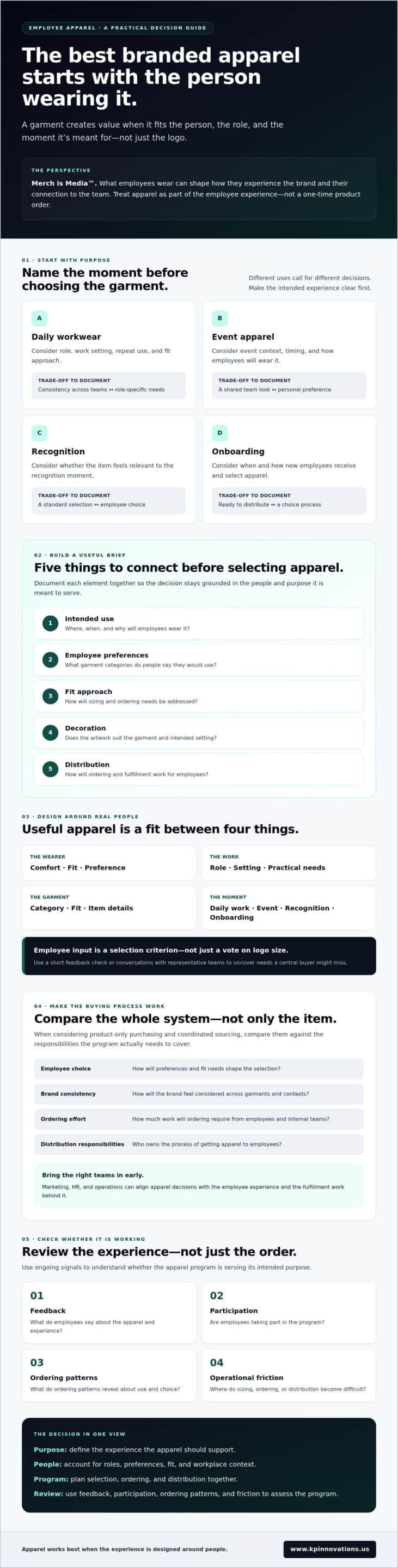
Turn employee needs into a brief the team can use to compare options. For each apparel choice, document five things: intended use, employee preferences, fit approach, decoration, and distribution. This keeps decisions connected. The right option for an event may not suit daily work, and one selection may not work across roles or locations.
Match apparel choices to the work and the wearer
Start with the setting. Ask where and when employees are expected to wear the garment, what their work involves, and what they find comfortable and appropriate. Gather input on preferred garment categories and sizing or ordering needs. Then confirm the selected garment’s details with the supplier. Materials, fit, decoration methods, and performance depend on the specific item, so verify them rather than assume.
Separate the purpose before comparing options:
| Use case | What to consider | Trade-off to document |
|---|---|---|
| Daily workwear | Role, work setting, repeat use, and fit approach | Consistency across teams versus role-specific needs |
| Event apparel | Event context, timing, and how employees will wear it | A shared team look versus personal preference |
| Recognition | Whether the item feels relevant to the recognition moment | A standard selection versus employee choice |
| Onboarding | When and how new employees receive and select apparel | A ready-to-distribute option versus a choice process |
Apply the same criteria to decoration. Confirm that the artwork suits the garment and intended setting, and review a proof before approval. Keep the brand consistent, but don’t let decoration decisions take the place of checking whether the apparel fits the use case.
Decide how much choice employees should have
A centrally selected option can simplify decisions and support a consistent look, but it may not suit every role or preference. A defined range of approved choices can make a program more relevant, while requiring clear ordering rules and inventory coordination. The right balance depends on the workforce and how apparel will be distributed.
For a broader employee-facing program, consider employee program support. A sourcing partner can help compare options against the brief and verify item details with suppliers. Learn about apparel sourcing support. A disciplined comparison is a practical step toward branded apparel that employees will actually wear.
Compare sourcing approaches before committing to an apparel program
The right sourcing model depends on the work your team needs to own and the experience you want employees to have. A single, clearly defined apparel need may call for a straightforward product order. A recurring program with multiple audiences, ordering cycles, or distribution needs may require more coordination. Neither approach suits every organization. The key question is where decisions and responsibilities will sit.
Product order or managed program: what is the difference?
With a product-only purchase, the buyer typically connects the steps: define the need, select apparel, provide artwork, review proofs, coordinate approvals, collect orders, and arrange distribution. This can work for a limited, one-time need when an internal owner has the time and information to manage each step.
A managed program brings those workstreams together under a coordinated plan. The buyer still sets priorities and approves decisions, while planning, creative, sourcing, ordering, and fulfillment can be handled as connected parts of the program. Explore apparel program management when ongoing coordination is part of the challenge.
Compare the trade-offs before choosing:
- Employee choice: A single selection is simpler to administer. A defined set of approved options can serve varied preferences but needs clear ordering rules.
- Brand consistency: Central selection can make visual standards easier to apply. Multiple choices require clear artwork and usage guidelines.
- Ordering administration: A one-time order may involve fewer recurring decisions. Ongoing programs need an owner for approvals, ordering, and updates.
- Distribution: A direct handout may suit a defined occasion. Distribution across teams or locations requires a plan for getting apparel to employees.
When custom or private label apparel makes sense
Existing apparel can be a sensible choice when the need is specific and the garment supports its intended use. Custom apparel or private label development may be worth considering when the brand needs more control over creative direction and identity. That choice also involves evaluating the development and approval work, not just the finished garment.
In either case, confirm garment, decoration, and sourcing details with the supplier before approval. Don’t assume a particular material, fit, performance feature, availability, or timeline without verification. Keep the decision tied to the employee use case and the program’s operating needs.
Make responsibilities visible: who sets the brief, approves artwork, coordinates orders, and manages distribution? Clarity about those roles helps teams select a model suited to their capacity and create a more coherent employee experience.
Build an employee apparel buying process that avoids preventable friction
A clear process connects the employee experience to the operational details. Involve marketing, HR, and operations before finalizing choices. Marketing can guide brand use, HR can represent employee needs, and operations can flag ordering and distribution requirements. Assign an owner to each decision so approvals and handoffs don’t get lost.
Set the brief before selecting garments
Document who the apparel is for, when and where it will be used, what brand experience it should support, and what constraints the program must account for. Agree on who approves the design and how employee input will shape the selection. If you’re still defining the program’s purpose and direction, explore merchandise strategy services.
Use this five-step sequence to move from intent to execution:
- Define the purpose. Clarify whether the apparel supports daily work, an event, onboarding, recognition, or another specific need.
- Gather employee input. Ask relevant teams about preferred garment categories, intended use, and what would make the apparel practical for them.
- Set selection criteria. Agree on fit considerations, approved choices, decoration, and how the decision will balance employee needs with brand consistency.
- Confirm the artwork. Identify the design approver, review placement and scale on the selected garment, and confirm the final proof before production.
- Plan distribution. Decide how employees will make selections, provide sizing information, and receive their apparel.
Plan ordering, sizing, and distribution together
Don’t treat fulfillment as a final detail. For each program, confirm how sizes will be collected, how orders will be placed, what inventory process applies, and how apparel will reach employees. The right approach depends on the program, so establish responsibilities with the project team instead of assuming one process will fit every group.
If employees need a structured way to order from a set of pre-approved options, a company store may be worth considering. Decide who will maintain the approved selection and how employees will be guided through ordering. Clear instructions and ownership can reduce avoidable questions and support a consistent experience.
Planning these steps together gives branded apparel that employees will actually wear a better chance of fitting both the employee experience and the realities of execution. If you’re comparing apparel options or coordinating supplier details, explore sourcing support as part of your planning process.
Make branded apparel a managed employee experience, not a one-time order
Apparel can support onboarding, recognition, team identity, or uniforms, but each purpose calls for a different measure of success. For onboarding apparel, assess whether new employees find the selection relevant and know how to order it. A uniform program may call for closer attention to employee feedback and the process for getting the right items to the right people. The garment is one part of the experience. How people receive and use it matters too.
That’s the idea behind Merch is Media™. Apparel is a brand touchpoint, so its value isn’t captured by counting logos alone. A program needs clear goals and a way to learn from how employees interact with it.
Review whether the program is working
Before launch, agree on what you want the program to do. Choose measures that match that purpose rather than relying on assumed benchmarks. Review employee feedback about relevance, fit, ordering, and the experience of receiving apparel. Participation and ordering patterns can also offer useful signals. Recurring questions or delays may point to operational friction.
Look for themes, not just totals. If employees say ordering is confusing, improve the instructions or process. If feedback points to a mismatch between the apparel and its intended use, revisit the selection. Use what you learn to guide future decisions, and avoid claiming impact the program hasn’t measured.
What a strategic sourcing partner can coordinate
Sourcing works best as part of a connected program. Strategy establishes the purpose and audience. Creative development shapes how the brand appears. Sourcing helps identify options for evaluation, while program management and fulfillment connect decisions to ordering and distribution. KP Innovations has access to more than 1.2 million products as a sourcing capability. The right choice still depends on employee needs and confirmed item details.
If employees need a structured way to order approved apparel, an online company store may be a suitable channel. Define its role within the wider program, including who maintains approved options and how orders will be handled.
A coordinated approach can help teams manage decisions across strategy, creative, sourcing, and fulfillment instead of treating each apparel purchase as a disconnected task. It also gives the organization a practical way to review feedback and refine the employee experience over time. That’s how a program can work toward branded apparel that employees will actually wear, with decisions guided by purpose and real signals rather than assumptions.
To discuss the sourcing needs behind your employee apparel program, connect with KP Innovations about apparel sourcing.
Make your next apparel program work harder
Apparel earns a place in employees’ routines when decisions start with their needs, roles, and real use cases. The logo matters, but fit, relevance, and a workable ordering and distribution plan shape the experience around it. Treating apparel as a managed program also gives your team a way to learn from employee feedback and refine future choices.
That’s the value of the Merch is Media™ perspective. Each garment is a brand touchpoint, and the full experience includes the decisions behind it, from strategy and creative through sourcing and fulfillment. KP Innovations offers access to more than 1.2 million products and project management from design through global fulfillment to support a coordinated approach.
If you’re ready to build branded apparel that employees will actually wear, start by defining the employee experience you want to support. Then shape the apparel program around it, with decisions guided by real needs and a clear plan for ordering and fulfillment.
Frequently Asked Questions
How do you choose branded apparel employees will actually wear?
Start by defining who will wear it, where, and for what purpose. Ask employees about their preferences and practical needs before selecting garments or decoration. Compare options against agreed criteria such as fit, comfort, relevance, brand consistency, and distribution. Confirm product details with the supplier, then review feedback and participation after rollout. Use what you learn to guide future decisions.
Should employees get to choose their own branded apparel?
Employee choice can make an apparel program more relevant, but the approach should fit your organization’s goals and operating needs. Decide which options employees can select, how those choices will follow brand guidelines, and how orders will be managed. A defined range of approved options may balance personal preference with consistency. After rollout, ask employees whether the choices and ordering process worked for them, then use their feedback to refine the program.
What type of branded apparel is best for employees?
There isn’t one best garment for every employee or workplace. The right choice depends on its intended use, work environment, employee preferences, fit needs, and distribution plan. First define what the apparel needs to support, such as daily work, an event, onboarding, or recognition. Then compare suitable categories with employees and stakeholders. Confirm material, sizing, and performance details for each specific garment with the supplier before making claims or finalizing a selection.
How can a company avoid ordering branded apparel employees will not wear?
Don’t choose apparel based only on the logo or a decision-maker’s preference. Define the use case, ask employees for relevant input, and assess whether the garment suits its setting and intended wear. Before committing, confirm how sizes will be collected, how orders will be placed, and how apparel will be distributed. Afterward, gather feedback and review participation. Those signals can help the next decision reflect actual employee experience rather than assumptions.
Is custom apparel better than standard branded apparel for employees?
Custom apparel isn’t automatically better than selecting existing apparel. Custom development may suit a need for more control over brand identity or creative direction. Existing apparel may work when the use case is clear and an option meets employee and program needs. Compare both approaches based on purpose, employee preferences, approvals, sourcing, and fulfillment. Verify garment details and availability with the supplier before deciding which route makes sense for your program.
How do you measure whether an employee apparel program is successful?
Define success before launch, based on what the program is meant to support. Useful signals can include employee feedback, participation, ordering patterns, and administrative friction. For example, repeated questions about sizing or ordering may point to a process that needs clarification. Don’t rely on an assumed industry benchmark or logo visibility alone. Review the evidence with relevant stakeholders, then use the findings to adjust future apparel selections and program operations.
Can a company store help manage employee apparel orders?
A company store can give employees a structured place to order approved apparel when that suits the program. Before choosing a store, clarify which options employees can select, how orders will be processed, and how fulfillment will work. Compare this route with other ordering approaches based on employee access, brand consistency, and the administrative work involved. Confirm the provider’s specific capabilities so the ordering channel fits your program’s requirements.
To plan branded apparel around your employees’ needs, contact KP Innovations about apparel sourcing.