
What if the best branded apparel for a professional services firm isn’t the piece with the biggest logo, but the one that supports confidence in the moments that matter? A generic shirt can feel out of place in a client meeting. A considered apparel choice can reinforce the firm’s identity while respecting the setting and the person wearing it.
A polished, consistent appearance doesn’t require every employee to dress alike. Apparel works best when it reflects the people who’ll wear it and the experiences they help create. That’s the idea behind “Merch Is Media™”: what your team wears can shape how people experience your brand.
This guide explains how to choose apparel for your firm’s identity and client-facing needs, balancing comfort with a cohesive presentation. It also covers how to coordinate selection, production, sizing, and reorders as an ongoing program rather than a one-time order. The goal is a managed brand experience that works for your people and the moments they represent.
Key Takeaways
- Match apparel choices to the impression you want to create in client meetings, team events, onboarding, and public-facing work.
- Evaluate brand fit, comfort, setting, intended use, and likely wear frequency before narrowing garment options.
- Choose between a consistent Uniform Program and a flexible apparel collection based on where consistency matters and where employees need choice.
- Build branded apparel for a professional services firm around clear objectives, defined audiences, and ongoing program ownership.
- See how KP Innovations’ Chief Swag Officer model connects strategy, creative, sourcing, production, program management, and fulfillment.
Why Branded Apparel for a Professional Services Firm Is More Than a Logo
A logo identifies the firm, but it doesn’t make an apparel choice right for the person wearing it or the moment they represent the business. For a consulting team meeting a client, a real-estate team hosting an open house, or a technology firm welcoming new colleagues, start by asking what the apparel should communicate in that setting.
Strategic branded apparel is a planned brand touchpoint, chosen to suit the people, purpose, and setting where it will be worn. That perspective reflects “Merch Is Media™”: apparel carries the brand into real interactions, so the experience matters as much as the mark on the garment.
Where apparel meets the professional-services brand experience
Employees embody a firm’s brand through their expertise, conduct, and the details clients encounter while working with them. Apparel is one of those details. An item selected only because it can carry a logo may feel disconnected from the firm’s standards or the wearer’s role. Purposeful apparel starts with a reason for being worn and a clear impression to support.
Consider how that plays out across professional settings:
- A legal team may want apparel for an internal gathering that reflects its culture without resembling courtroom attire.
- A financial firm could choose a coordinated look for a client event that suits the formality of the occasion.
- A real-estate team may need a recognizable, comfortable option for public-facing work, while a consulting team may prioritize apparel for off-site collaboration.
- A technology firm could use apparel to welcome new employees and help them feel part of the team.
These examples aren’t prescriptions. They show why context should lead the decision. KP Innovations connects apparel to broader merchandise strategy and brand experience services, rather than treating a logo as the whole brief.
Why a single apparel approach may not fit every firm moment
A client presentation, an onboarding welcome, a team event, and everyday office wear each have different audiences and expectations. A coordinated look might make sense for a public-facing role, while an internal event may call for more individual choice. Consistency doesn’t require identical garments in every situation. It means the choices feel intentional and recognizably connected to the firm.
Before selecting apparel, define the moment and the experience you want to support. Who will wear it, and who will see it? Is the goal to welcome, identify, unite, or outfit a team for a particular setting? Those answers help prevent a common misstep: approving an item because it looks on-brand in a mockup, then finding it doesn’t suit the way people will use it.
Apparel is one part of a wider merchandise program, not a substitute for thinking across branded items and interactions. For that broader view, see What Are Promotional Products? A Complete Guide to Branded Merch. A clear purpose for apparel gives the firm a stronger starting point for the practical choices that follow.
How to Evaluate Branded Apparel for Your Firm
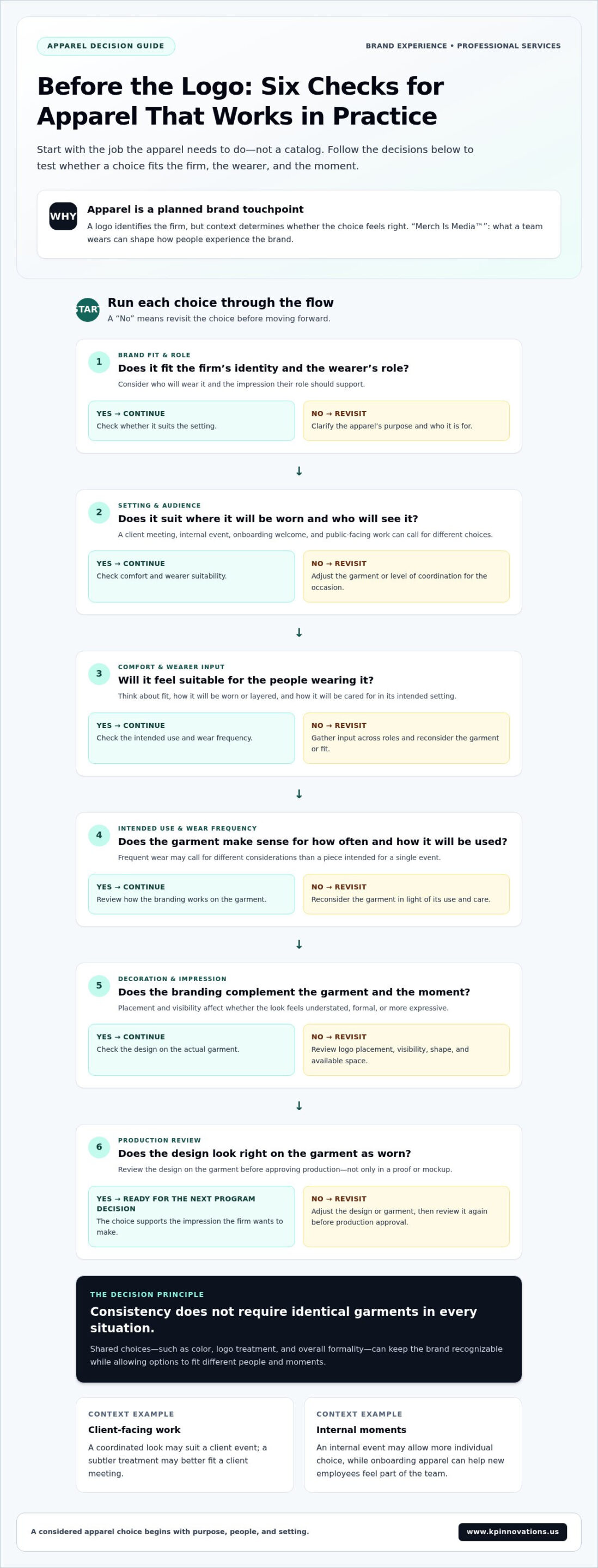
Start with the job the apparel needs to do, not a catalog. The right choice should fit your firm’s identity, the wearer’s role, the setting, and how often the item is likely to be used. A considered evaluation helps avoid apparel that looks right in a proof but feels out of place in practice.
Assess every option for brand fit, comfort, setting, intended use, wear frequency, and decoration before choosing a garment. This checklist keeps the decision focused without assuming one style works for every person or occasion.
Match apparel to role, setting, and wearer
A client-facing team may need a more coordinated presentation than employees attending an internal event. An event choice should suit its audience and activities, while recognition apparel should feel relevant to the people receiving it. These different needs can coexist within a consistent brand system.
Comfort, fit, and wearer input matter because employees are more likely to use apparel that feels suitable for their day. Gather input across roles and consider how the piece will be worn, layered, or cared for in its intended setting. A real-estate professional working with clients, for example, may have different needs from a technology employee wearing apparel at a team gathering.
Role-specific choices don’t have to dilute the firm’s identity. Shared decisions about color, logo treatment, or overall formality can create cohesion while allowing variation in what people wear.
Assess customization and production decisions
Branding should complement the garment, not overwhelm it. Placement and visibility affect whether apparel feels understated, formal, or more expressive. A prominent mark might suit a public-facing team event, while a subtler treatment may better match a client meeting. Consider the garment’s shape and available space, as well as how the decoration looks when worn.
Material, construction, and decoration choices should follow the intended use. Apparel for frequent wear may call for different considerations than a piece for a single event. Before approving production, review how the design appears on the garment and whether it supports the impression your firm wants to make.
For deeper manufacturing considerations, the guide Choosing the Right Apparel Factory: A Strategic Guide for Brands in 2026 explores custom apparel production decisions within a broader sourcing process. KP Innovations’ Product Sourcing connects those choices to the apparel program’s purpose, rather than treating sourcing as a standalone transaction.
Uniform Program or Flexible Apparel Collection: Which Fits Your Firm?
The right apparel model depends on how your firm works. Some roles benefit from a coordinated appearance that’s easy to maintain. Other moments call for choice, variety, or apparel selected for a particular experience. For branded apparel for a professional services firm, the decision isn’t whether consistency or flexibility is better in general. It’s which approach supports your teams and objectives.
A Uniform Program sets shared expectations for defined roles or settings. A flexible collection gives people or teams options within an intentional brand framework. Some firms may use one approach across their apparel; others may use both for different purposes.
| Consideration | Uniform program | Flexible apparel collection |
|---|---|---|
| Consistency | Emphasizes a coordinated presentation for specified roles or settings. | Uses shared brand cues while allowing different apparel choices. |
| Wearer choice | Follows clearer guidelines about what to wear. | Offers options suited to individual preference or occasion. |
| Use context | May fit recurring work where a recognizable team appearance matters. | May fit events, onboarding, recognition, or selected internal moments. |
| Ongoing coordination | Requires consistent guidelines for sizing, presentation, and reorders. | Requires a clear framework to keep choices connected to the firm’s identity. |
When a consistent uniform program makes sense
A coordinated program can suit teams whose roles benefit from being readily recognizable, such as employees welcoming visitors, representing the firm at an event, or working in a shared client-facing setting. The value isn’t simply that everyone wears the same thing. It’s that people understand what fits the role and how the firm wants to present itself.
Clear guidelines help keep sizing, presentation, and reorders organized as team needs change. KP Innovations’ Uniform Programs connect apparel choices to ongoing coordination, rather than treating each order as an isolated decision.
When a flexible collection better serves the experience
Flexibility may be more appropriate when the purpose varies by moment. An onboarding welcome, an internal culture event, a recognition occasion, and client gifting don’t necessarily call for the same apparel. A shared color direction, logo treatment, or design standard can keep a collection cohesive without requiring everyone to wear an identical garment.
Think of apparel as one channel within a broader merchandise strategy, alongside other items and experiences chosen for distinct audiences and purposes. The guide What Are Promotional Products? A Complete Guide to Branded Merch explores that wider perspective. A well-managed apparel program can support the experience, but it can’t guarantee trust, sales, or engagement on its own. The fit between purpose, people, and execution matters.
Plan a Branded Apparel Program Your Team Can Actually Use
A useful apparel program starts before anyone chooses a garment. Define the experience it should support, decide who it serves, and establish who will own the work after the first order. That sequence helps keep a branded apparel program connected to business needs as teams, roles, and occasions change.
A clear merchandise strategy turns those decisions into a brief instead of a collection of disconnected requests. Use this planning sequence to make the brief actionable:
- Set the purpose. Clarify what the apparel should support, such as welcoming new employees, coordinating a client-facing team, or creating a shared experience at a firm event. Name the intended experience before discussing products.
- Define the audiences and settings. Identify the wearer groups, where they’ll use the apparel, and who may see it. Separate needs that differ by role or occasion rather than assuming one choice serves everyone.
- Agree on brand and practical requirements. Document the brand cues to carry through, the desired level of coordination, wearer considerations, and distribution needs. Invite input from the teams responsible for brand, people, and operations so the brief reflects how the program will work in practice.
- Choose the apparel and production approach. Once the purpose is clear, evaluate garments, decoration, and distribution against the brief. Keep the choices tied to the intended use, and define who approves designs and production decisions.
- Assign ongoing ownership. Decide who gathers employee feedback, manages approved options, coordinates orders, and handles reorders. Set a process for reviewing whether the apparel still suits its audience and purpose.
Set the brief before choosing apparel
Make the brief specific enough to guide decisions, but flexible enough to reflect different wearer groups. For example, identify which teams need a coordinated client-facing presentation and which apparel moments are intended for internal culture or onboarding. Include the people who understand brand standards, employee needs, and operational coordination. Their shared input can surface practical issues before a selection becomes a production decision.
Build for repeatability, not a one-time order
A repeatable program makes it clear how employees access approved apparel and how the firm coordinates future orders. KP Innovations’ Company Stores support setup, budgeting, self-serve ordering, and reporting within a defined program. For apparel with consistent role-based needs, Uniform Programs provide a framework for sizing, reorders, and store integration.
Feedback should have a path back to the program owner. Capture what employees use, what they find suitable, and where sizing or access creates friction. Revisit those signals before reorders, and keep brand guidelines and approved choices aligned as needs evolve. This is the difference between repeating an order and managing a program.
For a coordinated sourcing approach, explore apparel sourcing with KP Innovations.
From Apparel Order to Brand Program: The KP Innovations Approach
Once your firm has clarified the purpose, audience, and operating needs for its apparel, the next question is ownership. A traditional vendor may focus on supplying a requested item and delivering an order. A strategic partner considers how apparel fits into the broader merchandise program, how decisions connect across teams, and what needs to happen after production.
KP Innovations works through a Chief Swag Officer model: a single point of ownership across the merchandise ecosystem. Rather than treating apparel as a product-only transaction, this model connects Merchandise Strategy, Creative Development, Product Sourcing, Production Management, Program Management, and Fulfillment. The goal is to align decisions from the initial brief through the experience of receiving and using the apparel.
What strategic ownership changes for the firm
With a connected program, brand intent can guide creative choices, sourcing, production, and fulfillment instead of being reconsidered separately at each handoff. Program Management coordinates the work and keeps the apparel’s purpose in view. That structure gives internal teams a clearer way to manage decisions and revisit them as needs change.
“Merch Is Media™” captures why this matters. Apparel is a brand-experience channel: its design, use, and delivery contribute to how employees and clients encounter the firm. It isn’t a generic giveaway, and it can’t guarantee trust, sales, or engagement by itself. Its role is to support a purposeful experience alongside the people, service, and relationships that define the firm.
For firms that want one partner to guide the program across those stages, the Chief Swag Officer model brings that ownership together.
How apparel fits into a broader merchandise ecosystem
Apparel rarely exists in isolation. Onboarding may combine clothing with other welcome materials; a client-facing occasion may call for apparel alongside event materials; and ongoing employee needs may benefit from an organized ordering approach. Company Stores provide a structured way to access approved merchandise, while Fulfillment covers warehousing, kitting, shipping, and tracking. These elements should serve the program’s purpose, not add complexity for its own sake.
For employee apparel that needs continued coordination, Uniform Programs can connect sizing, reorders, and store integration. KP Innovations’ apparel-related client testimonials include Chad Sierer of McLaren Philadelphia, who describes work involving duffle bags, polos, hats, and private-label apparel, and Mike Noce of RDS Automotive Group, who describes custom polos, hats, and charity event apparel. These examples show the range of apparel work, not a promise that a particular garment or program will produce the same result for every firm.
If your team is ready to connect apparel decisions with sourcing and program needs, build a strategic apparel program with KP Innovations.
Make the Next Apparel Decision Count
The next step isn’t necessarily a larger apparel order. It’s deciding what your firm wants the next apparel moment to make easier, clearer, or more considered for the people involved. That could mean refining an existing approach or creating a focused program around one team or use case.
Keep the brief close to the experience you want to shape. When the purpose is clear, sourcing becomes a deliberate part of how the firm expresses its identity, rather than a purchasing task driven by a logo or deadline. That’s the difference between choosing branded apparel for a professional services firm and building apparel into the way your brand is experienced.
KP Innovations can connect apparel sourcing to the needs and direction of your broader merchandise program. Plan your apparel sourcing approach with a clear purpose and a partner focused on the whole program.
Start with the moment you want to improve, then build from there. A thoughtful next step can help your apparel program grow with your people and your firm.
Frequently Asked Questions
What should a professional services firm look for in branded apparel?
Look for a clear fit between the apparel, the firm’s identity, and the setting where people will wear it. Consider whether the piece suits the team’s role, whether employees find it comfortable, and whether the branding supports the intended impression. For branded apparel for a professional services firm, also think about how the item will be used after its first occasion. A choice that fits real work routines is more purposeful than one selected mainly for its logo space.
Should a professional services firm use uniforms or offer flexible branded apparel?
Choose based on how much coordination different roles and moments require. A firm with employees who regularly welcome clients in a shared setting may benefit from clear apparel guidelines. A firm whose teams work across varied roles and occasions may prefer a flexible set of approved choices. Some organizations can use both, with defined expectations for particular roles and more choice for internal events. Decide what needs consistency, then allow flexibility where it serves the wearer and occasion.
How can branded apparel support a professional firm’s client experience?
Apparel can help clients understand who represents the firm during an interaction, while reinforcing a considered, coordinated impression. For example, a consultant leading a client workshop might wear apparel that feels aligned with the firm but doesn’t distract from the discussion. A real-estate team hosting visitors could use a shared visual cue to make staff easier to identify. Apparel supports the experience; clients’ trust still depends on the quality of the interaction and service.
How do you choose branded apparel employees will actually wear?
Involve employees before finalizing the selection. Ask people in different roles what would suit their workday, and gather practical input on comfort, fit, and how they expect to use the item. Review sample options with a representative group and collect feedback before making a broader decision. Make room for meaningful choices where appropriate, such as different approved options for distinct roles. Their input can reveal a mismatch between an appealing concept and everyday use.
What branding method is best for professional services apparel?
There isn’t one method that suits every garment and presentation. Consider how prominent the firm wants its branding to be, the design’s level of detail, the garment’s surface, and the setting where it will be seen. A subtle treatment may suit a formal client interaction, while a more visible mark could make sense at a team event. Review a production proof against the garment and intended use before approving the final design.
How can a firm manage sizing, reorders, and consistency across teams?
Give the process a clear owner and maintain a current reference for approved apparel, sizing information, and decoration choices. Record reorder decisions so teams aren’t relying on old email threads or individual memory. When employees join or roles change, provide a defined way to request the appropriate apparel. Review feedback and ordering patterns before replenishing, so recurring issues can inform the next decision. Company Stores can centralize access to approved options and support ongoing ordering.
Can branded apparel be part of an employee onboarding or recognition program?
Yes. Apparel can be included in an onboarding experience or used as part of recognition when it connects meaningfully to the employee or milestone. For a new hire, pair an apparel choice with information that explains the team’s culture and how the item fits into their role. For recognition, consider whether the recipient would value and use it. Employee Programs can connect apparel with broader onboarding and culture experiences, rather than treating it as an isolated handout.
How should a company measure whether its apparel program is working?
Set measures that reflect the program’s purpose. For onboarding, track whether new employees receive the intended apparel and ask how useful it feels. For a client-facing team, gather wearer feedback and observe whether the apparel suits the situations it was designed for. Reorder activity, participation, and recurring fit concerns can reveal operational patterns. Compare results with the original objective, and avoid attributing business outcomes to apparel alone. Use what you learn to refine the program.