
Your branded merchandise strategy might be the most undermanaged asset in your entire marketing budget. Not because you’re not spending money on it, but because most companies treat it like a procurement task instead of what it actually is: a media channel.
You already know something’s off. There are boxes of forgotten quarter-zips stacked in a supply closet. The last batch of conference giveaways cost a small fortune to ship and disappeared into tote bags, never to be seen again. And when someone asks what the ROI was on all of it, the honest answer is: nobody knows.
That’s not a vendor problem. It’s a systems problem.
This article is for marketing leaders, HR teams, and executives who are ready to stop treating merchandise as a line item and start managing it like the brand asset it is. You’ll learn how to move from reactive, one-off orders to a fully managed merchandise program that reinforces your culture, strengthens loyalty, and actually gets measured. We’ll walk through what a strategic approach looks like, why the old model keeps failing, and what it takes to build a system that works.
Key Takeaways
- A strong branded merchandise strategy is not a series of one-off orders — it’s a managed system with measurable outcomes, and most companies are losing budget because they’ve never built one.
- Merchandise functions as a long-term media channel, and when evaluated by cost-per-impression, it often outperforms digital advertising in ways most marketing teams have never stopped to calculate.
- Operational failures — overstocked closets, untracked inventory, and inefficient fulfillment — quietly destroy both brand equity and budget, and they’re entirely preventable with the right infrastructure.
- There is a meaningful difference between sending a gift and running a recognition program, and that distinction determines whether your merchandise builds lasting loyalty or gets forgotten in a drawer.
- The most effective merchandise programs are run by a dedicated strategic partner — not a vendor — who owns everything from creative direction and sourcing to fulfillment and performance measurement.
The ‘Swag Gap’: Why Most Branded Merchandise Strategies Fail
There’s a specific moment most marketing leaders recognize immediately: you’re standing in a supply closet, surrounded by boxes of branded items nobody ordered strategically, nobody tracked carefully, and nobody can quite explain. The budget was spent. The brand was represented. And yet nothing meaningful happened.
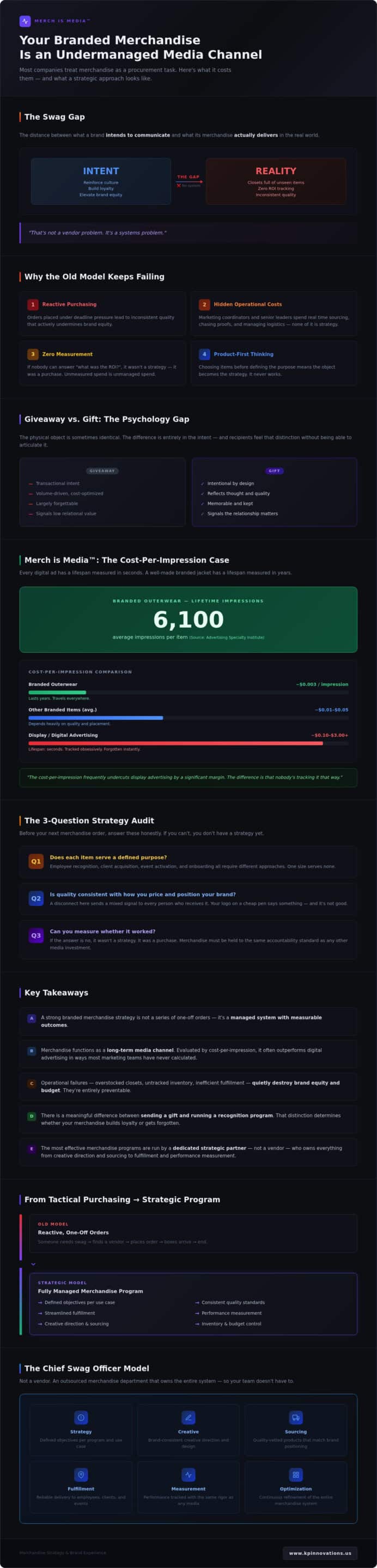
That disconnect has a name. The Swag Gap is the distance between what a brand intends to communicate and what its merchandise actually delivers in the real world.
Closing that gap isn’t a creative problem. It’s a systems problem. And it starts with understanding why the traditional approach to merchandise keeps producing the same disappointing results.
The Hidden Operational Costs of Tactical Purchasing
When there’s no system in place, someone still has to manage the work. That someone is usually a marketing coordinator, an office manager, or, in smaller organizations, a senior leader who has better things to do. They’re sourcing vendors, chasing proofs, coordinating shipping logistics, and fielding complaints about sizing. None of that is strategy. All of it takes time.
The operational drag is real, but the brand damage is worse. When merchandise is purchased reactively, quality becomes inconsistent. One quarter the conference giveaway is a well-made item that reflects the brand well. The next quarter, under time pressure and budget constraints, it’s something cheap that communicates exactly the wrong thing. Recipients notice. They may not say anything, but they form an impression, and that impression sticks.
A weak branded merchandise strategy doesn’t just waste money. It actively works against the brand equity you’re spending everywhere else to build.
Moving from Product-First to Strategy-First Thinking
Here’s the uncomfortable truth about your logo on a cheap pen: it’s not neutral. It signals something. When someone receives a low-quality item bearing your brand, the implicit message is that this is how much you value the relationship. That’s a liability, not a marketing win.
The psychology matters here. A giveaway is transactional. It’s volume-driven, cost-optimized, and largely forgettable. A gift is intentional. It reflects thought, quality, and an understanding of the recipient. The physical object is sometimes identical. The difference is entirely in the intent behind it, and recipients can feel that distinction without being able to articulate it.
Auditing your current merchandise spend for strategic alignment doesn’t require a complex framework. Start with three honest questions:
- Does each item serve a defined purpose? Employee recognition, client acquisition, event activation, and onboarding all require different approaches.
- Is quality consistent with how you price and position your brand? A disconnect here sends a mixed signal to everyone who receives it.
- Can you measure whether it worked? If the answer is no, it wasn’t a strategy. It was a purchase.
The shift from buying items to building brand experiences isn’t philosophical. It’s operational. It requires treating merchandise the way you treat any other managed media channel: with defined objectives, consistent standards, and accountability for outcomes.
Merch is Media™: A New Framework for Brand Elevation
Every digital ad you run has a lifespan measured in seconds. A well-made branded jacket has a lifespan measured in years. That’s not a minor distinction. It’s the entire argument for treating merchandise as a media channel in its own right.
The Merch is Media™ philosophy reframes how brands should think about physical touchpoints. A premium item placed in the right hands isn’t a giveaway. It’s an impression that compounds over time, travels through offices, homes, and airports, and carries your brand into spaces no paid placement ever could.
The numbers support this. According to the Advertising Specialty Institute, a branded outerwear item generates an average of 6,100 impressions over its lifetime. Divide a quality item’s cost by those impressions, and the cost-per-impression frequently undercuts display advertising by a significant margin. The difference is that nobody’s tracking it that way. They’re comparing the cost of a jacket to the cost of a click, which is the wrong comparison entirely.
Three principles define what makes merchandise function as media:
- Utility. Items people actually use generate impressions naturally. A bag, a water bottle, a quality notebook — these travel. They’re seen. They work for your brand without any additional spend.
- Longevity. The longer someone keeps an item, the more impressions it generates. Cheap items get discarded. Premium items get kept. The difference in retention isn’t marginal; it’s the entire ROI story.
- Brand Resonance. An item that feels consistent with your brand’s positioning reinforces your identity every time it’s used. An item that doesn’t sends a contradictory signal. Resonance is what separates merchandise that builds equity from merchandise that erodes it.
Measuring the ROI of Physical Touchpoints
The right question isn’t “did they like it?” It’s “how long did they keep it, and who saw it while they did?” Premium apparel and lifestyle goods have measurable lifecycles. Tracking retention rates, usage frequency, and secondary exposure (the colleague who notices the jacket, the client who asks about the bag) gives you data that justifies the investment and guides future sourcing decisions. Learn more about the Merch is Media™ philosophy and how this framework translates into measurable brand performance.
Aligning Merchandise with the Buyer’s Journey
A strong branded merchandise strategy maps physical touchpoints to where someone is in their relationship with your brand. At the top of the funnel, awareness items spark conversation and create organic reach. Mid-funnel, utility-based tools like premium notebooks or tech accessories build trust through repeated use. At the bottom of the funnel, a thoughtfully sourced recognition gift cements a relationship that no email campaign can replicate. Each stage requires a different approach to product selection, quality threshold, and intent. If you’re sending the same item at every stage, you’re not running a strategy. You’re running a supply closet.
If you’re ready to evaluate how your current merchandise choices perform across each stage of that journey, exploring a more strategic sourcing approach is the logical next step.
The Closet Is Not a Fulfillment Strategy: Operational Excellence
At some point, every growing organization arrives at the same uncomfortable reality: the supply closet has become the de facto merchandise management system. There’s a shelf of branded items nobody can fully account for, a few boxes that arrived six months ago and haven’t been touched, and a vague sense that something was ordered for the conference that never came back. Nobody stole it, exactly. It just disappeared into the operational void.
That’s not a storage problem. It’s a structural one. And it’s costing more than most leaders realize, not just in wasted inventory, but in the staff hours spent managing chaos that shouldn’t exist in the first place.
The swag closet model fails on three predictable fronts: inventory accuracy, consistent distribution, and brand control. Items run out without warning. Others accumulate because nobody tracked demand. And when a remote employee, a new hire in a different city, or a client in another country needs something, the answer is usually a shrug followed by a shipping improvisation that costs more than the item itself.
A serious branded merchandise strategy requires infrastructure that matches the ambition behind it. Fulfillment and logistics isn’t a back-office detail. It’s the mechanism by which your brand actually reaches people, on time, in the right condition, and with the right impression intact.
Company Stores: The Central Nervous System of Your Brand
The decentralized team problem is real. When your workforce spans multiple offices, remote locations, or franchise territories, maintaining consistent brand standards across every merchandise touchpoint becomes nearly impossible without a centralized system. An online company store solves this by giving every authorized user access to a curated, pre-approved catalog, regardless of where they’re located. Brand standards don’t drift. Rogue ordering doesn’t happen. And the marketing team isn’t fielding requests from twelve different departments asking where to get the right logo files.
Company stores also shift the operational burden away from internal teams. Instead of a coordinator managing spreadsheets and tracking individual shipments, the system handles it. Orders are placed, fulfilled, and tracked through a single platform. If you’re still unclear on the broader landscape of what merchandise programs can include, this complete guide to branded merch is a useful starting point.
Inventory Management vs. Strategic Sourcing
There’s a meaningful difference between managing what you already have and making smarter decisions about what to order in the first place. Reactive inventory management keeps you perpetually behind: ordering in bulk to avoid stockouts, sitting on excess when demand shifts, and writing off items that aged out before they could be used.
Data changes that equation. When you track what’s being ordered, by whom, and at what velocity, you can forecast demand with enough accuracy to shift from bulk purchasing to on-demand distribution. That model reduces waste, lowers carrying costs, and ensures the items in circulation are always current and on-brand.
For large-scale programs, white-glove project management isn’t optional. It’s the difference between a logistics operation that runs quietly in the background and one that creates escalations, delays, and brand inconsistencies that undo the work your team put into the strategy itself. The operational layer has to be as deliberate as the creative one.
Designing the System: Recognition, Uniforms, and Gifting
There’s a distinction that most companies miss entirely, and it costs them in ways that don’t show up on a single line item. Sending someone a gift is a transaction. Running a recognition program is a system. One happens once. The other shapes how people feel about working for you, buying from you, and staying loyal to you over time.
The difference isn’t always visible in the object itself. It lives in the intent, the timing, the consistency, and whether anyone actually designed the experience on the other end. A well-built branded merchandise strategy accounts for all three of these use cases — recognition, apparel, and gifting — as distinct programs, each with its own logic, cadence, and success criteria.
If you’re managing all three the same way, you’re not running a program. You’re reacting to requests. Strategic employee appreciation programs require the same deliberate architecture as any other retention or engagement initiative.
Modern Employee Recognition Programs
The years-of-service plaque is a relic. Not because tenure doesn’t matter, but because a plaque communicates obligation, not appreciation. What people actually remember are the moments that felt personal, timely, and useful.
Recognition merchandise has a real role in retention, particularly in a competitive labor market where employees have more options and less patience for performative gestures. The goal isn’t to impress someone on their fifth anniversary. It’s to build a program that reinforces belonging at every stage: onboarding, milestones, performance, and daily life. The full guide to meaningful employee recognition covers how to structure these touchpoints so they land with the right weight at the right moment.
Utility drives retention here, just as it does with any other merchandise. An item someone uses every day keeps the recognition present. An item that sits in a drawer doesn’t.
Custom Apparel: From Uniforms to Lifestyle Brands
Forward-thinking companies aren’t just outfitting employees. They’re building internal clothing lines that people actually want to wear outside of work. That shift matters because it transforms a uniform from a compliance requirement into a cultural signal.
The reason it works comes down to one thing: fabric and fit. When corporate apparel is built to retail standards rather than bulk-order minimums, employees wear it voluntarily. That voluntary use is what turns your workforce into a distributed brand presence. This private label clothing guide explains how the sourcing decisions behind apparel determine whether it becomes a brand asset or a forgotten closet item.
Scaling client gifting without losing the personal touch follows the same principle. The answer isn’t to spend more per gift. It’s to build a system that delivers relevance at scale, where the right item reaches the right person at the right moment, every time, without requiring manual intervention from your team on every order.
That’s what a managed program delivers. If you’re ready to evaluate how your current sourcing decisions are either supporting or undermining these programs, a more strategic sourcing approach is where that conversation starts.
The Chief Swag Officer: Your Outsourced Merchandise Department
Every function that matters in a serious organization has an owner. Finance has a CFO. People have a CHRO. Brand has a CMO. But the physical layer of your brand, the items that travel through the world carrying your name, your values, and your reputation, almost never has a dedicated owner. It gets divided across departments, delegated to coordinators, and managed reactively by whoever has bandwidth that week.
That’s the gap the Chief Swag Officer model was built to close.
The concept is straightforward: your brand deserves a dedicated partner who owns the entire merchandise system, not just the sourcing, not just the fulfillment, but the strategy, the creative direction, the vendor relationships, the inventory logic, and the performance measurement. Everything under one roof, with one point of accountability.
That’s not how most companies currently operate. Most are managing a loose network of vendors, each handling a slice of the problem, none of them responsible for the whole. The result is predictable: inconsistent quality, fragmented data, and a branded merchandise strategy that exists in name only.
Tactical Vendor vs. Strategic Agency
A tactical vendor answers the question you asked. A strategic agency asks the question you didn’t think to. The difference shows up immediately when you compare how each model operates in practice.
The quote-driven model starts with a product. You come in with a request, they return a price, you approve or push back, and the cycle repeats. There’s no audit of whether the item serves a defined purpose. No review of whether it aligns with your brand positioning. No measurement of whether it worked. You get a transaction, and then you start over next quarter.
The strategy-driven model starts with a business objective. What are you trying to accomplish? Who’s receiving this? What impression should it leave, and how will you know if it did? The product selection follows from those answers, not the other way around. That’s a fundamentally different relationship, and it produces fundamentally different results over time.
The long-term benefits of consolidating your physical brand assets under a single strategic partner extend beyond efficiency. Brand standards become consistent. Vendor relationships deepen, which improves sourcing quality. And because one partner has full visibility into your program, they can spot patterns, flag inefficiencies, and make proactive recommendations that a rotating cast of vendors never could.
Getting Started with a Managed Program
The first 90 days of transitioning to a managed program aren’t glamorous, but they’re essential. The work is diagnostic: auditing what’s currently in circulation, identifying which items are performing and which are sitting in boxes, centralizing inventory data, and establishing brand standards that will govern every sourcing decision going forward.
From that foundation, you can set goals that are actually measurable. Not “we want better merchandise,” but specific targets: reducing per-unit costs through smarter sourcing, increasing retention rates on recognition items, cutting fulfillment time for remote employees, or improving the consistency of brand presentation across distributed teams.
Access to a database of over 1.2 million products matters here, but not in the way most people assume. The value isn’t in having more options. It’s in having a partner with the expertise to navigate that scale and surface the right fit for your specific program, your brand standards, and your budget, without you having to evaluate hundreds of samples yourself.
That’s what separates a managed program from a purchasing relationship. One requires your time and attention at every step. The other runs in the background, consistently, measurably, and in service of your brand rather than just your next order.
If you’re ready to stop reacting and start building a branded merchandise strategy that functions like the media channel it actually is, partnering with KP Innovations is where that conversation begins.
Your Brand Deserves More Than a Supply Closet
The core argument of this article is simple: a branded merchandise strategy isn’t a purchasing decision. It’s a media channel, a culture-building tool, and a measurable driver of loyalty, and it deserves the same deliberate management as any other serious marketing investment.
Most companies aren’t failing because they’re spending too little on merchandise. They’re failing because nobody owns the system. Items get ordered, shipped, forgotten, and reordered, with no strategy connecting the dots and no data proving the investment was worth making.
That changes when you have a dedicated partner who manages the entire program, from sourcing across a catalog of over 1.2 million products to end-to-end global fulfillment, all guided by a Pennsylvania-based strategy team that treats your physical brand with the same rigor you apply to your digital one.
You don’t need another vendor. You need a partner who owns the outcome.
Start building a merchandise program that actually performs and see what strategic sourcing looks like when someone’s accountable for the results.
Frequently Asked Questions About Branded Merchandise Strategy
What is a branded merchandise strategy?
A branded merchandise strategy is a managed system for planning, sourcing, distributing, and measuring physical brand touchpoints across your organization. It’s not a series of one-off orders. It connects every merchandise decision to a defined business objective, whether that’s employee retention, client loyalty, or brand awareness, and holds those decisions accountable to measurable outcomes. Without that system, you don’t have a strategy. You have a purchasing habit.
How do you measure the ROI of branded merchandise?
ROI measurement starts with tracking the right metrics: item retention rates, usage frequency, and secondary exposure. According to the Advertising Specialty Institute, a branded outerwear item generates an average of 6,100 impressions over its lifetime, which makes cost-per-impression a far more useful metric than cost-per-unit. Beyond impressions, measurable outcomes include fulfillment speed, reduction in wasted inventory, and employee or client engagement data tied to specific gifting or recognition moments.
What are the benefits of a managed company store?
A managed company store gives every authorized user, regardless of location, access to a curated, pre-approved catalog that maintains consistent brand standards. It eliminates rogue ordering, reduces the internal staff hours spent managing merchandise requests, and creates a single source of data on what’s being ordered and by whom. For distributed teams and franchise organizations, it’s the only reliable way to ensure brand presentation stays consistent across every touchpoint without requiring constant oversight from a central team.
Why is fulfillment the most important part of a merch strategy?
Fulfillment is where strategy either succeeds or collapses. A perfectly sourced item that arrives late, damaged, or to the wrong address doesn’t just fail to build goodwill; it actively damages the relationship it was meant to strengthen. Fulfillment and logistics is the mechanism by which your brand actually reaches people, and every breakdown in that system creates an impression your team worked hard to avoid. Getting the strategy right upstream means nothing if the operational layer can’t deliver on it.
How do I choose between private label and off-the-shelf products?
The decision comes down to how the item will be used and what impression it needs to leave. Off-the-shelf products work well for high-volume distribution where speed and cost efficiency matter most. Private label makes sense when the item is central to your brand experience, like a custom apparel line your employees will wear voluntarily outside of work. When apparel is built to retail standards rather than bulk-order minimums, people keep it longer and wear it more, which is the entire ROI argument for the investment.
What is the Merch is Media™ philosophy?
Merch is Media™ is a trademarked framework that reframes physical brand touchpoints as a long-term media channel rather than a procurement task. The core argument is that a premium branded item placed in the right hands generates compounding impressions over months or years, traveling through offices, homes, and public spaces in ways no paid placement can replicate. Three principles drive the framework: utility, longevity, and brand resonance. Items that score well on all three don’t just get kept; they work for your brand continuously without additional spend.
Can a merchandise strategy help with employee retention?
A well-designed branded merchandise strategy contributes meaningfully to retention when it’s built as a system rather than a series of gestures. Recognition merchandise that’s timely, useful, and tied to real milestones reinforces belonging in ways that generic perks don’t. The distinction matters: a plaque communicates obligation, while a thoughtfully sourced item that someone actually uses keeps the recognition present in their daily life. In a competitive labor market, that sustained sense of being valued has a measurable effect on how long people stay.
How does global fulfillment work for corporate gifting?
Global fulfillment for corporate gifting operates through a centralized platform that manages inventory, order routing, and international shipping logistics without requiring manual intervention on every order. The goal is to ensure that a recipient in a different city or country receives the same quality of experience as someone down the hall, on time and in the right condition. KP Innovations manages this through its company store infrastructure and global logistics capabilities, so your team isn’t improvising a shipping solution every time a remote employee or international client needs something.