
If your company’s logo is currently buried at the bottom of a closet or, worse, sitting in a landfill, you don’t have a merchandise strategy; you have a budget leak. Most organizations treat branded tote bags for business as an afterthought or a cheap giveaway, yet they wonder why the investment fails to move the needle on brand loyalty. It’s frustrating to watch your budget disappear into low-quality items that actually damage your professional reputation through poor printing and flimsy materials. You want your brand to be seen, but you don’t want it to be seen as disposable.
We believe that Merch is Media™. A tote bag shouldn’t just carry groceries; it should function as a sophisticated mobile billboard that represents your culture and commitment to quality. In this guide, you’ll learn how to move beyond disposable items and engineer strategic assets that people feel proud to carry every day. We’ll show you how to eliminate logistical headaches and inventory waste by adopting a managed system led by a Chief Swag Officer mindset. It’s time to stop acting like a promotional vendor and start thinking like a brand strategist, ensuring your physical touchpoints drive real sentiment and lasting equity.
Key Takeaways
- Shift your perspective from disposable giveaways to strategic media assets that generate consistent brand impressions and cultural impact.
- Learn how to engineer branded tote bags for business using premium materials and functional design elements that ensure long-term utility.
- Eliminate the operational drain of “closet fulfillment” by adopting a managed logistics system for global sourcing and delivery.
- Discover how the Chief Swag Officer model provides an outsourced department to manage your entire merchandise strategy from concept to fulfillment.
Why Your Current Tote Bag Strategy Is Failing Your Brand
Most organizations treat branded tote bags for business as a simple line item. They call a distributor, select a mid-range canvas option, and request a centered logo. This approach doesn’t build a brand; it generates waste. When merchandise is treated as a commodity, it inevitably ends up in the “Closet of Shame.” This is the place where uninspired, low-quality items are stashed and forgotten because they fail to provide any functional or aesthetic value to the recipient. If your merchandise isn’t being used, it isn’t marketing. It’s just an expensive way to create clutter.
The history of these items is telling. Understanding the history and evolution of the tote bag reveals how it transitioned from a utilitarian tool for carrying ice to a high-visibility fashion and promotional staple. However, many companies are stuck in the past. They prioritize the lowest unit cost, ignoring how flimsy materials and peeling screen prints erode trust. When a client carries a bag that falls apart after three uses, they subconsciously associate that lack of durability with your professional services. You aren’t just saving pennies; you’re actively damaging your reputation.
The Environmental and Brand Impact of Disposable Merch
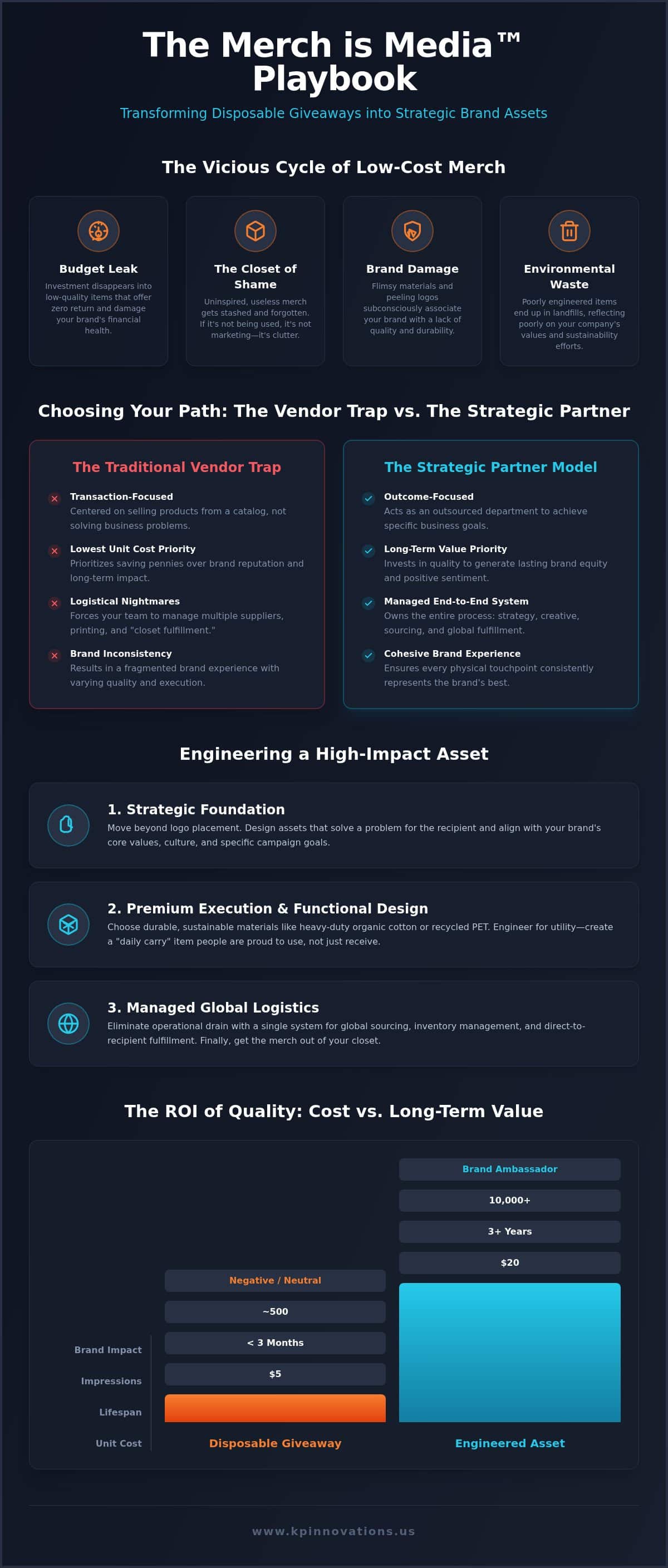
Modern consumers and employees are increasingly sensitive to the lifecycle of the products they receive. Distributing poorly engineered items creates a negative feedback loop. A cheap bag that quickly reaches a landfill reflects poorly on your company’s values and environmental stewardship. We’re seeing a massive shift toward “fewer, better things” in corporate gifting and recognition programs. Choosing sustainable materials like heavy-duty organic cotton or recycled PET isn’t just a trend. It’s a strategic move to align your physical assets with the expectations of a sophisticated audience. High-quality materials ensure the bag stays in rotation for years, providing thousands of impressions rather than a single afternoon of visibility.
The Vendor Trap vs. Strategic Agency Support
Relying on a traditional promotional products distributor often leads to operational friction. These vendors are focused on transactions, not outcomes. Managing multiple suppliers for sourcing, printing, and fulfillment creates brand inconsistency and logistical nightmares for your marketing or HR teams. You don’t need another catalog to flip through; you need a strategic partner to own the system. At KP Innovations, we move beyond the vendor trap by acting as your outsourced merchandise department. We treat physical items with the same rigor as a digital ad campaign, ensuring every bag is a high-performing brand asset rather than a forgotten giveaway. When your program outgrows a simple distributor, it’s time to invest in a managed brand experience.
Merch is Media™: Redefining the Value of Branded Tote Bags
When you invest in branded tote bags for business, you aren’t just buying canvas and ink. You are purchasing a media channel with a lifespan that far exceeds any digital display ad. We view physical items as tools that influence culture and relationships. A high-quality bag functions as a mobile billboard, moving through airports, grocery stores, and commutes, signaling your company’s presence to a broad, diverse audience. Instead of a fleeting click, you’re securing a permanent place in your customer’s physical environment.
The ROI of this physical media is staggering when you calculate the cost per impression. A single digital click might cost five dollars and last a few seconds. Conversely, a well-engineered tote bag might cost twenty dollars but provide thousands of daily brand impressions over several years. It’s a long-term asset that builds cultural familiarity. This isn’t just about external visibility. When your team carries these items, it reinforces internal culture, turning every employee into a brand ambassador who carries your values into their personal communities.
The Psychology of the ‘Daily Carry’ Bag
Utility is the primary driver of brand recall. If a bag is flimsy, it’s discarded. If it becomes a ‘daily carry’ item, it generates powerful social proof. Merch is Media™ is a strategic marketing philosophy that treats physical assets with the same analytical rigor as a digital advertising campaign. When someone sees a respected colleague or a stylish stranger carrying your brand, it’s a silent endorsement more effective than any sales pitch. People don’t just remember the logo; they remember the reliability of the tool that carries their essentials.
Integrating Totes into Your Broader Marketing Mix
Your physical touchpoints shouldn’t exist in a vacuum. They should complement your digital presence and internal initiatives. Branded bags serve as the tangible foundation for Recognition Programs, giving employees a physical symbol of their belonging. For sales teams, a sophisticated bag is a conversation starter that bridges the gap between a cold outreach and a warm relationship. To achieve this level of impact, you need a partner who understands strategic sourcing and can find materials that actually reflect your brand’s premium position.
Engineering the Perfect Tote: Beyond Basic Logo Placement
A logo printed on a generic canvas sack isn’t engineering; it’s a commodity. To develop branded tote bags for business that command attention and provide long-term value, you must approach the process with the mindset of a product designer. Most vendors focus only on the print area, but we focus on structural integrity and the tactile experience. A bag that lasts five years builds five years of brand equity. Conversely, distributing fifty bags that fail within five months doesn’t just waste your budget; it signals that your brand doesn’t value quality. High-performance merchandise requires a commitment to durability that standard distributors simply cannot match.
Material Science and Sustainability
The weight of the fabric dictates the bag’s destiny. A 6oz cotton bag feels like a giveaway, while a 12oz or 16oz heavy-duty canvas feels like a retail product. Choosing materials like organic cotton or recycled PET (rPET) does more than provide a durable carry; it communicates your brand’s commitment to ESG goals in a tangible way. We’ve seen a significant rise in recycled materials within Private Label Apparel and accessories, as marketing leaders realize that sustainability is now a baseline requirement for high-tier corporate gifts. The texture of the material is the first touchpoint a client has with your brand, and it should feel substantial and premium.
Strategic Design for Maximum Utility
Design should always follow the intended use case. A ‘Commuter Tote’ requires a padded laptop sleeve and reinforced straps to handle the weight of technology, whereas an ‘Event Carry-all’ might prioritize a wider opening and external pockets for quick access. We often recommend advanced decoration techniques like tonal embroidery, woven labels, or even custom metal hardware over oversized screen prints. Subtle, sophisticated branding often leads to a higher frequency of use because the bag feels like a curated accessory rather than a walking advertisement. Functional interior pockets significantly increase the ‘keep rate’ of corporate bags because they transform a simple sack into an organized tool for daily essentials. When you engineer for utility, you ensure your branded tote bags for business become a permanent part of the user’s daily routine.
Custom hardware, such as gunmetal rivets or branded zippers, adds a final layer of sophistication that separates strategic assets from standard promotional items. These details may seem small, but they are the markers of a brand that understands excellence. By moving beyond basic logo placement, you transform a simple carry-all into a high-performance brand tool that people actually want to use.
The Logistics of Impact: Global Sourcing and Fulfillment
The most significant operational bottleneck in many marketing departments isn’t a lack of ideas; it’s the “Closet Fulfillment” nightmare. When your high-value creative team is stuck in a storage room packing boxes and tape-gunning cartons, you’ve lost the thread of strategy. Branded tote bags for business are high-impact assets, but their value is neutralized if the distribution process is chaotic or inconsistent. Your team’s time is your most expensive resource. Wasting it on manual logistics prevents them from focusing on the high-level brand work that actually drives growth. Professionalizing this process is the only way to scale a merchandise program without increasing internal stress.
Global Sourcing and Ethical Manufacturing
Navigating global supply chains requires more than a search engine; it demands a rigorous vetting process for social compliance and quality standards. We prioritize ground-up manufacturing because it allows for total control over every seam, strap, and pocket. This approach is fundamentally different from off-the-shelf product decoration, which often limits your choices to what is already sitting in a warehouse. By manufacturing from the ground up, you ensure that your ethical standards are met and your brand consistency remains absolute across every global office. Managing lead times and international logistics becomes a managed system rather than a series of emergencies when you have a partner who understands the complexities of the global landscape.
Professional Fulfillment and Inventory Management
Managing a global program means solving the problem of decentralized teams and remote employees. Online Company Stores provide a centralized platform where managers can order exactly what they need without bothering your headquarters. This system works in tandem with professional Fulfillment Services that handle the heavy lifting of storage, kitting, and shipping. Real-time inventory tracking and automated reordering ensure you never run out of critical assets before a major event or recognition milestone. You can even combine your custom totes with other items for a cohesive kitted experience that arrives professionally packaged and ready for use. This level of precision ensures that the brand experience is as polished in the recipient’s hands as it was on the design board.
If you’re ready to move beyond the storage closet and build a scalable, managed system, you need a strategic sourcing partner that owns the entire lifecycle from concept to delivery.
The Chief Swag Officer: Your Outsourced Merchandise Department
A standard vendor waits for your order; a strategic partner anticipates your business needs. If you are currently managing branded tote bags for business by reacting to upcoming events or stockouts, you are operating in a defensive posture. The Chief Swag Officer model replaces this reactive cycle with a managed system of strategic ownership. We act as your outsourced merchandise department, taking full responsibility for the strategy, creative, sourcing, and fulfillment of your entire program. This isn’t about buying items; it’s about deploying brand assets that drive measurable results.
We manage the complexity so your team doesn’t have to. Our process ensures that your merchandise program is integrated into your broader marketing and HR objectives. This includes:
- Strategic auditing of your current merchandise impact and waste.
- End-to-end production management from ground-up manufacturing to delivery.
- Centralized control over brand consistency across all physical touchpoints.
- Proactive inventory management that eliminates last-minute emergencies.
Strategy First, Product Second
Our process never begins with a catalog. It begins with a deep dive into your business objectives. Whether you are launching a recognition program or preparing for a global summit, the product is merely the tool we use to solve a specific business problem. This is where Creative Development becomes essential. We don’t just place a logo; we design an experience. By understanding the employee or customer journey, we ensure that every branded tote bag serves a distinct purpose, whether that is increasing referral rates or boosting internal sentiment. We move beyond the “swag” mindset to embrace the Merch is Media™ philosophy.
The Outcome: A Measured Brand Investment
The world’s most successful brands don’t view merchandise as a line-item expense; they treat it as a strategic marketing spend with a required return on investment. We help you measure success through engagement metrics, retention data, and long-term brand visibility. When you stop acting as a buyer and start acting as a strategist, your physical assets become powerful engines for growth. You gain a hands-off, managed system that delivers high-quality results without the operational friction of traditional vendor management. Your brand deserves a partner that values precision and strategy as much as you do.
Ready to elevate your brand and move beyond disposable giveaways? Consult with our Chief Swag Officer today to begin engineering your strategic merchandise program.
Transforming Your Physical Brand Presence
The transition from disposable giveaways to high-performance brand assets requires a fundamental shift in perspective. By embracing the Merch is Media™ philosophy, you turn everyday items into powerful tools for cultural impact and client loyalty. Engineering premium branded tote bags for business ensures your logo lives on a durable, functional billboard that people actually want to carry. This strategic approach protects your professional reputation and eliminates the environmental and financial waste associated with low-quality merchandise.
You don’t have to manage the logistical complexity of global sourcing or “closet fulfillment” alone. Our Chief Swag Officer model provides a dedicated partner to oversee your entire program, from initial creative development to global warehousing. Having managed over 1.2 million products for top-tier brands, we have the expertise to scale your vision while maintaining absolute brand consistency. It’s time to stop acting as a vendor manager and start acting as a brand strategist.
Elevate your brand experience with a strategic merchandise partner and discover how a managed system can reduce your operational stress while maximizing your visibility. We’re ready to help you build something lasting.
Frequently Asked Questions
What is the best material for branded tote bags for business use?
The best material depends on your brand’s specific values and intended use case. For professional environments, heavy-duty canvas with a weight of 12oz or higher offers a premium tactile feel and superior durability. If sustainability is a core pillar, recycled PET or organic cotton communicates environmental stewardship effectively. Selecting materials that feel substantial ensures your branded tote bags for business are perceived as high-value assets rather than disposable giveaways.
How can I ensure my corporate tote bags are actually used by recipients?
Utility is the primary driver of the “keep rate” for any physical merchandise. You ensure usage by engineering bags with functional features like interior laptop sleeves, reinforced straps, and secure pockets. Subtle branding, such as tonal embroidery or woven labels, often leads to more frequent daily use than oversized logos. When a bag solves a specific problem for a commuter or traveler, it becomes a permanent part of their daily routine.
What is the typical lead time for custom-manufactured tote bags?
Lead times vary based on design complexity and sourcing requirements. Standard products with simple decoration often move faster than ground-up custom manufacturing. However, ground-up production allows for deep-level customization of every seam and strap, which is essential for creating a truly unique asset. We manage the entire timeline through our white-glove project management system, ensuring your strategic assets arrive in time for your critical events without internal stress.
Can you manage the shipping of branded bags to multiple global locations?
Yes, we specialize in global fulfillment and logistics capabilities to support international brands. Our system manages the complexities of warehousing and distribution, ensuring brand consistency across every office and remote team. By integrating these services with our online company stores, we streamline the ordering process for global managers. This managed approach removes the burden of international shipping from your internal marketing team, allowing them to focus on high-level strategy.
Why is a managed merchandise program better than buying from a distributor?
A managed program provides strategic ownership of your entire merchandise lifecycle rather than just a transaction. Traditional distributors focus on taking orders for products, but we focus on solving business problems through the Merch is Media™ philosophy. This approach includes creative development, ethical sourcing, and professional fulfillment. You gain a dedicated partner who ensures every item drives long-term brand equity and cultural impact, rather than just another line-item expense.
How do I calculate the ROI of my branded tote bag program?
ROI should be measured with the same rigor as any other marketing investment. You calculate it by analyzing the cost per impression over the bag’s lifespan, which often reaches thousands of views over several years. Additionally, we look at data like employee retention and client sentiment. High-quality branded tote bags for business function as mobile billboards, providing a lower long-term cost than many fleeting digital advertising channels.
What are the benefits of ‘ground-up’ custom manufacturing for bags?
Ground-up manufacturing offers total control over the product’s design, material, and functionality. Unlike decorating off-the-shelf items, this process allows you to specify fabric weights, custom hardware, and unique interior configurations that reflect your brand’s specific identity. This level of precision creates a unique brand experience that competitors can’t replicate. It ensures your merchandise is engineered for maximum utility and longevity, serving as a true strategic asset for your organization.
How do I integrate tote bags into an employee recognition program?
Use tote bags as the tangible foundation for recognition milestones or new-hire onboarding kits. Instead of a standalone gift, the bag acts as a vessel for a cohesive brand experience that signals belonging and value. By combining high-quality bags with other custom apparel or awards, you create a physical symbol of your company culture. This integration reinforces internal loyalty and turns employees into proud brand ambassadors during their daily commutes.