
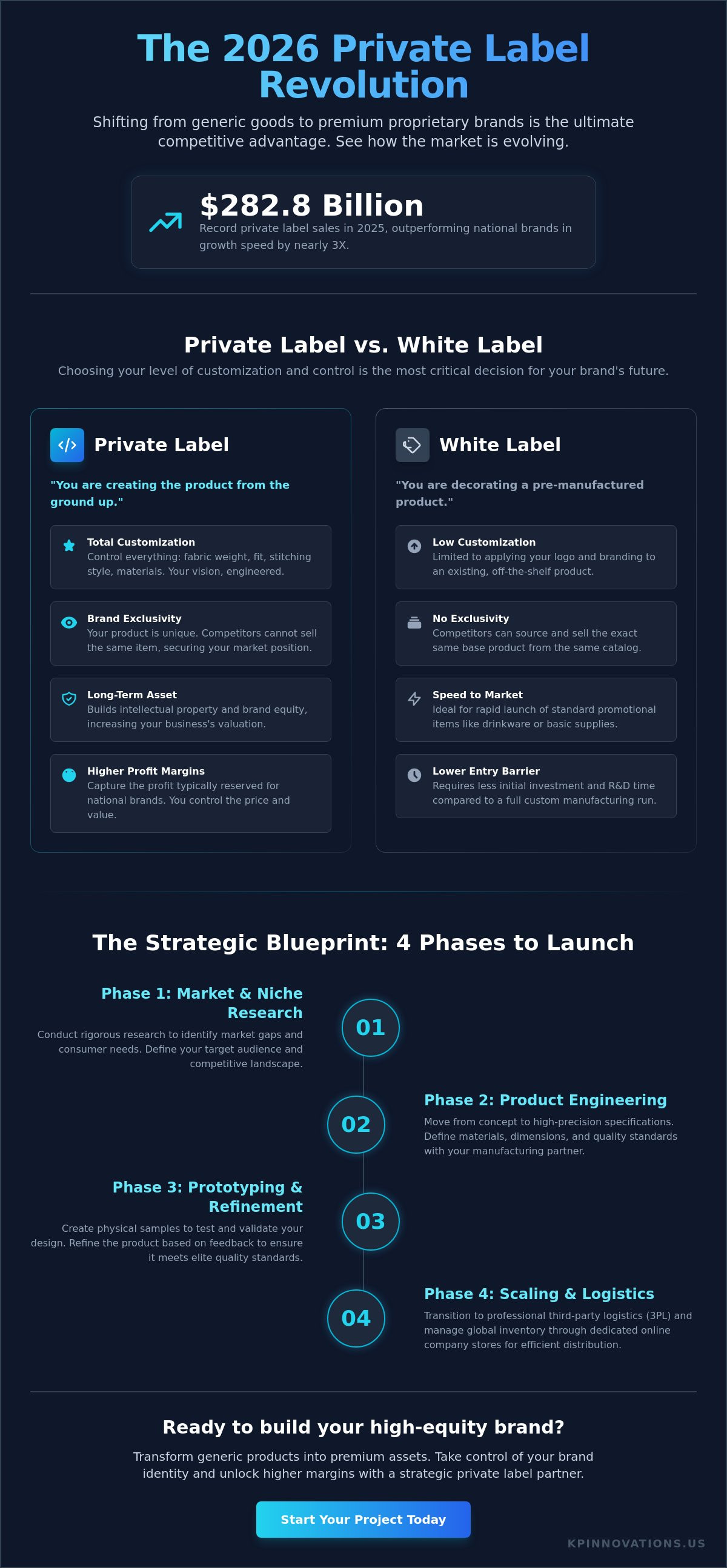
Did you know that private label sales in the U.S. reached a record $282.8 billion in 2025, outperforming national brands in growth speed by nearly three times? It’s clear that the market has shifted, yet many ambitious entrepreneurs still fear their offerings will look like generic copies of a thousand other listings. You likely recognize the complexity of managing global sourcing while trying to keep fulfillment logistics from eating your margins. It’s a high-stakes environment where “good enough” no longer wins.
This guide proves that building a brand with private label in 2026 is actually about engineering a custom brand experience through strategic manufacturing and elite fulfillment. You’ll learn how to transform generic products into high-equity assets that command premium prices and foster deep customer loyalty. We’ll examine the critical shift toward “quiet quality” and provide a roadmap for navigating new 2026 regulations, from EU unsold goods bans to updated FDA traceability rules. By the end, you’ll have a blueprint for a scalable, high-margin business model that gives you complete control over your brand identity without the heavy burden of manufacturing overhead.
Key Takeaways
- Discover why shifting from generic alternatives to premium proprietary brands is the ultimate competitive advantage for the 2026 market.
- Master the distinction between white labeling for speed and building a brand with private label for long-term intellectual property and design control.
- Follow a structured four-phase blueprint that moves from rigorous niche research to high-precision product engineering and prototyping.
- Eliminate the “generic” stigma by focusing on elite material selection and custom apparel specifications that project a designer feel.
- Scale your distribution efficiently by transitioning to professional third-party logistics and managing global inventory through dedicated online company stores.
Why Building a Brand with Private Label is Your 2026 Competitive Edge
The 2026 market demands more than just a logo on a box. Consumers have moved beyond looking for the cheapest option. They now seek “quiet quality” and authentic connection. For sophisticated business leaders, building a brand with private label isn’t just about sourcing; it’s about engineering a unique market position that standard vendors can’t replicate. While many see this model as a simple retail play, it’s actually a powerful vehicle for creating long-term brand equity and differentiation. You’re moving from a vendor mindset to a strategic owner mindset.
Understanding what is a private label brand? requires looking past the old “generic” stigma. In 2026, the strategy has evolved into creating premium proprietary brands that rival national leaders in quality but offer far superior control. You aren’t just selling a product. You’re owning the entire intellectual property stack. This shift allows you to bypass the traditional manufacturer markup of national brands. It gives you the flexibility to invest more in high-end materials or capture that margin for your own bottom line.
Speed is your other silent weapon. Launching a custom product line through traditional R&D often takes years of prototyping and testing. Strategic private labeling compresses that timeline into months. It allows you to respond to emerging trends with professional precision while your competitors are still stuck in the design phase. You gain the agility of a startup with the polished output of a global corporation.
The Economics of Private Labeling
Private labeling is a strategic partnership between a brand and a manufacturer that allows for complete creative and financial autonomy. By eliminating the national brand tax, you capture significantly higher profit margins than businesses that simply resell third-party goods. You’re building a tangible asset. A proprietary product line increases the valuation of your business because you own the source, the specs, and the customer relationship. It’s the difference between being a middleman and being a market maker.
- Higher Margins: Capture the profit usually reserved for the national brand owner.
- Asset Valuation: Own the IP and designs that make your company attractive to investors.
- Price Control: You dictate the MSRP without being tied to manufacturer-enforced minimums.
Market Trends: Why 2026 is the Year of the Niche Brand
The “mass-market” era is fading. Modern consumers are fatigued by the lack of personality in global conglomerates. They gravitate toward boutique identities that reflect their specific values and aesthetics. This is where high-quality merchandise, such as custom apparel and premium promotional products, becomes a tool for community building. Corporate entities are also leveraging this trend. They’re using private label apparel to elevate internal culture, moving away from “cheap swag” toward high-tier items that employees actually want to wear. In 2026, building a brand with private label means your brand is defined by the quality of the physical touchpoints you provide.
Private Label vs. White Label: Choosing Your Level of Customization
Choosing between white label and private label is essentially a decision about where your brand’s soul resides. White labeling involves taking a pre-manufactured product and applying your logo. It’s an efficient route for standard promotional products like drinkware or basic office supplies. You gain speed and lower entry costs, but you sacrifice exclusivity. If a competitor can buy the exact same mug from the same catalog, your differentiation is limited to your graphic design and brand story.
Building a brand with private label, however, implies a ground-up manufacturing approach. This is where you move beyond “off-the-shelf” and into “cut and sew” territory. For custom apparel, this means specifying the fabric weight, the exact fit, and even the stitching style. You aren’t just decorating a garment; you’re creating it. This level of control is what provides the competitive edge of private labels in a saturated market. When you own the physical specifications, you own the intellectual property. It’s a moat that competitors can’t easily cross.
When to Choose White Label
White label is your best tool for rapid market testing. If you need to launch a gift line for a corporate event in three weeks, white labeling is the answer. It’s a low-risk way to gauge interest in a product category before committing to a full production run. It’s perfect for standard items where the brand value comes from the association with your company rather than the innovation of the item itself. However, don’t expect it to carry a brand in high-competition niches where “generic” is a dealbreaker.
The Power of Full Private Label Customization
True building a brand with private label happens when you dictate the details. Think about custom apparel tags, specialized fabric blends, or unique hardware on a bag. These aren’t just aesthetic choices. They are physical evidence of quality that justifies premium price points. When a customer feels a 300 GSM organic cotton hoodie that was engineered specifically for your brand, they recognize the value immediately. This proprietary approach allows you to solve specific pain points for your audience that standard products ignore.
Your choice depends on your current scale and long-term vision. Many brands start with white label to build cash flow and then transition to full private label as they scale. If you’re ready to explore how high-touch production can elevate your offerings, you might want to consult with a strategic manufacturing partner to map out your next move.
The Strategic Blueprint: 4 Phases to Launching Your Private Label Line
Success in building a brand with private label requires a methodical, high-precision framework. It’s not a gamble; it’s a process of engineering value where none existed before. By following a structured blueprint, you move from a simple idea to a high-equity asset that commands market respect. This journey demands a transition from a consumer mindset to a strategic architect mindset, where every detail is a deliberate choice.
Phase 1 & 2: From Concept to Physical Sample
Launching a proprietary line is a high-stakes exercise in problem-solving. Phase 1 centers on rigorous Niche Research and Product-Market Fit Analysis. You aren’t just looking for a product that sells; you’re looking for a product that currently fails to meet expectations. Identify the specific pain points in existing offerings. Perhaps the fits are inconsistent, or the materials lack the durability required for professional use. Your private label line should be the definitive answer to these documented frustrations.
Once the gap is identified, Phase 2 moves into Product Engineering and Prototyping. This is where you partner with a specialized apparel factory to turn technical sketches into physical realities. This stage is governed by the “Golden Sample” rule. You must never move to mass production until you hold a finalized, perfect physical prototype in your hands. This sample serves as the legal and quality benchmark for every unit that follows. It’s your insurance policy against manufacturing drift.
Phase 3 & 4: Branding and Market Entry
Phase 3 focuses on Brand Identity Integration. This includes packaging, labels, and your overarching visual language. A brand is not a logo, but a consistent promise of quality across every touchpoint. The “unboxing” experience is critical here. In the 2026 market, your packaging is 50% of the perceived brand value. It’s the first tactile interaction a client has with your company. High-touch packaging transforms a simple delivery into a significant brand event, reinforcing the premium nature of your line.
Finally, Phase 4 is the Multi-Channel Launch and the establishment of Feedback Loops. This requires sophisticated demand forecasting to balance your inventory levels effectively. Data from the Private Label Manufacturers Association suggests that brands with agile supply chains outpace competitors by responding to real-time market signals. You launch, listen to your community, and refine your next production run based on actual usage data. This iterative process is the secret to building a brand with private label that survives the initial launch and builds lasting equity.
Overcoming the “Generic” Trap: Infusing Quality into Your Brand
The biggest fear for any executive entering the private label space is the “knock-off” stigma. If your product feels like a cheap imitation of a national leader, your brand equity evaporates instantly. Success in building a brand with private label requires a relentless focus on material integrity and manufacturing precision. You aren’t just slapping a label on a pre-existing item. You’re choosing the “Designer” path over the “Discount” shortcut. This distinction is made in the factory, long before the product reaches the customer’s hands.
To move beyond the generic trap, you must implement rigorous Quality Control (QC) protocols. This includes in-line inspections where products are checked during the assembly process, rather than just at the end. Final audits should verify that every measurement and stitch matches your “Golden Sample” exactly. By the time your inventory leaves the facility, it should carry a tactile authority that justifies your premium positioning. High-tier brands don’t leave quality to chance; they engineer it into the production contract.
Material Science and Product Integrity
Fabric weight and weave determine the lifespan of your apparel and the reputation of your brand. When your team or customers hold a garment with a weight of 350 GSM, they instantly perceive a level of durability that off-the-shelf alternatives simply cannot match. In 2026, consumer demand has shifted toward high-performance, eco-friendly materials that don’t sacrifice style for sustainability. Sourcing organic cotton blends or recycled polymers isn’t just an ethical choice. It’s a strategic move to meet the sophisticated expectations of a modern audience. Even the role of specialized hardware, such as custom-engraved zippers or heavy-duty drawstrings, plays a massive part in brand perception. These small details signal to the buyer that the product was designed with intent.
The Human Element: Ethical Sourcing and Transparency
Supply chain transparency is a marketing superpower in the current era. Modern clients want to know the “Where and How” behind their purchases. Vetting your manufacturers for ethical labor practices and environmental compliance is no longer optional; it’s a foundational requirement for brand safety. This is why many premium brands are leveraging “Made in USA” positioning or partnering with specialized boutique factories that offer deep-level transparency. When you can tell a story about the artisans or the sustainable facility behind your line, you create a connection that a generic competitor can never replicate. If you’re ready to move beyond generic catalogs, explore how we help you engineer premium custom apparel and promotional lines that stand the test of time.
Ultimately, building a brand with private label is about owning the narrative of quality. By controlling the materials and the ethics of production, you eliminate the risk of being viewed as a “me-too” brand. You transform a physical item into a strategic asset that reflects the high standards of your organization.
Scaling Your Brand: Fulfillment, Logistics, and Global Growth
Scaling is the ultimate test of a brand’s infrastructure. While the initial phases of building a brand with private label focus on design and manufacturing, the growth phase relies entirely on your ability to deliver. Moving from manual shipping to a professional Third-Party Logistics (3PL) provider is a non-negotiable step for any brand with high ambitions. It’s the difference between a side project and a high-equity business that operates with corporate-level efficiency. You’re no longer just managing products; you’re managing a global supply chain.
Strategic fulfillment does more than just move boxes. It reduces shipping times and improves customer retention by providing a seamless, predictable experience. In a market where external fulfillment fees continue to rise, owning your logistics through a dedicated partner allows you to maintain healthier margins. KP Innovations positions itself as your end-to-end partner, managing everything from the initial design and production to final global delivery. This integrated approach ensures that the quality engineered in the factory is the same quality delivered to the doorstep.
Global Fulfillment and Warehouse Management
Managing inventory across multiple regions is essential for reducing both your carbon footprint and your shipping costs. By positioning stock closer to your primary hubs, you minimize transit times and mitigate the risks of global supply chain disruptions. Professional logistics also means automated fulfillment. Your e-commerce store should integrate directly with warehouse management systems to provide real-time updates and error-free processing. During this scaling phase, “White-Glove” project management becomes your greatest asset. You need a partner that handles the granular details of customs, duties, and regional compliance so you can focus on high-level brand strategy.
Company Stores: The Future of Branded Merchandise
For large organizations and growing brands, centralized online company stores are the most efficient way to manage distribution. These platforms simplify the process of getting branded apparel and promotional products into the hands of global teams or dedicated fans. Instead of managing individual requests, you provide a curated portal with real-time inventory tracking and on-demand ordering capabilities. This ensures brand consistency across every department and location, no matter how far they are from your headquarters. It’s a sophisticated solution that turns logistics into a tool for brand reinforcement.
Your journey from a generic product to a market leader requires more than just a good idea. It requires a partner that understands the complexity of the modern global landscape. Building a brand with private label is a long-term investment in your company’s future. Elevate your brand with KP Innovations’ end-to-end private label solutions and secure your place as a dominant force in the 2026 market.
Secure Your Market Position for 2026
The transition from a simple vendor to a strategic brand owner requires more than just a vision. It demands a rigorous commitment to quality and a logistics network that can handle global scale. By moving beyond off-the-shelf catalogs and embracing deep-level customization, you create a proprietary asset that competitors cannot easily duplicate. Building a brand with private label is the most direct path to capturing higher margins and establishing a lasting legacy in your niche. You’ve seen the blueprint; now it’s time to execute with precision.
Success depends on choosing a partner that manages the complexity of the supply chain so you can focus on growth. KP Innovations provides the expertise needed to navigate this landscape with confidence. With access to over 1.2 million products and comprehensive global fulfillment capabilities, we offer the high-touch project management required for a smooth design-to-delivery process. Don’t leave your brand equity to chance when you can build it on a foundation of professional excellence.
Start your private label journey with a custom quote from KP Innovations and transform your physical items into strategic assets. Your brand’s elevation starts here.
Frequently Asked Questions
What is the difference between private label and white label?
White label products are pre-manufactured items where you only apply your logo to an existing design. Private label involves ground-up customization of materials, fit, and specialized features. While white label offers speed, private label provides the unique intellectual property and “cut and sew” precision required to build high-equity brand differentiation.
How much does it cost to start a private label brand in 2026?
Initial investment depends heavily on product complexity and the specific minimum order quantities required by the factory. A simple product line with low MOQs might require a few thousand dollars. However, custom apparel lines involving premium fabrics and specialized hardware often require a more significant budget to cover prototyping, manufacturing runs, and global logistics fees.
Do I need to be a designer to build a private label apparel brand?
You don’t need formal design training to launch a successful line. Most brand owners act as creative directors, providing the vision and market references while a strategic manufacturing partner handles the technical execution. This includes developing tech packs, specifying fabric weights, and managing the engineering of the actual garment to ensure professional-grade results.
What are the typical minimum order quantities (MOQs) for private labeling?
Typical MOQs for new brands often range from 500 to 1,000 units for items like cosmetics or supplements. In the custom apparel sector, quantities depend on the rarity of the fabric and the complexity of the design. While some manufacturers offer lower entry points for standard blanks, deep-level customization usually requires higher volume commitments to maintain production efficiency.
How do I find a reliable private label manufacturer in the USA?
Reliable domestic partners are best identified through industry trade shows and professional associations. You should look for manufacturers that prioritize transparency in their supply chain and offer robust quality control protocols. It’s critical to vet their fulfillment capabilities alongside their production quality to ensure they can handle the logistics of a scaling business model.
Can I private label promotional products for my corporate team?
Yes, building a brand with private label is a highly effective strategy for elevating internal corporate culture. Moving away from “cheap swag” toward high-quality, proprietary promotional products turns internal merchandise into a premium asset. This ensures that the items your team wears and uses reflect the high standards and sophisticated identity of your organization.
How long does the private label production process usually take?
The timeline from initial concept to final delivery generally spans three to six months. This period accounts for niche research, engineering the “Golden Sample,” and the actual mass production phase. You should also factor in two to four weeks for global logistics and warehouse intake, depending on your manufacturing location and chosen distribution strategy.
What happens if the quality of the mass production doesn’t match the sample?
This risk is managed by establishing the approved physical sample as the legal benchmark for the entire production run. Professional partners utilize in-line inspections to catch deviations before the run is completed. Your contract should specify clear remediation steps, such as re-production or credits, to ensure that every unit delivered meets your brand’s established quality standards.