
What if a conference welcome bag made attendees feel expected before the first session even begins? The best conference welcome bag ideas don’t start with a list of popular giveaways. They start with who’s attending, what their day looks like, and what would genuinely help.
It’s easy for well-intended gifts to become extra weight in a suitcase or clutter left behind at the hotel. A useful item feels different: it anticipates a real need, fits the event, and gives attendees a reason to keep engaging with your brand. That’s the idea behind Merch is Media™. Each item contributes to the experience instead of simply carrying a logo.
This article explores purposeful welcome bag ideas and a practical framework for choosing the contents, package, and handoff around your audience, venue, travel needs, and schedule. You’ll also see how coordinated creative, sourcing, and fulfillment can make the experience feel cohesive without adding unnecessary work for your event team. The goal is a welcome that feels considered, useful, and unmistakably connected to the conference.
Key Takeaways
- Start with the attendee journey, then choose items that help people feel oriented and ready to participate.
- Organize conference welcome bag ideas around practical needs, such as staying hydrated, taking notes, charging devices, and finding their way around.
- Match the package format to your audience, event duration, travel mode, and distribution plan.
- Set quantity assumptions alongside registration expectations and event logistics to keep planning manageable.
- Use merchandise as part of the broader brand experience, not just a place to display a logo.
Conference welcome bag ideas start with the attendee experience
A welcome bag can help attendees feel oriented, prepared, and included before the first session. Or it can become one more thing to carry. The difference isn’t the size of the logo or the number of objects inside. It’s whether the contents respond to what attendees will actually experience at the event.
A conference welcome bag is a curated set of items that supports the attendee journey, from arrival and check-in to sessions, breaks, and time away from the venue. Each choice should earn its place through usefulness, context, or a meaningful connection to the event’s brand. The broad category of promotional merchandise is described in Swag (promotional merchandise), but a conference bag needs more than a collection of branded items. It needs a point of view.
Let attendee usefulness lead: the right item solves a real need and makes the event easier to experience.
What makes a conference welcome bag feel intentional?
Start with the event promise. If the conference is designed to help people learn, make useful session materials easy to access. If it’s built around connection, consider how the welcome can help attendees feel part of the gathering. These priorities give planners a filter for conference welcome bag ideas before they begin selecting items.
Then give every item a job: support a specific moment, meet a clear audience need, or reinforce what makes this event distinct. A useful assortment might include one item for navigating the day and another that remains relevant after the conference. Cohesion matters more than volume. A smaller set with a clear purpose feels considered; unrelated items can make even a full bag feel like leftover inventory.
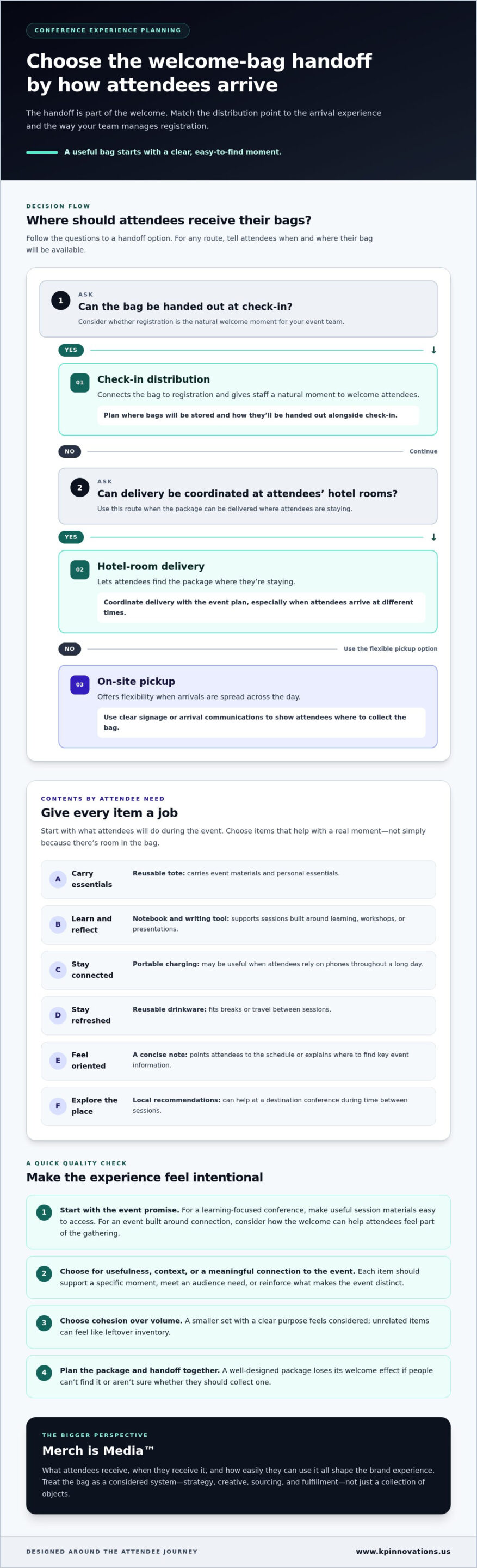
When should attendees receive their welcome bags?
Choose a delivery point based on how attendees arrive and how your team manages registration. The handoff is part of the welcome, so make the location and process clear before people need to ask.
- Check-in distribution: Connects the bag to registration and gives staff a natural moment to welcome attendees. Plan where bags will be stored and how they’ll be handed out alongside check-in.
- Hotel-room delivery: Lets attendees find the package where they’re staying. Coordinate delivery with the event plan, especially when attendees arrive at different times.
- On-site pickup: Offers flexibility when arrivals are spread across the day. Use clear signage or arrival communications to show attendees where to collect the bag.
For any option, clarify when and where the bag will be available in attendee communications. A well-designed package loses its welcome effect if people can’t find it or aren’t sure whether they’re meant to collect one.
This is why merchandise belongs in event planning, not at the end of it. The Merch is Media™ perspective treats physical items as part of the brand experience. What attendees receive, when they receive it, and how easily they can use it all shape the impression. KP Innovations brings strategy, creative, sourcing, and fulfillment together so the experience is planned as a system, not just a bag of objects.
Conference welcome bag ideas organized by what attendees need
The strongest conference welcome bag ideas solve practical needs tied to the schedule and setting. Think about when attendees will use each item: while moving between sessions, taking notes, staying connected, or exploring the host city. This functional lens helps planners build a useful assortment instead of filling a bag simply because there’s room.
For a broader range of possibilities, EventMobi’s conference gift bag ideas also emphasizes attendee experience. Use those possibilities as prompts, then narrow the choices to what fits your event. An item earns its place when it helps attendees do something they already need to do.
Useful items for travel, check-in, and a full conference day
Start with the attendee’s hands, attention, and phone. A reusable tote can carry event materials and personal essentials; a notebook and writing tool can support sessions built around learning. If attendees will rely on their phones for schedules, networking, or event updates, portable charging may be useful. For drinkware, choose a format that fits the event routine, such as carrying between rooms or refilling during breaks.
Give each item a clear use case, not just a category label. A notebook makes more sense when sessions invite reflection or working notes. Portable power is more relevant when attendees will use their phones throughout a long day. A thoughtful merchandise sourcing process can help align those practical needs with the event’s creative direction.
Personal touches that connect the bag to the event
Useful objects handle immediate needs; a personal touch makes the welcome feel specific. Add a concise note that points attendees to the schedule or explains where to find key event information. At a destination conference, local recommendations can help people make the most of time between sessions. Apparel can work when it suits the event, audience preferences, and likely opportunities to wear it.
For a purposeful assortment, consider these functions:
- Stay refreshed: Reusable drinkware for breaks or travel between sessions.
- Capture ideas: A notebook and writing tool for workshops or presentations.
- Stay connected: Portable charging for attendees using their phones as event companions.
- Feel part of the event: Apparel or another branded item selected with the audience and setting in mind.
- Get oriented: A welcome note with schedule details, venue guidance, or relevant local suggestions.
- Bridge the gap between sessions: A snack that suits the event’s timing and attendee needs.
Match the mix to the agenda. A conference with hands-on sessions may call for note-taking materials, while a program spread across a large venue could make orientation especially helpful. The point isn’t to include every category. Choose a few complementary items that support real moments, then bring them together through consistent creative. That turns the bag into a considered part of the event experience, rather than an assortment attendees have to sort through.
Compare welcome bag concepts by audience, format, and travel needs
The right package depends on who’s attending and how the event works. A local attendee arriving for a single-day program has different needs from a speaker traveling between sessions or a guest staying for a multi-day conference. Compare audience, duration, travel mode, usefulness, and distribution before settling on an assortment. This turns conference welcome bag ideas into a decision framework instead of a one-size-fits-all checklist.
- Local attendee, single-day event: Focus on essentials that support the program and are easy to take home. Check-in or on-site pickup can fit naturally into the arrival flow.
- Traveler, single-day event: Prioritize lightweight items that are manageable on air or public transportation. Make the pickup location clear so attendees can collect the package without disrupting their arrival.
- Multi-day attendee: Consider a more complete kit for repeated use across sessions and time away from the venue. An arrival-day handoff or coordinated hotel delivery may suit the schedule.
- Speaker: Account for different responsibilities and arrival patterns. A separate handoff may be useful if speakers follow a distinct schedule or have different practical needs.
Choose a package for local attendees, travelers, and speakers
For attendees arriving by air or public transportation, favor essentials that are easy to carry and pack. Local attendees may have more flexibility, but still need a package that’s comfortable to manage through the event. Speakers deserve a separate look: their schedules, preparation, and arrival patterns may differ. Use attendee profiles to decide whether one shared package serves everyone or a focused variation would be more useful.
A lightweight essentials package might pair a carry-friendly format with a few items tied directly to the day’s program. A multi-day kit can include pieces intended for repeated use across sessions, breaks, and travel back to the hotel. Neither concept is automatically better. More items don’t guarantee a better experience; each should fit the recipient’s needs and the event plan.
Match the assortment to the event format
Single-day programs call for choices that help attendees move through a concentrated schedule. For a multi-day conference, consider what people will need again on later days and whether they’ll move between the venue, hotel, and off-site activities. Let the conference theme guide colors, messaging, and presentation, while keeping the package practical for its setting.
Event context changes the right assortment, not the value of a welcome. A hands-on event may benefit from items suited to active participation; a program centered on presentations may call for tools attendees can use while listening. Brand expression should connect the package to the event without making decoration more important than usefulness.
Compare each proposed item against the audience, schedule, travel mode, and handoff plan. Then remove anything without a clear role. A defined merchandise strategy can connect event goals to a coherent package and help planners make deliberate choices for different attendee groups.
Plan conference welcome bags without creating an operations headache
A welcome bag can be thoughtfully designed and still create avoidable work if nobody owns the details. Item selection, artwork, quantities, assembly, delivery, and distribution are connected decisions. Treat them as one plan, with clear owners and checkpoints, and the event team is less likely to be solving packaging questions while managing attendee arrivals.
A practical sequence for selecting and sourcing items
Begin with the attendee experience you want to create, then use it to guide the assortment. Shortlist items by audience relevance, portability, intended use, and how well each can be customized. Coordinate creative and sourcing together so the artwork, colors, packaging, and items feel like parts of one program, not separate decisions made at different times.
Use a simple sequence to keep decisions moving:
- Define the audience and purpose. Identify who will receive a package and what it should help them do or understand.
- Build the assortment. Select item categories that fit the event schedule, attendee needs, and travel context.
- Align creative and sourcing. Review how the visual treatment will work across the chosen items and package.
- Set quantity assumptions. Compare registration expectations with the event plan, including the groups receiving packages and the distribution approach.
- Confirm assembly and delivery ownership. Assign responsibility for bringing the components together and getting packages to the right location.
- Plan the attendee handoff. Decide who will distribute the bags and how attendees will learn where and when to collect them.
Quantity planning deserves attention early. Registration expectations can shift, while the event plan may include speakers, staff, or other attendee groups with different package needs. Make those assumptions visible and assign someone to keep the registration picture, quantities, and distribution plan aligned. This gives the team a shared basis for decisions instead of relying on last-minute estimates.
Coordinate assembly, delivery, and attendee distribution
Before items are assembled, map the handoff: who receives the packages, where they arrive, where they’ll be held, and who gets them to attendees. Packaging and item size affect storage and handling, especially if the check-in area has limited room or bags need to move between locations. Clear ownership at each step helps prevent gaps between delivery and distribution.
Event details shape these logistics. A conference with room delivery has different coordination needs from one where attendees collect bags at registration. KP Innovations coordinates merchandise strategy, creative, sourcing, and fulfillment so these decisions work together as part of the event plan.
When the assortment and plan are clear, coordinate sourcing for your conference welcome bags as part of the full program, from item selection through the planned handoff. That way, the team can focus on the event itself, while each package has a defined path to the attendee.
Make conference welcome bags part of a larger brand experience
A conference welcome bag works best when it supports a clear event goal, rather than sitting apart from the rest of the program. Decide what the organization wants attendees to take away from the experience, then use that purpose to guide the merchandise plan. This creates a connection between the event’s priorities and the decisions behind the package.
Treat every item as a brand touchpoint
Consider where the welcome bag fits in the attendee journey and what it should help make possible. An event focused on learning might use its welcome materials to prepare people for active participation. A gathering built around community might use them to help guests feel included. These choices make the package more intentional without assuming that merchandise alone can deliver a particular outcome.
That planning approach aligns with Merch is Media™: merchandise is one part of a broader experience, and its role should be designed with the event’s purpose in mind. The useful question is not only what goes in the bag, but how the package supports the experience the organization is creating.
Build a program with a partner who owns the details
A coordinated program connects strategy, creative development, sourcing, and fulfillment. Strategy defines the purpose and audience; creative development translates the event identity into a cohesive direction; sourcing brings the selected items together; and fulfillment connects the finished package to its planned destination. When these responsibilities are coordinated, internal teams have fewer handoffs to manage.
KP Innovations can manage these connected parts as an outsourced merchandise partner, helping event teams keep decisions aligned from planning through delivery. Bring the audience profile, event goals, and distribution plan into the discussion to establish a practical starting point. Plan conference merchandise sourcing with KP Innovations to shape a program around the event’s needs and the team responsible for delivering it.
Make the welcome a deliberate first step
The next time you plan a conference, treat the welcome as the start of a relationship, not a handout to check off the event list. Let attendee needs and the experience you want to create shape the merchandise program. That gives every decision a clear purpose, from the first creative direction to the moment the package reaches an attendee.
KP Innovations brings strategy, creative, sourcing, and fulfillment together, with access to more than 1.2 million products and white-glove project management from design through global fulfillment. That support helps event teams move from promising conference welcome bag ideas to a coordinated plan without carrying every detail themselves.
Start with your audience, event goals, and the moments you want attendees to remember. Plan conference merchandise sourcing with KP Innovations and build a welcome that feels considered from the first touchpoint. A thoughtful beginning can set the tone for everything that follows.
Frequently Asked Questions
What should go in a conference welcome bag?
A conference welcome bag should include items that help attendees participate and feel prepared. Consider a carryall for materials, drinkware for breaks, a notebook for sessions, portable charging, or a concise event guide. Choose conference welcome bag ideas by looking at the attendee’s actual day: what they’ll carry, where they’ll go, and what information they may need. A short welcome note can also connect the package to the event.
How many items should a conference welcome bag have?
There’s no fixed item count that guarantees a useful welcome bag. The right number depends on the event’s purpose and the needs of its attendees. Before approving an item, consider whether it has a distinct role or duplicates something else in the package. For example, if printed materials are already available digitally, another paper insert may add bulk without helping guests. A focused assortment is easier to carry and simpler to coordinate.
Are conference welcome bags worth it?
They can be worthwhile if they make the event more welcoming or give attendees something useful beyond the first impression. Define what the package should accomplish, such as helping guests get oriented or supporting participation in the program. Then assess its value after the event by collecting feedback from attendees and the staff who distributed it. Their observations can show which items were useful and what could be refined for a future conference.
What are good welcome bag ideas for a multi-day conference?
For a multi-day conference, consider what attendees will use throughout the program rather than only at arrival. A carryall can keep materials together as people move between sessions, while a notebook can support notes across several days. A compact schedule or venue guide may help guests plan their day. Use the event agenda and destination to identify recurring needs, and avoid adding items that attendees would have to store or carry without a clear reason.
How do you make conference welcome bags feel more personal?
Make the package personal by connecting it to attendees’ roles, activities, or reasons for being there. A message can explain how an item relates to the event or point guests toward a useful program detail. If speakers have different responsibilities from general attendees, a tailored version may better reflect their needs. Personalization doesn’t require putting a name on every item; relevance and thoughtful context can make the welcome feel specific.
When should conference welcome bags be distributed?
Distribute welcome bags at a point that matches attendee arrival patterns and the registration process. On-site check-in can work when most guests arrive at the venue, while a designated pickup point may help when arrivals are spread out. Decide who will manage the handoff and where packages will be kept before the event begins. Include the location and timing in arrival communications so attendees know what to expect.
How can conference organizers manage welcome bag sourcing and fulfillment?
Organizers can simplify sourcing and fulfillment by putting decisions and responsibilities in one coordinated plan. Define the attendee groups, package contents, artwork, quantities, delivery destination, and handoff owner. Keep the event team and merchandise partner aligned as those decisions progress, so changes to the plan don’t leave assembly or distribution unclear. A partner can coordinate sourcing, creative, and fulfillment while the internal team focuses on running the conference.