
A logo order is easy. Building construction company branded gear that crews actually use, across job sites and seasons, takes a plan. The right gear can support the people wearing it and shape how employees, clients, and communities experience your brand.
It’s understandable to start with the items: shirts, jackets, hats, or gear for project teams. But without a coordinated approach, one purchase can become a short-lived giveaway. Sizing, reorders, and distribution can create extra work, too. And branding should never interfere with required protective equipment.
A stronger program treats merchandise as media: a practical part of your culture and relationships, not just a logo on a product. This guide explains how to choose useful gear for different construction audiences, create a consistent experience across crews and locations, and manage sourcing, ordering, and fulfillment as one system. The goal is gear that works for the people who wear it and a program your team can maintain.
Key Takeaways
- Match each gear choice to its audience and use case, then plan the item, branding, sizing, and distribution.
- Build construction company branded gear around practical needs and repeat use, not logo placement alone.
- Compare one-off orders with a managed program to see how approved items, reordering, and distribution can work together.
- Assign clear program ownership and plan for different teams, changing workforce needs, and ongoing inventory decisions.
- Use a company store as an ordering tool within a broader strategy that defines what belongs in the program.
Why construction company branded gear is more than a logo on a shirt
A construction company rarely has one audience or one kind of workday. Field crews, project managers, office staff, new hires, and clients encounter the company in different settings, so one shirt or design may not serve every purpose. A crew member may need practical apparel for the workday, while a new hire’s first-day item should help them feel welcomed and part of the team.
That difference changes how to think about merchandise. Promotional merchandise can carry a company’s identity, but its value depends on how it fits into the recipient’s experience. In the Merch is Media™ approach, useful items become everyday brand touchpoints, supporting culture and relationships through real moments.
Strategic construction gear is a managed brand touchpoint, not simply a logo placed on an item. Choose each category with a purpose instead of expecting one design or order to meet every need.
Start with the people and moments the gear should serve
Before selecting an item, identify who will receive it and what the moment calls for. Field crews, project managers, office staff, new hires, and clients have different routines and expectations. A simple planning map might look like this:
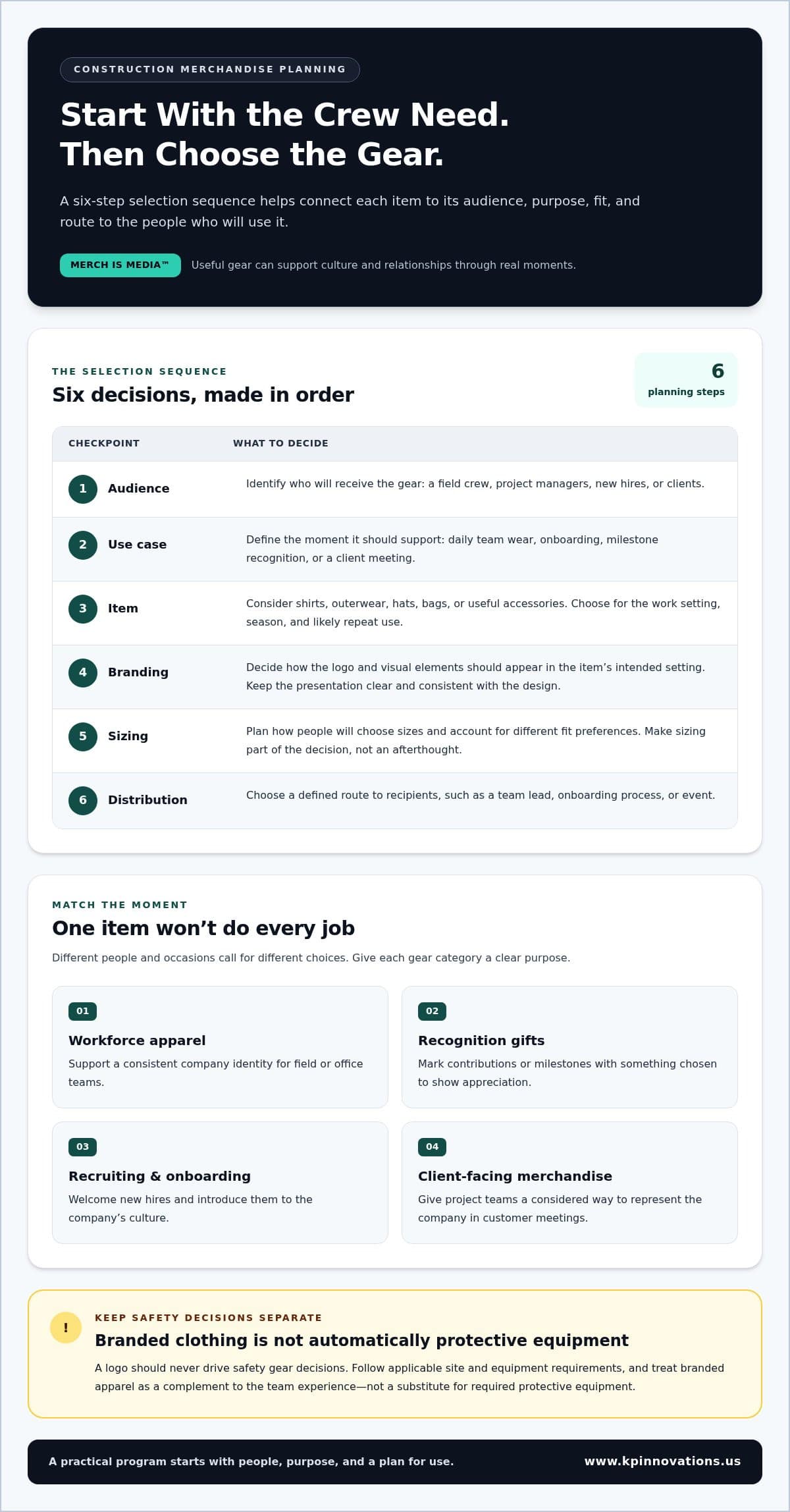
- Workforce apparel: Support a consistent company identity for field or office teams.
- Recognition gifts: Mark contributions or milestones with something chosen to show appreciation.
- Recruiting and onboarding items: Welcome new hires and introduce them to the company’s culture.
- Client-facing merchandise: Give project teams a considered way to represent the company in customer meetings.
One item won’t automatically do all four jobs. The right choice depends on the audience, occasion, and whether the item will be useful in that person’s day-to-day context. Separating these purposes also helps teams make deliberate decisions about design and distribution.
Keep branded apparel separate from protective equipment
Branded clothing doesn’t automatically qualify as required protective equipment, and a logo shouldn’t drive safety gear decisions. Keep merchandise and brand-design choices separate from decisions about protective equipment. For safety-related apparel and equipment, follow applicable site and equipment requirements. Treat branded apparel as a complementary part of the team experience, not a substitute.
When the purpose is clear, gear can do more than create a consistent look. It can welcome a new colleague, recognize a team’s contribution, or support a thoughtful client interaction. A coordinated program starts by assigning each item a role in those experiences, then shaping its design and distribution around the people who will use it.
How to choose construction company branded gear crews will use
The best construction company branded gear starts with a crew need, not a product category. A practical selection process helps you move from a broad idea to a considered choice and reduces the risk of ordering something that looks right on a screen but doesn’t fit how people work.
The best item is the one that fits a real crew need. Ask employees what they reach for, what they use repeatedly, and what would make a workday or company moment more comfortable. Their input can point you in a better direction than browsing a catalog first.
Use a six-step selection sequence
- Audience: Identify who will receive the gear, such as a field crew, project managers, new hires, or clients.
- Use case: Define the moment it should support, whether daily team wear, onboarding, milestone recognition, or a client meeting.
- Item: Consider shirts, outerwear, hats, bags, or other useful accessories. Choose based on the work setting, season, and how often people are likely to use the item.
- Branding: Decide how the logo and other visual elements should appear in the item’s intended setting. Aim for clear, consistent presentation that works with the design.
- Sizing: Plan how people will choose sizes and how the program will account for different fit preferences. Make sizing part of the decision, not an afterthought.
- Distribution: Decide how items will reach recipients, whether through a team lead, onboarding process, event, or another defined route.
This sequence helps distinguish repeat-use apparel from occasional gifts. A shirt or outerwear piece may support regular team wear, while a bag or another accessory may suit an onboarding kit or client interaction better. For any item that intersects with protective equipment, keep its selection separate from branded merchandise decisions and refer to OSHA’s construction PPE requirements.
Evaluate comfort, fit, and brand presentation together
Usefulness depends on more than appearance. Consider how the item fits, whether the sizing options serve the intended group, and how straightforward it is to care for. Ask a small group of intended recipients to review the proposed choices and flag concerns before finalizing them. Their feedback can reveal issues that a product image won’t show.
Then review the creative proof and sizing plan before approving a larger program. Check that logo placement suits the garment’s design and the context where it will be seen. A visible mark may make sense for one purpose; a more restrained treatment may suit another. Keep the company identity recognizable without letting the logo overwhelm an item people should want to use.
Thoughtful merchandise sourcing connects these choices to the intended audience, use, and brand presentation, rather than treating every item as a separate purchase.
Compare one-off gear orders with a managed construction merchandise program
A one-off order can solve an immediate need. Friction often appears later, when another team needs apparel, a new project calls for client gifts, or an employee recognition moment arises. Without shared decisions about design, approvals, and ownership, every request can become a separate mini-project.
A managed program connects requests without treating every audience or occasion as identical. It gives the company a clear framework for what gets ordered, who approves it, and how people receive it. The difference isn’t simply the number of items available. It’s whether the process can be repeated consistently.
When one-time ordering creates avoidable friction
Separate orders often start with separate decisions. A site team may use a different logo treatment from the office, while another group chooses an item without knowing what has already been approved. Over time, designs can drift, ownership can become unclear, and employees may not know where to direct a request.
Repeat ordering can also mean starting over: locating past artwork, reconstructing item details, or coordinating distribution through a new process. These are workflow challenges, not individual failures. They point to the need for a shared system that preserves decisions and makes the next order easier to manage.
What a managed program brings together
A coordinated program connects several functions: strategy defines the purpose and audiences; creative development shapes the brand presentation; sourcing identifies suitable items; production management coordinates the order; and fulfillment gets merchandise to recipients. Together, these steps keep apparel, recognition items, and client gifts distinct in purpose while connecting them through the company’s brand standards.
An online company store can provide centralized access to approved options, but it’s an ordering tool, not the strategy itself. The program still needs to define what belongs in the store, who each option serves, and how ordering and distribution should work. A company store and team ordering approach makes approved merchandise easier to access while keeping choices within the program’s framework.
The difference becomes clearer across key operating needs:
- Consistency: One-off orders can produce different designs; a managed program applies shared brand guidance across appropriate items.
- Administration: Separate requests require repeated coordination; defined roles and approved options clarify who handles each step.
- Reordering: Past orders can be difficult to reproduce when information is scattered; documented choices support a more orderly repeat process.
- Distribution: Ad hoc handoffs can leave recipients or locations out of sync; a planned method defines how items reach each audience.
To understand whether the system is working, track practical indicators over time: repeat-order frequency, distribution completion, requests for unapproved alternatives, and feedback from employees or recipients. These measures won’t prove financial return on their own, but they can show where the process is consistent and where it needs attention. That gives leaders a clearer basis for improving the construction company branded gear program.
Build a construction gear program around ordering, sizing, and fulfillment
A gear program needs more than a list of approved items. It needs a clear operating process, especially when employees work across teams, locations, and project sites. Define who owns decisions, how employees access approved options, and how each order reaches its recipient before requests pile up.
A practical setup sequence keeps responsibilities visible:
- Define owners: Assign responsibility for program decisions, approvals, ordering, and distribution.
- Map audiences: Identify the employee groups and other recipients the program serves, including how their needs differ.
- Approve items: Establish which options serve each purpose and who can authorize changes.
- Set the ordering method: Decide whether purchasing is centralized or employees select from approved options through an online company store.
- Plan distribution: Determine where orders go and who coordinates delivery to each team or location.
These decisions turn construction company branded gear into a repeatable process rather than a series of disconnected requests. They also clarify the employee experience: people know what they can order, how to provide their sizing information, and what happens after an order is placed.
Make sizing and ordering easier for distributed teams
Sizing plans should account for new hires, changing team rosters, and groups with different fit needs. Decide how employees will share size preferences, when that information will be collected, and how it will be updated. For centralized purchasing, a designated coordinator can gather requests and place orders together. Individual ordering may suit a workflow where employees select from approved options. Either approach works best with clear guidelines about eligibility, choices, and approvals.
A company store can reduce ad hoc requests by giving employees one place to access approved gear. But access alone won’t resolve uncertainty. Set rules for who can order, which items are available to each audience, and how orders are distributed. Keep sizing guidance easy to find so employees can make informed selections.
Connect sourcing and fulfillment to the program’s purpose
Choose items based on the audience, brand direction, and intended use, then plan how they will be sourced and delivered. Recurring needs may call for a different inventory approach than a single, time-specific order. For multiple locations, decide whether orders should go to a central point for distribution or directly to designated recipients. These choices shape the experience as much as the item itself.
Thoughtful fulfillment and logistics connect ordering decisions with storage, coordination, and delivery across teams. Track participation, repeat orders, employee feedback on use and fit, and the time or effort required to administer the program. Reviewing these indicators can reveal which options are working and where the process needs adjustment.
To align item selection with audience needs and brand direction, plan merchandise sourcing around your gear program.
Turn construction company branded gear into a managed brand experience
A gear program is strongest when each decision serves a business goal and the people who experience it. That might mean helping employees feel part of the company, creating a consistent impression in client interactions, or making recognition feel considered. Start with the outcome you want merchandise to support, then decide which items and processes belong in the program.
This is the Merch is Media™ philosophy: merchandise is a brand touchpoint that can shape everyday experiences, not simply a logo applied to apparel or a promotional item. Construction company branded gear can support different moments, but those moments need a coherent plan behind them.
What a strategic partner manages
KP Innovations works as a Merchandise Strategy & Brand Experience Agency, not just a source for individual orders. Through a Chief Swag Officer model, we manage merchandise workstreams as connected parts of one program. Strategy establishes purpose and audiences. Creative development translates brand direction into appropriate designs. Sourcing aligns apparel and promotional product choices with intended use, while project management and fulfillment coordinate the work from design through delivery.
That ownership helps teams make connected decisions. Company apparel, employee recognition items, and client gifts can each have a distinct role without feeling like unrelated expressions of the brand. Project management carries decisions across teams and stages, keeping the purpose established at the start visible through creative, sourcing, and fulfillment.
A managed approach also gives internal teams a clear place to bring requests and program questions. Instead of asking each department to rebuild the process for every need, a partner can maintain direction across the work. The aim isn’t to prescribe one universal gear package. It’s to make sure each choice has a reason, an audience, and an accountable path from planning to distribution.
Make the next step a conversation about outcomes
A useful first conversation is about the program, not the catalog. Bring together what you know about the audiences you serve, the moments merchandise should support, and the challenges that make current ordering difficult. Include goals such as improving consistency across teams, simplifying repeat requests, or creating a more intentional experience for employees and clients.
From there, shape the approach around your company’s needs. Strategic sourcing and program ownership connect item decisions to brand direction and intended use, while coordinated project management keeps creative, production, and fulfillment aligned. The result is a clearer system for making and managing merchandise decisions, without assuming every construction company needs the same items or process.
If you’re ready to build a more coordinated construction gear program, start a conversation with KP Innovations. Share your audiences, use cases, current ordering challenges, and goals, and discuss an approach shaped around your team.
Make your next gear decision part of a bigger plan
The next order can improve more than what crews wear. Treat it as a decision about the experience you want employees and clients to have, and the process your team needs to support that experience over time. That shift turns construction company branded gear from a series of purchases into a program with purpose and clear ownership.
KP Innovations brings strategic sourcing to that work, with access to more than 1.2 million products to help shape choices around your audiences, use cases, and brand direction. The right selection isn’t the biggest assortment. It’s the one that makes sense for your people and the moments the gear should serve.
Start with what you want to make easier or more meaningful, whether that’s welcoming new employees, coordinating orders across teams, or strengthening client relationships. Then build from those priorities instead of forcing every need into the same package.
Plan a construction gear program with KP Innovations and take the next step toward a more intentional brand experience for your teams.
Frequently Asked Questions
Can branded construction apparel replace required PPE?
No. A company logo or branded design doesn’t make ordinary apparel protective equipment. Keep choices about required PPE separate from merchandise decisions, and follow the applicable requirements for each site and task. A branded layer may be part of a team’s clothing, but it shouldn’t be treated as a substitute for protective equipment. This distinction helps keep brand decisions from obscuring safety responsibilities.
What should a construction company include in a new-hire gear kit?
Build the kit around the new employee’s role and first days on the job, rather than using a fixed bundle for everyone. Custom apparel can introduce the company identity, while a practical promotional item or welcome note can make the experience feel considered. Include only items the new hire can use in their context, and keep any required protective equipment separate from the branded welcome kit.
How often should a construction company refresh its branded gear?
Refresh gear when a practical reason emerges, not simply because a calendar interval has passed. Review items when designs change, apparel is no longer being used, teams report fit or utility concerns, or the company’s needs shift. A periodic review can identify what to retain, revise, or retire. Tracking those signals helps keep construction company branded gear relevant without replacing useful items unnecessarily.
Should every construction employee receive the same branded gear?
No. A shared visual identity can unite the company, but specific items should reflect differences in role, work setting, and occasion. An office team, project manager, and field crew may have distinct apparel needs, while recognition or onboarding items serve a different purpose. Keep the brand elements coherent, then tailor selections so employees aren’t given gear that doesn’t fit their day-to-day responsibilities.
Can construction company gear help with recruiting?
It can contribute to a candidate’s impression of the company by making its culture tangible during recruiting or onboarding. A thoughtfully chosen item, for example, can help a new team member feel welcomed and included from the start. Gear alone can’t guarantee hiring or retention outcomes, but it can reinforce how a company presents itself and the care it puts into employee experiences.
What should a construction company logo look like on apparel?
Make the logo clear, legible, and suited to the garment’s design and intended setting. Consider how its size, placement, and color interact with the apparel rather than treating the logo as an afterthought. Review a creative proof before approving production, and assess the design as it will appear on the actual item. The goal is recognizable branding that feels considered, not overpowering.