
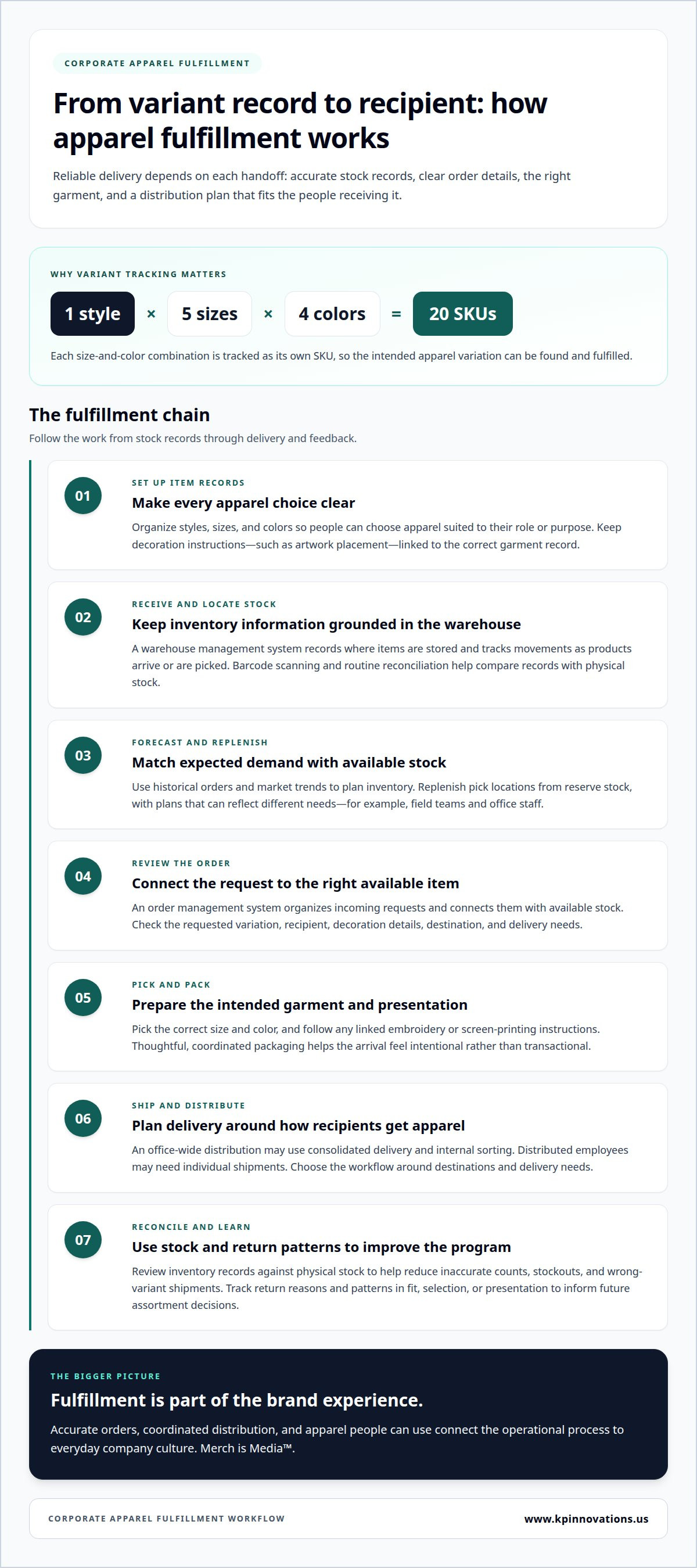
Corporate apparel fulfillment services manage the storage, inventory, picking, packing, and shipping of business clothing orders. Each size and color combination is tracked as a separate SKU, so one style offered in five sizes and four colors creates 20 SKUs to manage. The work connects accurate stock records with the right items reaching the right recipients.
Corporate apparel fulfillment services involve more than moving boxes. Orders can include different sizes, colors, destinations, and delivery needs, while gaps between inventory and order systems can complicate the experience. This guide explains how fulfillment handles SKU organization, order processing, picking, packing, shipping, and technology integrations. You’ll see how each step supports a reliable business apparel program and what to consider when planning fulfillment around your operations.
Key Takeaways
- Build inventory records that distinguish each apparel variation, so teams can see what’s available and fulfill the intended order.
- Set clear processes for receiving, order review, picking, and packing to reduce avoidable fulfillment errors.
- Choose shipping workflows around order destinations, delivery needs, and the way garments are packaged.
- Connect fulfillment tools with ordering and inventory systems to keep information aligned across the process.
- Treat apparel fulfillment as part of the brand experience, not simply a way to move merchandise.
What is an Apparel Fulfillment Service?
Corporate apparel fulfillment coordinates clothing storage, inventory, order preparation, and distribution. It also shapes how employees experience a brand when apparel arrives and becomes part of their everyday work.
Forecasting, Picking, Packing, and Distribution
Forecasting connects expected demand with available stock across styles, sizes, and colors. Teams can use historical orders and market trends to plan inventory, then replenish pick locations from reserve stock. For example, a uniform program may need different replenishment plans for field teams and office staff. Review how forecasts inform picking, packing, and distribution so the program can respond as demand changes.
These operational choices also shape the brand experience. Accurate orders, thoughtful packaging, and coordinated distribution can make receiving apparel feel intentional rather than transactional. Merchandise is media: what people wear and how they receive it can influence their connection to company culture and colleagues. Fulfillment carries that experience from an apparel decision into everyday use.
Custom branding can be part of apparel fulfillment too. Embroidery or screen-printing instructions can be linked to garment records, helping teams prepare the intended design and placement. A uniform order, for instance, may need decoration details matched to the right style and recipient before fulfillment.
Inventory Visibility and Software Connections
A warehouse management system tracks where items are stored and records movements as products arrive or orders are picked. An order management system organizes incoming requests and connects them with available stock. Integrations with existing ecommerce and inventory software help keep records aligned. Current stock updates help teams make informed decisions about what employees can order.
Inventory risks include inaccurate counts, stockouts, and shipping the wrong variant. Barcode scanning, routine reconciliation, and comparisons between records and physical stock help reduce these problems. Clear replenishment rules can also keep pick locations supplied as demand changes. The goal is accurate information that supports reliable apparel access and a consistent experience, not software for its own sake.
Provider Pricing, Capabilities, and Service
Fulfillment workflows differ in their systems, the order steps they handle, and their ability to manage decorated apparel. Assess receiving, storage, variant tracking, order review, packing, distribution, and software connections. Consider whether the workflow supports your organization’s ordering process and recipients, not just warehouse activity.
Pricing depends on the scope of work and is provided after a quote request. Factors include inventory needs, customization, order handling, and distribution requirements. For example, a program serving several departments may require different coordination than a single-location uniform order. Apparel fulfillment services connect these operational decisions with how merchandise reaches the people who wear it.
SKU management for size and color variations
SKU management matters because employees and customers need apparel suited to the person, purpose, and moment. Useful item records help a business offer clear choices and keep its program consistent across departments or locations. The goal is not simply to catalogue garments, but to make the intended brand experience easier to deliver.
Start by deciding how people will choose apparel. A uniform program may need approved options for different roles, while an event order may prioritize a consistent team look. Product records should make those choices clear to both the person ordering and the team fulfilling the request. Clear descriptions reduce confusion and help people select apparel they will actually wear.
Decoration and presentation shape the experience too. Keep artwork placement and garment instructions linked to the correct item record so the apparel reflects the intended design. A customer-facing team uniform, for example, may need a different presentation from apparel intended for an internal event. Aligning these details helps each item serve its purpose, rather than treating decoration as an afterthought.
Plan freight around how recipients will receive apparel. An office-wide distribution may call for consolidated delivery and internal sorting, while distributed employees may need individual shipments. Organizing orders around these needs can simplify distribution and reduce the burden on local teams. The right plan connects transportation choices with how people access and use the items.
Returns can reveal whether the program serves its audience well. Record the reason for each return and review patterns in fit, selection, or presentation. If employees repeatedly exchange a particular option, that information can inform future assortment decisions. Separating returned items by condition and intended use also helps prevent unsuitable garments from re-entering the program.
Set return instructions with the recipient experience in mind. A personalized garment may need a different review from an undecorated item, while a fit-related exchange can offer useful feedback about the available choices. Clear handling expectations help teams respond consistently and maintain confidence in the program.
A dedicated account contact can connect apparel decisions with distribution needs and resolve issues that affect recipients. For example, a change to delivery grouping should reach the people coordinating office distribution, rather than remain isolated in a freight update. That coordination gives employees a clearer path from selecting apparel to receiving it.
Finally, evaluate sourcing choices by how well they serve the program’s purpose, audience, and distribution plan. Considering those needs together can make the apparel experience more coherent. Businesses refining their assortment can use apparel sourcing guidance to align item choices with recipient needs.
Order processing and shipping turnaround
Order-to-delivery fulfillment moves apparel from a business request to its recipient. Each delivery decision should support the moment the apparel is meant to create, not simply move a package.
Shipping Efficiency and Carrier Routing
Routing shapes how and when recipients encounter apparel. A coordinated delivery for a team launch, for example, can help employees receive items together and share the same moment. Individual shipments may work better for distributed teams. Review how routing accounts for destinations, delivery priorities, and package details, then align the plan with the experience recipients should have.
In the United States, apparel fulfillment providers operate across domestic shipping networks. The right fit depends on a business’s destinations, order volume, and distribution model, such as office deliveries or direct-to-employee shipments.
Carrier Selection and Shipping Costs
Carrier selection depends on destination, package size and weight, and desired delivery speed. Apparel boxes can incur dimensional-weight charges, so packaging affects shipping calculations. Fulfillment teams can compare carriers across package profiles instead of routing every order through one service. Evaluate how the carrier plan balances delivery requirements with cost and supports the timing of an event, onboarding, or another brand touchpoint.
Shipment volume also affects logistics planning and a business’s ability to negotiate carrier rates. A varied mix of destinations may call for flexible routing, while office-based distributions may suit consolidated shipments.
Domestic and International Shipping
Domestic shipments typically move through a warehouse, carrier network, and recipient address. International orders add destination-specific documentation and questions about responsibility for duties, taxes, and delivery charges. Set those responsibilities before dispatch and make the recipient experience clear. A package for an overseas office may require different coordination from a domestic employee shipment.
For international distribution, consider whether to consolidate shipments or send them individually. The choice depends on recipient locations, order volume, and how the apparel will be handed out. Clear instructions help local teams distribute items as intended.
Order-to-Delivery Process
Fulfillment begins when an order is received and validated. Staff allocate available apparel, prepare it for shipment, and pass recipient and service details to the carrier. At a facility described by the National Institute for Occupational Safety and Health, garments were inspected, packaged, and shipped after sewing. That sequence illustrates why production completion and shipment readiness are separate milestones.
Track important handoffs, including order approval, shipment preparation, and carrier dispatch. When an apparel delivery supports a team event or employee welcome, visibility helps coordinators respond to delays and protect the intended experience.
Order processing, picking, and packing
Accurate apparel orders depend on clear handoffs between the order queue, warehouse team, and shipping station. A management system should show each order’s status, from release through packing and dispatch.
Order Processing and Same-Day Handling
Processing starts by validating the requested items, quantities, recipient details, and delivery method. The team then releases eligible orders for picking and flags exceptions, such as unavailable garments or incomplete addresses. Same-day handling depends on when the order arrives, available inventory, and any customization steps. Build those conditions into the workflow rather than treating every order as equally ready.
Next-day or same-day delivery expectations can affect order priorities. A time-sensitive event shipment, for example, may need a separate queue from routine employee orders. Define which orders qualify for expedited handling and how staff identify them in the system. This gives warehouse teams a consistent way to prioritize demand without losing sight of standard orders.
Picking Accuracy and Order Auditing
Picking accuracy starts with a clear pick list that identifies each garment and its location. Staff should match the selected item to the order’s style, size, color, and quantity. Grouping commonly purchased SKUs can shorten pick paths, while placing high-velocity SKUs near audit or packing stations can reduce unnecessary movement.
Before packing, audit the order against its original details. Confirm garment variants, quantity, recipient, and any special instructions. For example, an order requesting two different sizes should be checked item by item, not only by total quantity. A documented audit catches mismatches while staff can still correct them at the warehouse.
Packing and Shipment Tracking
Packaging should reflect how each garment is stored and handled. Apparel may be picked loose, bagged, placed on hangers, or boxed, and customized items can require different preparation. Choose polybags or boxes based on the order’s presentation, protection, and destination. Consistent packing instructions help different shifts prepare similar orders the same way.
After packing, link the order record to its shipment details and current status. A tracking workflow should distinguish packed, dispatched, and delivered orders rather than show only a broad “complete” label. This helps operations teams answer recipient questions and identify orders awaiting carrier handoff. To support customer satisfaction, provide clear updates through the relevant ordering channel and assign delivery exceptions to an owner.
Treat the audit as a distinct checkpoint between picking and packing, rather than relying on packing to reveal errors. Auditing apparel orders before packing helps verify accuracy. This checkpoint confirms that the items being packed match the order, including when apparel requires special preparation. Applying the check consistently gives the team a clear opportunity to verify accuracy before the order moves forward.
Packaging decisions should reflect how apparel is stored: loose, bagged, on hangers, or boxed. Customized products may also need a different fulfillment method. Use polybags or boxes according to the packaging requirements. Processing should also account for expectations around next-day or same-day delivery. Keeping these considerations visible alongside the order connects accuracy checks, preparation, and delivery expectations without assuming every apparel order follows the same path.
Fulfillment technology and integrations
A fulfillment center relies on connected systems to keep orders, inventory, and warehouse activity aligned. An order management system organizes incoming purchases, while a warehouse management system directs storage and fulfillment tasks. Together, they help operations teams see whether an item is available, reserved, picked, or packed. Their value comes from consistent records, not simply having more software.
For ecommerce, map the information that must move between the sales channel and fulfillment operations. An order should pass along its items, quantities, recipient details, and delivery selection. Inventory updates should then flow back as stock is received, reserved, or picked. For example, when a medium shirt sells through an online company store, connected systems should reflect that order in the available count.
Current inventory updates help teams act on stock levels rather than an older spreadsheet export. Warehouse staff can scan barcodes when receiving or moving goods, then update the relevant item record. When an order is picked, the system records the movement. This supports visibility across storage locations and helps identify differences between recorded quantities and physical inventory.
Integration planning should account for exceptions too. Systems need a clear way to flag a short pick, canceled order, or shipment address change. Decide which platform owns each update and how teams resolve conflicting records. For instance, if an order changes after allocation, the workflow should indicate whether the warehouse must pause, replace, or repack the items.
Technology should fit the apparel program’s operating model. A single employee store may need a different process from multiple ordering channels serving separate departments. Map who can place orders, how approvals work, and which inventory each channel can access. Then test common scenarios, such as a new color arriving, a size selling out, or an order containing several apparel styles.
Review system performance using operational measures teams already track, such as order status accuracy, inventory discrepancies, and exception resolution. These measures can reveal where a handoff breaks down. If order data arrives correctly but stock updates lag, focus on inventory synchronization. If counts match but items are misallocated, examine warehouse workflows and scanning steps.
Before connecting platforms, document the data fields, update frequency, exception owner, and test cases. That plan gives ecommerce, warehouse, and operations teams a shared view of the work. To align product decisions with fulfillment needs, plan apparel sourcing around operational requirements.
Apparel brands should choose fulfillment partners that provide current inventory updates and integrate with their existing software. Both capabilities should inform partner selection.
KP Innovations: Promotional Products
KP Innovations connects apparel choices with the experience businesses want employees and customers to have. Merchandise is more than an item to distribute; it carries your brand into everyday interactions. That perspective matters when apparel, recognition, and other branded materials need to work together as one coordinated program.
Turn to KP Innovations when your business needs custom apparel alongside promotional products, awards and recognition items, or print and display materials. Fulfillment and logistics connect the journey from design through distribution, bringing the pieces together around your program’s purpose.
Consider the role each item should play before deciding what to order. A uniform can support consistency across teams, while recognition items can mark meaningful achievements. Visit KP Innovations online to discuss your business’s merchandise needs.
Make Apparel Part of the Brand Experience
Start by deciding what your apparel program should make possible. A consistent employee experience, easier access to the right garments, or a more thoughtful way to recognize teams can each guide your choices. Treat merchandise as a brand touchpoint, then build the operating plan around its purpose.
KP Innovations offers Promotional Products, Custom Apparel, and Awards & Recognition Items to support business programs. Its approach connects merchandise choices with the experience you want employees and customers to have. Corporate apparel fulfillment services work best when sourcing decisions support that experience as well as the practical needs of ordering and distribution.
Start a conversation about the apparel your program needs and how those choices can support your brand. Contact KP Innovations about apparel sourcing, and take the next step with a clear purpose.
Frequently Asked Questions
What services do corporate apparel fulfillment companies provide?
Corporate apparel fulfillment companies can manage storage, inventory, order preparation, packing, shipping, and returns. Some also connect fulfillment to online company stores, simplifying distribution of approved apparel across teams. For example, a business onboarding new employees might coordinate apparel orders with a scheduled kit shipment. Service scope varies, so map the tasks your internal team needs handled, from receiving garments to resolving delivery exceptions.
How much do corporate apparel fulfillment services cost?
Pricing depends on the specific program and is provided after a quote request. Cost factors include storage needs, order volume, packing requirements, distribution destinations, and whether garments need customization. A program shipping individual orders to employees has different handling needs from one sending consolidated packages to offices. Compare quotes based on the work included, not just a single handling line, to assess operational scope consistently.
What are typical order processing times, shipping options, and delivery costs?
Processing time depends on inventory readiness, order approval, customization, and warehouse workload. Delivery timing depends on the selected carrier service and destination. Options can include consolidated shipments to an office or separate packages for individual recipients. Delivery costs vary with package dimensions, weight, route, and service level. For a company event, plan backward from when apparel must arrive, allowing time for decoration and order review.
What should businesses look for when choosing a corporate apparel fulfillment provider?
Choose a fulfillment partner whose systems and workflows match your apparel program’s complexity. Assess how it manages size and color records, decorated garments, order exceptions, returns, and updates between your ordering platform and warehouse. Consider who owns day-to-day coordination and how issues are communicated. A growing company with several offices, for example, may value consistent processes for individual employee orders and bulk office shipments.