
Your corporate apparel is not a commodity; it is a high-impact media channel that should be managed with the same rigor as your digital ad spend. With the global corporate apparel market projected to reach $321.50 billion in 2026, the stakes for your brand identity have never been higher. Yet, most organizations still treat corporate apparel suppliers as simple order-takers. This approach leads to office closets overflowing with items that employees eventually use as rags because the quality doesn’t match the brand’s ambition.
It’s time to stop settling for logistical nightmares and poor strategic alignment. You need a merchandise program that enhances company culture without requiring your team to act as a part-time shipping department. This article promises to show you how to transition from basic logo application to a Chief Swag Officer model that prioritizes brand experience. We will explore how to achieve streamlined global fulfillment and why treating your gear as Merch is Media™ is the key to creating items your people actually value.
Key Takeaways
- Stop treating apparel as a line-item expense and start viewing it as a strategic asset that prevents the common “closet-to-landfill” waste.
- Adopt the Merch is Media™ philosophy to ensure every piece of clothing strengthens company culture and external brand loyalty simultaneously.
- Learn to distinguish between traditional corporate apparel suppliers and strategic agencies that manage the entire system from creative sourcing to global fulfillment.
- Professionalize your operations by moving beyond the “marketing closet” and implementing a streamlined, hands-off logistics strategy.
- Discover how the Chief Swag Officer model acts as your outsourced merchandise department, managing your brand impact with the same rigor as any other marketing investment.
Beyond the Logo: Why Most Corporate Apparel Programs Fail
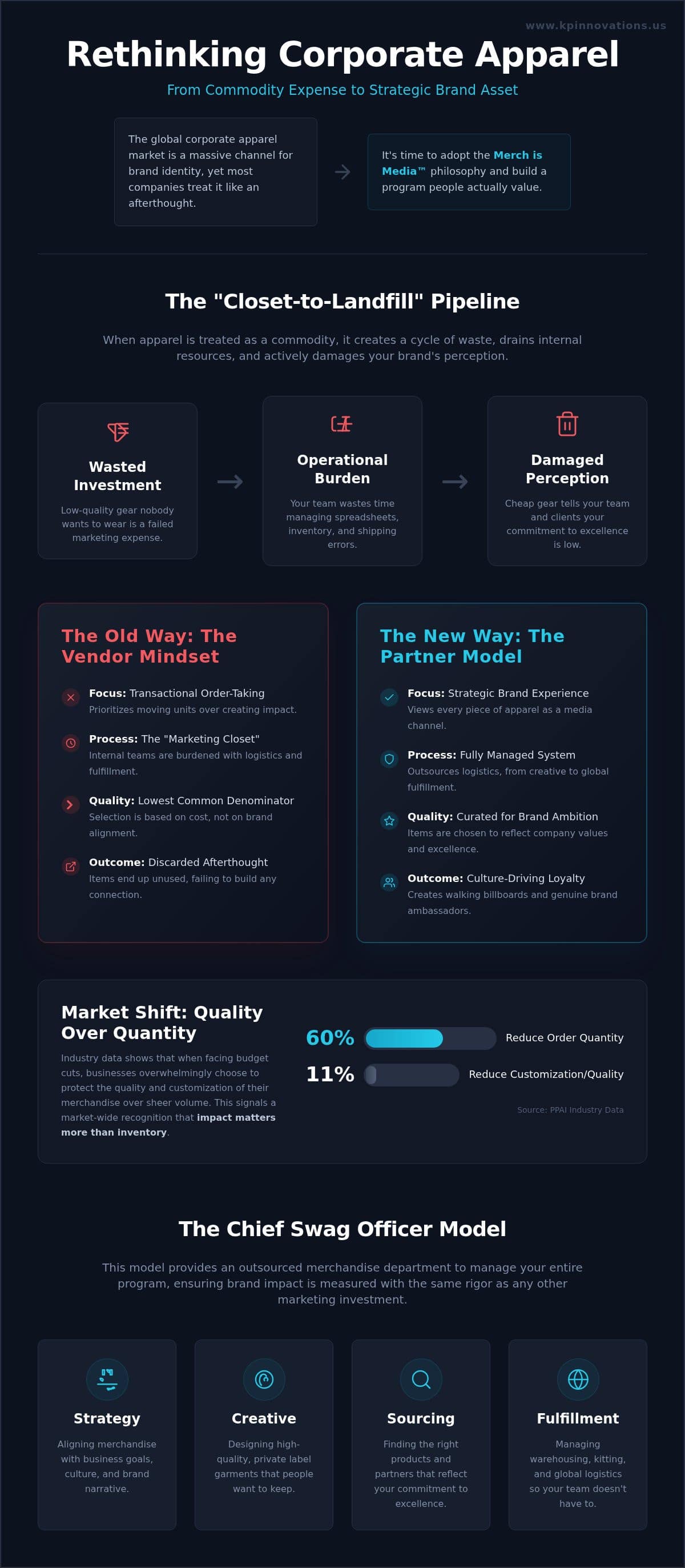
Many organizations view corporate apparel as a simple line-item expense, a box to be checked for the next trade show or employee onboarding. This perspective is fundamentally flawed. When you treat apparel as a commodity, you inadvertently create a “closet-to-landfill” pipeline. This happens when low-quality items are produced by volume-focused corporate apparel suppliers who prioritize the stitch over the strategy. If your employees won’t wear the gear outside of office hours, your investment has failed.
This failure isn’t just a waste of budget; it’s an operational and cultural disconnect. Your brand represents your values, your mission, and your standards. Handing out generic, ill-fitting garments sends a clear message that those standards don’t apply to the people representing the brand. Physical Promotional merchandise should be a tangible extension of your culture, not a discarded afterthought. When you view apparel through the lens of our Merch is Media™ philosophy, you realize that every shirt is a walking billboard for your culture. When clothing sits unused in a drawer, it represents a missed opportunity to build an emotional connection with your team.
The High Cost of Cheap Merchandise
Selecting the lowest bidder among corporate apparel suppliers often results in a high long-term cost. Cheap materials and poor construction damage employee perception. If a shirt shrinks after one wash or the logo peels, it reflects poorly on your company’s commitment to excellence. Industry data from PPAI in 2026 shows that when buyers face budget cuts, 60% reduce the quantity of their orders while only 11% cut back on customization. This indicates a significant market shift toward valuing personalization and quality over sheer volume. For companies prioritizing this level of detail in smaller batches, working with a specialist like Trilli Prints ensures that quality isn’t sacrificed for flexibility. Beyond the emotional impact, the hidden costs of working with traditional vendors are substantial. You face misprints, late deliveries, and inconsistent sizing that lead to logistical friction. Simply slapping a logo on a basic tee is a wasted marketing investment because it lacks the intention required to drive real brand loyalty.
The Operational Burden of Traditional Sourcing
Traditional sourcing models place an immense burden on your internal teams. HR and marketing leaders shouldn’t spend their valuable hours managing vendor back-and-forth or untangling shipping errors. When your staff is responsible for tracking sizing spreadsheets and managing inventory in a cramped office closet, they aren’t focusing on their core objectives. This operational drag is a symptom of a vendor-first mindset that prioritizes the transaction over the result. Transitioning to a strategic agency partnership allows you to offload these complexities. By treating apparel as a managed system rather than a series of one-off transactions, you ensure that every garment serves a purpose without draining your internal resources.
Merch is Media™: Turning Apparel into a Strategic Brand Asset
To truly elevate your brand, you must stop thinking of apparel as a promotional giveaway and start viewing it as a high-performance media channel. This is the foundation of the Merch is Media™ philosophy. While traditional corporate apparel suppliers focus on the physical transaction of selling a shirt, we focus on the message that shirt broadcasts. Every time an employee or customer wears your gear, they become an active participant in your brand’s narrative.
This shift in mindset transforms apparel into a strategic asset. High-quality, private label garments move beyond simple giveaways to become genuine brand experiences. When a piece of clothing is well-designed and constructed with precision, it earns a permanent place in someone’s wardrobe. This creates long-term loyalty that a cheap, generic alternative can’t replicate. Understanding the psychology of consumer behaviour reveals that tangible items foster a sense of reciprocity and connection. When you provide something of actual value, the recipient’s perception of your brand improves significantly.
Apparel as a Culture Driver
Your team gear should do more than just meet a dress code; it should foster a deep sense of belonging. There is a vast difference between “work clothes” that employees feel forced to wear and apparel they choose to wear on their own time. By investing in Employee Programs that prioritize comfort and style, you turn your staff into brand ambassadors. Unified apparel creates a visual representation of your company culture, signaling a shared mission to both internal teams and external clients. To achieve this, you need a partner who understands how to source materials that align with your brand’s specific identity and quality standards.
Measuring the ROI of Wearable Media
Traditional digital media is fleeting. A social media ad lasts seconds before it’s scrolled past, and a search ad disappears once the budget is exhausted. In contrast, a high-quality garment can provide years of impressions. If a hoodie is worn once a week for three years, the cost per impression becomes remarkably low compared to digital spend. This longevity is why we treat merchandise with the same rigor as any other marketing investment. Merch is Media™ is the intersection of physical products and brand storytelling. Focusing on durable materials and construction, as seen with Memento Mori Clothing, is what allows these items to stand the test of time. By partnering with strategic corporate apparel suppliers who prioritize this longevity, you ensure that your brand remains visible and relevant long after a digital campaign has ended.
When you evaluate corporate apparel suppliers, you’re deciding between a vendor that fills orders and an agency that owns outcomes. Most distributors operate on a transactional basis. They wait for your instructions, apply a logo to a stock garment, and move to the next client. A strategic partner takes a holistic view, managing the four critical pillars of a successful program: strategy, creative, sourcing, and fulfillment. This comprehensive approach ensures that your apparel isn’t just a physical product, but a tool that solves specific business problems.
A common trap in this industry is the appeal of “no minimum order” policies. While this sounds flexible, it’s often a sign that the supplier lacks the infrastructure for strategic scalability. If a partner can’t handle complex manufacturing or high-volume logistics, your brand will suffer as you grow. Strategic programs require a partner with private label expertise. This capability allows for deep-level customization, ensuring that your apparel is unique to your brand and manufactured to your exact specifications.
The difference between these models is most visible during the sourcing phase. A vendor picks from a catalog; a partner sources with intent. They consider the ethical implications of the supply chain and the long-term durability of the materials. This proactive approach prevents the cultural disconnect that occurs when brand values aren’t reflected in the physical products your team receives.
The Vendor Model vs. The Agency Model
Vendors are essentially order-takers. They fulfill your requests without questioning whether those requests actually serve your brand. In contrast, an agency challenges your assumptions to drive better results. This begins with Creative Development. Design in the corporate world is often neglected, yet it’s what determines whether a garment is worn or discarded. A strategic partner uses design to tell your brand story, selecting fabrics and fits that reflect your company’s premium positioning.
Questions to Ask Your Potential Supplier
To identify a true strategic partner, look beyond the stitching. Ask if they manage the entire product lifecycle or simply outsource production. You need to know how they handle global logistics and warehousing for distributed teams. Finally, confirm they can implement a Custom Company Store. This professionalizes your program and removes the administrative burden from your internal teams, ensuring consistency across every region. This level of service is what separates professional corporate apparel suppliers from standard promotional vendors.
The Closet Is Not a Fulfillment Strategy: Managing Global Apparel Logistics
Most businesses fall into the trap of the “marketing closet.” It’s that disorganized space where leftover shirts go to die. This isn’t just a mess; it’s a massive operational drain. When you rely on internal teams to pack boxes and track shipments, you’re wasting high-value talent on low-value tasks. The “closet model” fails for several specific reasons:
- Inaccurate inventory tracking leading to stockouts or expensive overages.
- Inconsistent unboxing experiences that diminish your brand value.
- The heavy manual burden placed on HR and Marketing teams.
- The complexity of managing international shipping, taxes, and customs.
Professional Fulfillment and Logistics turn this chaos into a streamlined brand asset. It ensures your global team receives their gear on time, every time, without your staff acting as a part-time postal service. Managing corporate apparel suppliers requires a partner who understands warehousing and on-demand distribution. Global teams need more than just a single shipment to headquarters. They need a system that ensures brand consistency across every office and every border. On-demand distribution means you don’t over-order, which significantly reduces waste and cost.
Streamlining the Distribution Loop
Online company stores are the engine of a modern merchandise program. They eliminate the manual tracking of sizes and addresses that plagues traditional vendor relationships. By integrating fulfillment with Recognition Programs, you create a seamless experience for your employees. When someone hits a milestone, they can choose their own apparel, ensuring they receive something they actually value. This automated loop keeps inventory moving and prevents the accumulation of dead stock that eventually ends up in a landfill.
Global Sourcing and Compliance
Superior quality control starts at the source. Navigating the landscape of Apparel Factories requires deep expertise in ethical sourcing and compliance. Ground-up manufacturing allows for precise control over every detail, from fabric weight to seam reinforcement. This level of oversight is impossible when you buy off-the-shelf products from standard corporate apparel suppliers. Managing the “last mile” of delivery is the final, crucial step in protecting your brand impact. You need a partner who ensures the unboxing experience is as premium as the garment itself. If you’re ready to professionalize your program, it’s time to partner with a strategic sourcing expert who manages the entire system from factory to front door.
Implementing the Chief Swag Officer Model for Your Brand
Most organizations approach corporate apparel as a series of tactical errands. They wait for a deadline, rush an order through one of several corporate apparel suppliers, and hope the result is wearable. This fragmented approach is inefficient and dilutes your brand impact. The Chief Swag Officer model offers a superior alternative by installing a dedicated strategic partner to own the entire process. It moves your organization away from reactive ordering and toward a cohesive, long-term merchandise strategy.
Your Outsourced Merchandise Department
When you adopt this model, you essentially gain an outsourced merchandise department. This team manages every detail from high-level strategy and creative development to global sourcing and production. By offloading these complexities, you significantly reduce the operational burden on your internal HR and Marketing teams. They no longer need to untangle shipping errors or manage inventory spreadsheets. Professional Program Management ensures that every initiative is executed with precision, maintaining brand consistency across all touchpoints. This high-touch service allows your leaders to focus on their core business while we ensure your brand impact is measured with rigor.
Next Steps: From Order-Taker to Strategic Partner
Transitioning from a vendor-based to an agency-based program begins with a shift in perspective. You must stop viewing corporate apparel suppliers as simple distributors and start seeing them as strategic assets. The first practical step is to audit your current program. Look for signs of waste, such as unused inventory in closets or low-quality items that employees refuse to wear. This audit often reveals a significant disconnect between your brand values and the physical products you distribute.
Before selecting your next round of products, define your brand objectives. Are you trying to boost employee retention, celebrate a major milestone, or professionalize your field team? When you lead with strategy rather than a catalog, the results are fundamentally different. Your apparel becomes a tool for culture building and brand elevation rather than just another line-item expense. If you’re ready to move beyond the logo and treat your gear as wearable media, schedule a strategy session with your Chief Swag Officer today to begin professionalizing your entire system.
Elevate Your Brand Beyond the Stitching
Your apparel program should be a strategic driver of culture and brand loyalty, not a logistical burden for your marketing team. By embracing the Merch is Media™ philosophy, you transform physical garments into powerful assets that broadcast your brand’s values. Moving away from traditional corporate apparel suppliers who only focus on transactional orders allows you to reclaim your time and professionalize your internal operations.
As a premier U.S. promotional product supplier, we understand that success requires more than just a logo. It requires a managed system that integrates strategy, creative development, and comprehensive global fulfillment services. This transition ensures that every item you distribute provides a tangible return on your brand investment while eliminating the “closet-to-landfill” waste that plagues average programs.
It’s time to stop settling for vendors and start building a legacy. Partner with a Chief Swag Officer today to move beyond the closet and begin building a high-impact merchandise program. You have the opportunity to turn every piece of gear into a meaningful brand experience that resonates with your people and your partners.
Frequently Asked Questions
What is the difference between a corporate apparel supplier and a merchandise agency?
Traditional corporate apparel suppliers typically act as distributors, focusing on the transaction of selling stock items with a logo. In contrast, a merchandise strategy agency like KP Innovations owns the entire outcome. We act as a strategic partner, managing everything from creative development and ethical sourcing to global fulfillment. This shift moves your program from a tactical expense to a strategic brand asset that influences company culture.
How do we manage apparel sizing for a global team without manual tracking?
Managing sizes manually is an operational nightmare that often leads to waste and poor employee experiences. We solve this through online company stores where employees select their own sizes directly. This automated system eliminates manual tracking and ensures that your global team receives gear that actually fits. It professionalizes the process and allows your internal teams to focus on their core objectives rather than logistics.
Why should we choose private label apparel over retail brands for our uniforms?
Choosing private label apparel allows for a level of customization that retail brands simply cannot match. While retail brands prioritize their own logo and aesthetic, private label gives you complete control over the fabric, fit, and finish. This ensures your uniforms are a unique reflection of your brand identity. It also provides superior quality control, ensuring that your investment results in clothing that employees choose to wear.
What are the benefits of an online company store for employee apparel?
Online company stores act as a centralized hub for your brand’s physical assets. They provide pre-approved merchandise to your team while removing the administrative burden of order management from HR and Marketing. These platforms offer real-time inventory tracking and on-demand distribution. This ensures brand consistency across multiple locations and significantly reduces the risk of over-ordering or accumulating dead stock in a marketing closet.
How does the Chief Swag Officer model save my company money in the long run?
The Chief Swag Officer model saves money by replacing fragmented, reactive ordering with a cohesive system. By increasing the quality and design of your gear, we improve wearability, which lowers the cost-per-impression of your wearable media. Additionally, we reduce internal labor costs by managing the entire lifecycle of your merchandise. This strategic approach minimizes waste and ensures that every dollar spent contributes to long-term brand equity.
Can you handle global fulfillment and international shipping for corporate apparel?
Yes, we provide comprehensive global fulfillment and warehousing capabilities. Our system is designed to navigate the complexities of international shipping and customs to ensure your gear reaches its destination on time. By leveraging our logistics expertise, you can maintain a unified brand experience for your team regardless of where they are located. This professionalizes your distribution loop and protects your brand impact across international borders.
What is Merch is Media™ and how does it apply to corporate clothing?
Merch is Media™ is our core philosophy that treats physical products as high-impact media channels. In the context of corporate clothing, it means every garment is a walking billboard for your company culture and brand values. When you partner with strategic corporate apparel suppliers, you ensure that these physical impressions are of the highest quality. This approach creates lasting emotional connections with employees and customers that digital ads cannot replicate.
How do we ensure our corporate apparel is ethically sourced and manufactured?
Ethical manufacturing requires deep-level visibility into the supply chain. We ensure ethical sourcing by managing ground-up manufacturing through verified factory relationships. This allows for strict oversight of labor standards and material certifications. By moving beyond off-the-shelf products, we provide a level of transparency and quality control that traditional vendors cannot offer. This protects your brand from the reputational risks associated with opaque supply chains and poor construction.