
What if the most valuable media channel your brand owns isn’t a social platform, but the jacket your lead engineer wears to the airport? Most companies treat apparel as a commodity to be checked off, yet they wonder why their expensive items end up in a donation bin. It’s a waste of budget and a missed opportunity to build real culture. At KP Innovations, we believe Merch is Media™; it’s a strategic asset that influences relationships and brand perception.
You’ve likely dealt with the frustration of low-quality products, complex supply chains, and inconsistent branding across different items. It’s exhausting to manage vendors who don’t understand your vision. We promise to show you how to move beyond a simple vendor mentality. You’ll learn how to use a corporate merchandise store platform to build a curated clothing line that employees actually want to wear.
We’ll break down the transition from managing vendors to partnering with a “Chief Swag Officer” who owns the entire process. From design and sourcing to global fulfillment, this guide provides the roadmap for a managed system that treats your merchandise with the rigor it deserves in 2026.
Key Takeaways
- Shift your perspective from buying commodities to managing a “Merch is Media™” strategy that drives employee culture and customer loyalty.
- Identify how a corporate merchandise store platform functions as a strategic brand asset rather than just a digital catalog for ordering items.
- Learn the fundamental differences between white label and private label apparel to gain full creative control over your brand’s physical identity.
- Follow a strategy-first roadmap that prioritizes the wearer’s experience to ensure your investments end up on people, not in donation bins.
- Discover the Chief Swag Officer™ model and how an outsourced merchandise department manages the entire lifecycle from design to global fulfillment.
Beyond the Catalog: Why Most Corporate Merchandise Platforms Fail
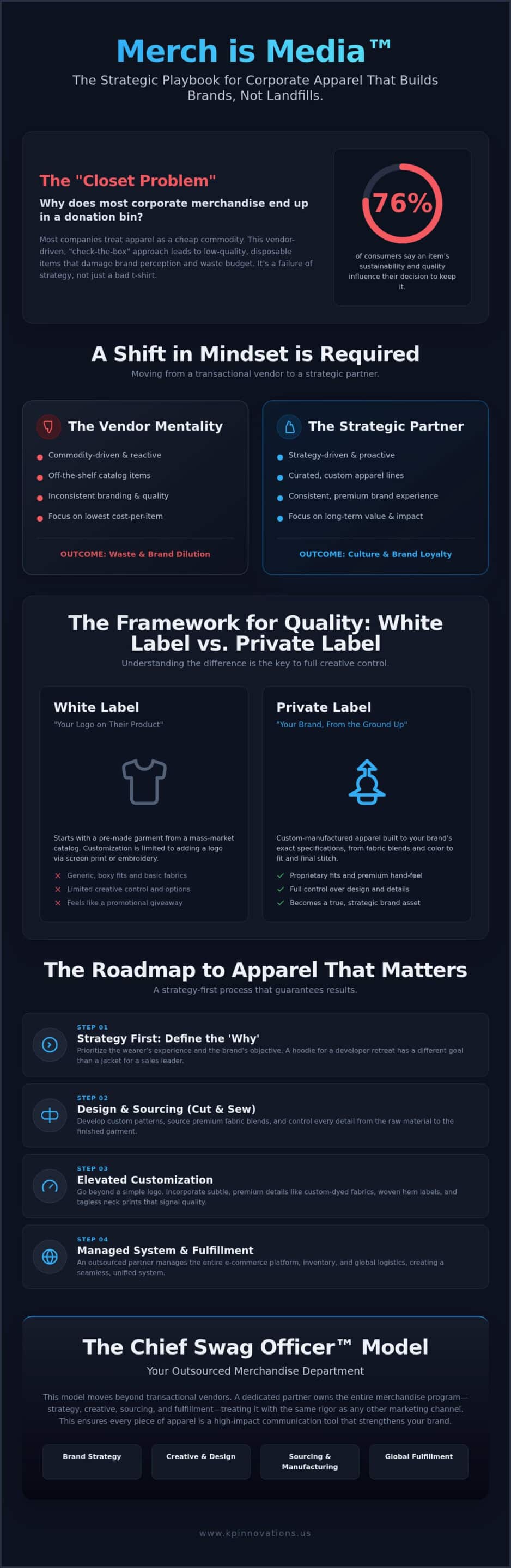
Most businesses view a corporate merchandise store platform as a digital vending machine. They upload a logo, pick a generic shirt, and hope for the best. This approach leads directly to the “Closet Problem.” Research from PPAI shows that 76% of consumers say an item’s sustainability influences their decision to keep it. When you distribute items that feel disposable, they end up at the bottom of a drawer or in a landfill. This isn’t just a waste of money. It’s a failure of brand strategy.
To fix this, you must shift from a commodity mindset to a Merch is Media™ philosophy. Your apparel is a high-impact communication channel. It influences internal culture by making employees feel like part of an elite team; it shapes external perception by turning customers into brand ambassadors. A standard vendor just takes your order. A strategic partner, operating as your Chief Swag Officer, owns the entire outcome. Historically, Promotional merchandise was about volume. Today, it’s about value and wearer-intent.
The Hidden Cost of Cheap Apparel
Choosing low-quality fabrics is a hidden liability. When a shirt shrinks after one wash or the fabric feels abrasive, that negative experience is transferred directly to your brand. Beyond the immediate reputation hit, there’s the broader issue of fast fashion. Discarded, low-quality items create significant environmental and social strain. By focusing on longevity and premium materials, you demonstrate a commitment to quality that resonates with modern consumers. We help you design for the long term. This ensures your merchandise remains a functional part of the wearer’s life for years.
Apparel as a Strategic Communication Channel
Think about your favorite hoodie. You wear it because of the fit, the feel, and what it says about you. We aim to replicate that psychology for your brand. Using private label clothing allows you to tell a story through proprietary fits and custom details that off-the-shelf blanks can’t match. This level of customization transforms a simple garment into a strategic asset. It’s not just a shirt with a logo. It’s a curated brand experience that people actually want to wear. This approach ensures your brand message is carried with pride, not just obligation.
Decoding Private Label Apparel: Manufacturing from the Ground Up
Most brands start by selecting a pre-made shirt from a catalog. While this is fast, it limits your brand to someone else’s fit and fabric choices. Private label clothing is a custom-manufactured garment sold under your brand’s unique specifications and identity. When you own the entire garment experience, you move beyond being a customer of a blank shirt manufacturer. You become the creator. This transition is essential for any premium brand using a corporate merchandise store platform to drive real engagement.
Moving from off-the-shelf blanks to custom manufacturing requires a shift in how you view your supply chain. It’s a move from a reactive model to a proactive strategy. Instead of hoping a vendor has enough inventory in a specific color, you are creating the inventory from your own specifications. This ensures that your brand identity remains consistent across every item in your collection. You aren’t just buying clothes; you’re building a proprietary asset.
The Power of Cut and Sew Manufacturing
True differentiation happens when you control the hand-feel of the fabric and the specific silhouette of the piece. Cut and sew manufacturing allows you to develop custom patterns that fit your team perfectly. You aren’t stuck with boxy, generic fits. Instead, you can choose specific fabric blends, weights, and finishes that align with your brand’s quality standards. If your brand stands for precision, your apparel must reflect that in every stitch. You can explore our guide on cut and sew manufacturing to see how this process works from the first sketch to the final seam.
Customization Methods That Elevate Your Brand
Standard screen printing has its place, but premium brands often require more sophisticated techniques. Think about woven labels on the hem, custom neck prints instead of itchy tags, or high-density embroidery. These details signal quality to the wearer. There’s also the “loudness” factor. Loud logos often decrease how often someone wears an item in public. Subtle, tonal branding or small woven tags increase wearer frequency. This turns your apparel into a staple of their wardrobe rather than a one-time giveaway. Choosing the right technique depends on the garment type and the intended use case. Integrating these custom pieces into your corporate merchandise store platform ensures a consistent, high-end experience for every user. Our team helps you navigate these choices through strategic global sourcing to ensure the final product meets your exact vision.
White Label vs. Private Label: Choosing the Right Framework
Selecting the right production model is the first step in optimizing your corporate merchandise store platform. You have to decide if your priority is immediate availability or long-term brand equity. White label solutions offer speed and a lower barrier to entry. They are the standard for many businesses. However, private label manufacturing provides full creative control and proprietary fits that set your brand apart. This choice defines whether you are simply buying inventory or building a brand asset.
Looking at the ROI requires analyzing long-term brand value against short-term cost savings. A cheap blank might save money today. If that garment sits in a drawer, the cost per impression is infinite. Private label items often require a higher initial investment but deliver a much lower cost per wear. People keep what they love. Established brands often outgrow white label solutions because they need a level of consistency and quality that off-the-shelf items cannot provide. They need a system that works for them, not a catalog they have to work around.
When to Stick with White Label
White label is ideal for quick-turn events or low-budget testing. If you need shirts for a trade show in two weeks, white label is your best path. The limitations are clear: you don’t own the fit or the fabric. You are limited by what a third-party manufacturer decides a “large” should look like. You can still maximize this approach through strategic Creative Development. Even with a standard blank, thoughtful design and placement can elevate the final product. It’s about making the most of the tools available while acknowledging their limits.
The Case for Private Label Investment
Investing in private label apparel builds a “moat” around your brand. You create unique products that nobody else can replicate. This control extends to the entire supply chain. You ensure consistency in color, texture, and sizing year after year. This reliability is vital for maintaining a professional image across a global team. By leveraging our Sourcing capabilities, you move from being a simple purchaser to a strategic manufacturer. This shift ensures that every item in your corporate merchandise store platform reinforces your premium positioning. It turns your apparel into a proprietary media channel that belongs exclusively to your brand.
The Strategic Roadmap: From Brand Identity to Global Fulfillment
Transitioning from basic merchandise to a sophisticated brand collection requires a disciplined methodology. A corporate merchandise store platform is a powerful tool, but its success depends on the system supporting it. We guide our clients through a five step process designed to ensure every item serves a specific purpose. It begins with strategy. We define the business problem your apparel needs to solve, whether that is increasing employee retention or deepening customer loyalty. We then move into creative development, where we design for the wearer first. If the garment doesn’t become a wardrobe staple, the brand message is lost.
The roadmap continues with strategic sourcing and production management. We identify the right manufacturing partners and oversee rigorous quality control to protect your brand’s integrity. Finally, we manage the global fulfillment and logistics. This ensures that a new hire in London receives the same premium experience as an executive in Philadelphia. This end to end ownership is what separates a strategic partner from a simple product vendor.
The Importance of Strategic Sourcing
The cheapest factory is rarely the most strategic choice. In 2026, brands must navigate a complex landscape of labor standards and material transparency. Choosing a partner based solely on the lowest bid often results in inconsistent sizing or poor fabric longevity. We prioritize factory alignment, matching your specific quality needs with facilities that specialize in your chosen silhouettes. Whether you are looking for domestic production or overseas manufacturing, our strategic sourcing services ensure your supply chain is resilient and ethical.
Fulfillment: The Closet Is Not a Strategy
Many marketing leaders find themselves overwhelmed by the operational burden of packing boxes and tracking shipments. This is not a sustainable way to manage a brand. Beyond the time drain, managing global distribution involves navigating complex data privacy laws. As of January 2026, new comprehensive privacy regulations in states like Indiana, Kentucky, and Rhode Island require strict handling of recipient data. A managed corporate merchandise store platform automates this complexity.
By utilizing professional fulfillment and logistics services, you gain access to precision systems. Industry data shows that 3PL pick and pack fees for B2C orders typically range from $2 to $3, a small price to pay for reclaiming your team’s time and ensuring regulatory compliance. We handle the storage, the data, and the delivery so you can focus on the strategy. If you are ready to stop packing boxes and start building a legacy, you can partner with us to secure your supply chain today.
The Chief Swag Officer™ Model: Your Outsourced Merchandise Department
Managing a brand’s physical presence is an operational minefield. Most companies treat it as a series of disconnected purchases. They buy a shirt for one event, a trophy for an anniversary, and a banner for a trade show. This fragmented approach is the primary reason brand standards slip and budgets vanish into low-value items. You don’t need another vendor to sell you shirts. You need a dedicated partner to own the entire system. Our Chief Swag Officer model replaces the transactional vendor relationship with a strategic agency partnership that prioritizes your long-term brand equity.
The Chief Swag Officer model is built on the belief that your physical brand assets deserve a dedicated department. We manage the entire lifecycle of your private label program, from the initial concept to the final delivery. This includes overseeing factory audits, managing lead times, and ensuring that your corporate merchandise store platform remains stocked with items people actually want to wear. Research from Snappy in 2026 shows that 88% of employees state that receiving gifts from their employer increases engagement and collaboration. However, this only happens when the items feel genuine and high-quality. Our model ensures that your investment translates into real cultural value, not just more noise.
A Strategic Partnership for Growth
Moving from transactional vendor relationships to long-term agency partnerships changes how your brand is perceived. We act as your Chief Swag Officer to protect your brand standards across every touchpoint. This isn’t about picking items from a catalog; it’s about deep-level customization and manufacturing from the ground up. We believe strategy must precede the first stitch of production. By integrating your vision into a managed corporate merchandise store platform, we ensure that every item produced reinforces your “Merch is Media™” philosophy. This model reduces operational friction, allowing your marketing and HR teams to focus on their core goals while we handle the complexities of sourcing and global logistics.
Ready to Elevate Your Brand Experience?
Initiating a private label project begins with a conversation about your business objectives. We don’t start with a product list. We start with the problem you’re trying to solve. During the initial strategy and creative phases, our team works to understand your brand’s unique specifications. We look at silhouettes, fabric weights, and the intended wearer experience to ensure the “Keep Factor” is high. When your merchandise is treated with the same rigor as any other marketing investment, the return becomes clear. You build a curated collection that drives culture and loyalty. If you’re ready to transform your apparel from a commodity into a strategic asset, connect with a Chief Swag Officer today.
Transforming Your Merchandise into a Strategic Growth Engine
The shift toward a Merch is Media™ philosophy is no longer optional for brands that want to remain relevant in 2026. You’ve seen how moving beyond the traditional catalog and embracing private label manufacturing ensures your apparel ends up on people, not in donation bins. By owning the entire garment experience, you turn a simple purchase into a proprietary media channel. A managed corporate merchandise store platform serves as the backbone of this strategy, ensuring consistency and quality across your global organization.
Success requires more than just picking products; it demands a dedicated program management partner. With access to over 1.2 million products and expertise in strategic sourcing, we manage every detail from design to global fulfillment. You don’t have to navigate the complexities of supply chains or data privacy laws alone. It’s time to treat your physical brand assets with the same rigor as your digital marketing investments.
Are you ready to stop being a customer of a vendor and start being a partner in a strategic agency? Work with a Chief Swag Officer to build your brand and ensure your merchandise drives the culture and loyalty your brand deserves. Your legacy is built one stitch at a time.
Frequently Asked Questions
What is the minimum order quantity (MOQ) for private label clothing?
Minimum order quantities for private label clothing typically start at 144 to 300 pieces per style. These MOQs are necessary because the garments are manufactured from the ground up; this requires specific fabric runs and custom patterns. We manage these requirements by aligning your volume needs with the right manufacturing partner. This ensures you maintain the proprietary fits that define your brand’s unique identity without over-ordering unnecessary inventory.
How long does the private label manufacturing process typically take in 2026?
Total lead times for custom private label manufacturing generally range from 12 to 18 weeks. This comprehensive timeline includes the initial strategy, creative development, sampling, production, and global fulfillment. While this is longer than ordering off-the-shelf blanks, it’s necessary for the deep-level customization required to turn apparel into a strategic asset. We provide white-glove project management to ensure every milestone is met without unnecessary delays or logistical friction.
Can I customize the fabric and fit of my private label apparel?
Yes, you have complete control over the fabric weight, blend, and specific garment silhouette. Unlike white label options where you’re restricted to pre-made blanks, private label allows you to develop custom patterns that reflect your brand’s premium positioning. You can choose specific hand-feels and technical properties that ensure the item becomes a wardrobe staple. This level of control is essential for any brand utilizing a corporate merchandise store platform.
What is the difference between screen printing and embroidery for branding?
Screen printing is best for large, vibrant graphics on lightweight fabrics, while embroidery offers a tactile, high-end feel suitable for outerwear and headwear. For a premium brand experience, we often recommend subtle customization methods like woven labels or high-density embroidery. These techniques increase the “Keep Factor” of the garment. Choosing the right method depends on the wearer’s intent and the specific business problem the apparel is meant to solve.
How do I ensure my private label clothing is ethically manufactured?
We ensure ethical manufacturing through rigorous factory audits and a transparent supply chain. In 2026, verifiable ESG standards are a business requirement rather than just a marketing claim. We partner with facilities that provide transparency regarding labor conditions and material sourcing. This protects your brand’s reputation. It ensures your merchandise program aligns with modern corporate social responsibility standards and the evolving global regulations that businesses face today.
Do I need to handle my own shipping and warehousing for private label lines?
No, you don’t need to handle your own logistics when partnering with a strategic agency. Our Chief Swag Officer model includes end-to-end management of fulfillment and logistics. We handle the storage, pick-and-pack services, and global delivery through your managed corporate merchandise store platform. This removes the operational friction of packing boxes in-house. It ensures your team can focus on high-level brand strategy instead of inventory management.
What are the most popular private label apparel items for businesses in 2026?
The most popular private label items for businesses focus on the “Accessible Premium” trend. These include:
- Heavyweight organic cotton hoodies with custom silhouettes.
- Technical quarter-zips featuring moisture-wicking fabrics.
- Structured commuter bags with modular compartments.
Brands are moving away from disposable items toward durable products with high utility. This ensures your merchandise becomes a wardrobe staple that reinforces your brand experience and provides lasting impact.
How do I protect my apparel designs and brand identity?
You protect your brand identity by owning the proprietary patterns and specifications of your private label collection. When you move beyond off-the-shelf blanks, you create a unique physical product that competitors cannot replicate. We manage the production process to ensure your brand standards are strictly maintained across every batch. This ownership builds brand equity and ensures your merchandise remains a distinct, high-impact communication channel that belongs exclusively to your organization.